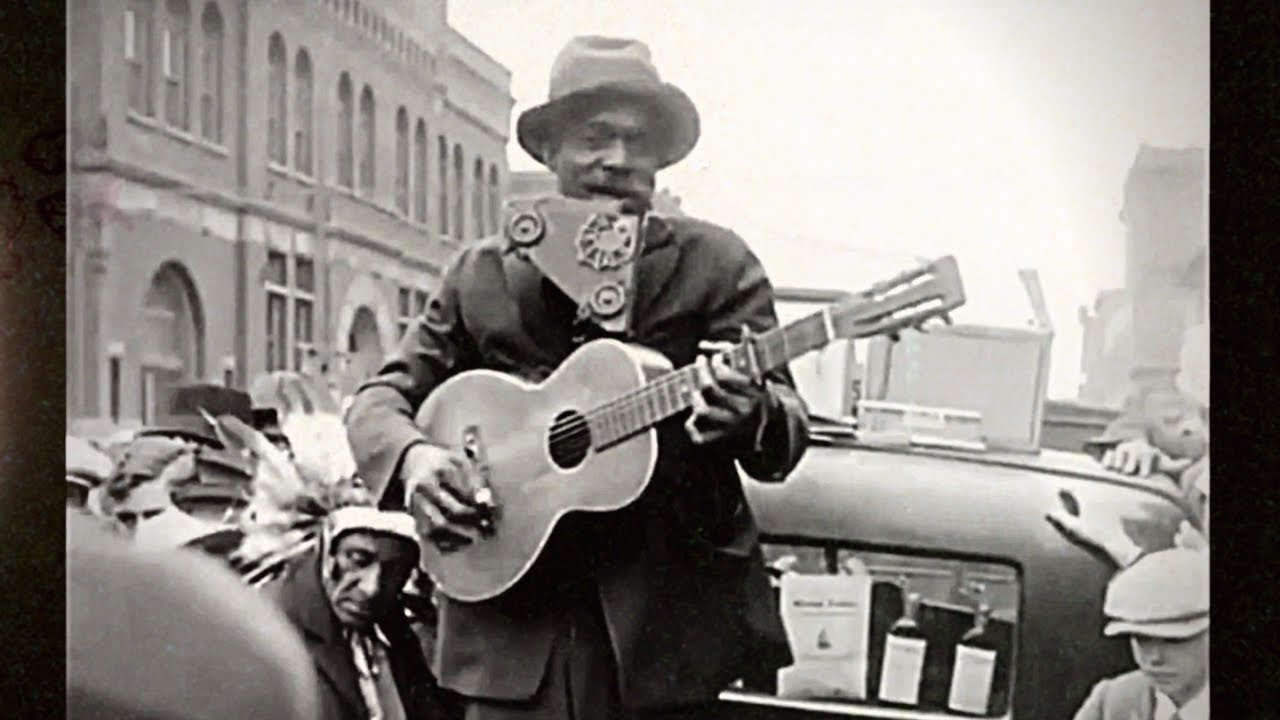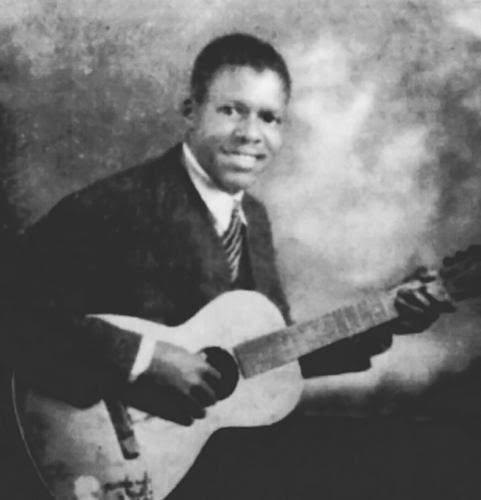
He was born Willard Thomas in Logansport, Louisiana, recorded only 24 sides, died unknown in Memphis around 1945, and left behind some of the most raggy, lonesome, and modern Texas blues ever cut.
In Dallas in 1928, if you walked down Deep Ellum on a Saturday night — the stretch of Elm Street east of downtown where Black Dallas lived, worked, and played — you would hear a dozen guitarists playing for tips outside barbershops and cafes, in front of the Tip Top Tailors and the Gypsy Tea Room, where Blind Lemon Jefferson had played and where Blind Willie Johnson still played for nickels. Among them was a tall, thin man with a soft voice and a guitar tuned to ring like a piano, playing a blues that sounded like he was already leaving town even as he played it.
He called himself Ramblin' Thomas. His real name was Willard Thomas, and he was from Logansport, Louisiana, just across the Sabine River from Texas, but he had been rambling so long that people in Dallas thought he was from Dallas and people in Shreveport thought he was from Shreveport. He would record only 24 sides for Paramount and Victor between 1928 and 1932, then disappear, dying around 1945 in Memphis, largely unnoticed, leaving behind a brother, Jesse Thomas, who would become a well-known bluesman in his own right, and a handful of records that still sound like a man walking away.
For blues enthusiasts, Ramblin' Thomas is a ghost, a name that surfaces in footnotes about Texas blues, Deep Ellum, and Paramount Records. Listen closely and he is something else: one of the most distinctive and modern Texas guitarists of the late twenties, a bridge between the older, raggy blues of Henry Thomas and the more polished urban blues of Blind Lemon Jefferson, a songwriter who wrote about hard times, no jobs, and rambling minds with a directness that still feels contemporary.
Logansport
Willard Thomas was born around 1902 in Logansport, Louisiana, a river and sawmill town in DeSoto Parish on the Sabine River, 40 miles south of Shreveport. The exact date is lost. The 1930 census lists a Willard Thomas in Dallas as 28, which points to 1902. That is the year we will use. No death certificate has been found.
Logansport sits on the Texas-Louisiana line, a musical borderland. On the Texas side are the piney woods of East Texas; on the Louisiana side, the red clay hills of DeSoto Parish. String bands — fiddle, guitar, banjo, mandolin — played for dances, mixing blues with ragtime and Mexican music. Thomas grew up hearing that blend. It explains his rolling, piano-like bass and syncopated, almost fiddle-like treble.
His family was musical. His younger brother Jesse Thomas, born in 1911 in Logansport, learned guitar from Willard and recorded from 1929 into the 1970s in a more urban, jazz-tinged style. Another brother, Joe L. Thomas, also played. Their parents were sharecroppers who moved back and forth across the river for work.
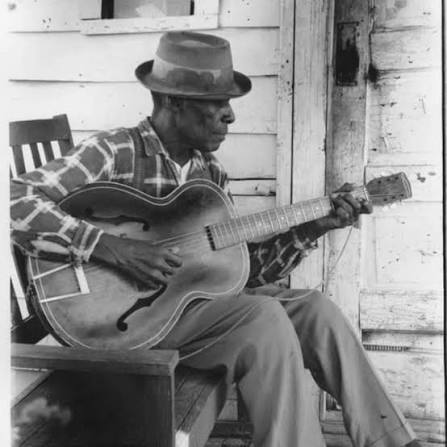
Willard learned guitar as a boy, by ear, watching local players and listening to records. He played with a thumbpick and fingers, not a flatpick, developing a light touch that let the bass walk and the treble sing. He earned the nickname Ramblin' early. As a teenager he left Logansport, working levees and fields when he had to, playing house parties, fish fries, and street corners from Dallas to Shreveport to Memphis. By the early twenties he was a regular on Deep Ellum.
Deep Ellum in the mid-twenties was Black Dallas's Wall Street. Elm Street east of downtown held clubs, cafes, barbershops, pawnshops, the Gypsy Tea Room, and the Palace Theater. Jefferson had played there. Texas Alexander, who sang with a field-holler roar, worked there. Thomas knew them both. He played for tips, accompanied singers, and honed a style that was not the loudest on the block, but the most distinctive: a high, soft tenor, almost conversational, with a slight nasal edge, and a guitar that sounded lonesome even when it was dancing.
Paramount and Victor, 1928-1932
To understand his records, you have to understand two very different labels.
Paramount was owned by the Wisconsin Chair Company in Port Washington, Wisconsin. Its studio in Chicago at 27th and State and its pressing plant in a chair factory in Grafton, Wisconsin, were primitive — a single microphone, blankets on the walls, sawdust in the air, cheap shellac that wore quickly. Its talent scout for Black music was J. Mayo Williams, a former football star at Brown who found musicians on street corners. Williams heard Thomas in Dallas in early 1928 and brought him north.
On February 22, 1928, in Chicago, Thomas cut four sides as Ramblin' Thomas: "Hard Dallas Blues," "No Job Blues," "Ramblin' Mind Blues," and "Poor Boy Blues," issued on Paramount 12654 and 12656. The guitar is in standard tuning, fingerpicked with a rolling, ragtime-inflected bass and a syncopated treble that nods to Jefferson but is sparer and more lonesome. The voice is high, soft, almost whispered. The lyrics are field reports: Dallas is hard, there is no job to be found, the mind won't stay still, a poor boy has nowhere to go. Thomas was singing Depression blues before the Depression, because in East Texas hard times were already the norm.
He cut again for Paramount in August 1928 — "New Way of Living Blues" and "So Lonesome" — and in 1929 — "Good Time Blues" and "Locked Up in Jail Blues."
That same year he also recorded for Victor, a major label with better microphones and better distribution. Victor's blues scout Ralph Peer, who had found Jimmie Rodgers and the Carter Family, heard Thomas in the South and set up sessions in temporary hotel studios in Memphis and Dallas. In August 1928 in Memphis, Thomas recorded alternate versions of "Ramblin' Mind Blues" and "Poor Boy Blues" for Victor V-38561 and V-38562. The Victor sides have less surface noise and a stronger bass, showing a slightly more polished player, sometimes with a second guitarist who may be Jesse.
From 1928 to 1932 Thomas recorded 24 sides as a leader for the two labels, plus a handful as an accompanist. His last sessions were in Dallas in 1932, with a touch more swing in the rhythm, reflecting changing tastes. Then the Depression killed sales and he went back to tips on Elm Street and Beale Street.
The Guitar
For players who want to hear what he did, start with standard tuning, E-A-D-G-B-E, no slide. He played straight, clean, almost ragtime in feel.
Thumb and two fingers, no flatpick. The thumb walks eight to the bar, steady, almost like a left hand on piano. The index and middle fingers play a melodic, syncopated treble with a lot of space. He rarely crowded a bar. That space is why his records sound lonesome — you hear the street between the notes.
His voice sits just behind the beat, conversational, not shouting. He was not Bessie Smith. He was a man telling you a story on the corner, so you lean in.
Repertoire is twelve-, eight-, and sixteen-bar blues built on familiar changes, but with melodic turns that make them his. Learn "Hard Dallas Blues" for the bounce and stop-time break, "No Job Blues" for topical directness — "I got the no job blues, can't find no job to do" — and "Ramblin' Mind Blues" for the walking feel.
The Brother
Jesse Thomas, nine years younger, learned directly from Willard. His early sides like "Blue Goose Blues" show Willard's rolling bass and melodic treble, but with a stronger, more confident voice and jazzier chords, reflecting Dallas in the thirties. Jesse lived until 1995 in Shreveport and is our best oral source. He said Willard taught him how to play, how to work a crowd for tips, and how to ramble — how to catch a freight, how to find a house party in a new town.
Influence
Thomas's influence outweighs his fame because it was absorbed early.
First, the rambling mind. His "Ramblin' Mind Blues" from February 1928 establishes the restless mind as a blues subject eight years before Robert Johnson recorded "Ramblin' on My Mind" in 1936. Johnson knew Texas records. Johnny Shines said Johnson played Texas numbers. The title and theme lineage is clear.
Second, the no-job song. Singing about unemployment as a blues topic became a flood after 1929. Thomas was already there in early 1928.
Third, the raggy Texas guitar. That rolling, piano-like bass with a singing treble runs from Thomas through his brother Jesse into T-Bone Walker, who grew up hearing Thomas and Jefferson on Deep Ellum and translated that rolling bass into electric, horn-like lines.
Fourth, repertoire. "Hard Dallas Blues" and "No Job Blues" entered the Texas songbook, covered by other Dallas players. "Ramblin' Mind Blues" became part of the vocabulary every Texas guitarist knew.
Play his "Ramblin' Mind Blues" back-to-back with Johnson's "Ramblin' on My Mind." Same high, lonesome tenor, same talk of a mind that won't stay still, same guitar that sounds like walking.
Death and Rediscovery
After 1932 Thomas kept playing Dallas, Shreveport, and Memphis but stopped recording. In the early forties he fell ill — tuberculosis is the most consistent account, though an accident and a beating are also mentioned in oral histories — and died around 1945 in Memphis, about 43, buried in an unmarked grave, likely in Zion or Hollywood Cemetery, historic Black cemeteries where Frank Stokes and others lie.
No white paper noted it. The Black weeklies, overwhelmed by war news, missed it.
For decades he survived only as a collector's name. Original Paramounts — light blue with a peacock, later black with gold — sell for $100 to $300 because fewer survived than Jefferson's. Victors — black with gold and the dog-and-gramophone — bring $50 to $200.
The blues revival brought reissues. Paul Oliver and Mike Rowe cited him as a distinctive raggy stylist. Document Records collected everything on one essential disc: "Complete Recorded Works in Chronological Order (1928-1932)" DOCD-5018, 24 sides remastered from 78s. Yazoo put "Hard Dallas Blues" on its "Texas Blues" anthology in 2003.
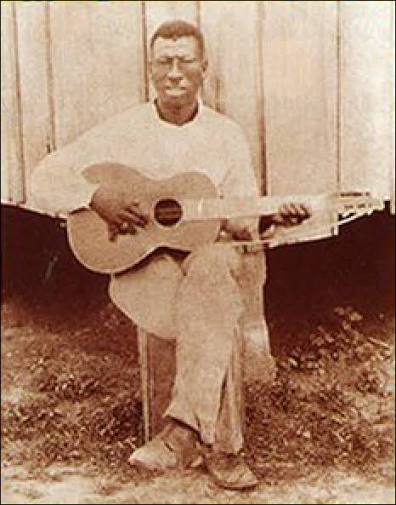
Today Deep Ellum is condos and restaurants. The Gypsy Tea Room and Tip Top Tailors are gone. At the Deep Ellum Blues Museum pop-up and at the Old Town School of Folk Music, his photo remains — tall, thin, soft smile, 1920s suit, guitar in hand.
How to Hear Him Now
Start with Paramount 12654: "Hard Dallas Blues" for the bounce and Dallas-as-hard-place lyric, and "No Job Blues" for topical blues that still feels contemporary. Then Paramount 12656: "Ramblin' Mind Blues" for the walking guitar and "Poor Boy Blues" for personal and universal at once.
 Hard Dallas
Then hear the better sound of Victor V-38561 and V-38562 for the same titles, stronger bass, more melodic treble.
For deep listening, play DOCD-5018 in order. You hear a young rambler become a working musician, moving from solo to second guitar, from hard-time blues to good-time blues and back, from 1928 to 1932, before the needle lifts and he goes back to the street.
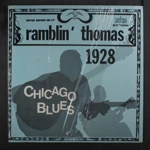 Chicago Blues (Biograph)
Put it on late at night with a little surface noise that sounds like rain on Elm Street. That high tenor, that rolling, raggy guitar, that soft voice that knows about hard times and rambling and Dallas being hard. That is Ramblin' Thomas, Willard Thomas from Logansport, brother of Jesse, author of 24 sides that still sound like a man walking away.
The ghost still rambles.
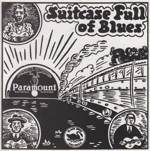 Suitcase Full Of Blues
Essential Listening: Document DOCD-5018 Complete Works (1928-1932); Yazoo Texas Blues anthology. Original 78s: Paramount 12654, 12656; Victor V-38561, V-38562.