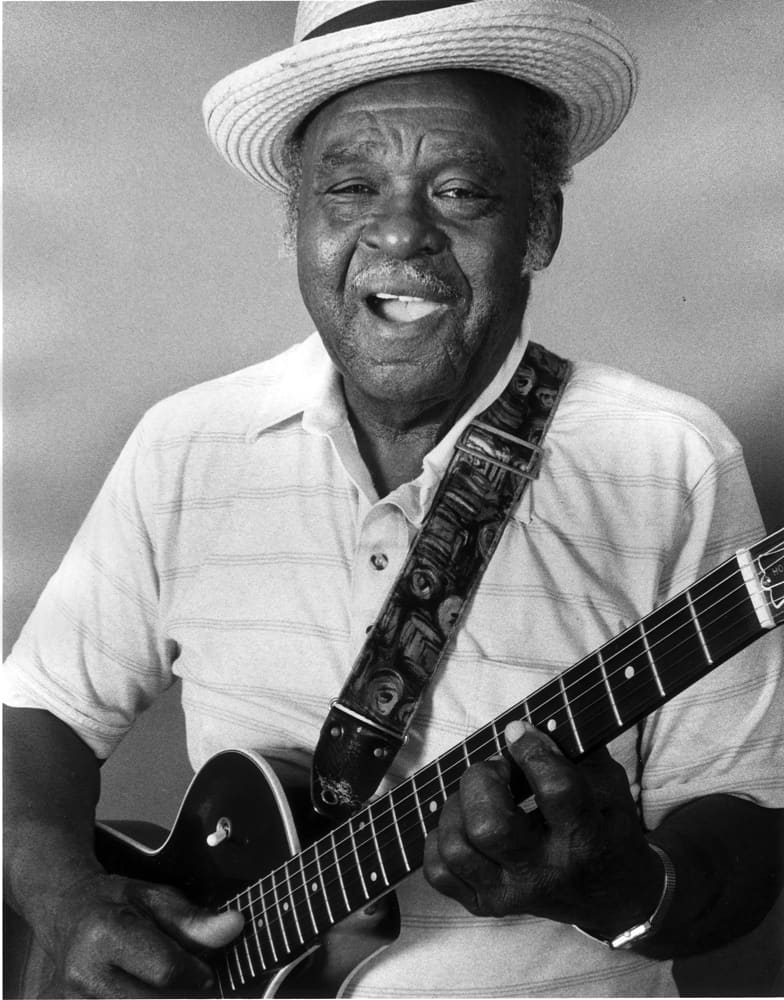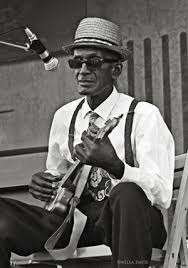
There is a quality to Sleepy John Estes's voice that defies explanation and defeats easy categorisation. It is the sound of a man at the absolute end of his tether, of someone singing through tears he has long since exhausted, of grief so thoroughly inhabited that it has become something almost comfortable — a permanent condition rather than an acute crisis. Critics and listeners reaching for a vocabulary to describe it settled quickly on the word "crying," a term that appears in virtually every serious account of Estes's singing. But the word barely scratches the surface. What Estes produced was something deeper and more disturbing than simple crying — a vocal quality that suggested accumulated suffering, a life experience so broad and so heavy that the voice itself had been shaped by it, the way a river is shaped by the stone it flows over.
That voice was so fully formed, so utterly convincing in its mature desolation, that when Estes made his first recordings in Memphis in 1929 — at an age somewhere between twenty-nine and thirty, depending on which birth record you accept — it sounded to subsequent listeners as though they were hearing a very old man. The misapprehension was so complete, and so widely shared, that when the folk blues revival of the early 1960s set researchers searching for the original artists whose records they had been discovering in second-hand shops and on mail-order labels, they delayed looking for Sleepy John Estes on the assumption that anyone who sang like that in 1929 must surely be dead by 1960. They had, in addition, the testimony of the musician Big Bill Broonzy, who had told an interviewer that Estes was no longer living — a piece of misinformation that delayed the rediscovery of one of the greatest songwriters in blues history.
He wasn't dead. He was in Brownsville, Tennessee, living in a tumbledown sharecropper's shack in the middle of a cotton field, blind in both eyes, subsisting on disability checks, a man whom the music world had essentially forgotten. When he was found in 1962, the news spread through the blues research community like the arrival of a genuinely miraculous event. Here was not a rumour, not a photograph, not a name on an old 78 — here was the actual, living Sleepy John Estes, still able to sing, still writing blues poetry, and playing guitar better, some observers thought, than in his prime.
The story of Sleepy John Estes is in many ways the story of country blues itself: the hard early years in the rural South, the migration to the city and the recording sessions that preserved the music for posterity, the long decades of obscurity when the world moved on and the old style seemed exhausted, and then the extraordinary resurrection of the 1960s folk revival, when young white Americans and Europeans discovered with something like religious fervour the music that African American Southerners had been making for decades. It is a story of poverty and persistence, of extraordinary creative gifts exercised in the most difficult possible circumstances, and of a music so rooted in lived experience that it could reach across decades and cultures to speak directly to anyone willing to listen.
Origins: Ripley, Brownsville, and the Roots of a Bluesman
John Adam Estes was born on January 25 in either 1899 or 1900 — the gravestone says 1899, the World War I draft card says 1900, and no authoritative resolution of the discrepancy has been established — in Ripley, the seat of Lauderdale County in west Tennessee, not far from the Mississippi River. The world into which he was born was one of sharecropping and subsistence farming, of cotton fields and seasonal labour, of a Southern African American community that had been nominally free since the end of the Civil War but remained bound by the economic and social structures of a segregated society that offered very little latitude for individual advancement.
His father was a sharecropper who also played some guitar — the first musician Estes would ever hear, and the man who showed him his first chords and taught him his first song, a simple piece called "Chocolate Drop." The musical tradition in the Estes household was not a professional aspiration but a social practice, something you did in the evenings and on weekends, at fish fries and house parties, as part of the texture of community life. The guitar was a domestic instrument before it was a professional one, and the blues — in its early, pre-commercial form — was the music of a community talking to itself about its own experience.
In 1915, when Estes was around fifteen or sixteen years old, his father moved the family to Brownsville, in Haywood County — a somewhat larger town, about sixty miles northeast of Memphis, that would become the fixed point of Estes's life, the place he always returned to and eventually died in. Brownsville was a more substantial musical environment than rural Ripley; it was home to several musicians who would prove influential to the young Estes, most notably the guitarist known as "Hambone" Willie Newbern.
Newbern was an important transitional figure in early blues history — a musician whose 1929 recording "Roll and Tumble Blues" established a musical template that would be used and re-used throughout blues history. For Estes, Newbern served as both a model and a teacher. The young man watched Newbern closely, absorbed his techniques and his repertoire, and began developing his own approach to the guitar and, more crucially, to the voice. He also, around this time, built himself a cigar-box guitar — a common improvised instrument in the rural South — on which he practised when no proper instrument was available.
Shortly after the family's arrival in Brownsville, Estes lost the sight in his right eye. Accounts differ on the exact circumstances: some say a friend threw a rock at him, others suggest it occurred during a baseball game. What is not in dispute is that the injury was permanent and that it left him with the appearance — a drooping, partially closed eye — that would give him his nickname. "Sleepy" was what people called him, though the sources of the name are multiple: the appearance of the injured eye, a documented tendency to fall asleep at inconvenient moments, and a blood pressure condition or something resembling narcolepsy. Estes himself, in the most charming of the explanations, offered this: "Every night I was going somewhere. I'd work all day, play all night and get back home about sunrise. I'd get the mule and get right on going. I went to sleep once in the shed. I used to go to sleep so much when we were playing, they called me Sleepy. But I never missed a note." Bob Koester, the founder of Delmark Records who would later play a crucial role in Estes's rediscovery, provided another interpretation: that Estes had a "tendency to withdraw from his surroundings into drowsiness whenever life was too cruel or too boring to warrant full attention" — a description that, in its wry sympathy, captures something essential about the man.
In Brownsville, Estes also met the two musicians who would become his most enduring musical partners. James "Yank" Rachell was a guitarist and mandolin player from the Brownsville area whose playing would complement and support Estes across much of his recording career. Hammie Nixon was a harmonica player whose story has its own remarkable quality: Estes first heard him playing at a country fish fry, was immediately struck by the soulfulness of the sound coming from the young boy's mouth, and persuaded Nixon's mother to allow her son to accompany him when he played around Brownsville and Memphis. Nixon was reportedly only twelve years old when Estes first heard him. The friendship and musical partnership that grew from this first encounter would last more than fifty years, extending beyond Nixon's professional relationship with Estes into something that, by all accounts, resembled profound personal loyalty.
Memphis and the Jug Band World: The Making of a Musician
In the late 1920s, as Estes entered his late twenties, he and his musical associates began ranging increasingly far from Brownsville, drawn by the economic and musical opportunities of Memphis, some sixty miles to the southwest. Memphis in this period was one of the great crossroads of American popular music — a city where Delta blues musicians from Mississippi, white country music acts from Tennessee and Arkansas, jug bands with their distinctive folk-jazz mixture, and vaudeville performers all competed and collaborated in a dynamic and crowded scene. The focal point of this world was Beale Street, the African American commercial and entertainment district that had been thriving since before the turn of the century and would continue to define Memphis music for decades to come.
Estes, Rachell, and Jab Jones — a jug and piano player who was a veteran of various Memphis ensembles including the famous Memphis Jug Band — formed a trio that called itself the Three J's Jug Band when they played Handy Park and the joints on Beale Street. Their regular gig at the Blue Heaven Club gave them a consistent audience and the kind of practical experience that develops musical range and flexibility. The Three J's competed well with the more established Memphis jug bands, offering audiences the combination of Estes's guitar and vocals, Rachell's mandolin, and Jones's piano and jug — a versatile ensemble that could handle dance music, blues, and the more comedic "hokum" style that was fashionable in the late 1920s.
It was in this context that Estes came to the attention of Ralph Peer, the talent scout for the Victor Talking Machine Company — the same Ralph Peer who had famously recorded the Carter Family and Jimmie Rodgers at the Bristol Sessions in 1927, the event that is often cited as the origin of commercial country music. By 1929, Peer was active throughout the South, looking for regional talent in the newly lucrative "race records" market that had been established by labels recognising that African American audiences constituted a commercially significant consumer base for recorded music. According to various accounts, the veteran blues artist Jim Jackson was responsible for bringing Estes and his associates to Peer's attention, pointing out the young Brownsville bluesman as someone worth recording.
The recording sessions that followed — taking place in September and October of 1929 at makeshift facilities set up at the Peabody Hotel in Memphis — were Estes's first encounter with the recording process, and they produced sixteen sides for Victor that represent some of the most important documents in the history of early blues. The key personnel on most of these sides were Estes on guitar and vocals, Rachell on mandolin, and Jab Jones on piano. The combination of these three instruments created a sound that was simultaneously of the moment — the jug band and string band traditions were commercially fashionable in 1929 — and distinctively personal, driven by Estes's voice in a way that none of the other Memphis performers could match.
The recordings from these sessions include some of the songs that would become permanently associated with Estes's name: "Diving Duck Blues," which drew on older folk material and became one of the most frequently covered songs in his catalogue; "Milk Cow Blues," a track of such structural and melodic elegance that it would be used as the basis for compositions by multiple generations of artists; and "The Girl I Love She Got Long Curly Hair," which borrowed its tune from Newbern's "Roll and Tumble Blues" while putting Estes's own lyrical stamp on the material. Four additional sides were recorded with Estes as a member of Noah Lewis's Jug Band, adding another dimension to his early discography.
What was immediately striking about these recordings — and what has remained striking to every subsequent listener — was the voice. Estes sang with an urgency and an emotional weight that seemed to come from somewhere beyond normal human experience. The technical description of "crying" blues accurately captures the surface quality of the sound, but does nothing to explain the depth of feeling communicated by that sound, or the manner in which it could simultaneously represent the most personal and the most universally communicable of experiences. He sang, to use a phrase that would be applied to him repeatedly across decades of critical attention, like a man who had seen too much and felt too much and was somehow still standing, still making music, still finding the words.
Not long after the Victor sessions, Rachell departed to go back to farming, as the Depression tightened its grip on the Southern economy. It was an economic reality that forced many musicians of this era into agricultural labour, not as a choice but as a necessity. Estes's response was to deepen his partnership with Hammie Nixon, who had by this point developed into a highly accomplished harmonica player, and to continue performing wherever opportunity presented itself — Memphis and the surrounding area, occasional trips to Kentucky, always hustling for the next engagement.
Chicago and the Decca Years: The Peak of the Pre-War Career
In 1931, Estes and Nixon hopped a freight train to Chicago — one of the countless migrations that defined African American life in the early twentieth century, as people moved from the limited opportunities of the rural South toward the larger, if far from perfect, possibilities of the Northern cities. Chicago in 1931 was in the grip of the Depression but still offered a more varied economic and cultural landscape than Haywood County, Tennessee. The two musicians found work playing on street corners and at the house rent parties that were a staple of African American urban social life — events where guests paid an entry fee that went toward paying the host's rent, and where musicians provided entertainment in exchange for whatever combination of money, food, and drink they could negotiate.
The Chicago sojourn brought Estes into contact with the broader world of urban blues and boogie-woogie that was transforming the music at the time. He absorbed elements of this urban environment without abandoning his essentially rural sensibility. Unlike many of the bluesmen who migrated north and gradually electrified or urbanised their sound, Estes remained fundamentally a country blues artist — his acoustic guitar and the interplay with Nixon's harmonica constituting a sound world that was recognisably rooted in west Tennessee and distinctly apart from the emerging Chicago electric blues style.
It was in Chicago that Estes began recording for the Decca label, which would prove the most productive recording relationship of his career. Between 1935 and 1940, Estes produced thirty vocal recordings for Decca — a remarkable output for the period — accompanied primarily by Nixon's harmonica and, on many sides, by the guitarist Charlie Pickett. These Decca recordings represent the high-water mark of his pre-war output: fully realised performances of exceptional songs, captured with enough sonic fidelity to preserve the essential character of the music while remaining direct and unadorned.
Among the Decca recordings are some of the enduring masterpieces of pre-war blues. "Someday Baby Blues," recorded on July 9, 1935, is perhaps the most significant single recording of Estes's career — a performance that one music historian has described as "iconic" without a moment's hyperbole, a record that inspired countless cover versions across blues, jazz, and country music. The song's opening statement of loss and resignation — a narrator contemplating a departed love with an equanimity that barely conceals its underlying devastation — established a template that would be reworked by Muddy Waters (as "Trouble No More"), Big Maceo Merriweather, and eventually Bob Dylan (as "Someday Baby" on his 2006 album Modern Times). Estes and Nixon are credited as the song's composers, though this attribution is complicated by the existence of an earlier unissued recording by Memphis Willie B. that preceded the Decca session.
"Floating Bridge," from the same period, is one of the great narrative blues compositions — a song that describes a near-death experience Estes apparently had in reality, a near-drowning incident that left him momentarily insensible: "They dried me off and they laid me in the bed / Couldn't hear nothing but muddy water running through my head." The specificity of the imagery — the cold water, the confused sensory experience of near-death, the gradual return of consciousness — gives the song a vividness that is almost cinematic. It is less a blues in the conventional 12-bar sense than a sustained narrative poem set to music, and it demonstrates the extent to which Estes's approach to songwriting went beyond the standard templates of the form.
"Drop Down Mama," also from the Decca period, is another composition that has demonstrated extraordinary durability and influence. The song's opening lines — "Drop down, baby, let your daddy see / Drop down, my lady, just dream of me" — were borrowed almost wholesale, decades later, by Led Zeppelin for "Custard Pie" on their 1975 album Physical Graffiti. The borrowing was not credited, a common enough practice when established rock acts drew on pre-war blues material, but it points to the foundational quality of Estes's songwriting: these were not obscure or marginal compositions but genuine standards of the country blues tradition.
"Lawyer Clark Blues" exemplifies another dimension of Estes's songwriting entirely. Where "Floating Bridge" is personal and lyrical, "Lawyer Clark Blues" is essentially journalistic — a portrait of a specific individual (Hugh L. Clarke, a Brownsville lawyer who would later become a judge and senator) rendered with affectionate accuracy and gratitude. Estes sang that Clarke let him "off the hook" for an offense, a detail of genuine biographical specificity that is unusual even in a genre known for its autobiographical tendencies. The song is part of what might be called Estes's Brownsville cycle — a series of compositions that effectively constitute a musical portrait of a specific community at a specific moment in American history: "Vassie Williams' Blues" (about the local auto mechanic), "Little Laura Blues" (about a girl whose romantic fantasies had a way of coming true), "Working Man Blues" (about the mechanisation of agriculture displacing sharecroppers), and "Special Agent (Railroad Police Blues)" (about the adventure and risk of hopping freight trains).
This local specificity was, paradoxically, one of the things that made Estes's music universal. By grounding his songs in the exact details of particular lives and places — naming names, describing circumstances, singing about the lawyer who helped him out rather than a generic benefactor — he gave his compositions a weight and authenticity that abstract treatments of the same emotions could never achieve. The universality came from the emotion, not from the generalisation; the emotion was made credible by the specificity. It was, in a sense, the same artistic principle that underpins the greatest literary realism: the particular case, rendered with full attention to its actual texture, reveals the universal condition.
Estes's final pre-war recording session took place on September 24, 1941, with Son Bonds and Raymond Thomas joining him for twelve sides for RCA Victor's Bluebird label — three credited to Estes, three in which he accompanied Bonds, and the rest released under the name "The Delta Boys." The session produced further valuable music, including recordings that captured Estes's mature style with an intimacy that the earlier Decca recordings had not always achieved. But it was the last of his pre-war work, and the years that followed were the ones that would test his endurance most severely.
The Dark Years: 1941–1962
When Estes returned to Brownsville in the early 1940s, the world he came back to was in the process of a transformation that would leave him increasingly stranded. The acoustic country blues he played was going out of fashion — being replaced, in the African American market that had sustained it, by the electrified, urbanised blues of Chicago artists like Muddy Waters and Little Walter, and by the gospel-inflected rhythm and blues of the emerging post-war entertainment industry. The rural, acoustic, story-song approach that Estes had developed seemed, to the commercial market of the mid-1940s, hopelessly old-fashioned.
His eyesight, already compromised since the childhood accident that had cost him the sight in his right eye, continued to deteriorate. By 1950, he was completely blind — an affliction that further limited his ability to farm, to travel independently, and to pursue whatever musical opportunities might have presented themselves. He and Nixon made attempts to revive their recording careers after the war: sessions for the Ora Nelle label in 1948 in Chicago came to nothing, and a session for Sam Phillips's Sun Studio in Memphis in 1952 — a version of the rock and roll crucible that would make Elvis Presley famous — produced recordings of "Runnin' Around" and "Rats in My Kitchen" that were not released at the time. The man who had been part of a vibrant, commercially active blues scene through the 1930s was now, in the early 1950s, entirely outside the music industry, living on disability checks in a falling-down shack in a Tennessee cotton field.
The cruelty of his situation in these years was intensified by the fact that the music he had made was not forgotten — it was circulating on old 78 rpm records among the growing community of blues enthusiasts, and its influence was spreading. The records he had made for Victor, Decca, and Bluebird in the 1929-1941 period were among the items that American folk enthusiasts and European listeners were discovering with increasing excitement through the late 1940s and early 1950s. But the living artist whose voice animated those records was unknown, presumed dead, and living in poverty so complete that it amounted to a kind of social invisibility.
Big Bill Broonzy, the respected Chicago blues musician who had written a memoir in the early 1950s, confirmed in that book that Estes had died — a piece of misinformation that was taken seriously precisely because Broonzy was a credible source with direct knowledge of the pre-war Chicago blues scene. Big Joe Williams, another old-timer who knew better, eventually corrected the record by informing Bob Koester of Delmark Records that Estes was in fact still living somewhere in Tennessee. But even Koester, when first told, was skeptical: the legend of Estes's death was so well established that disbelieving it required some effort.
It was a documentary filmmaker named David Blumenthal who actually found Estes, in 1962, while making a film called Citizen South — Citizen North — a document of African American experience in both regions of the country. Blumenthal had been steered toward Brownsville by Memphis Slim, who in turn had heard of Estes's whereabouts from Big Joe Williams. When Blumenthal found him, Estes was living in an abandoned sharecropper's shack near Brownsville with his wife Ann and five children, subsisting on disability checks, completely blind, and very much alive. Blumenthal also photographed Samuel Charters filming Estes performing in front of his shack — blind and frail but singing, still capable of producing the remarkable voice that had so astonished the first listeners to his Victor recordings more than thirty years earlier.
Blumenthal mentioned his find to Delmark Records, and Koester immediately arranged to bring Estes to Chicago for a recording session. The news, as it spread through the blues research community, provoked reactions of something close to disbelief. Incredulous letters arrived at Delmark's offices from blues fans around the world. One English fan registered his disbelief in print. And yet here was Sleepy John Estes — not a name on a vintage record label, but, as Koester later wrote, "a flesh-and-blood reality still able to sing as well as ever, still writing blues poetry, and playing better guitar than in former" years.
The Rediscovery: Delmark Records and the Second Career
The recording session that Koester organised on March 24, 1962, was, in retrospect, one of the most significant events in the folk blues revival. The session found Estes — joined by Ed Wilkinson on bass, John "Knocky" Parker on piano, and his old partner Hammie Nixon on harmonica — revisiting a set of older songs and demonstrating beyond any doubt that age and hardship had taken nothing essential from his voice. If anything, the additional decades of experience had deepened the quality that had always distinguished him: the singing seemed even more thoroughly inhabited by lived experience, the "crying" quality more intensely present, the commitment to every phrase more complete.
The resulting album, The Legend of Sleepy John Estes, released on Delmark Records in 1962 (catalogue number DD 603), became one of the landmark recordings of the folk blues revival era. It presented Estes revisiting old favourites — "Divin' Duck Blues," "Someday Baby Blues," "Stop That Thing," "Milk Cow Blues," "Married Woman Blues" — with the same directness and emotional commitment that had characterised the pre-war originals, but with a seasoned quality that gave even familiar material a fresh weight. The album was proof that Estes's music was not merely historically interesting but actively, presently vital.
The second album that came from the 1962 sessions, Brownsville Blues (Delmark 613), presented a collection of original Estes compositions organised around the theme of his Brownsville community — a continuation of the local portraiture that had distinguished the best of his pre-war work. In a sub-cellar jazz club in Düsseldorf, during the 1964 European tour with the American Folk Blues Festival, Estes participated in an impromptu session that brought together Hubert Sumlin (Howling Wolf's guitarist), Sonny Boy Williamson, and Sunnyland Slim — a gathering of blues masters from different generations and styles that serves as a vivid reminder of how central Estes's position was in the broader tradition.
The third major album from this period, Broke and Hungry (Ragged and Dirty, Too) (Delmark, 1964), featured Estes alongside Yank Rachell on mandolin and harmonica, Nixon on harmonica, and — in one of the more striking connections of the folk revival period — a young Mike Bloomfield, the electric guitarist who would soon become famous as a member of the Paul Butterfield Blues Band and later Electric Flag. Bloomfield's presence on four tracks of the album — he is described in session notes as "quietly adding his powerhouse guitar" — brought a new instrumental voice into the Estes ensemble without disrupting its essential character. It was also one of the earliest documented recordings featuring Bloomfield, who would later become one of the most significant electric blues guitarists of the rock era.
The reactivation of Estes's career in the early 1960s gave him access to audiences and venues he had never previously reached. His first concerts after the rediscovery were at college campuses — Westminster College, the University of Illinois, Purdue University — the institutions where the folk revival was finding its most enthusiastic support. He played the Newport Folk Festival in 1964, the most prestigious showcase of the folk revival world, alongside Rachell and Nixon, presenting the music of three Brownsville veterans to an audience of young white Americans who received them with something close to reverence.
The 1964 European tour with the American Folk Blues Festival — an annual package tour that had been bringing American blues artists to European concert halls since 1962 — opened another world entirely. European audiences, particularly in Britain and Germany, had developed an intense relationship with American blues music through the import records that circulated among musicians and enthusiasts, and the blues artists who performed on these tours were received as masters of a tradition that European rock musicians were simultaneously revering and attempting to learn from. Estes, Rachell, and Nixon were among the American artists who participated in the 1964 edition of the festival, joining a lineup that also included Lightnin' Hopkins, Howling Wolf, Sonny Boy Williamson, Hubert Sumlin, and Sunnyland Slim.
In November 1974, Estes led one of the first blues tours of Japan — preceded only by a B.B. King State Department tour — and the reception there was extraordinary enough that a track appeared on the Japanese Top 100 chart. The Live in Japan album that resulted from the 1974 concerts captured Estes and his long-time associates at a late peak, the music worn and weathered and all the more powerful for it.
Estes also recorded Electric Sleep (Delmark 619) during this revival period — a departure into electrified instrumentation that brought him together with Sunnyland Slim on piano, Carey Bell on harmonica, Earl Hooker on guitar, Odie Payne Jr. on drums, and Jimmy Dawkins on guitar. The session demonstrated that Estes's musical sensibility was not incompatible with the electric blues context, though his essential character — the voice, the storytelling approach, the emotional directness — remained unchanged by the shift in instrumentation.
The Collaborators: Yank Rachell and Hammie Nixon
No account of Sleepy John Estes's career can be complete without extended attention to the two musicians who were most consistently present throughout his recording and performing life. James "Yank" Rachell and Hammie Nixon were not merely sidemen — they were creative partners whose musical personalities shaped the character of Estes's recordings as profoundly as his own contribution.
Yank Rachell, born on March 16, 1905, in Brownsville, was a guitarist and mandolin player of considerable technical accomplishment. His mandolin playing, in particular, added a melodic lightness and agility to the Estes ensemble that complemented the blues guitar and harmonica without duplicating their functions. The mandolin has a brightness and clarity of tone that cuts through a mix differently from a guitar, and Rachell used it to create answering phrases and commentary on Estes's vocal lines in a manner that was fundamentally dialogic — a conversation between the singer and the instrumentalist rather than mere accompaniment. Rachell eventually moved to Indianapolis, where he became a central figure in the local blues scene. He also recorded for Yazoo's Blue Goose label and appeared in a documentary film about the string band tradition. His biography, Blues Mandolin Man by Richard Congress, was published by the University of Mississippi Press.
Hammie Nixon, whose first name in various sources is also spelled "Hamnie" or "Hammie," was in many respects the most indispensable element of the Estes ensemble. Nixon had learned to play harmonica from Noah Lewis — described in various accounts as "the first great modern harp player" — and had gone on to teach John Lee Williamson (the original Sonny Boy Williamson) the instrument. This pedagogical connection makes Nixon a crucial figure in the development of blues harmonica history: his teaching of Sonny Boy Williamson effectively transmitted the rural Tennessee harmonica tradition to Chicago, where it became one of the foundational elements of urban electric blues. Estes himself said that Sonny Boy Williamson's vocal style came directly from the way Sleepy John sang. If that is accurate — and the vocal similarity between the two artists supports the claim — then through Nixon's instruction of Williamson, Estes's influence on the Chicago blues tradition was both direct and immeasurable.
Nixon's harmonica work on the Estes recordings is marked by a plaintive, singing quality that mirrors and supports Estes's vocal approach. Where many blues harmonica players emphasised rhythmic drive or technical showmanship, Nixon used the instrument to sustain and extend the emotional content of the songs — his notes breathing and sighing alongside Estes's voice rather than competing with it. The interplay between the two on recordings like "Someday Baby Blues" and "Floating Bridge" is the sound of two musicians who have played together so long that the distinction between leader and accompanist has essentially dissolved.
The Songwriting: A Blues Poet of the Particular
Among the things that distinguish Sleepy John Estes from most of his blues contemporaries is the quality and specificity of his songwriting. While many country blues artists drew on a common stock of traditional verses and floating lyrics, rearranging familiar material into new combinations, Estes was a genuinely original composer who created songs that were unmistakably and irreducibly his own.
His most distinctive characteristic as a songwriter was the use of documentary specificity — naming real people from his community, describing actual events from his own life, anchoring universal emotions in particular local circumstances. This approach is unusual in American popular music and virtually unique in blues. Most blues songwriting generalises its emotional content, presenting love and loss and hardship in terms that could apply to any listener's experience. Estes did the opposite: he particularised, making songs about specific people and places and events, trusting that the emotional truth of the specific case would communicate universally.
The results were, at their best, something more like literature than like conventional popular songwriting. "Lawyer Clark Blues" is a vignette of civic gratitude, a portrait of a professional man who treated his poor clients with the same seriousness as his wealthy ones — not the kind of subject matter that appears in blues with any frequency, and yet treated with such warm specificity that it becomes genuinely moving. "Floating Bridge," as noted above, describes a near-drowning in terms of such precise sensory accuracy that the listener's imagination is fully engaged. "Hobo Jungle Blues" and "Working Man Blues" are pieces of social journalism, observations on the conditions of African American life during the Depression that have the documentary value of oral history.
The Brownsville cycle as a whole constitutes what might legitimately be called the most sustained literary project in pre-war blues: a series of portraits of a community, created by someone who was both inside that community and capable of looking at it with enough artistic distance to render it in song. The comparison to William Faulkner's Yoknapatawpha County has been made by blues historians, and while Estes was working in a very different medium with very different formal constraints, the analogy is not entirely fanciful. Both Faulkner and Estes created worlds — specific, particular, imaginatively vivid — from the raw material of a real Southern community.
The songs that transcend the specifically local — "Someday Baby Blues," "Milk Cow Blues," "Drop Down Mama" — demonstrate a different but equally impressive quality. These are compositions of such structural and melodic elegance that they could serve as material for artists in virtually any genre, which is precisely what has happened. They have a rightness to them, a quality of inevitability, that marks the work of the genuinely gifted composer: this is not just one way of expressing this feeling, but the way, the configuration of melody and lyric that fits the emotion perfectly.
The Sound: Guitar Style, Harmonic Approach, and Musical Character
Estes was not, by the assessment of most critics and fellow musicians, a technically exceptional guitarist. He freely acknowledged that he relied on better instrumentalists — Rachell, Nixon, Son Bonds, Charlie Pickett — to fill in the gaps in his guitar playing, and the recordings bear this out: the guitar work is functional rather than virtuosic, providing a rhythmic and harmonic foundation for the voice rather than offering significant melodic interest on its own. What Estes did with the guitar was serve the song, and in that limited but essential function he was absolutely effective.
The harmonic world of his recordings is the standard blues vocabulary of the period — the I, IV, and V chords of the 12-bar and 8-bar blues forms — but deployed with an idiosyncratic rhythmic approach that gives his recordings their distinctive character. The time feel on Estes's recordings is often described as "loose" or "relaxed," but these are insufficient descriptions of what is actually happening: a very specific kind of rhythmic elasticity that allows the music to breathe and shift without losing its underlying pulse. It is the sound of music organised around the natural flow of vocal phrasing rather than an imposed metrical grid — the rhythm follows the singer rather than constraining him.
The overall sound of the Estes recordings — voice, guitar, and either harmonica or mandolin, or some combination of these — is spare and direct in a way that can seem almost primitive to listeners accustomed to more elaborate productions. But this sparseness is an asset rather than a limitation. The recordings have a transparency that allows every nuance of the vocal performance to register fully, every quiver and catch and cry in the voice communicating directly to the listener without the buffering effect of a dense instrumental texture. You hear Sleepy John Estes as though he were in the room.
Influence: From Sonny Boy to Dylan, from the Beatles to Led Zeppelin
The influence of Sleepy John Estes on subsequent music is so extensive and operates on so many different levels that it is difficult to map comprehensively. There are the direct musical influences — songs that were covered or adapted by other artists, specific stylistic qualities that were absorbed and transmitted. There are the indirect influences that operated through intermediary figures. And there are the influences that belong to the broader cultural phenomenon of the folk blues revival, in which Estes played a significant role both as a recorded artist and as a living presence.
The most direct and immediate influence was on John Lee Williamson — Sonny Boy Williamson — who grew up near Estes in Brownsville and whose vocal style, by multiple accounts, derived directly from the way Estes sang. Hammie Nixon was the one who introduced Williamson to the harmonica, and through Nixon's instruction the combination of Estes's vocal approach and the Brownsville harmonica tradition passed to Williamson, who would take it to Chicago and transform it into one of the foundational elements of urban blues. The chain of influence from Estes through Nixon and Williamson runs directly to the Chicago electric blues style that has dominated blues history ever since.
Among the specific songs that have been recorded by subsequent artists, the range is extraordinary. "Someday Baby Blues" became a standard that has been recorded in jazz, blues, and country contexts and was rewritten by Muddy Waters as "Trouble No More" — one of the great Muddy Waters recordings — and again by Bob Dylan for his 2006 album Modern Times. "Milk Cow Blues" became the model for Dylan's "From a Buick 6" on Highway 61 Revisited — Dylan acknowledged this specific debt in the sleeve notes for Bringing It All Back Home. "Drop Down Mama" was recorded by Tom Rush, Big Joe Williams, the North Mississippi Allstars, and many others; its opening lines were borrowed essentially verbatim by Led Zeppelin for "Custard Pie." "Diving Duck Blues" was recorded by Taj Mahal, Johnny Winter, and others. "Leaving Trunk," a Taj Mahal cover of Estes's "Milk Cow Blues," appeared on Mahal's self-titled 1968 debut album.
John Lennon's acknowledgement of Estes's influence, published in the 1970 interview collection Lennon Remembers, is particularly striking: "We were all listening to Sleepy John Estes and all that in art school, like everybody else." The casualness of the phrase "like everybody else" is actually one of the most significant things about it — Lennon is not claiming a unique or esoteric connection to Estes's music, but describing it as part of the common musical vocabulary of a generation of young British musicians in the early 1960s. By the time the Beatles were forming and beginning to develop their sound, Sleepy John Estes's pre-war recordings were circulating widely among British blues enthusiasts, shaping the musical sensibilities of the generation that would define rock and roll.
Robert Plant's naming of Estes as one of his earliest influences is consistent with the broader Led Zeppelin relationship to pre-war blues, which was intimate and detailed but not always credentialed. The borrowing from "Drop Down Mama" in "Custard Pie," and the broader debt that Led Zeppelin's heavy acoustic blues sensibility owes to pre-war artists like Estes, is not something that the band consistently acknowledged in formal terms, but the influence is audible throughout their work.
Bob Dylan's engagement with Estes's material is the most extensively documented and analytically interesting. Dylan mentioned Estes specifically in the sleeve notes for Bringing It All Back Home, the 1965 album that marked his pivotal shift from acoustic folk to electric rock. The sleeve notes — a characteristically stream-of-consciousness document — are not an explicit critical statement but a list of artists and influences that registers Estes's name as part of Dylan's active cultural consciousness. That "Milk Cow Blues" provided the basis for "From a Buick 6" is a relationship that musicologists have mapped carefully: the harmonic structure, the melodic shape, and specific lyrical phrases from the Estes song are reworked into Dylan's composition in ways that constitute genuine creative transformation rather than simple copying. Dylan returned to Estes's "Someday Baby Blues" in 2006, recording a version as "Someday Baby" on Modern Times — a late-career acknowledgement from a Nobel Prize-winning songwriter of the foundational importance of a pre-war bluesman from west Tennessee.
The influence that operates through the folk blues revival more broadly is more diffuse but no less significant. Estes was one of the artists — alongside Skip James, Son House, Mississippi John Hurt, and others — whose rediscovery in the early 1960s gave the folk revival its most historically grounded dimension, connecting the young white audiences who were discovering acoustic music to the African American tradition from which it had sprung. His appearances at Newport in 1964, his European tours, his Delmark recordings — all of these contributed to the cultural environment in which the British Invasion blues bands were forming their musical identities. The Rolling Stones, the Yardbirds, the Animals, the early Fleetwood Mac — all drew, to varying degrees, on the pre-war blues tradition that Estes exemplified.
Specifically, the acoustic guitar style that spread through the 1960s folk revival — characterised by open tunings, finger-picking, and the blues-folk synthesis that artists from Taj Mahal to Ry Cooder would develop — owes something to the Estes example, both directly and through the network of influence that his recordings created. John Fahey, the guitarist and musicologist who was one of the most important architects of the folk blues aesthetic, named Estes as an influence. Taj Mahal's extensive engagement with Estes's song catalogue — he recorded multiple Estes compositions including versions of both "Milk Cow Blues" and "Diving Duck Blues" — was one of the most substantial acts of transmission between the pre-war generation and the rock era.
The Final Years: Legacy and Death
The late years of Estes's career, from the mid-1960s through to 1977, were characterised by a gradual broadening of his performing world and a continued creative engagement with new recording contexts. He appeared at the Smithsonian Festival of American Folklife in both 1970 and 1973, events that situated him within the institutional recognition of American folk heritage. He continued to record for Delmark and to perform with Rachell and Nixon, the three Brownsville veterans maintaining their musical partnership into their seventh and eighth decades — a relationship of such duration that it had become something more like a shared language than a professional collaboration.
The Electric Sleep album, recorded with Chicago electric blues musicians, was an experiment that demonstrated the adaptability of Estes's musical personality even as it highlighted what was irreducibly his own. The late touring period — the Japanese tour of 1974, the continued European appearances, the university and folk festival circuit in America — brought him into contact with audiences around the world who received his music with the kind of attention and reverence that he had never experienced during the years when he was working juke joints and roadhouses in west Tennessee.
In 1977, preparing for another European tour — the music that had kept his career alive for a second time was continuing to take him to new places — Estes suffered a stroke at his home in Brownsville, the town where he had grown up, the town he had sung about across five decades of recordings, the town where the cotton fields and the sharecropper's shacks and the lawyer's office and the auto mechanic's shop had provided the raw material for some of the most vivid songs in American music. He died at his home on June 5, 1977.
He was buried at Elam Baptist Church Cemetery in Durhamville, Lauderdale County, Tennessee. His grave marker carries the inscription: "Sleepy John Estes — '..ain't goin' to worry Poor John's mind anymore' — Blues Pioneer — Guitarist — Songwriter — Poet." The epitaph is drawn from "Someday Baby Blues," the recording made in Chicago in 1935 that had become his most enduring composition. The word "Poet" on the gravestone is not an honorary addition or a romantic flourish — it is an accurate description of what Sleepy John Estes was, in the deepest sense of the term.
In 1991, Estes was posthumously inducted into the Blues Hall of Fame. His former two-room home is now on display at Brownsville's West Tennessee Delta Heritage Center, alongside Tina Turner's Flagg Grove School — two sharecroppers' children from Haywood County who went on to make music that the world would not forget.
The Recorded Legacy: A Discographical Overview
The recorded legacy of Sleepy John Estes spans nearly six decades, from the Victor sessions of 1929 to the final Delmark recordings of the 1970s, and encompasses work for Victor, Champion, Decca, Bluebird, Ora Nelle, Sun, and Delmark labels. The Old Time Blues website has characterised him, with full justification, as ranking "alongside Blind Boy Fuller, Big Bill Broonzy, Peetie Wheatstraw, and a few others as one of the most prolific of the pre-war bluesmen," having produced more than fifty recordings between 1929 and 1941 alone.
The most comprehensive collection of the pre-war work is the Complete Recorded Works 1929-1941, released by the Document label in two volumes, which gathers all the commercially released material from those sessions in chronological order. The Yazoo compilation I Ain't Gonna Be Worried No More covers similar territory with attention to sound quality and historical context. Both sets reward sustained listening as a complete body of work, revealing the development of Estes's songwriting and vocal style over a twelve-year period.
Of the post-rediscovery Delmark recordings, The Legend of Sleepy John Estes remains the essential entry point — a perfectly realised document of an artist at once reconnecting with his earlier self and demonstrating how fully alive his creative personality remained. Brownsville Blues and Broke and Hungry (Ragged and Dirty, Too) deepen the portrait considerably, with the latter's inclusion of Mike Bloomfield offering a fascinating cross-generational encounter. The Live in Japan album from 1974 provides an invaluable record of the late-period live performance, capturing the completeness and authority with which Estes inhabited his material after more than half a century of playing it.
Conclusion: What Poor John Knew
Sleepy John Estes lived through experiences that would have broken most people and emerged from them with a voice that could break most listeners. He was born into poverty, was partially blinded in childhood, lost his sight entirely by his fifties, spent decades in circumstances of near-total destitution, and was presumed dead by the music world he had helped create. And yet, when he was found in 1962, he was still singing. Still writing. Still playing better, some observers said, than he ever had.
What sustained him through those twenty years of invisibility and poverty was not, apparently, professional optimism — there was very little rational basis for that — but rather the deeper thing that his music always expressed: a relationship with experience so direct and so honest that it provided its own sustenance. He sang about his life because his life was what he knew, and he knew it better than anyone else could. The lawyer who helped him out, the mechanic on the corner, the near-drowning, the freight train, the departed lover — these were the materials of a poetry that needed no elaboration or sophistication, because the raw material itself, rendered with absolute fidelity, was art.
The gravestone epitaph says it better than any critic could: Blues Pioneer. Guitarist. Songwriter. Poet. The sequence is exactly right, and the final word is the most important. Sleepy John Estes was a poet of the common life — of sharecroppers and lawyers and mechanics and freight trains and floods and lovers and the thousand ordinary catastrophes and consolations that constitute a life lived at the bottom of the American social order. He turned that life into music that could move anyone who heard it, across any boundary of culture or time or circumstance, because the emotions it expressed were not particular to any community but common to all humanity.
"I used to go to sleep so much when we were playing, they called me Sleepy," he said. "But I never missed a note." That is the perfect self-portrait of an artist: exhausted, half-blinded by circumstance, always half-asleep, and never, in all the years of hardship and poverty and disappearance and rediscovery, missing a note.
Selected Discography
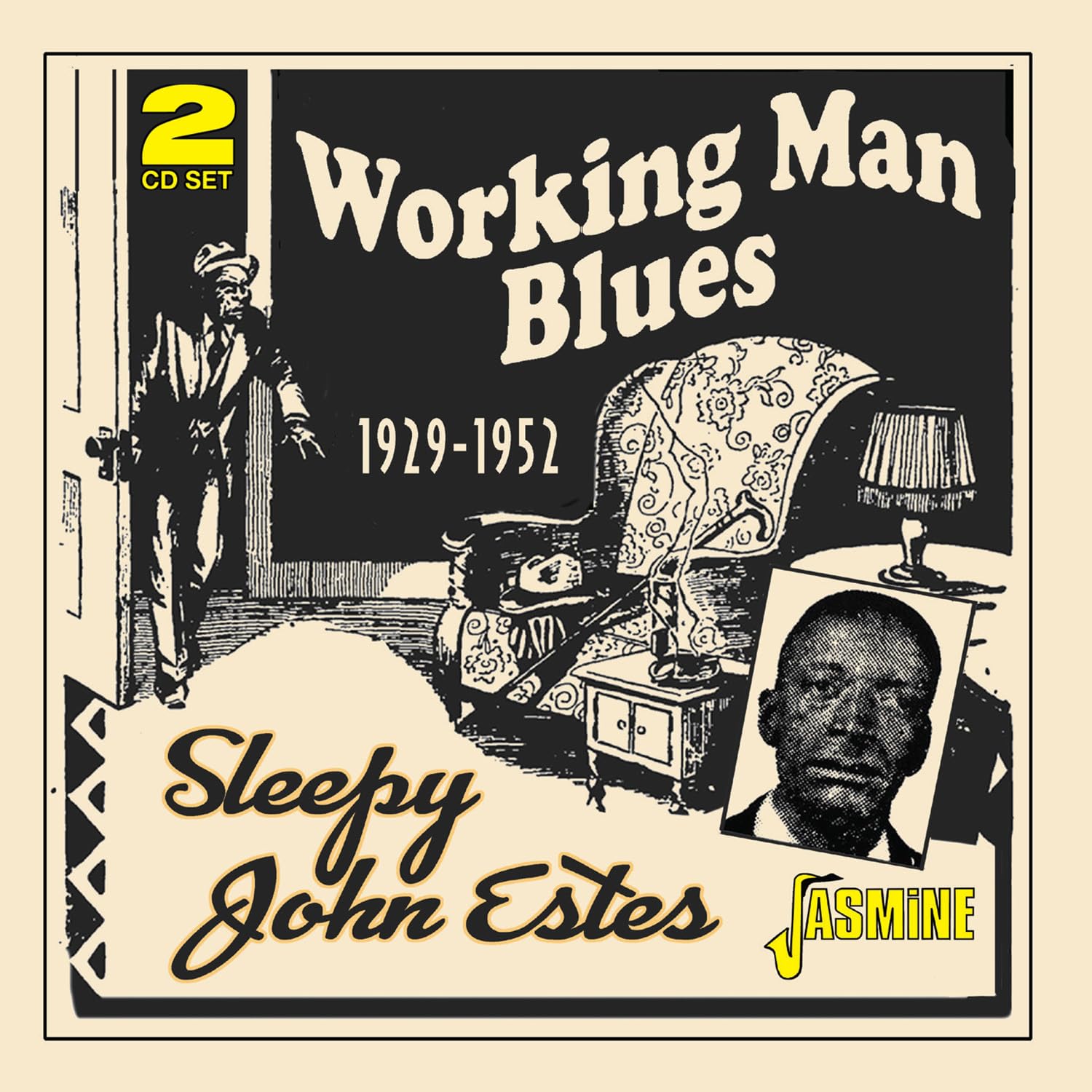
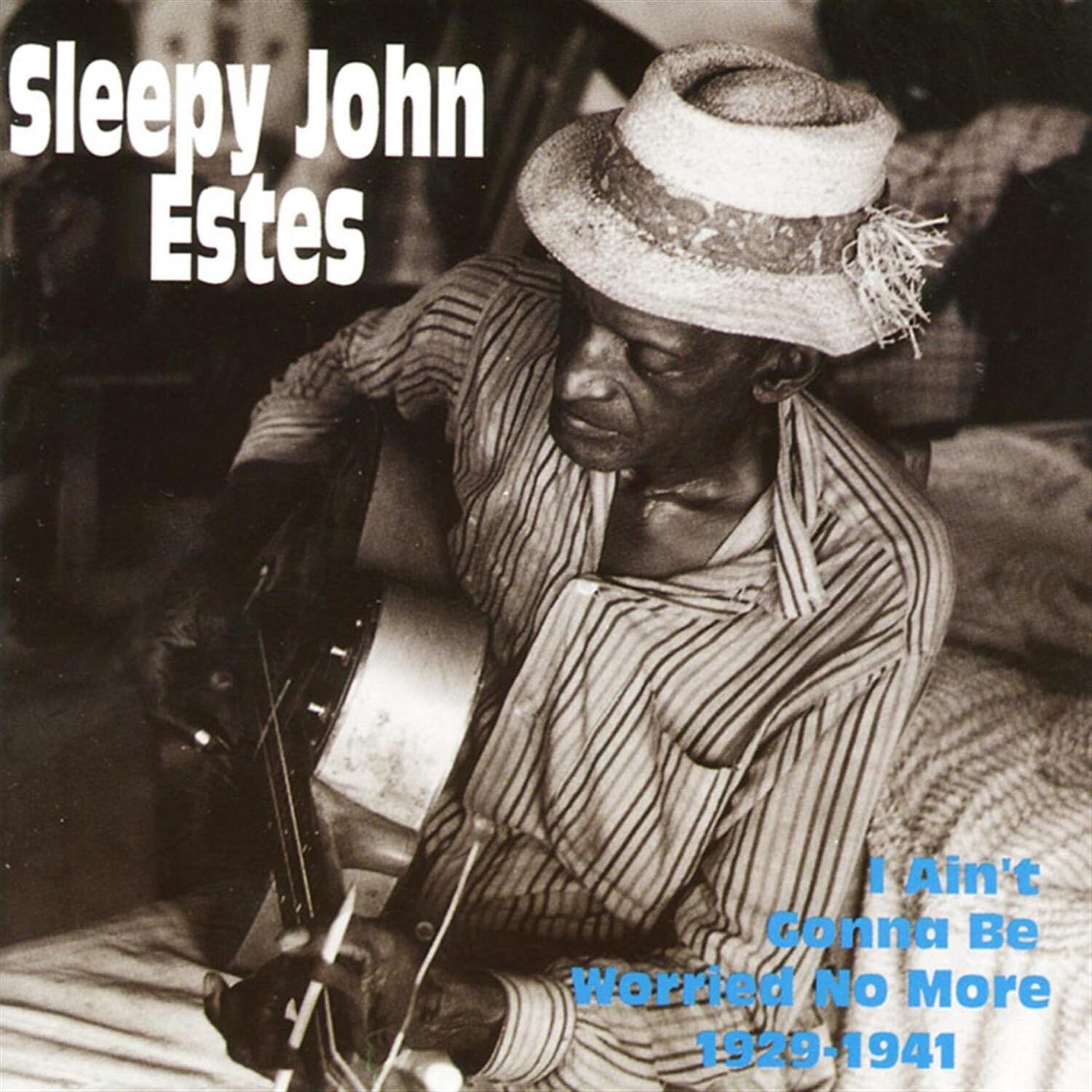
I Ain't Gonna Be Worried No More 1929-1941
John Adam "Sleepy John" Estes, born January 25, 1899 (or 1900), Ripley, Lauderdale County, Tennessee. Died June 5, 1977, Brownsville, Haywood County, Tennessee. Buried at Elam Baptist Church Cemetery, Durhamville, Lauderdale County, Tennessee. Inducted into the Blues Hall of Fame, 1991. Principal recordings: Victor Records (1929-1930); Champion/Decca Records (1935-1940); Bluebird Records (1941); Delmark Records (1962-1970s). Principal collaborators: James "Yank" Rachell (mandolin/guitar); Hammie Nixon (harmonica); Jab Jones (piano/jug); Son Bonds (guitar); Charlie Pickett (guitar).