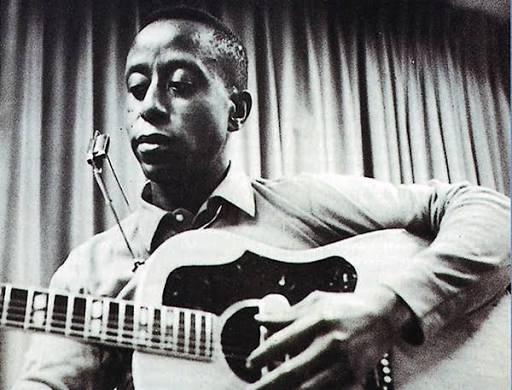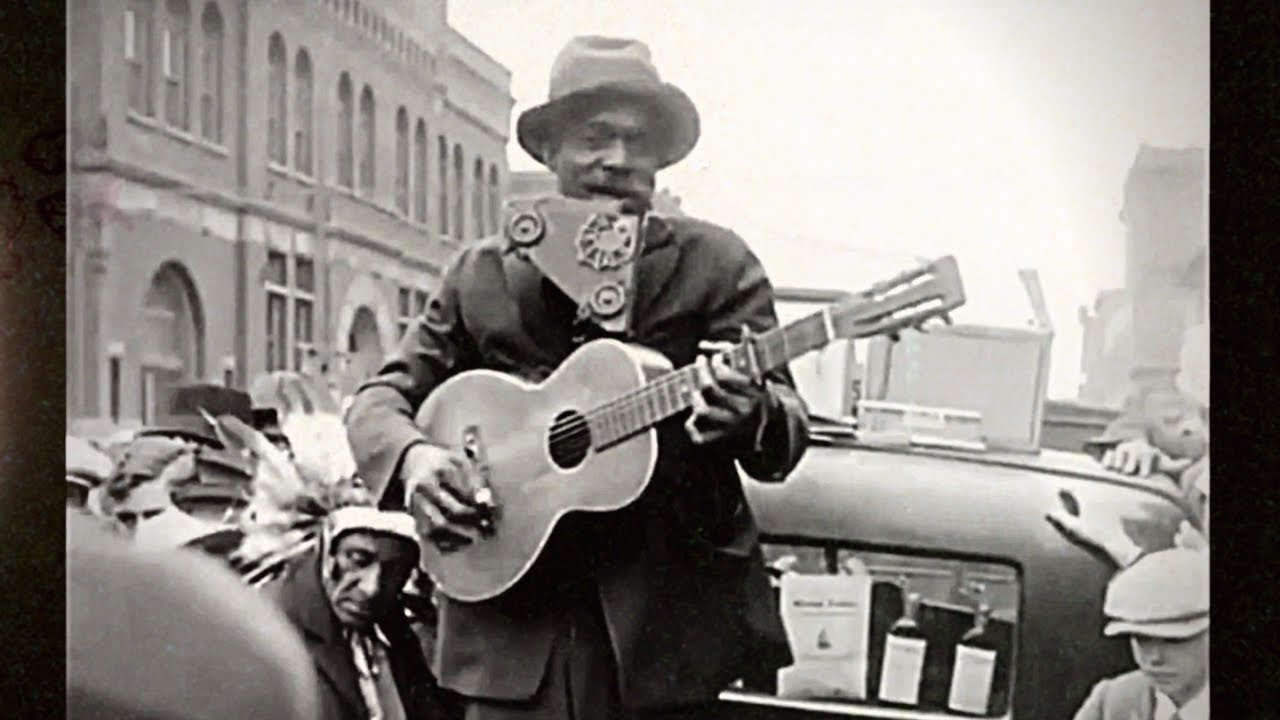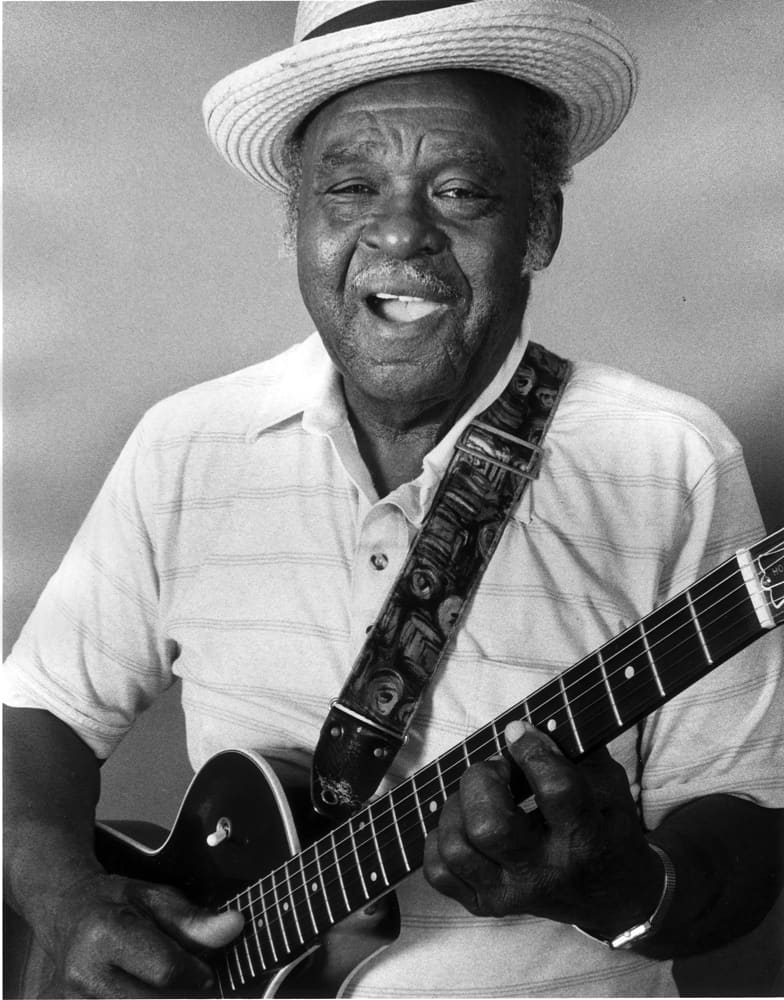
Robert Johnson named him in "Cross Road Blues." Charley Patton and Son House wanted him beside them more than anyone else. He left behind only three solo recordings that anyone has ever heard. Willie Brown was the great second guitarist of the Delta blues, and the music sounds the way it does in part because of him.
"You can run, you can run, tell my friend-boy Willie Brown."
For most blues fans, that line from Robert Johnson's "Cross Road Blues" is where they first meet Willie Brown. It is a strange introduction. Johnson, alone at the crossroads as the sun goes down, frightened and sinking, calls out for someone to carry word to a friend. The friend is a real man. He was not a mythical figure or a stock character in a blues lyric but a working musician from the Mississippi Delta, a guitarist whom Johnson had followed around as a teenager, watching and learning, in the juke joints and on the plantations of Tunica County.
The line made Willie Brown famous, in a way. Eric Clapton sang it with Cream in 1968, on the live version of "Crossroads" that became one of the most famous rock recordings of the era, and millions of people who had never heard a Delta blues record knew the name. In 1986 the Hollywood film Crossroads made Willie Brown a central character, an aging harmonica-playing bluesman, played by Joe Seneca, who had supposedly sold his soul at the crossroads alongside Johnson. But that fictional Willie Brown had almost nothing to do with the real one. The real Willie Brown played guitar, not harmonica. He never claimed to have made a deal with the devil. And for all the attention his name received, his music remained almost unknown.
He is worth knowing. Willie Brown was one of the central figures of the first generation of Delta blues, the musician who stood at the side of Charley Patton for nearly two decades and of Son House for more than twenty years. He was, by the testimony of those who heard him, an extraordinary guitarist, and he was celebrated among his peers for his ability to "second," to play accompaniment behind another musician so well that he lifted the whole performance. He was a teacher and an example to the young Robert Johnson and, at least indirectly, to Muddy Waters. And on the handful of recordings he left, he shows himself to be a powerful singer and a brilliant guitarist in his own right.
His story is a story about the importance of the sideman, the musician who makes others sound better and whose name rarely appears on the record label. It is also a story about loss: of records that vanished, of a life that went largely undocumented, and of a man who died just over a decade before the blues revival might have brought him the recognition his friends received. To tell it, we have to piece together fragments. But the fragments add up to a remarkable musician.
Two, or Three, Willie Browns
Before we begin, there is a problem to acknowledge. Willie Brown is one of the most common names in America, and it was common in the Mississippi Delta in the 1920s and 1930s too. There were at least two, and possibly three, blues musicians named Willie Brown playing in the region during those years. Researchers have spent decades trying to untangle them, and the job is not entirely finished.
The Willie Brown of this story is the guitarist who recorded for Paramount in 1930, who played with Charley Patton and Son House, who lived in Robinsonville and Lake Cormorant in the 1930s, and whom Robert Johnson mentioned in "Cross Road Blues." That much is generally agreed. But details of his early life, and of some recordings attributed to him, remain uncertain, and there is a real chance that biographical facts about another Willie Brown have attached themselves to him over the years.
The confusion even affected one of the men who recorded him. In 1942 Alan Lomax recorded a William Brown in Sledge, Mississippi, singing a song called "Ragged and Dirty." That performance is often attributed to the Paramount Willie Brown, and Lomax himself, writing half a century later in his memoir The Land Where the Blues Began, seemed to suggest they were the same man. But most researchers believe they were different musicians. Lomax, it seems, had forgotten that he had already recorded the Paramount Willie Brown the previous summer, with Son House.
Throughout this article, then, a certain caution is necessary. Where facts are well established, we will state them plainly. Where they are disputed, we will say so.
Beginnings
The Willie Brown of the Paramount session is usually said to have been born on August 6, 1900, in Clarksdale, Mississippi, in Coahoma County, at the northern end of the Delta. Other sources give his birthplace as Shelby, Mississippi, and his birth year as 1899 or earlier. His full name was Willie Lee Brown.
The blues scholar David Evans has reconstructed the early life of a Willie Brown who lived in and around Drew, Mississippi, in Sunflower County, until 1929. This Willie Brown was married by 1911 to a woman named Josie Mills, who was herself a proficient guitarist. If that Willie Brown is our man, then the 1900 birth date must be wrong, since it would have made him a child bridegroom of ten or eleven. Some researchers therefore believe he was born somewhat earlier, perhaps around 1896. Others suspect the Drew Willie Brown was a different person. The question remains open.
What is clear is that the Willie Brown of the Paramount session came of age in the heart of the early Delta blues, in the region around Drew and the vast Dockery Plantation, in the years when that music was taking shape. And the man at the center of that world was Charley Patton.
Dockery and Patton
Dockery Plantation, near the town of Ruleville in Sunflower County, was one of the largest cotton plantations in the Delta, a self-contained community of thousands of people, with its own stores, churches, and railroad depot. It is often called the birthplace of the Delta blues. That claim is too simple, but there is no doubt that Dockery and the surrounding area produced or nurtured an astonishing number of early blues musicians.
The founding figure was Henry Sloan, an older guitarist about whom almost nothing is known, who is said to have been playing blues around Dockery in the early years of the twentieth century. His most famous student was Charley Patton, born around 1891, who grew up on and around Dockery and became the dominant musician of the region: a small, light-skinned man with a huge, rasping voice, a master showman who played the guitar behind his head and between his legs, and the most influential Delta bluesman of his generation.
Around Patton gathered a circle of younger musicians, among them Tommy Johnson, Howlin' Wolf, Roebuck "Pops" Staples, and Willie Brown. Brown is often said to have learned from Patton in his teens at Dockery, though how much he owed Patton and how much he brought with him is impossible to know, and for roughly the next twenty years he was Patton's most frequent partner, playing alongside him at juke joints, house parties, picnics, and plantation dances throughout the Delta. He also worked with other musicians in the area, including Tommy Johnson and, according to some accounts, Luke Thomson and Thomas "Clubfoot" Coles.
Their partnership defined Brown's career. Patton was the star: flamboyant, unpredictable, enormously popular. Brown was the steady presence beside him, laying down the rhythm, filling the spaces, and supporting the singer. It was a role that suited his temperament. He was not a self-promoting front man. He preferred to second other musicians, and among his peers his skill at doing so was celebrated.
Saturday Night in the Delta
It is worth picturing the world in which Brown made his living, because it explains why a musician like him mattered so much. In the 1920s, the Mississippi Delta was a land of plantations, where tens of thousands of Black families worked cotton as sharecroppers or day laborers. The work was brutal, the pay meager, and the debts often impossible to escape. Saturday night was the one release.
On Saturday nights, and sometimes on Friday and Sunday too, people gathered at juke joints, small wooden shacks on the edge of the plantations where moonshine was sold and the floors shook under dancing feet. They gathered at house parties in sharecroppers' cabins, where the furniture was pushed back and a musician was hired for the night. They gathered at picnics, fish fries, and country suppers. Wherever they gathered, they needed music, loud and steady enough to dance to from dusk until dawn.
That was the job of the Delta bluesman. He was paid a few dollars a night, sometimes less, plus food and whiskey, and he was expected to play for hours without stopping. A musician who could hold a crowd was in constant demand, and a pair of musicians who could make a single room sound like a band were worth more still. Plantation owners sometimes tolerated or even encouraged the dances, since a contented workforce was less likely to leave; at other times they tried to suppress them. Either way, the music was woven into the economic and social life of the region.
Brown spent his whole career in this world. He was not a recording artist who occasionally played live. He was a working musician who happened, on a few occasions, to be recorded. The handful of sides he left behind are snapshots of a life spent mostly in rooms that no microphone ever entered, playing for people whose names no one wrote down.
What It Meant to "Second"
To modern listeners, the idea of a "second guitarist" may sound like a minor role. In the Delta in the 1920s, it was nothing of the kind.
The music of Patton's world was dance music. It was played at juke joints and house parties for people who wanted to dance all night, often in noisy, crowded rooms with no amplification. A single guitarist could do it, and many did. But two guitarists working together could produce a much fuller, more powerful sound, with one player carrying the melody and the vocal accompaniment while the other locked down the rhythm and the bass. The second guitarist had to know the lead player's music intimately, anticipate every change, and keep the groove steady no matter what the singer did. With a musician as unpredictable as Charley Patton, that was no small task.
Seconding was also a matter of musical conversation. A good second guitarist did not simply strum chords. He answered the lead player, added countermelodies, reinforced the rhythm with bass runs, and pushed the performance forward. In the best duos, the two guitars became a single instrument, and the result was greater than either player could achieve alone.
This was Willie Brown's genius. Everyone who played with him seems to have recognized it. Patton wanted him. Son House wanted him, for more than two decades. Robert Johnson, as a teenager, followed him around. When Alan Lomax came to record Son House in 1941, the first thing House did was go and get his friend Willie Brown.
Robinsonville
In 1929, Brown moved north to Robinsonville, in Tunica County, the area just south of Memphis where the Delta begins. The area would remain his base for the rest of his life; by 1935 he had moved a few miles north to Lake Cormorant, across the line in DeSoto County.
Robinsonville was a thriving center of plantation life, with juke joints and house parties every weekend, and it became the setting for one of the most important musical partnerships in the history of the blues. In 1930, Brown was introduced to a young preacher-turned-bluesman named Eddie James House Jr., known as Son House.
House was an extraordinary musician. Born in 1902, he had grown up in the church and had been a preacher before turning to the blues, and he never fully resolved the conflict between the two. His music was intense, almost frightening in its power: a slashing, percussive bottleneck guitar style and a voice that seemed to come from the bottom of the earth. He had recently been released from Parchman Farm, the notorious Mississippi state penitentiary, after serving time for killing a man in what he said was self-defense. He had arrived in the Lula area, near the Mississippi River in Coahoma County, and there he met Charley Patton, Willie Brown, and the pianist Louise Johnson.
The four musicians became a loose touring group, playing together around the Delta. And in the spring of 1930, they got the chance to record.
Grafton, 1930
In 1930, Arthur Laibley, who had produced Charley Patton's most recent session for Paramount Records, came south and stopped in Lula to arrange another recording date with Patton. Patton told him about Son House, Willie Brown, and Louise Johnson, and Laibley agreed to record them all. That spring, the four musicians traveled north to Grafton, Wisconsin, where Paramount had its studio, for what would become one of the most legendary recording sessions in the history of the blues.
The trip itself became part of the legend. The musicians rode north together in a car, and, by the accounts that survive, largely from House's later recollections, the journey was a lively one, with drinking along the way. House also spoke of tensions within the group, and he and Louise Johnson are said to have become involved, though such stories, told decades after the fact, should be taken with some caution. However the journey went, it produced recordings of enormous historical importance.
At Grafton, Patton recorded several songs with Willie Brown playing second guitar. Among them were "Moon Going Down," "Bird Nest Bound," and "Dry Well Blues," three of Patton's finest late recordings. Son House recorded his first sides, including the monumental "My Black Mama," "Preachin' the Blues," and "Dry Spell Blues," which are among the most powerful recordings ever made in the Delta blues tradition. Louise Johnson recorded four sides of rocking barrelhouse piano, with the men shouting encouragement in the background. And Willie Brown recorded six solo sides of his own, issued on three 78s.
Only one of those three records has ever been found.
"M & O Blues" and "Future Blues"
Paramount 13090 coupled "M & O Blues" with "Future Blues." It is one of the great records of the Delta blues, and on the strength of these two sides alone, Willie Brown would deserve a place in the history of the music.
"M & O Blues" takes its title from the Mobile and Ohio Railroad, one of the lines that crossed the South, and it uses the railroad as a symbol of departure and longing, as so many blues songs do. It is a strong, driving performance, with Brown's guitar working in the percussive, rhythmic style of the Patton school, his voice firm and resonant. You can hear immediately why other musicians valued him: the guitar part is rock-steady, intricate, and full of drive, the kind of playing that could hold a dance floor all night.
"Future Blues" is even more remarkable. It shares its musical foundation with Patton's "Pony Blues" and with a whole family of Delta songs, but Brown makes it his own. His guitar snaps and pops; he had a distinctive string-snapping technique, pulling the strings so that they slapped against the fretboard, creating a percussive crack that cuts through the music. The rhythm drives relentlessly forward. His voice is commanding, strong, and expressive. And the lyrics, with their wry, fatalistic humor about what the future holds, have a sharpness that makes them memorable.
The two sides together show a musician fully formed, confident, and distinctive. They are not the work of a mere sideman who stepped forward for a moment. They are the work of a master. Forty years later, in 1970, the blues-rock band Canned Heat used the title "Future Blues" for an album; given the band's deep roots in record collecting, the echo of Brown's song is hard to miss.
The Lost Records
The other four sides Brown recorded for Paramount have never been found. The titles survive in Paramount's records: "Grandma Blues" and "Sorry Blues" on one disc, and "Window Blues" and "Kicking in My Sleep Blues" on another. (Sources disagree about which catalog number belongs to which pair.) The records were issued. Paramount pressed them and released them into the market. But not a single copy of either has turned up in the more than ninety years since.
This is not as surprising as it might seem. By 1930 the Depression had devastated the record industry, and sales of race records had collapsed. Paramount was in its last years, and many of its releases from this period were pressed in tiny quantities, sometimes only a few hundred copies, and sold to impoverished buyers in the rural South who played them on wind-up phonographs until they wore out. Many were broken, thrown away, or destroyed. Collectors have spent decades searching the South for surviving copies of late Paramount releases, knocking on doors and searching attics and junk shops, and some records have turned up in a single copy after decades of searching.
Indeed, one of the records from the same 1930 session was itself thought lost until fairly recently. Son House's "Clarksdale Moan" backed with "Mississippi County Farm Blues," Paramount 13096, was known to have been issued, but no copy was known to survive until one surfaced among collectors in the 2000s. That discovery gives hope that Willie Brown's missing records might still be out there somewhere, in a box in an attic or a forgotten collection. For collectors of prewar blues, they are among the holy grails of the hobby. If they turn up, they will double the amount of Willie Brown's solo music that we know.
After Paramount
The Grafton session was the high point of Brown's recording career. Paramount went out of business soon afterward, and the Depression all but ended the recording of rural Black musicians for several years.
Brown continued to play. He performed occasionally with Charley Patton until Patton's death in 1934, and he formed a lasting partnership with Son House that continued, on and off, for the rest of his life. Their partnership is the subject of a later section; for now it is enough to say that it anchored Brown's working life through the 1930s.
There is a recording that may give us another glimpse of Brown from this period, but its attribution is disputed. In 1929 a musician named Kid Bailey recorded "Rowdy Blues" and "Mississippi Bottom Blues" for Brunswick in Memphis. Some researchers have argued that "Kid Bailey" was actually Willie Brown recording under a pseudonym, pointing to the similarity between the guitar style on "Rowdy Blues" and Brown's playing on "Future Blues." Others believe Brown simply played second guitar behind a real Kid Bailey. Still others think Brown was not involved at all. The question may never be resolved, but "Rowdy Blues" is worth hearing either way. It is a fine record, and it may well contain more of Willie Brown's guitar.
Robert Johnson
Sometime around 1929 and 1930, as Brown and House were playing around Robinsonville, a teenage boy began to hang around them. His name was Robert Johnson. He was living in the area with his mother and stepfather, and he was desperate to learn the guitar.
Son House told the story many times in later years, and it has become one of the most famous anecdotes in the blues. Johnson, House said, was a nuisance. He played harmonica fairly well, but when he picked up a guitar during the musicians' breaks, the results were terrible, and the dancers complained. House and Brown would chase him away. Then Johnson disappeared for a while, perhaps six months, perhaps longer. When he came back, he could play better than either of them. House remembered being astonished.
That story became the root of the legend that Johnson had sold his soul to the devil at the crossroads in exchange for his talent, a legend that has overshadowed his actual biography ever since. The truth seems more prosaic: during his absence, Johnson had been studying with another guitarist, Ike Zimmerman, and practicing obsessively. But whatever the explanation, the earlier part of the story is clear. Willie Brown and Son House were among the musicians Robert Johnson learned from. He watched them, listened to them, and absorbed what they did. Brown's rhythmic, driving guitar style and his skill at combining bass and treble parts left their mark on the young man who would become the most famous bluesman of all.
And then, in 1936, when Johnson recorded "Cross Road Blues" in San Antonio, he put his old mentor into the song. "You can run, you can run, tell my friend-boy Willie Brown," he sang. The meaning of the line has been debated endlessly. Is Johnson asking someone to carry a message to a friend? Is he hoping Brown will come to his rescue? Is it simply a natural reference to a man he knew? Whatever the meaning, the line ensured that Willie Brown's name would be remembered, even when his music was not.
Johnson died in 1938. Brown outlived him by fourteen years.
The Library of Congress, 1941
In the summer of 1941, Alan Lomax came to the Delta on a joint project between the Library of Congress and Fisk University, documenting the music of Coahoma County. One of his goals was to find out more about Robert Johnson, who had died three years earlier, and to record the musicians who had known him. He found Son House in the Robinsonville area, and asked to record him.
House's first response, by the accounts that survive, was to get his band together, beginning with his friend Willie Brown. The group Lomax recorded at the end of August 1941 consisted of Son House, Willie Brown, the mandolin player and singer Fiddlin' Joe Martin, and the harmonica player Leroy Williams. Brown played second guitar on three performances by the full band. Fiddlin' Joe Martin sang on songs including "Going to Fishing" and "Uncle Sam Done Called," and the recordings capture the sound of a Delta string band at a time when such ensembles were common but rarely recorded.
Brown also recorded one solo performance: "Make Me a Pallet on the Floor." It is his last known recording, and it is a beauty. "Pallet on the Floor" is an old song that existed in many versions, a plea for a place to sleep that carries undercurrents of longing and desire. Brown's performance is mellower and gentler than his Paramount sides, with a lilting guitar part and a warm, relaxed vocal. It shows a different side of him, the songster as well as the bluesman, and it is a precious document of a musician in his early forties, still in full command of his gifts.
The 1941 session captured more than the music. It also preserved a picture of the relationship between House and Brown. These were two men who had played together for a decade, who knew each other's music thoroughly, and who trusted each other completely. When House needed a band, Brown was the first man he called.
Two Friends
The partnership between Willie Brown and Son House was one of the longest and closest in the history of the Delta blues, and it is worth considering what each man brought to it.
House was intense, conflicted, and volatile. He swung between the pulpit and the juke joint, between piety and whiskey, and his music carried that tension in every note. On a good night he could hold a room spellbound; on a bad night, as he later acknowledged, drink could get the better of him. Brown, by most accounts, was steadier. He was the reliable one, the musician who kept the rhythm going whatever happened, and his temperament seems to have balanced House's.
They were also, simply, friends. When House talked about Brown in the 1960s, he spoke of him with obvious affection, as a companion of long years on the road and in the jukes, not merely as a musical colleague. The two men traveled widely together and shared the long nights, the bad pay, the dangers and pleasures of the life. When Brown died, House lost not only a partner but a part of his own history, and the fact that he stopped playing almost entirely afterward says a great deal about what the friendship meant.
The Last Years
After 1941, Willie Brown faded from the musical scene. So did Son House. In 1943 House moved north to Rochester, New York, where he worked for the railroad and largely stopped playing. Brown remained in the Delta.
Little is known about Brown's last decade. In 1952 he went north to Rochester and joined House briefly, but he soon returned to Mississippi. On December 30, 1952, he died of heart disease in Tunica, Mississippi. He was fifty-two, assuming the 1900 birth date is correct. He was buried in an unmarked grave behind the Good Shepherd Church near Prichard, in Tunica County.
His death hit Son House hard. House, who had already largely retired from music, gave up playing almost entirely. He did not return to music until 1964, when a group of young blues enthusiasts tracked him down in Rochester and persuaded him to perform again. House enjoyed a remarkable second career in the 1960s, playing at the Newport Folk Festival and touring Europe, and he spoke often about his old partner. But Willie Brown did not live to see any of it. Had he lived another dozen years, he might have been rediscovered alongside House, recorded in high fidelity, and celebrated at folk festivals. Instead he died at the very moment when the world was about to start listening.
For decades, his grave remained unmarked. In February 2011, through a fundraising effort organized by a Delta blues website, a headstone was finally placed on the site. Its inscription reads: "A Pioneer and Founding Father of the Delta Blues."
The Sound of Willie Brown
What exactly was distinctive about Willie Brown's playing? With only three surviving solo recordings and a handful of accompaniments, we have to listen carefully. But the evidence is rich.
First, there is the rhythm. Brown was above all a rhythm player, in the sense that his guitar drove the music forward with relentless momentum. His playing on "Future Blues" and "M & O Blues" has a rock-solid, propulsive groove that is almost hypnotic. That quality made him the ideal partner for Patton and House, both of whom tended to play in a freer, more unpredictable manner. Brown provided the foundation on which they could improvise.
Second, there is his string-snapping technique, which gives his guitar a sharp, percussive crack. Patton used a similar technique, and it is one of the defining sounds of the Dockery school. In Brown's hands, it adds punch and urgency to the music.
Third, there is his combination of bass and treble. Like the best Delta guitarists, Brown could play a steady bass line with his thumb while picking melodic figures with his fingers, creating the effect of two instruments at once. That technique, passed on to Robert Johnson and refined by him, became one of the foundations of later blues guitar.
Fourth, there is his voice. Brown is remembered primarily as a guitarist, but on his solo records he is a strong, expressive singer, with a deep, resonant tone and an assured delivery. He was not as dramatic as Patton or as intense as House, but he had a warmth and authority all his own.
And finally, there is the quality of listening. A great second guitarist is, above all, a great listener, someone who hears what the lead player is doing and responds instantly. On Patton's "Moon Going Down," for example, Brown's second guitar meshes so tightly with Patton's that the two parts become inseparable, driving the song with tremendous force. That ability to listen and respond is perhaps the rarest of all musical skills.
Hearing the Second Guitar
For listeners who want to understand Brown's contribution, the best exercise is to listen closely to the Patton recordings on which he plays and try to separate the two guitars.
It is not always easy. The recordings were made on primitive equipment, and Paramount's pressings of this period were notoriously noisy. Many surviving copies are badly worn. But with good remastering and a little patience, the two parts begin to emerge. Typically, one guitar carries the more active, melodic part, answering Patton's vocal lines and taking the lead between verses, while the other drives the rhythm with a steady, repeating pattern, often with a strong bass. On some songs the roles shift as the performance goes on.
What becomes clear on close listening is how completely the two players lock together. There is no sense of two people playing separate parts. The guitars breathe together, accent together, and push the tempo together, creating a single, surging groove. That kind of unity does not happen by accident. It comes from years of playing side by side, night after night, until each player knows instinctively what the other will do. It is the sound of a partnership, and it is one of the great pleasures of the early Delta blues.
Influence and Legacy
How should we measure Willie Brown's influence? It is difficult, because so much of his music is lost and so much of his contribution was made in support of others. But it is real, and it is considerable.
He was a central part of the first great generation of Delta blues. His partnerships with Charley Patton and Son House placed him at the heart of the music's development in the 1920s and 1930s, and his second guitar can be heard on some of the most important recordings of that era. When we listen to Patton's late Paramount sides, we are hearing Willie Brown too.
He helped shape Robert Johnson. Through Johnson, his influence extended into the entire later history of the blues and rock. The rhythmic drive, the combination of bass and treble, the importance of the groove: these elements of Johnson's style owed something to the musicians he had watched in Robinsonville, and Willie Brown was one of them.
His influence also reached Muddy Waters, though less directly. The young McKinley Morganfield, growing up on Stovall Plantation near Clarksdale in the 1920s and 1930s, idolized Son House and studied his playing, and House's music in those years was inseparable from his partnership with Brown. Muddy, in turn, carried the Delta sound to Chicago and electrified it, and from there it spread around the world.
And through his name, he became part of popular culture. Robert Johnson's line about "my friend-boy Willie Brown" was carried by Cream's "Crossroads" to a vast rock audience, and the 1986 film Crossroads, though it bore little relation to the real man, made Willie Brown a recognizable character to people who had never heard a note of his music. Ry Cooder, who scored the film, contributed a piece called "Willie Brown Blues." In that sense, Willie Brown became a symbol of the whole Delta blues tradition: a name everyone knew, attached to a music few had heard.
Where to Start
The essential starting point is "Future Blues" and "M & O Blues," the two Paramount sides that survive. They appear on numerous compilations, including Document's Son House and the Great Delta Blues Singers, and on JSP's box set of Charley Patton's recordings. Listen to them several times. They reward close attention.
Then listen to Charley Patton's "Moon Going Down," "Bird Nest Bound," and "Dry Well Blues" from the same 1930 session, and pay attention to the second guitar. That is Willie Brown, and once you learn to hear him, you will hear him everywhere in Patton's late work. Listen to Son House's 1930 recordings too, to hear the musician who became Brown's longtime partner.
Next, find "Make Me a Pallet on the Floor," his 1941 Library of Congress recording, and the band recordings he made with House, Fiddlin' Joe Martin, and Leroy Williams. They have been issued on various collections of Lomax's Mississippi field recordings and are available through the Library of Congress archive. And for a possible bonus, listen to Kid Bailey's "Rowdy Blues" and decide for yourself whether that might be Willie Brown.
Finally, listen to Robert Johnson's "Cross Road Blues" and hear that line again: "Tell my friend-boy Willie Brown." Having heard Brown's music, you will hear it differently.
The Friend-Boy
There is something appropriate about the way history has remembered Willie Brown. He spent his career standing beside greater stars, making them sound better, rarely stepping into the spotlight himself. And today, he is remembered mostly through the words of others: Johnson's lyric, House's stories, Patton's records with his guitar in the background.
But listen to "Future Blues," and you hear a musician who could have been a star in his own right. The snap of the strings, the relentless drive of the rhythm, the strong, sure voice: it is all there, in three minutes of music that has survived nearly a century. If the four lost sides ever turn up, we may find that Willie Brown was even greater than we know.
Until then, we have what we have: three solo recordings, a handful of accompaniments, a few stories, and a line in the most famous blues song ever written. It is not much. But it is enough to know that Willie Brown was one of the founding fathers of the Delta blues, just as his headstone says, and that the music would have sounded very different without him.