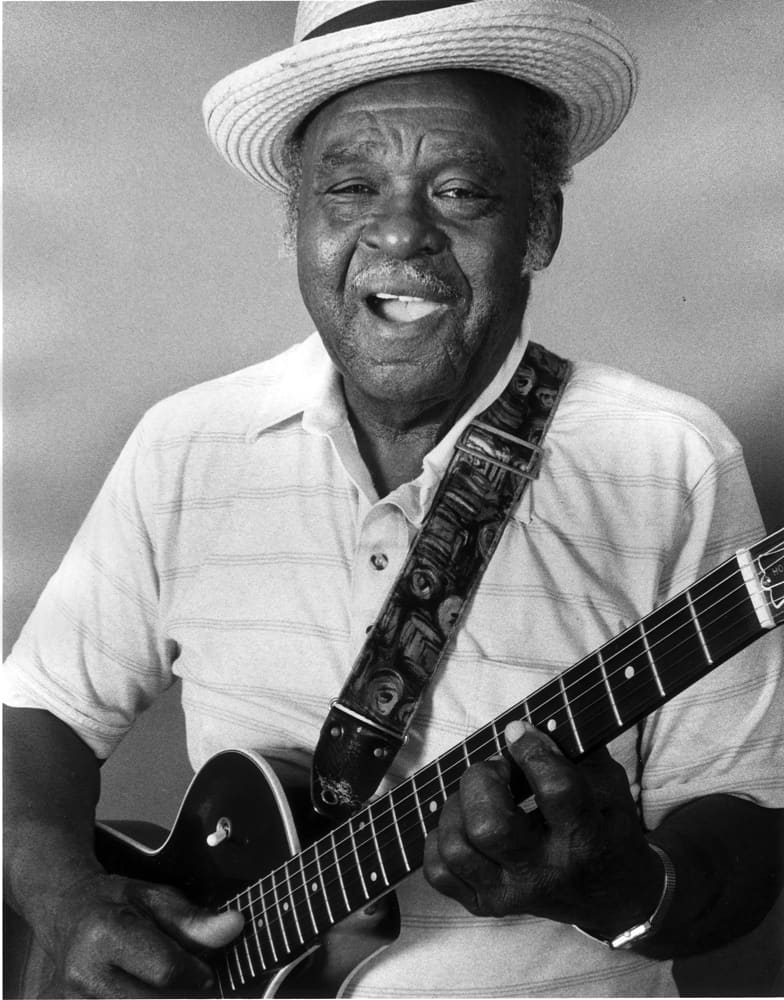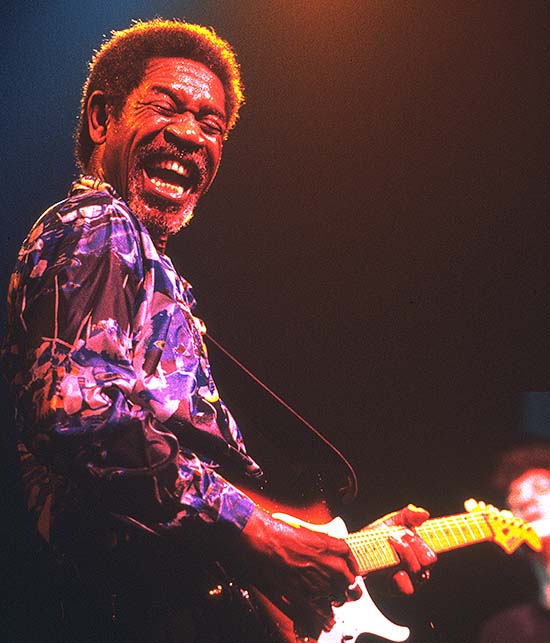
In Chicago, Luther Allison learned among the West Side’s guitar kings. In Europe, he found an audience that heard the breadth of his music. And in the last three years of his life, a homecoming brought his singing, songwriting and fiery stagecraft to the attention of a new generation of blues listeners.
One night in April 1997, Luther Allison played at the Théâtre St. Gilles on Réunion Island, a volcanic outpost in the Indian Ocean thousands of miles from the Chicago streets where he had learned his trade. Ruf Records later preserved the concert as Live in Paradise. The setting was far from the West Side, but the work was familiar: take the stage, hold a room through a long set, and use the guitar to make a song travel beyond language. Allison had spent much of his adult life doing exactly that, first in Chicago, then across Europe, and finally back in the United States. The concert’s location makes one truth of Allison’s career visible: by the 1990s, music he had learned in Chicago could reach an audience nearly anywhere. 1 2
In July 1997, while touring in the United States, Allison was diagnosed with inoperable lung cancer that had spread to his brain. He died in Madison, Wisconsin, on August 12, 1997, five days before his fifty-eighth birthday. Seen in retrospect, the concert can look like a farewell; in the moment, it was another working date in a career still expanding. Allison was touring, writing and trying to build a lasting audience at home. His path moved through different cities and musical worlds, but the constant was a musician refining his own sound and widening the places it could be heard. 3 4 1
Arkansas, gospel and the first guitar
Luther Sylvester Allison was born on August 17, 1939, in Arkansas, the fourteenth of fifteen children in a family whose livelihood was cotton farming. Sources disagree over whether his birthplace was Widener or Mayflower; the Library of Congress and the Encyclopedia of Arkansas give Widener, while some contemporary obituaries name Mayflower. Allison’s early musical world was shaped by a large, active family, church singing, country radio and the rhythms of work. He grew up hearing gospel before pursuing the blues professionally. He learned to sing in church and play organ, and later described the music at home as a mixture of sacred sound and whatever the family radio brought in from farther away. 4 5 6 7
As a boy, Allison made music on a homemade diddley bow: a length of wire stretched between nails, with a bottle used to fret the string. It was a simple instrument, but it taught him how a single line could carry melody, rhythm and feeling. He experimented with guitar around the age of ten, learning licks from his older brother Ollie, who was already playing blues. His family also performed as the Southern Travellers, a gospel group, and Luther sang with his siblings. For Allison, gospel and blues were never competing inheritances. The church’s raised voice, the radio’s country and blues, and the one-string instrument all became part of the same musical memory. 3 5 8
In 1951, when Luther was twelve, the family moved from Arkansas to Chicago in search of a better life. They first settled on the West Side, near a remarkable concentration of blues musicians: Freddie King, Magic Sam, Otis Rush and Jimmy Dawkins were not distant names on record sleeves but players who might be heard in clubs and neighborhood rooms. The family later moved to the South Side, where Muddy Waters lived nearby. Allison attended school with Waters’ son and sometimes stopped at the Waters home to listen while the band rehearsed. Chicago did not erase his Southern foundation; it expanded his musical world and gave the young guitarist a new set of teachers. 4 5 9
Ollie Allison’s example was immediate. Luther joined his brother’s outfit and, by 1957, had formed a band with another brother, Grant. They called themselves the Rolling Stones, after the Muddy Waters song; when the name began to feel wrong, they changed it to the Four Jivers. Allison was still young, but he was already learning the habits that would define him: play often, absorb the work of other musicians and develop a sound of his own. He dropped out of high school to pursue music, took day jobs when gigs were scarce, and worked in shoemaking and repair—a trade that would later surface in one of his best-known song titles. 3 5 8
The West Side as a school
Allison’s education in the blues came through proximity and practice. He played bass for Jimmy Dawkins, sat in with Muddy Waters and picked up licks from Magic Sam and Otis Rush. Howlin’ Wolf and James Cotton were among the musicians he encountered as he worked through Chicago’s club circuit. Freddie King became a particularly important mentor. King encouraged Allison to sing as well as play. When King began touring nationally, he passed his regular engagement at Walton’s Corner to Allison. Allison held the job for about five years, long enough to turn a promising young sideman into a bandleader who could sustain a room night after night. 3 5 6
The West Side sound was not a single guitar style, and Allison was not a copy of one of its celebrated players. He admired B.B. King, Freddie King, Muddy Waters and Hubert Sumlin, but he also heard the sharply articulated, modern attack of Magic Sam and Otis Rush. His own playing leaned into a hard, singing note, then pushed it with a rock player’s weight and a soul singer’s sense of climax. He could move from clipped rhythm figures to a long, vocal-like solo without losing the song’s pulse. The influences were audible, but the point was not to sound like any one of them. In a mid-1990s interview, he put the distinction plainly: he wanted to stand in the same “ballpark” as the greats, “but do something different too.” 5 8 9
Walton’s Corner gave Allison more than a steady booking: it gave him repetition. King’s encouragement had helped him become a singer as well as a guitarist, and night after night in the residency taught him how to pace a set and keep an audience with him. The showmanship that would later become part of his reputation grew from that practical skill. He was learning not only how to play the blues but how to hold an audience through a song. 3 5 8
That local apprenticeship did not immediately translate into national recording success. Allison worked around Chicago, spent time in Peoria and California, and took session work backing fellow Chicagoans Shakey Jake Harris and Sunnyland Slim. He returned to Delmark, the label run by Bob Koester, as a sideman and bandleader. His first major appearance on record came on Delmark’s 1967 anthology Sweet Home Chicago, which captured him within the city’s broad community of players. It was a valuable introduction, but his career would be made as much by live performance as by recordings: the guitar’s volume and his willingness to take a song into unfamiliar territory were best understood in a room. 3 8 1
Ann Arbor and Love Me Mama
Allison’s first breakthrough in the wider blues world came through Ann Arbor in 1969. John Fishel, one of the organizers, heard him in Chicago and brought him and his trio to the Michigan Union ballroom for a free spring warm-up concert. The room was about a third full; as Allison played, word of mouth drew campus listeners until it was packed. The organizers booked him for the August festival, where his electric set helped turn a Chicago bandleader into one of the event’s breakout names. He was not the most famous musician on the bill, but he was among the most forceful: a young guitarist who could make deep blues feel as urgent and immediate as rock. 3 10
The Ann Arbor audience was largely white and college-going, many of its listeners arriving through folk or rock rather than Chicago blues. That crossing mattered. The festival brought urban electric blues into a wider youth culture, and Allison did not soften the music for that audience. His guitar attack and soul-inflected singing made the blues contemporary on their own terms. His performance did not depart from tradition; it presented the blues as a living, evolving music. At Ann Arbor, a young audience heard urban blues as a living music, played by a Chicago musician who had no reason to disguise its power. He returned to later festival editions, and the organizers’ confidence in him grew. 3 10 11
Delmark released Allison’s first solo album, Love Me Mama, in 1969, billed with his group, the Blue Nebulae. It was not a polished bid for crossover so much as a statement of the player he had become: blunt, electric blues, a rough-edged voice, and room for the guitar to speak in full sentences. The set moves from “Little Red Rooster” and “Dust My Broom” to the title song alongside Allison’s own material. The band could lean into a shuffle or stretch a slow blues until the tension became palpable. This debut did not capture every dimension of the live act, but it established the central fact of his music: Allison could play traditional material with the weight and heat of a musician who did not regard tradition as a limit. 12 3 1
The album’s sequencing gives a first glimpse of Allison as both interpreter and composer. “Why I Love the Blues” states his allegiance without overexplaining it; “Little Red Rooster,” “Dust My Broom” and “The Sky Is Crying” place him in direct conversation with the Chicago and Delta blues repertory. The long “Bloomington Closer,” meanwhile, gives the guitar and band time to build beyond the compact shape of a single. Even on a debut made for a small independent label, Allison was already negotiating the two scales that would define his career: the carefully made record and the expansive live event. 12 13
Between the Delmark debut and the festival bookings, Allison entered a new phase: the album gave listeners a record to follow, while the Ann Arbor reception drew him onto a wider touring circuit. For the rest of his career, records and live work would remain intertwined. Each album marked a point in the evolution of his sound; the stage showed how far he could take it. 3 10
The Motown years: an unlikely contract
In the early 1970s, Motown signed Allison to its Gordy subsidiary, a rare move by a label best known for soul and pop. The first album in the deal, Bad News Is Coming, was recorded in 1972 and released soon afterward; it retained his Chicago grounding while bringing a cleaner studio finish and a more contemporary feel. Its mix of Willie Dixon, Elmore James and B.B. King material with Allison’s own songs made the point that the blues could carry the label’s production sheen without losing its bite. 11 14 6
The album’s songs make the balance tangible. On Willie Dixon’s “The Little Red Rooster,” Allison roughens a familiar riff; Elmore James’s “Dust My Broom” gives him room to use slide guitar as a second, sharper voice; and his slowed-down reading of B.B. King’s “Rock Me Baby” makes the performance patient and spacious. The title track turns toward a darker, testifying mood. These choices show a musician steeped in Chicago blues but unwilling to treat a standard as finished: a song is a framework, not a museum piece. That is why the album resists the simple label of “blues goes to Motown.” The sound is recognizably Allison’s even when the studio gives the familiar material a larger frame. 14 15
Luther’s Blues followed in 1974. It pushed further into rhythm and blues, with a sound that could be more arranged and polished than Allison’s earlier Chicago work. There were still hard blues performances and a singer who could take control of a phrase, but the record also carried the promise—and the tension—of a musician trying to fit the blues inside a large label’s idea of what might sell. Allison later felt Motown did not know how to promote him and disliked the tendency to overproduce his records. That judgment should not reduce the albums to a failure. Bad News Is Coming and Luther’s Blues contain vivid playing and strong songs; they also show the compromises of a moment when the blues was losing domestic commercial attention. 11 1
The third Gordy album, Night Life (1976), placed even more emphasis on soul and R&B arrangements. For some listeners the horn-heavy production buried the very qualities that had made Allison compelling: the sharp guitar, the grain of his voice, the looseness of a blues band breathing together. But the record also demonstrates that his curiosity was genuine. He was willing to reach into Motown’s songbook and work with a fuller sound, not merely repeat the same small-club formula. What the label never solved was how to make an artist who thrived on long, unpredictable performances fit the routines of commercial promotion. Allison could be marketed as a novelty—the bluesman at Motown—but that framing made it harder to hear the sophistication of the music itself. 6 11
Allison did not stop working when the contract ended. He toured, played festivals, and continued to release records on smaller labels. The live Gonna Be a Live One in Here Tonight! and Power Wire Blues, issued in the late 1970s, preserved the high-voltage band that Motown’s studio productions could not contain. The period also taught him an unwelcome lesson about the U.S. market: a major-label deal did not guarantee a lasting audience. When his American profile faded, he turned toward the place where the live act was already being received with unusual warmth. Europe did not rescue him from the blues. It gave the bluesman more places to play. 3 5 1
Europe: recognition and distance
Allison first went to Europe in 1976, when Motown’s Night Life was appearing and his faith in the U.S. recording business had begun to fray. The trip took him to the Montreux Jazz Festival, a major stage for blues and jazz musicians, and he returned in 1978 and 1979. European audiences, he recalled, seemed to know his work and value his playing in a way he had not experienced at home. The reception meant more than ticket sales. It gave him the sense that people were listening to the whole musician—the long solos, the rock edges, the soul in his singing—rather than deciding in advance what a bluesman was supposed to sound like. 8 6 9
By 1984, Allison had settled in France, near Paris, and Europe became his working base. He later explained the attraction with a wry line he used onstage: “I don’t speak French, but my guitar does.” The joke carried a practical truth. A blues performer could communicate with a crowd that did not share his language, and Allison’s playing made that exchange feel immediate. He toured through France, Germany and elsewhere on the continent, often spending much of the year on the road. As his European reputation grew, Allison’s profile in the United States receded. France became his working base, not an artistic retreat. 4 8 6
The 1979 Live in Paris captured the performance that helped establish him as a European headliner. Recorded at the Chapelle des Lombards, it has the directness of a club set, not the distance of a studio reconstruction. The band gives Allison space to let a lyric settle, then to send the guitar line outward until it becomes a second voice. His repertoire moved between standards and originals, but the through-line was the singer’s authority: whether he was working a slow blues or a driving shuffle, he sounded like a man making a case in real time. The album sold strongly in Europe and showed why his career had become inseparable from the stage. 6 5 1
Europe also widened the recording trail. Allison made records for French, German and independent labels that did not always receive U.S. distribution. Love Me Papa (1977) and later albums preserved the work of a musician developing in public, not simply protecting his early sound. In 1984 he released Life Is a Bitch in France, a title American listeners saw again when the album reached the United States as Serious in 1987. Its songs show his evolving perspective: “Parking Lot” and “We’re on the Road” turn the grind of touring into subject matter, while “Just Memories” and “Reaching Out” open a more reflective space. The arrangements are more contemporary and rock-edged than the early Delmark recordings, but the blues remains their center. This period was not an intermission; Allison was writing, recording and finding new shades in his sound while American attention had moved elsewhere. 1 11 16
The European years gave Allison the conditions to sustain a working band and develop a repertoire beyond the constraints of a major-label campaign. He remained rooted in Chicago blues but absorbed rock, soul, funk, reggae and jazz, carrying those colors into a sound that still turned on the shuffle and the slow 12-bar. By the time an American comeback opened to him, he was not returning to the sound of 1969; he was arriving with a broader, road-tested vocabulary. 8 9
Soul Fixin’ Man: the homecoming
The route back to a U.S. audience began with German blues agent and label owner Thomas Ruf, who had followed Allison’s career in Europe. Allison’s manager, Rocky Brown, and Ruf helped arrange a new recording partnership. Alligator founder Bruce Iglauer saw him perform in France and understood that Allison’s live energy could reach American audiences again if the right record and touring campaign accompanied it. The timing was right: the blues was regaining public visibility, and Allison was a veteran with a hard-earned catalog, not a newcomer trying to imitate the sound of an earlier generation. 3 5 2
In 1994, Alligator released Soul Fixin’ Man, Allison’s first album recorded in the United States in nearly two decades. Recorded in Memphis with producer Jim Gaines, the album paired him with the James Solberg Band and the Memphis Horns. It offers a compact portrait of Allison at this stage: hard electric blues, soul, gospel feeling and rock energy, with songs that made room for more than the familiar standards. “Bad Love” arrives with a dramatic riff and a vocal that sounds both wounded and unbowed. “Put Your Money Where Your Mouth Is” moves with a tight R&B snap; the title track turns an old trade into a new identity. Allison had learned shoemaking and shoe repair as a young man. While walking down Beale Street in Memphis, he joked that he was a “sole fixin’ man,” and the phrase became a song. 3 17 5
The closing “Freedom” brings the album’s range into focus. African rhythm instruments and the voices of the Another Blessed Creation Choir open the arrangement beyond the usual electric-blues band. The choice connects the song to Allison’s gospel beginnings while keeping it grounded in the album’s contemporary sound. It also reveals something about his role as a bandleader: he could make the guitar the signature, but he knew when a choir, horns or rhythm section could carry a song’s emotional claim further. 17
The album circulated in Europe under the title Bad Love and in the United States as Soul Fixin’ Man. The names suggest different entry points: a blues lament on one sleeve, a self-portrait and a return on the other. But the record resists a single mood. Allison could lean into a dirty shuffle, lift a chorus with gospel intensity, then let the band ease back so the guitar could answer the voice. The production was cleaner than a small Chicago-club recording, but it did not sand away the attack. The Alligator release presented the range not as a departure from blues but as a veteran’s command of its many possibilities. 17 5 1
By the Alligator years, guitarist James Solberg had become a key musical partner. The two worked as a songwriting and arranging team: Solberg played guitar alongside Allison and co-wrote material that gave the records a distinctive band identity. The credits for Soul Fixin’ Man list Allison and Solberg as arrangers; Blue Streak features their shared writing and places Solberg at the center of the guitar sound. His lean parts could frame Allison’s extended lines without boxing them in. The partnership helped the comeback develop from album to album, giving the band room to shift from Memphis soul to hard Chicago electric blues while keeping Allison’s voice at the center. 17 18
He toured the United States and Canada, taking the new songs into clubs and festivals. Allison was not a nostalgic visitor collecting applause for old work; he was trying to establish a second American career while keeping his European audience. His return became unmistakable at the 1995 Chicago Blues Festival, where a huge crowd saw him play at home again. The concert is one of the performances preserved on the posthumous Live in Chicago. 3 9 19
Blue Streak: a sound at full stride
Blue Streak followed in 1995 and made clear that Soul Fixin’ Man was not a one-album return. Its title came from a blue-painted Blade guitar whose model was actually called the Silver Streak. The small joke suited Allison: he could take a detail from the road and turn it into a hook, a record title, a story for the stage. The album itself is more than a showcase for his guitar. Solberg’s writing and arrangements give it a band identity, while Allison’s singing moves between grit and warmth. “Cherry Red Wine,” his own composition, became a signature, and the driving “All the King’s Horses” and the reflective “Walking Papers” broaden the portrait. 18 5
The track sequence places urban pressures and private hurt beside familiar blues themes. “Move from the ’Hood” and “What’s Going On in My Home?” ask about the conditions around a life; “Walking Papers” turns inward toward a relationship’s end. “Cherry Red Wine,” later honored as Blues Song of the Year, centers on a friend’s drinking. The writing helped make the album more than a guitar showcase. Allison could bring a crowd to its feet, but his songs also held listeners to a story, moving from social observation to personal loss without leaving the blues vernacular. 18 20
At the 1996 W.C. Handy Awards, Blue Streak was named Contemporary Blues Album of the Year. Allison also won four individual honors: Blues Entertainer of the Year, Contemporary Blues Male Artist of the Year, Blues Instrumentalist—Guitar, and Blues Song of the Year for “Cherry Red Wine.” That made five awards in all. 20 21 The album also stayed on the blues chart for nineteen weeks, a sign that the comeback was reaching listeners well beyond the first wave of critical attention. 11 The trophies marked a public correction to the years when he had been more famous abroad than at home. They were not, however, what made the album last. Blue Streak holds together because Allison’s voice and guitar have equal authority. He can play a solo that flashes and stings, then step back and let a song’s emotional shape do the work. The technical control is unmistakable, but it serves the song rather than replacing it. 18 5 21
The response was visible in the rooms he played. Allison’s concerts could run three or four hours, but the length was not an endurance stunt. He shaped a night with the instincts of a singer who knew when to press and when to wait. A roaring shuffle might give way to a slow blues; a familiar refrain could open into a long guitar passage; then, when the audience’s attention was fully in his hands, he might crack a joke or step down among the dancers. At a time when many blues artists were confined to specialist venues, Allison could attract rock listeners, college crowds and longtime blues fans without changing his name or pretending to be someone else. 3 8 9
There was a risk in such intensity. A performance could become so dominated by its own momentum that a song’s finer details disappeared. Allison’s best work avoided that trap by making the force musical rather than merely physical. He did not play loudly simply to overwhelm the room; he used dynamics, phrasing and tone to make the audience feel the arrival of each chorus. His voice could sound like a shout from the pulpit, but it could also turn tender or conversational. The capacity to move between those registers is why Blue Streak remains a better guide to his artistry than any single photograph of him walking through the crowd with a guitar. 5 18 1
Reckless and the late surge
Allison’s third Alligator album, Reckless, arrived in 1997. The title was apt but not a boast: the record has the sense of a musician willing to put his whole weight behind a song. It moves from hard-driving numbers such as “Low Down and Dirty” to the searching “Living in the House of the Blues,” the slow-burn “Just As I Am,” and the slide-guitar color of “Pain in the Streets.” Allison’s writing had grown more assured across the comeback years. The songs are not only vehicles for his solos; they describe fatigue, money, survival and desire in a voice that sounds lived-in rather than borrowed. The band and production give him room to use rock and funk without compromising the blues center. 22 3 1
Jim Gaines produced Reckless at 315 Beale Studios in Memphis, except for “Playin’ a Losin’ Game,” which was recorded in Paris. The split location captures the geography of Allison’s final career phase: a U.S. comeback built with Memphis studio craft by a musician who still had a European home and audience. The album’s “I’m Back” is more than a title; it is a statement from an artist who had re-entered the American conversation without ceasing to be an international performer. 22 2
The album earned a Grammy nomination for Best Contemporary Blues Album. Allison’s awards were accumulating at the same time: after his 1996 Entertainer of the Year honor, he won that title again in 1997, and it was awarded to him posthumously in 1998. The distinction between commercial breakthrough and critical recognition remained important. Allison had not become a pop star, but his name was now familiar far beyond Chicago and the European circuit. Alligator’s promotion, the festival run and the strength of the records had brought a musician who had spent years out of view back into the center of the blues conversation. 22 23 3
One of the most vivid documents of this period is Live in Chicago, released posthumously in 1999. It draws from multiple performances: the 1995 Chicago Blues Festival, a show at Buddy Guy’s Legends and a 1997 appearance at the Zoo Bar in Lincoln, Nebraska. Rather than edit Allison into a neat career retrospective, the two-disc set follows his band through several working performances. “Cherry Red Wine” stretches out; “Move from the ’Hood” locks into a groove; a performance with Otis Rush and Eddie C. Campbell preserves a rare onstage encounter among West Side musicians. The recording catches both the star and the bandleader, listening and responding while keeping the room in motion. 19 3
Allison’s illness makes the final recordings painful to hear, but it should not turn every late performance into a prophecy. The Live in Paradise show on Réunion Island was filmed in April, before his July diagnosis. It captures him in the act of doing what he had always done: take the stage, trust the band, and keep pushing the music forward. He died at the University of Wisconsin Hospital in Madison on August 12. The cancer had moved quickly, and the diagnosis came while he was still touring. His final months belong to the story not because they neatly explain the music, but because they show how little he had planned to stop. 4 6 1
The guitar, the voice and the room
Allison’s instrument was usually a Gibson Les Paul, often a gold-top, though he also played Strats, 335s and the blue Blade guitar that gave Blue Streak its name. His choices reflected the musical world he inhabited. Freddie King’s influence was present in the direct, high-energy attack; B.B. King’s vibrato and phrasing were part of the language; the Chicago West Side gave him the hard, rhythmic lines that could push a band without loosening its blues foundation. On slide, he drew from Elmore James and Hound Dog Taylor, but he did not confine himself to one tuning or one attack. He was a guitarist who could be sharp-edged and lyrical in the same chorus. 5 9
The long cable that let him walk into the audience became an emblem, but the gesture was not the point of his show. Allison understood performance as an exchange. He would step down from the stage, play among the people who had come to hear him, then return to the band and build the music again. The physical gesture worked because it expressed a real musical idea: the blues is not a display placed safely behind a barrier; it is a conversation with a crowd. His concerts could be dazzling, but spectacle was never their point. He listened, altered the pace, and made the audience feel involved in what the band was doing. 3 5 9
His voice was as central as the guitar. Allison had a gospel singer’s ability to rise into a note and hold it until it carried beyond the words. He could snarl, plead, tease or soften a line without changing the song’s emotional stakes. That quality explains why his blues-rock fusion remained grounded: the sound could broaden, but the singer never disappeared inside the arrangement. For Allison, blues was a language for disappointment, stubbornness and hope, not a set of scales beneath a loud guitar. He could make that truth audible in a phrase as easily as in a solo. 3 6
His range also reflected an openness to song form and style. He recorded standards by Willie Dixon, Robert Johnson and B.B. King, but he also wrote songs that carried the hard humor of the road and the vulnerability of someone who had experienced setbacks. Hand Me Down My Moonshine, recorded on a DAT machine in his Paris living room, revealed another side: acoustic guitar, traditional material and a more intimate vocal approach. Bassist Zox accompanied Allison on the album’s ten songs; Patrick Verbeke added National steel guitar to one track, and Bernard contributed slide guitar and call-and-response on the closing “Meet Me in My Own Hometown.” The project complicates the idea of Allison as only a high-volume performer. He could lower the amp, sit close to the microphone, and let the grain in his voice carry the arrangement. 24 4
What remained after the road
Luther Allison’s influence is clearest in what he made possible for his son Bernard without demanding that he become a replica. Bernard grew up around the band, listened to his father’s records and made his first appearance on one of Luther’s live recordings at thirteen. Years later, the two shared European stages and recorded together; on the acoustic Hand Me Down My Moonshine, Bernard’s slide guitar answers his father on the closing track. Bernard has described the pressure to sound like Luther, but insisted, “I can’t be Luther Allison, I can only be myself.” That distinction is part of the inheritance: Luther offered more than riffs to borrow. He modeled how gospel, Chicago blues, rock and soul could cohere into a voice—and how a musician could honor that vocabulary without imitating its source. 25 24 4
Allison’s wider influence also lies in his refusal to keep the blues in a fixed frame. He could play a Chicago shuffle, a rock-leaning band song, a soul ballad or a gospel-inflected plea and make each sound like part of the same life. His example was not that the blues should dissolve into other styles, but that its emotional center could hold a wider vocabulary. For later players, Allison’s career offered a model of how to absorb outside sounds without losing the music’s identity. The examples he named—B.B. King, Freddie King, Muddy Waters, Hubert Sumlin—were not templates to copy but musicians who had each made a distinct language from shared roots. 3 8 9
He was inducted into the Blues Hall of Fame in 1998, the year after his death. The honor followed a career in which recognition had arrived unevenly: local Chicago respect first, then a major-label contract that did not fulfill its promise, a long European success that left him less visible at home, and finally a U.S. comeback that was gaining force as his life ended. The same career also produced a Grammy-nominated album, multiple Handy Awards, and a body of live recordings that continue to make his stage presence available to new listeners. Recognition mattered, but it was not the source of his authority. He had earned it a room at a time, through records and performances that made the music feel immediate. 7 3 22
That is why Live in Paradise remains more than a final document, and why Love Me Mama and Soul Fixin’ Man still sound like parts of one career rather than distant bookends. Allison began as a boy in Arkansas making music on a wire and a board; he became a young Chicago guitarist learning from the best; he made France his base as the American market narrowed and European listeners welcomed his music; he returned, older and surer, with a sound shaped by both worlds. His story is not simply that the blues crossed the Atlantic and came home again. It is that Luther Allison kept carrying the blues forward, until the distance between its roots and its possibilities disappeared beneath the sound of his guitar. 3 4 1
Sources
Footnotes
-
Richard Skelly, “Luther Allison”, AllMusic. ↩ ↩2 ↩3 ↩4 ↩5 ↩6 ↩7 ↩8 ↩9 ↩10 ↩11 ↩12 ↩13
-
Ruf Records, “Luther Allison (1939–1997)”. ↩ ↩2 ↩3
-
Alligator Records, “Luther Allison”. ↩ ↩2 ↩3 ↩4 ↩5 ↩6 ↩7 ↩8 ↩9 ↩10 ↩11 ↩12 ↩13 ↩14 ↩15 ↩16 ↩17 ↩18 ↩19 ↩20 ↩21 ↩22 ↩23
-
Encyclopedia of Arkansas, “Luther Allison (1939–1997)”. ↩ ↩2 ↩3 ↩4 ↩5 ↩6 ↩7 ↩8
-
Michael Dregni, “Luther Allison”, Vintage Guitar. ↩ ↩2 ↩3 ↩4 ↩5 ↩6 ↩7 ↩8 ↩9 ↩10 ↩11 ↩12 ↩13 ↩14 ↩15 ↩16 ↩17
-
Spencer Leigh, “Obituary: Luther Allison”, The Independent, 1997. ↩ ↩2 ↩3 ↩4 ↩5 ↩6 ↩7 ↩8 ↩9
-
Library of Congress Name Authority File, “Allison, Luther, 1939–1997”. ↩ ↩2
-
Mark Edmonds, “Luther Allison”, Blues Access, interview. ↩ ↩2 ↩3 ↩4 ↩5 ↩6 ↩7 ↩8 ↩9 ↩10
-
KUNC, “Luther Allison Expanded the Blues’ World Overseas”, 2015. ↩ ↩2 ↩3 ↩4 ↩5 ↩6 ↩7 ↩8 ↩9
-
Ann Arbor District Library, “The Ann Arbor Blues Festival: What it Was”, including John Fishel’s recollections. ↩ ↩2 ↩3
-
“Allison, Luther (1939–1997)”, Encyclopedia.com. ↩ ↩2 ↩3 ↩4 ↩5 ↩6
-
AllMusic, Love Me Mama. ↩ ↩2
-
Delmark Records, Love Me Mama. ↩
-
Bad News Is Coming, AllMusic album entry. ↩ ↩2
-
“Luther Allison: Bad News Is Coming”, JazzTimes. ↩
-
AllMusic, Life Is a Bitch. ↩
-
Alligator Records, Soul Fixin’ Man. ↩ ↩2 ↩3 ↩4
-
Alligator Records, Live in Chicago. ↩ ↩2
-
“The 17th Annual W.C. Handy Awards”, Blues Access. ↩ ↩2
-
“Luther Allison”, Variety, August 1997. ↩ ↩2
-
Chicago Tribune, 1998 Grammy nominations, January 7, 1998. ↩
-
“Luther Allison: Hand Me Down My Moonshine”, JazzTimes, 1999. ↩ ↩2
-
“Bernard Allison”, Blues on the Chippewa. ↩