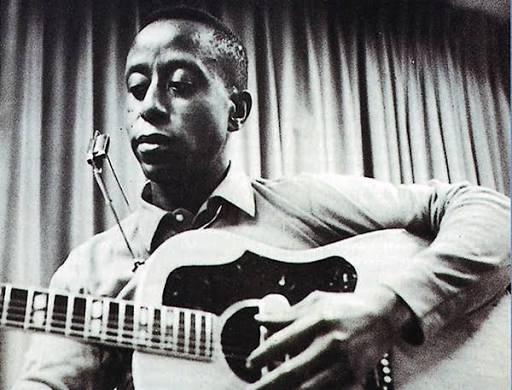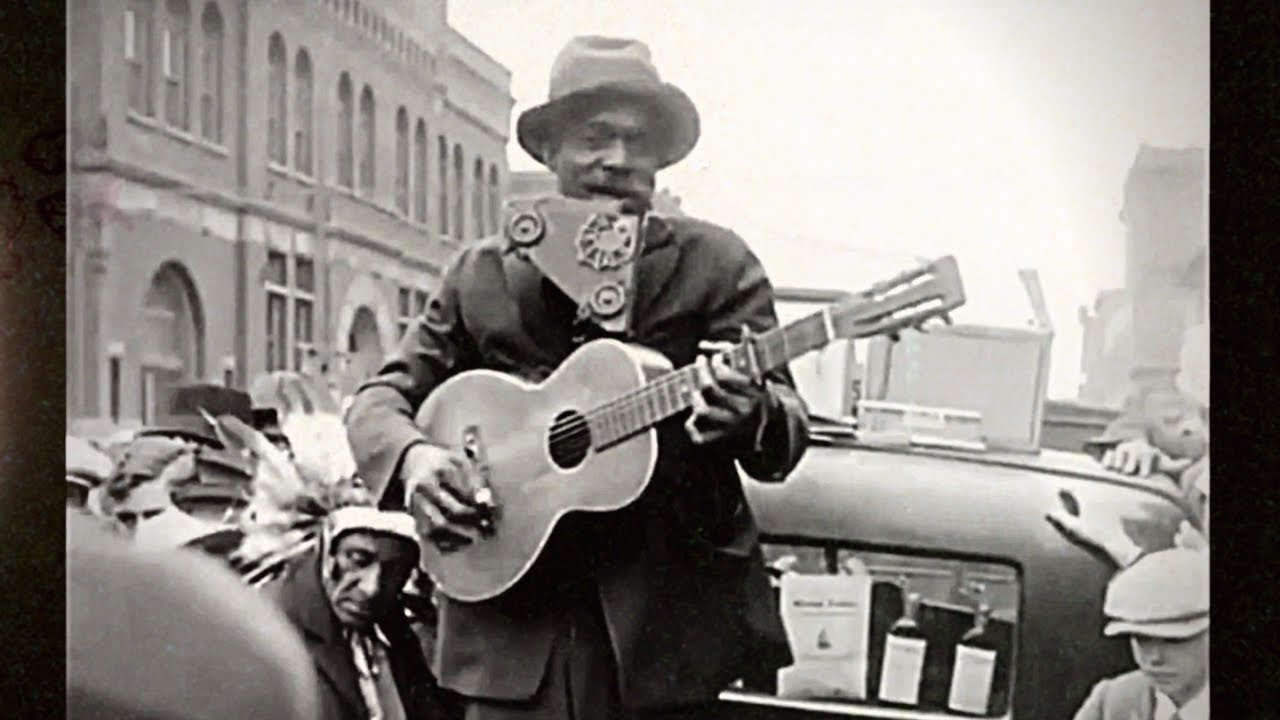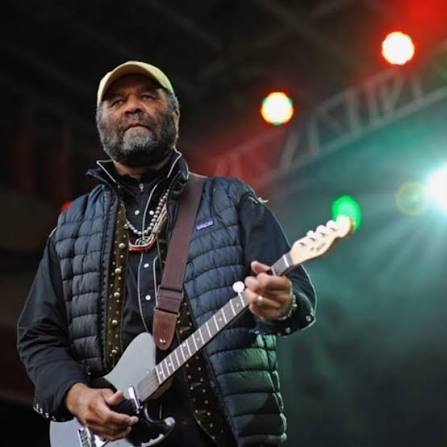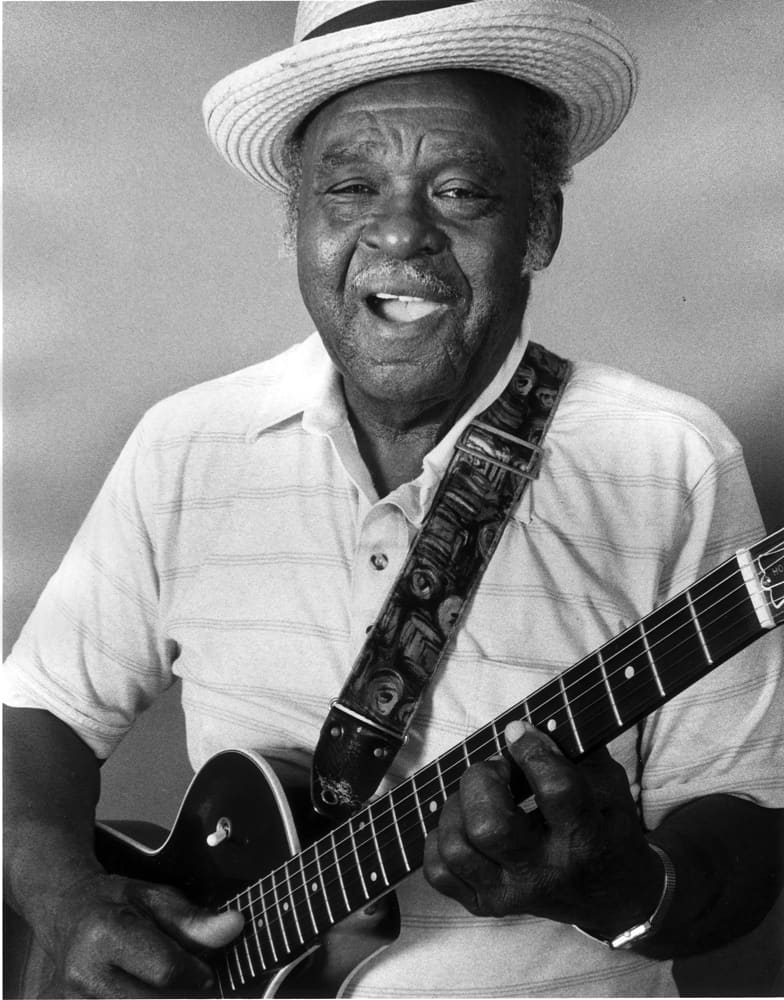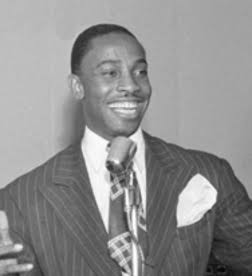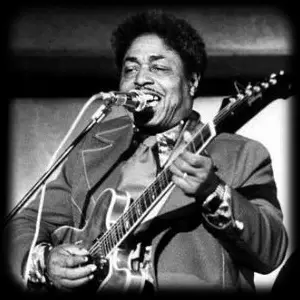
He traveled the roads of the 1930s beside the most mythologized bluesman of all, quit music in disgust, came back stronger, and spent the rest of his life proving that he had always been his own man.
There is a particular kind of burden that falls on the people who stand next to legends. For half a century, Johnny Shines carried it. Whenever a journalist, a folklorist, or a wide-eyed young fan sat down with him, the questions drifted, sooner or later and usually sooner, toward one subject: Robert Johnson. What was he like? Did he really sell his soul? How did he play? Where did he go? Shines answered patiently, generously, and with remarkable consistency for decades. He had, after all, been there. He had walked the roads, ridden the freight trains, and played the street corners with Johnson in the mid-1930s, and he was one of the very few people alive who could speak about the man from long, close experience.
But Shines also knew what those questions cost him. Each one implied that the most interesting thing about Johnny Shines was somebody else. And that was never true. Shines was one of the great voices of the Delta blues tradition: a singer of tremendous range and power, capable of a high, keening cry that could raise the hair on your neck and of a deep, rolling growl that seemed to come up from the ground; a slide guitarist of real distinction; and a songwriter whose best work holds its own beside anything his more famous companion ever recorded. His career spanned the rural jukes of Arkansas, the clubs of postwar Chicago, the folk-blues revival of the 1960s, and the international festival circuit of the 1970s and 1980s. He made records in almost every decade from the 1940s to the 1990s, and the best of them are among the finest documents of the country blues tradition carried forward into the modern era.
This is the story of that career: the life of a man who learned from Howlin' Wolf, traveled with Robert Johnson, made a handful of brilliant and commercially doomed records in Chicago, put down his guitar for years, picked it up again, and spent his last decades as one of the most respected elder statesmen the blues has ever had.
A Memphis Boy
John Ned Shines was born in late April 1915 (sources give both the 25th and the 26th), in Frayser, a community on the northern edge of Memphis, Tennessee. Memphis in those years was the great urban magnet of the mid-South, the city to which the Delta's people, its money, and its music all flowed. Beale Street was in its heyday, a riotous strip of saloons, theaters, pawnshops, barbershops, and gambling dens, and street musicians were everywhere: jug bands, guitar duos, songsters, and harmonica players working the sidewalks and the parks for whatever passersby would drop into a hat.
Shines grew up in and around this world. His family was musical. It was his mother who first taught him to play guitar, and the instrument was a presence in the household from his early childhood. By his own account, he began picking at the guitar as a boy, and by his teens he was good enough to earn a little money playing on the streets of Memphis, the same streets where Memphis Minnie, Furry Lewis, the Memphis Jug Band, and countless lesser-known performers made their livings. It was an education no conservatory could match. A street musician learned quickly what made people stop and what made them walk on, how to project a voice over traffic and crowd noise, and how to keep playing for hours on end. Shines absorbed all of it.
That street training shows in everything he did later. Shines never lost the projection of a man who had learned to sing outdoors, without amplification, to people who had not come to hear him. His voice, even in his last years, had a carrying power that made microphones seem almost superfluous.
Arkansas and the Wolf
In 1932, as the Depression tightened its grip, Shines left Memphis for Hughes, Arkansas, a small farming town in the flat cotton country across the Mississippi River. He went to work farming, as so many young Black men of the period did, and for a time music took a back seat to the demands of the fields, though he never lost touch with the jukes, house parties, and country suppers that made up the musical life of the rural South.
It was in this part of Arkansas, and in the surrounding river country, that Shines encountered the first great musical influence of his life: Chester Burnett, the man the world would come to know as Howlin' Wolf. Wolf, born in 1910, was a few years older than Shines and already a formidable performer, a huge man with a voice like a force of nature and a stage presence to match. He had learned from Charley Patton at Dockery Plantation, absorbing Patton's rough, rhythmic style and his flair for showmanship, and he was working the jukes on both sides of the river.
Shines idolized him. He followed Wolf around, watched how he played, studied how he sang, and modeled his own early style closely on the older man's. He imitated Wolf so faithfully, in fact, that people around Hughes began calling him "Little Wolf." It is a telling detail. Shines in his youth was not yet the singer he would become, but he had already found a model whose raw power suited his own instincts. Wolf's influence never entirely left him; the deep, rasping register that Shines could summon at will owes something to those early years of listening and imitating.
Shines later told interviewers that he admired Wolf's music enormously but was wary of the man, whose temper could be as large as his voice. Still, the apprenticeship mattered. It gave Shines a grounding in the Patton-derived Delta style, the heavy, percussive, rhythmically insistent approach that underlay so much of the music of the region. When Shines met his next great influence, he already had a foundation to build on.
Meeting Robert Johnson
Sometime around 1935, Shines met Robert Johnson. The usual account places the meeting in Helena, Arkansas, the bustling river town that was then one of the liveliest blues centers in the mid-South, a place where musicians congregated to play the jukes along the levee and on Elm Street and to trade songs and techniques. Johnson was about four years older than Shines, and he was already a remarkable musician, the product of years of obsessive practice, of time spent with Ike Zimmerman in southern Mississippi, and of countless nights watching and listening to Son House and Willie Brown around Robinsonville.
Shines was dazzled. In later interviews he described Johnson as a musician of almost uncanny ability, someone who could hear a song once on the radio or on a record and play it back immediately, and who seemed equally at home in blues, popular songs, polkas, hillbilly tunes, and whatever else an audience wanted to hear. Shines himself had thought of himself as a decent guitarist. Next to Johnson, he realized how much he had to learn.
The two men began to travel together. For roughly the next two years, from about 1935 into 1937, Shines was Johnson's most frequent traveling companion, and the journeys they took became the stuff of blues history. They went everywhere: up and down the Delta, to Memphis and St. Louis, up to Chicago and Detroit, across the border into Windsor, Ontario, and, by Shines's account, as far east as New York and New Jersey. They traveled by freight train, by hitched ride, and on foot. They played street corners, jukes, house parties, barbershops, lumber camps, and anywhere else they could draw a crowd and pass a hat.
Shines's recollections of those years are among the most important sources we have on Robert Johnson's life and personality. He described a man who was restless to the point of compulsion, who would leave a town abruptly, sometimes in the middle of the night, without telling anyone, and who might turn up again days or weeks later as if nothing had happened. He described a man who was courteous and soft-spoken in private but intensely private about his music, who would sometimes turn his back to other musicians while playing so they could not see his fingers. He described a man who drew women effortlessly and who drank heavily. And he described a musician whose effect on audiences could be overwhelming. In one often-repeated story, Shines recalled Johnson playing "Come On in My Kitchen" on a street in St. Louis so movingly that the crowd fell silent and people began to weep.
Those stories have been retold so many times that they have hardened into legend, and like all memories recalled decades after the fact, they should be taken with some care. But Shines was a consistent and thoughtful witness, and his accounts have generally held up well against what other researchers have been able to establish. More importantly for our purposes, those years with Johnson were the second great apprenticeship of Shines's life.
What Shines Took From Johnson
It would be easy to say that Shines simply copied Johnson, and for some listeners that remains the shorthand. It is not accurate. What Shines absorbed from Johnson was more subtle and more valuable than a set of licks.
He learned, first, a broader musical vocabulary. Johnson's approach to the guitar was more sophisticated than that of most Delta players of his generation, drawing on the boogie-woogie bass patterns of barrelhouse pianists, on the urban blues of Lonnie Johnson and Leroy Carr, and on the slide techniques of Son House and others, combining them into something new and compact and self-sufficient. Shines took in that whole approach: the walking bass lines on the low strings, the turnarounds, the use of open tunings for slide, and the idea that a single guitarist could sound like a full band.
He learned, second, a more polished and controlled vocal approach. Wolf had taught him power; Johnson showed him nuance, how to shade a line, how to hold back and then push, how to make a lyric sound intimate. Shines combined the two, and the result was a voice that could move from a near-whisper to a full-throated cry within a single verse.
And he learned, third, a repertoire. Shines heard Johnson play many of the songs that Johnson would later record, and he carried some of them in his memory for the rest of his life. Decades later, when Johnson's recordings had become the most celebrated in all of the blues, Shines's own versions of those songs carried a special authority. He was not working from the records. He was working from memory of the man.
But Shines never became a mere imitator. Even in his first recordings, made years later, his voice is unmistakably his own, higher and wilder than Johnson's, with a vibrato and a range that Johnson did not have. His slide playing, while clearly rooted in the same tradition, is heavier and more emphatic. If Johnson was the more intricate musician, Shines was arguably the more powerful singer.
The End of the Road With Johnson
Around 1937, Shines and Johnson drifted apart. There was no dramatic break; Johnson simply went his own way, as he always did, and Shines went his. Johnson had already made his two famous recording sessions, in San Antonio in November 1936 and in Dallas in June 1937, and his records were selling modestly in the South. In August 1938, he died near Greenwood, Mississippi, at the age of twenty-seven, under circumstances that have never been fully explained. The most widely repeated story holds that he was poisoned by a jealous husband or by the owner of a juke where he had been playing.
Shines was not with him at the end, and in later years he was careful to say so. He had heard the stories, as everyone had, but he did not claim knowledge he did not have. That restraint is characteristic. Shines was frequently pressed to embroider the Johnson legend, and particularly to confirm the tale that Johnson had sold his soul to the devil at the crossroads. He generally declined. He had known Johnson as a human being, a brilliant and troubled young man, not as a figure of myth.
After Johnson's death, Shines continued to travel and to play for a time, working through the South and the Midwest. But the years of hoboing were drawing to a close. Like millions of other Black Southerners in the era of the Great Migration, he was being drawn north.
Chicago
In 1941, Shines settled in Chicago. He would live there for nearly three decades.
Chicago in the 1940s was the great destination for Black migrants from Mississippi, Arkansas, Tennessee, and Alabama. The war industries were booming, jobs were plentiful by Southern standards, and the South Side was filling up with people who brought their music with them. The blues scene that would produce Muddy Waters, Little Walter, Jimmy Reed, Howlin' Wolf, Elmore James, and so many others was beginning to take shape in the taverns and clubs along 47th Street and Maxwell Street and throughout the South and West Sides.
Shines went to work in construction, which would remain his principal source of income for much of his Chicago life, and he played music at night and on weekends in the neighborhood taverns. He was part of the generation of transplanted Delta musicians who were, in those years, working out how to translate the acoustic country blues into something that could cut through the noise of a crowded Chicago bar. The answer, ultimately, was amplification and ensemble playing: electric guitars, harmonica blown through a microphone, piano, bass, and drums. Shines was among the musicians who made that transition, playing electric guitar and working with small bands.
He was respected among his peers. Muddy Waters, who arrived in Chicago a couple of years after Shines, knew him well. Shines played the same circuit as Sunnyland Slim, Big Walter Horton, Robert Lockwood Jr., Homesick James, and others of that generation. But recognition beyond the South Side was slow in coming, and the record business proved to be a source of repeated frustration.
The Columbia Session
Shines's first chance to record came in 1946, when he cut a session for Columbia Records under the supervision of Lester Melrose. Melrose was the dominant figure in Chicago blues recording in the 1930s and 1940s, the producer responsible for the polished, small-combo sound associated with Big Bill Broonzy, Tampa Red, Memphis Slim, Washboard Sam, and the first Sonny Boy Williamson. He controlled access to the major labels, and an artist who wanted to record for Columbia or RCA Victor's Bluebird subsidiary in Chicago generally had to go through him.
Shines recorded several sides for Columbia at that 1946 session. None of them were released at the time. The reasons are not entirely clear, but the most likely explanation is that Shines's raw, intense Delta style did not fit the smoother "Bluebird beat" that Melrose had perfected and that the major labels were still marketing. The postwar blues explosion, in which independent labels like Aristocrat, Chess, Chance, Parrot, and J.O.B. would record the rougher Delta-rooted sound that Melrose had passed over, had not yet arrived. Shines was a little too early.
The Columbia recordings sat in the vaults for decades before eventually being issued on reissue collections. When listeners finally heard them, they were struck by how fully formed Shines already was: the voice soaring and powerful, the guitar confident, the songs strong. Had they been released in 1946, they might have changed the course of his career. As it was, Shines remained, for the time being, an unrecorded artist.
Chess and "Shoe Shine Johnny"
In 1950, Shines got another chance, this time with the label that would come to define Chicago blues. Leonard and Phil Chess had recently renamed their Aristocrat label Chess, and they were building a roster around Muddy Waters, whose records were selling strongly in the South and in Chicago. Shines recorded for them that year, cutting songs including "Joliet Blues" and "So Glad I Found You."
What happened next is murky. Some discographies associate the session with a release credited not to Johnny Shines but to "Shoe Shine Johnny"; other accounts state flatly that nothing from it was issued at the time. Either way, the result was the same: the public heard little or nothing of Johnny Shines on Chess. It is often suggested that the label, which already had Muddy Waters, saw little point in promoting a singer working such similar territory. Whatever the reason, Shines's Chess career ended almost as soon as it began.
"Joliet Blues" is worth seeking out. It is a strong, driving performance, with Shines's voice at full power, and it shows a musician who had absorbed the lessons of the Delta and was now applying them to the amplified urban sound. It deserved better than it got.
J.O.B. and the Records That Should Have Made Him
Shines's best chance at a commercial breakthrough came in 1952 and 1953, when he recorded for J.O.B. Records, a small Chicago independent founded by Joe Brown, reportedly with the singer St. Louis Jimmy Oden as a partner, and best known for recordings by J.B. Lenoir, Sunnyland Slim, Baby Face Leroy, and Snooky Pryor. J.O.B. was a shoestring operation, with limited distribution and almost no promotional budget, but it gave its artists room to record the music they actually played.
The sessions Shines made for J.O.B. are among the treasures of postwar Chicago blues. Backed by small groups that featured the great harmonica player Big Walter Horton on some of the sides, Shines recorded songs including "Ramblin'," "Fish Tail," "Brutal Hearted Woman," and "Evening Sun." These records capture the moment when the Delta tradition was being transformed into Chicago blues, but they keep more of the country flavor than many of the Chess records of the same era. Shines's slide guitar is fierce and slashing, his voice reaches heights few blues singers could match, and Horton's harmonica, lyrical and inventive, makes an ideal foil.
"Ramblin'" is the most celebrated of them, and for good reason. Built on the same musical foundation as Robert Johnson's "Walking Blues" and the older Son House tradition from which it came, it is a declaration of restlessness and independence sung with total conviction. It is also, quite simply, one of the great slide guitar performances of the postwar era. Anyone who thinks of Shines as merely a disciple of Johnson should listen to "Ramblin'" and hear how completely he has made the material his own. Where Johnson's "Walking Blues" is taut and introspective, Shines's version is expansive and defiant, with a vocal that seems to strain against the very limits of the recording equipment.
"Evening Sun" is quieter and more haunting, with Shines's voice floating over a slow accompaniment. "Brutal Hearted Woman" shows his gift for the tough, sardonic lyric. Together, the J.O.B. recordings show a mature artist at the height of his powers, a singer and guitarist who belonged in the front rank of Chicago bluesmen.
They sold poorly. J.O.B. simply did not have the resources to get records into stores and onto jukeboxes in the numbers that would have made a difference, and the label was competing against Chess, Vee-Jay, and the other larger independents, all of which had far more muscle. By the mid-1950s, the blues market itself was beginning to shrink, as younger Black listeners turned toward rhythm and blues, doo-wop, and the new sound of rock and roll. Shines's records, brilliant as they were, disappeared almost without a trace.
Walking Away
By the late 1950s, Shines had had enough. He had been recording for more than a decade, and he had almost nothing to show for it. Labels had shelved his work, released it under the wrong name, or failed to promote it. The club scene in Chicago was competitive and poorly paid. Construction work paid better and was more reliable.
So Shines stepped away. According to the usual account, he pawned or sold his equipment and largely stopped performing. He continued working in construction, and he also took up photography, earning extra money by taking pictures of patrons in Chicago's nightclubs, a common sideline in the club culture of the period. It was a strange position for one of the finest blues singers alive: moving through the same clubs where he had once performed, now carrying a camera instead of a guitar.
It is impossible to know how much music Shines made privately during these years. He seems never to have stopped playing entirely; a musician of his depth does not simply forget his instrument. But for the public record, Johnny Shines had disappeared. He was in his early forties, and as far as the music business was concerned, his career was over.
Rediscovered
What brought Shines back was the same force that brought back Son House, Skip James, Mississippi John Hurt, Bukka White, and so many others: the folk-blues revival of the 1960s.
By the early 1960s, a new audience for the blues had emerged, made up largely of young white listeners in the United States and Europe who had discovered the music through reissue albums and through the folk revival. The 1961 Columbia LP King of the Delta Blues Singers, which collected sixteen of Robert Johnson's recordings, was a particular catalyst. It made Johnson a figure of fascination for a generation of listeners and musicians, among them Bob Dylan, Keith Richards, and Eric Clapton, and it sent researchers out looking for anyone who had known him.
Shines was an obvious person to find. He was living in Chicago, he was relatively young, and he had traveled with Johnson more extensively than almost anyone else still alive. Researchers and record producers began seeking him out in the mid-1960s, and they found not a faded relic but a singer whose voice had lost nothing.
In 1965, producer Samuel Charters recorded Shines for Vanguard's landmark series Chicago/The Blues/Today!, which presented the South Side's working blues bands to the new audience. Shines appeared on the third volume, released in 1966, leading a group with Big Walter Horton on harmonica. The tracks, including the cheerful "Dynaflow Blues" and powerful renditions of older material, introduced him to listeners far beyond Chicago's taverns. Around the same time, writer and producer Pete Welding recorded him for Testament Records, resulting in the album Master of Modern Blues, a title that made a pointed claim. Shines was not being presented as a museum piece or as Robert Johnson's sidekick. He was being presented as a master in his own right.
The rediscovery reignited his career. Shines began playing festivals, coffeehouses, and college concerts, and he found himself, in his fifties, with an audience larger and more attentive than any he had known in his prime.
Last Night's Dream and the Late-1960s Records
The records Shines made in the late 1960s are among his finest. In 1968, he recorded Last Night's Dream for Mike Vernon's British label Blue Horizon, with a superb supporting cast that included Otis Spann on piano, Big Walter Horton on harmonica, and Willie Dixon on bass. The album is a summit meeting of Chicago blues veterans, and Shines rises to the occasion with some of the most commanding vocals of his career.
Other albums followed for Testament and for various labels. Among the most notable was Standing at the Crossroads, a title that, inevitably, invoked Johnson, and a further collaboration with Horton. Shines also began recording more acoustic material, returning to the country blues of his youth, and these performances revealed how deeply he still carried the Delta tradition. Solo with an acoustic guitar, he could sound like a direct emissary from the 1930s, yet his performances never felt like re-creations. They were living music.
Alabama
In 1969, Shines left Chicago and moved south to Alabama, settling in the Tuscaloosa area, where he would live for the rest of his life. He settled in Holt, a small community just outside Tuscaloosa. The reasons were personal and painful. Following the sudden death of his daughter, Shines, his wife, and his mother took on the raising of grandchildren, and they wanted to bring the children up away from the pressures of urban Chicago. His renewed career, built on touring rather than local club work, no longer required him to live in the city in any case.
The local blues world soon found him. A University of Alabama student named Natalie Mattson, who ran a campus coffeehouse called the Down Under, learned that he was living nearby and invited him to play; he appeared there several times and brought his friend Mississippi Fred McDowell along to perform with him. Holt eventually honored him in turn: in 2009, the street where he had lived was renamed Johnny Shines Street.
In Alabama, Shines became a revered local figure and a regular presence on the national and international festival circuit. He toured Europe and Japan, played major festivals in the United States, and was recognized as one of the last living links to the Delta's golden age. He also became an advocate and teacher, generous with younger musicians who sought him out and committed to preserving the tradition he had inherited.
Shines and Lockwood
One of the most rewarding partnerships of Shines's later years was with Robert Lockwood Jr. The pairing had a deep historical logic. Lockwood is usually described as Robert Johnson's stepson: Johnson had a long relationship with Lockwood's mother in Helena, and he taught the young Lockwood to play guitar. Lockwood was perhaps the only musician to learn directly and at length from Johnson at home, just as Shines was the musician who had traveled with Johnson longest on the road. Between them, they held much of what remained of Johnson's living legacy.
They were also very different musicians. Lockwood, who had moved toward jazz-inflected harmonies and twelve-string guitar over the years, was a sophisticated, urbane player with little patience for the idea that he should re-create the 1930s. Shines was the more traditional of the two, closer in sound to the raw Delta style. The contrast made their collaborations fascinating. In the 1970s and early 1980s, the two men toured together and recorded together, and the albums they made for Rounder, including Hangin' On and Mister Blues Is Back to Stay, are warm, relaxed, and expert, the work of two old friends who understood each other completely. Hangin' On, recorded in 1980, won a W.C. Handy Award for best traditional blues album and earned a Grammy nomination, recognition from both the blues community and the wider industry that their work mattered.
The Stroke and the Last Years
Also in 1980, Shines suffered a severe stroke. It affected his ability to play the guitar, and his instrumental work in the years that followed never regained its former fluency. For a musician whose slide playing had been so central to his art, it was a heavy blow.
His voice, however, survived largely intact, and Shines kept performing. He adapted, leaning more heavily on his singing and on accompanying musicians, and audiences who saw him in the 1980s still came away awed by the power and feeling of his voice. He continued to appear at festivals and to record occasionally, and he took part in documentary projects about Robert Johnson and the Delta blues, including the 1991 film The Search for Robert Johnson, in which his recollections once again offered a rare first-hand view of the man.
He also found a final musical partner. In 1989 he met the younger guitarist Kent DuChaine, and the two toured together for the next several years, with DuChaine supplying the guitar work that Shines's hands could no longer manage. And he made one last outstanding record. Back to the Country, with harmonica player Snooky Pryor and guitarist Johnny Nicholas, was released in 1991 and won a W.C. Handy Award for best country blues album; Shines was also named country blues artist of the year. It was a fitting close: a man who had spent decades being asked about the past, honored at the very end for the music he was making in the present.
His health, however, was failing. He suffered from hardening of the arteries, and in March 1992 his left leg had to be amputated. He never left the hospital.
Johnny Shines died on April 20, 1992, at DCH Regional Medical Center in Tuscaloosa, just days short of his seventy-seventh birthday. He was buried at Cedar Oak Memorial Park in Tuscaloosa. Later that year he was inducted into the Blues Hall of Fame.
The Voice
If one thing sets Shines apart, it is his voice. Many great bluesmen had powerful voices, but few had Shines's range. He could sing in a high, almost falsetto register with a wild, wavering vibrato that suggests both Robert Johnson and the older field-holler tradition, and then drop into a deep, gravelly growl that recalls his early idol Howlin' Wolf. The ability to move between those registers, sometimes within a single line, gave his performances an extraordinary emotional range. He could sound vulnerable and menacing, plaintive and triumphant.
He also had tremendous control. For all its power, Shines's singing was never merely loud. He phrased with care, letting a line hang, then pushing it forward, and he understood how to build a performance to a climax. Listeners who heard him in concert often remarked on how his voice seemed to fill a room without any apparent strain.
The Guitar
As a guitarist, Shines worked in the Delta tradition that runs from Charley Patton and Son House through Robert Johnson. He was a fine slide player, working in open tunings, with a heavy, decisive attack and a strong sense of rhythm. His slide lines are not as intricate as Johnson's, but they are bolder, and they suit his voice perfectly. He was also a solid rhythm player, capable of laying down the boogie bass patterns that Johnson had popularized.
On electric guitar, as on the J.O.B. records, he was one of the players who showed how the Delta slide style could be translated into an amplified context, a path also followed by Muddy Waters and Elmore James. On acoustic guitar in the 1960s and 1970s, he returned to the older solo style, and his acoustic recordings are among the most convincing examples of country blues played by a musician who had lived it.
The Songwriter
Shines was a better songwriter than he is often given credit for. He drew on the common stock of blues verses, as every bluesman did, but he also wrote original lyrics of real wit and depth, songs about travel, about women, about work, about injustice. In his later years, he wrote songs that addressed the condition of Black Americans more directly than most bluesmen of his generation did, reflecting a thoughtful and outspoken man who had lived through the Jim Crow South, the Great Migration, and the civil rights era and had views about all of them.
He was also, by all accounts, an articulate and reflective interviewee, capable of discussing the blues not only as music but as a social and historical phenomenon. That intelligence comes through in his songs, which often have a narrative quality and a sense of perspective that lift them above the generic.
Influence and Legacy
Shines's influence operates on several levels. Most obviously, he was a crucial witness to the life of Robert Johnson, and much of what we know about Johnson as a person comes from his recollections. Every biography of Johnson, every documentary, every serious study draws on what Shines told interviewers over the years. Without him, Johnson would be even more of a cipher than he already is.
But his musical influence matters as much. As a carrier of the Delta tradition into the postwar era, Shines helped shape the sound of Chicago blues, and his J.O.B. records stand as examples of how that transition could be made without losing the music's rural power. As a performer in the revival years, he introduced the Delta style to audiences around the world, inspiring countless younger musicians. Players from the folk-blues and blues-rock worlds learned from his records, and in Alabama and on the festival circuit he taught and encouraged a younger generation of acoustic blues players directly.
Perhaps most importantly, Shines showed that the Delta blues was not a closed chapter of history. He demonstrated across five decades that a musician steeped in that tradition could keep creating, keep growing, and keep speaking to new audiences. In that sense, his career was a rebuke to the romantic notion that the blues belonged only to the dead and the vanished. He was alive, and so was the music.
Where to Start
For listeners new to Johnny Shines, the best starting point is the J.O.B. material from the early 1950s, available on various reissue collections. "Ramblin'" alone justifies the search. From there, move to the Vanguard Chicago/The Blues/Today! Volume 3 tracks and the Testament album Master of Modern Blues, which capture him at the moment of his rediscovery. Last Night's Dream, with Otis Spann, Walter Horton, and Willie Dixon, is essential.
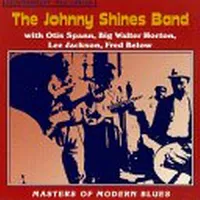 Buy from Amazon Master of Modern Blues
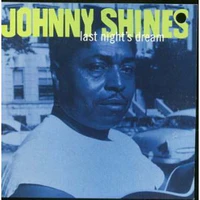 Buy from Amazon Last Night's Dream
For the acoustic side of his art, seek out his solo country-blues recordings from the late 1960s and 1970s, and then the Rounder albums with Robert Lockwood Jr., which show two masters in relaxed conversation. Don't overlook Back to the Country, the award-winning final album, which shows how much feeling his voice still carried at the very end. Finally, if you can find them, listen to the long-unissued 1946 Columbia sides, which reveal how complete an artist Shines already was before the world was ready to hear him.
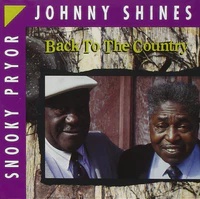 Buy from Amazon Back to the Country
Coda
Late in his life, Johnny Shines was asked yet again about Robert Johnson, and once again he answered with patience and care. But there was always a sense, in those interviews, of a man gently insisting on his own existence. He had walked beside Johnson, yes. He had learned from him and loved him and mourned him. But he had also lived fifty-four years beyond him, years filled with work and struggle and music, and he had made records that stand on their own.
The blues is full of stories of artists who were overshadowed, overlooked, or forgotten. Shines's story is different, because in the end he was not forgotten. He walked out of his shadow and into the light, and he spent his last decades singing with a power that astonished everyone who heard him. To listen to him now is to hear not an echo of Robert Johnson but a great bluesman in his own right, a man from Memphis by way of the Arkansas jukes and the Chicago construction sites, with a voice that could fill the sky.