Introduction: The Album That Almost Wasn't
Good Time Tonight arrived in 1990 as a Columbia Records compilation — twenty tracks drawn from sessions recorded between 1930 and 1940, most of them previously unissued, assembled into what amounted to the first coherent portrait of Big Bill Broonzy at the height of his commercial and creative powers. The liner notes, written by Lawrence Cohn, provided essential historical context. Reviews praised it as one of the great archival releases of the early CD era. And critics who listened carefully to what they were hearing recognised something that had been hiding in plain sight: here was not just a collection of historical curiosities but a body of music that had, in profound and traceable ways, helped to create the Chicago blues that would go on to conquer the world.
That most of the material was previously unissued tells its own story. Between 1930 and 1940, Broonzy recorded prodigiously for a network of labels — ARC (the American Record Corporation, which released material on Melotone, Perfect, Vocalion, Banner, and other budget imprints), Columbia, and subsidiaries thereof — and much of what he recorded was either rejected at the time or simply never got around to being issued before the trails went cold. When Columbia undertook its archival excavation in the late 1980s, applying state-of-the-art restoration techniques to material that had sat in the vaults for half a century, what they found was evidence of an artist at his most experimental and most alive, working with a series of extraordinary musicians across a decade of creative development that produced one of the most significant bodies of work in pre-war blues history.
This is the story of those recordings.
The Man: William Lee Conley Broonzy Before Big Bill
Before the band, before the Vocalion sessions, before Carnegie Hall and before the European tours that would make him famous on two continents, there was Lee Conley Bradley — the man who would become Big Bill Broonzy, one of the most important and most versatile blues musicians of the twentieth century. The facts of his birth remain contested. Broonzy himself claimed he was born June 26, 1893, in Scott, Mississippi; emerging research compiled by blues historian Robert Reisman suggests instead that he was born in Jefferson County, Arkansas, perhaps as late as 1903. His parents, Frank and Mittie (Belcher) Broonzy, were sharecroppers, children of slavery, part of the vast rural African American community that tilled the cotton fields of the Deep South under conditions of economic servitude that had changed relatively little since the formal end of slavery.
He was one of seventeen children in the Broonzy household — a family of extraordinary size even by the standards of the rural South — and the music he grew up with was the music of church and community: spirituals, work songs, the folk material that circulated among Black communities across the Delta region. His uncle, Jerry Belcher, built him a cigar-box fiddle when he was around ten years old and taught him to play spirituals and folk songs. He and a friend named Louis Carter, who played a homemade guitar, began performing at social and church functions — the beginning of a performing career that would span more than forty years.
The family moved to Pine Bluff, Arkansas, where Bill spent his youth. He was drafted into the Army around 1917, served in some capacity during the First World War period (the exact nature and length of his military service remains uncertain given the documented inconsistencies in his various accounts of his life), and following his discharge moved to Chicago in 1920. In Chicago, he worked the Pullman Company and foundries and various labouring jobs to supplement his income, but his attention was always on music. He fell under the tutelage of Papa Charlie Jackson, a New Orleans native and pioneer recording artist for Paramount who was one of the more significant figures in Chicago's early blues scene. Jackson taught Broonzy guitar; through Jackson he made the connections that would eventually lead to his recording debut.
His first records, made in 1927 with his friend John Thomas sharing vocal duties, were credited to "Big Bill and Thomps" and were not well received. Reviewers considered his style immature and derivative — an assessment that subsequent history would make look rather foolish, though in fairness the early Paramount sides are not the recordings by which Broonzy is best remembered. Through the late 1920s and early 1930s he worked the hokum scene with Georgia Tom Dorsey and others, developing a reputation as a versatile and increasingly accomplished guitarist. It was with Georgia Tom and guitarist Frank Brasswell, operating as the Famous Hokum Boys, that Broonzy "hit his stride and penned his first great blues original, 'I Can't Be Satisfied'" — a song that would anchor the opening track of Good Time Tonight six decades after it was first recorded, and that would provide the template, consciously or not, for Muddy Waters's first hit.
Lester Melrose and the Chicago Blues Factory
Understanding the sessions that produced Good Time Tonight requires understanding Lester Melrose — the Chicago-based record producer and music publisher who was, more than any other individual, responsible for shaping the sound of the Chicago blues industry in the 1930s and early 1940s. "Lester Melrose was a go-between man between Columbia, several different companies," as Willie Dixon later observed. This was an understatement of modest proportions: Melrose was, in fact, the de facto organiser and producer of a substantial proportion of all the blues music that was commercially recorded in Chicago during this decade, functioning as a one-man clearinghouse between the artists on one side and the labels — primarily ARC and its various imprints, and later Vocalion and Columbia — on the other.
Melrose's production philosophy was efficient to the point of formulaic. He favoured small ensembles — piano, guitar, bass, drums, and one or two horn players — that could move quickly through sessions, recording multiple sides in a single day. He was not interested in extended improvisation or technical experimentation; he wanted serviceable, danceable blues recordings that could be sold to the working-class African American audiences of the Northern cities. The sound that resulted — energetic, slightly rough around the edges, built on a steady rhythm and propelled by Broonzy's increasingly assured guitar — was what Mike Rowe famously called the "Bluebird beat" or, less charitably, the "Melrose Mess." The less charitable assessment misses what was genuinely innovative about the Melrose productions: they represented the first systematic attempt to adapt the rural blues aesthetic to an urban, post-migration audience, and in doing so they created the blueprint that Muddy Waters, Willie Dixon, and the Chess Records operation would refine into the Chicago electric blues of the 1950s.
Broonzy was central to this operation in multiple capacities. As a performer, his own recordings were the flagship of the Melrose blues factory. As a session musician, he played guitar on recordings by dozens of other artists — Washboard Sam (his half-brother, born Robert Brown), Jazz Gillum, Sonny Boy Williamson (John Lee Williamson), Memphis Minnie, and many others. And as a songwriter, he provided material for many of these artists, his name appearing as composer on a significant number of recordings by people other than himself. As the Columbia Records website notes, "Broonzy's recorded output through the 1930s only partially reflects his importance to Chicago blues. His half-brother, Washboard Sam, and his friends Jazz Gillum and Tampa Red, also recorded for Bluebird. Broonzy was credited as the composer of many of their most popular recordings of that time."
This creative economy — one artist's songwriting gifting multiple performers with material, the whole operation organised through a single producer's network of connections — prefigures the Willie Dixon model that would make Chess Records so commercially powerful in the 1950s. Broonzy was not the only component of this system, but he was its most important blues artist and arguably its organising creative intelligence.
The Sessions: Chronology and Context
The twenty tracks on Good Time Tonight span a decade of recording, from April 1930 to April 1940, capturing Broonzy at multiple stages of his artistic development and with multiple different configurations of supporting musicians. The Discogs entry for the vinyl edition documents the session dates with precision:
- Track 1: April 9, 1930 — Solo or minimal accompaniment, the earliest recording on the album.
- Track 2: March 30, 1932 — Solo or minimal accompaniment.
- Tracks 3, 4: March 29, 1932 — The same two-day stretch that produced Track 2.
- Track 5: August 16, 1937 — Beginning of the Altheimer period.
- Track 6: October 21, 1937 — Altheimer period continues.
- Tracks 7, 8: October 13, 1937 — The fuller ensemble of the Memphis Five period.
- Track 9: January 31, 1937 — Earlier in the same year as Tracks 5-8.
- Tracks 10, 11, 13, 14: September 15, 1938 — The Vocalion era, full small-band sound.
- Track 12: September 27, 1938 — Close to the previous session.
- Track 15: March 1, 1938 — Spring 1938 session.
- Tracks 16, 17: May 11, 1939 — Post-Carnegie Hall period.
- Track 18: February 5, 1939 — The Carnegie Hall concert recording.
- Tracks 19, 20: April 17, 1940 — The final recordings on the album.
All sessions were recorded in Chicago except Track 18, which was the Carnegie Hall concert in New York. The previously unissued tracks — Tracks 5, 7 through 12, and 13 through 20 — constitute the majority of the album, making Good Time Tonight as much a document of what Columbia left in the vaults as what it released.
The three broad musical periods represented on the album correspond roughly to three phases of Broonzy's development:
The Early Period (1930–1932): A guitarist of growing sophistication, working in a style that mixed country blues, hokum, and proto-urban blues. The accompaniment is minimal — sometimes just a second guitar or a pianist, sometimes Broonzy alone.
The Altheimer Period (1937): Beginning in 1937, Broonzy's partnership with pianist Joshua Altheimer produced the most coherent and artistically satisfying musical ensemble of his pre-war career. The two men were, by every account, an ideal musical pairing — Altheimer's rolling, supportive piano providing the harmonic foundation that freed Broonzy's guitar to move between rhythm and lead functions, while Broonzy's voice and guitar defined the band's character and sound.
The Memphis Five Period (1937–1940): Adding bass, drums, and one or more horn players to the Altheimer partnership, Broonzy created the ensemble billed as "Big Bill Broonzy's Memphis Five" — a name that, as more than one commentator has noted, was a misnomer, since Broonzy had spent little time in Memphis and the ensemble rarely numbered exactly five members. This was the fully formed Chicago small-band blues sound: polished, danceable, jazz-influenced, built for the urban working-class audiences of the South Side clubs and dance halls.
The Producers: Lester Melrose and Art Satherley
The production credit on the Good Time Tonight recordings divides, historically speaking, between two men whose approaches to the blues recording business were quite different but whose combined influence shaped the sound of the tracks on this album decisively.
Lester Melrose has been discussed above, but his specific contribution to the Broonzy sessions deserves more detailed attention. Melrose was not a producer in the modern sense of someone who shaped the sound of a recording from behind a glass partition. He was more accurately a contractor and coordinator — someone who negotiated the deal with the label, arranged the studio booking, brought in the musicians, and made sure the session produced a sufficient quantity of usable material in the time available. His creative contribution was largely in the selection of material and the assembly of the right combination of musicians for each session. He was nonetheless indispensable to everything that appears on this album, because without Melrose's network and organisational energy the sessions would not have happened.
Art Satherley, a Briton who had become one of the most important figures in American commercial recording through his work for ARC and later Columbia, also oversaw some of the sessions that appear on this album. Satherley had a broad and eclectic taste that encompassed country music (he was significant in the careers of Roy Acuff and Gene Autry) as well as blues, and his willingness to follow Melrose's recommendations and record the artists Melrose brought to him was a crucial element in the preservation of this music.
Lawrence Cohn, who wrote the liner notes for the Good Time Tonight CD and was a significant figure in Columbia Records' blues archival programme, is credited as the producer of the compilation itself — making the curatorial decisions about which previously unissued material to release and in what sequence, and overseeing the sound restoration work that made the recordings listenable.
The Musicians: A Revolving Door of Chicago's Finest
The personnel on Good Time Tonight shifts substantially across the decade covered by the album, reflecting Broonzy's evolving musical relationships and the different creative contexts of the various sessions. Several musicians appear with sufficient frequency to deserve detailed attention.
Joshua Altheimer (piano, various sessions 1937–1940) was, without question, the most important musician in Broonzy's working life during the period covered by this album. Altheimer, who was born in 1910 and died young on February 18, 1940, from meningitis, never had a record released under his own name, but his work as an accompanist — for Broonzy, for Lonnie Johnson, for Jazz Gillum, for Washboard Sam, for Sonny Boy Williamson — was among the most consistently brilliant of any Chicago sideman of his era. The Document Records liner notes for Volume 7 of Broonzy's Complete Recorded Works capture him perfectly: Altheimer "preferred to work in a band setting where he would seldom take a solo but would hold everything together with his rolling style." This characterisation is critical: Altheimer's genius was not the showman's genius of the great blues piano soloists but the ensemble player's genius, the ability to provide exactly the right harmonic and rhythmic support for whatever was happening around him. His sudden death at thirty would prove an irreplaceable loss.
Blind John Davis (piano, various sessions 1937–1940) was, alongside Altheimer, Broonzy's most regular piano collaborator during this period. Davis, born John Henry Davis on December 11, 1913, in Tate County, Mississippi, was a Chicago pianist who had worked extensively as an accompanist and session musician. His approach differed from Altheimer's in being somewhat more aggressive and melodically assertive — he was more likely to take a solo, more likely to comment on the vocal with his own melodic phrase. The interplay between Broonzy's guitar and Davis's piano on the Memphis Five recordings has a particular quality of mutual responsiveness that comes from two musicians who know each other's playing intimately.
Ransom Knowling (bass, various sessions from 1938) was one of the most sought-after bass players in Chicago — the Document Records notes describe him as "probably one of the most sought-after bass players in the city," pointing to his work on "Ride Alberta Ride" as evidence of why. His slapping, propulsive bass style was central to the rhythmic character of the Memphis Five sound, providing the foundation that the horns and drums built on. The bass on these recordings is not the metronomic timekeeping of a lesser player but an active, melodically engaged presence — Knowling was, by any measure, an accomplished musician playing a role that was systematically undervalued in the commercial blues recording industry.
Ernest "Punch" Miller (trumpet, various sessions) brought a genuine jazz pedigree to the Broonzy ensemble. Miller was a New Orleans-born trumpet player who had worked in the jazz world before becoming a significant presence in Chicago's blues and R&B recording scene. His trumpet playing on the Memphis Five recordings has the confidence and creativity of a jazz musician working in a blues context — not dominating but contributing to a collective sound that was more sophisticated than most contemporaneous blues recordings.
Odell Rand (clarinet, various sessions) was another regular in the Broonzy ensemble, his clarinet providing a different tonal colour from Miller's trumpet — sweeter, more sinuous, closer to the New Orleans jazz tradition from which the Chicago blues was emerging. The combination of Rand's clarinet and Miller's trumpet on some of the Memphis Five recordings gives those tracks a polyphony that goes well beyond the typical small-group blues arrangements of the period.
Joseph "Buster" Bennett (alto saxophone) and Bill Osborn (tenor saxophone and clarinet) were the horn players who appeared on the September 1938 sessions that produced some of the album's most commercial-sounding tracks. Their contributions to the Memphis Five sound were somewhat different from Rand's and Miller's — more assertively swinging, influenced by the jump blues and swing styles that were becoming increasingly fashionable as the decade progressed.
Track-by-Track: Twenty Sessions, One Artist, One Decade
1. "I Can't Be Satisfied" (Big Bill Broonzy)
Recorded: April 9, 1930, Chicago Personnel: Big Bill Broonzy (vocal, guitar); minimal or no additional accompaniment
The album opens with the earliest recording in the collection — a version of "I Can't Be Satisfied" that Broonzy recorded in April 1930, which also happens to be one of the most historically significant songs in the pre-war blues canon. The song appears here in its earliest documented recorded form, with Broonzy's guitar prominent and the arrangement stripped down to its essentials. The lyrical and musical framework that Broonzy established here — a narrator expressing dissatisfaction with his current situation and a desire for something he cannot quite name or obtain — would recur throughout the blues tradition, most immediately in Muddy Waters's first major hit. Waters's 1948 recording of "I Can't Be Satisfied" (Aristocrat 1305), which reached number one on the R&B chart and launched one of the most celebrated careers in blues history, drew directly from Broonzy's template. One account is precise: Broonzy "cut an early take of 'I Can't Be Satisfied' during this time — a tune Muddy Waters would later turn into a Chicago blues anthem." The Guitar work here already shows the technical sophistication that would make Broonzy the most in-demand studio guitarist in Chicago — clean, rhythmically propulsive, with a right-hand technique that combined flatpicking and fingerpicking in ways that were genuinely unusual for the period. The ragtime influence, absorbed from Papa Charlie Jackson and from Blind Blake, is clearly audible in the way the bass notes lock with the treble strings.
2. "Long Tall Mama" (Big Bill Broonzy)
Recorded: March 30, 1932, Chicago Personnel: Big Bill Broonzy (vocal, guitar); accompaniment details uncertain
The second track jumps forward two years to March 1932 — the same week that produced "Worrying You Off My Mind" — capturing Broonzy in the period when his commercial fortunes were finally beginning to improve. "Long Tall Mama" is a classic hokum-flavoured blues, the kind of good-time material that had made the Famous Hokum Boys popular and that Broonzy would return to throughout his career whenever he needed a danceable crowd-pleaser. The character of the "long tall mama" — the physically imposing woman who dominates the narrator's emotional life — is a stock figure in blues tradition, but Broonzy's delivery gives her specific weight and presence. The guitar work has the efficiency of someone who has been playing this style for years: no wasted motion, everything in service of the groove.
3. "Worrying You Off My Mind, Part 1" (Big Bill Broonzy)
Recorded: March 29, 1932, Chicago Personnel: Big Bill Broonzy (vocal, guitar); accompaniment details uncertain
One of the tracks cited by the Amazon review as a highlight of the album, "Worrying You Off My Mind" is among the earliest songs in the Broonzy catalogue to attract significant critical attention — it was reissued on a Yazoo compilation and was, according to the Amazon description, one of the Yazoo-era standards that Good Time Tonight predates. The song's title describes a project — the narrator working to dislodge a woman from his thoughts — that is at once impossible and entirely understandable, and Broonzy delivers the ambivalence with the kind of wry self-awareness that would characterise his best work throughout his career. The first part structure suggests that this was a two-part extended performance that Broonzy found too good to edit down.
4. "Too Too Train Blues" (Big Bill Broonzy)
Recorded: March 29, 1932, Chicago Personnel: Big Bill Broonzy (vocal, guitar); accompaniment details uncertain
Recorded on the same day as "Worrying You Off My Mind," "Too Too Train Blues" draws on the long blues tradition of the train as an emblem of departure, arrival, and the restless mobility that characterised life in African America during the Great Migration. The onomatopoeic "too too" of the title — imitating the train whistle — places the song in the hokum tradition while the emotional content (leaving, arriving somewhere new, the uncertain promise of a better life elsewhere) roots it in the deeper blues vocabulary. The guitar mimicry of the train's rhythm, a technique that Broonzy had clearly mastered, gives the recording an immediacy that a purely vocal approach would not achieve.
5. "Come Home Early" (Big Bill Broonzy)
Recorded: August 16, 1937, Chicago Personnel: Big Bill Broonzy (vocal, guitar); Joshua Altheimer (piano); probably drums and bass
The first recording from 1937 on the album, and the first to feature Joshua Altheimer's piano — the partnership that would define the most musically satisfying phase of Broonzy's pre-war career. "Come Home Early" is a domestic blues — a narrator addressing a woman who is coming home at inappropriate hours, the blues standard of infidelity and suspicion rendered in the warm ensemble sound that Broonzy and Altheimer were developing together. Altheimer's rolling piano immediately changes the character of the music relative to the earlier solo recordings: there is more harmonic depth, more rhythmic flexibility, a sense of two instrumentalists in conversation rather than one carrying the entire musical burden.
6. "Hattie Blues" (Big Bill Broonzy)
Recorded: October 21, 1937, Chicago Personnel: Big Bill Broonzy (vocal, guitar); Blind John Davis (piano); accompaniment
"Hattie Blues" is a personal song — a name blues, the kind of piece in which the specific, named woman of the lyric gives the performance an autobiographical quality whether or not it reflects any particular reality. Broonzy was working with Blind John Davis for this session rather than Altheimer, and the difference in piano style is audible: Davis is slightly more assertive, slightly more likely to add a comment between vocal phrases. The song has a melancholy quality that goes beyond the standard blues treatment of romantic disappointment — "Hattie Blues" sounds like it is about someone specific, someone who mattered.
7. "I Want My Hands On It" (Big Bill Broonzy)
Recorded: October 13, 1937, Chicago Personnel: Big Bill Broonzy (vocal, guitar); Blind John Davis (piano); horn players
One of the more explicitly comedic tracks on the album, "I Want My Hands On It" belongs to the hokum tradition of the double entendre blues — the narrator expressing a desire for something that is ostensibly innocent but carries unmistakable sexual suggestion. The Amazon review cites it as one of the album's highlights, describing it as "tongue-in-cheek," and the description is apt: Broonzy delivers the lyric with the comedic timing of a natural entertainer, the voice knowing and amused. The horn arrangement adds a sassy quality that suits the material perfectly.
8. "Made a Date With an Angel (Got No Walking Shoes)" (Big Bill Broonzy)
Recorded: October 13, 1937, Chicago Personnel: Big Bill Broonzy (vocal, guitar); Blind John Davis (piano); horn players
Recorded at the same session as "I Want My Hands On It," this track takes a different emotional tone — the narrator has arranged to meet someone (the "angel" of the title suggesting either an idealised woman or a somewhat more religious resonance) but lacks the shoes to get there. The material circumstances of poverty and the romantic or spiritual aspiration that transcends them are rendered here with a lightness of touch that makes the song more rather than less affecting.
9. "Horny Frog" (Big Bill Broonzy)
Recorded: January 31, 1937, Chicago Personnel: Big Bill Broonzy (vocal, guitar); possibly Joshua Altheimer (piano); minimal accompaniment
Described as "jazzy" in the Amazon review, "Horny Frog" is one of the more musically adventurous tracks on the album — closer to the jump blues and jive styles that were circulating in Chicago in the late 1930s than to conventional twelve-bar blues. The title character — whose precise nature and significance the lyric delights in not fully explaining — gives Broonzy an opportunity for the kind of wordplay and comic timing that was always part of his repertoire. The guitar work here is particularly fluent, Broonzy moving between rhythm and lead roles with the ease of long practice.
10. "I Believe I'll Go Back Home" (Big Bill Broonzy)
Recorded: September 15, 1938, Chicago Personnel: Big Bill Broonzy (vocal, guitar); Blind John Davis (piano); Ransom Knowling (bass); Joseph "Buster" Bennett (alto saxophone); drums
The first of the September 1938 sessions represented on the album, "I Believe I'll Go Back Home" is a nostalgic piece — the narrator contemplating a return to the South from which he migrated, a subject that carried particular resonance for the Chicago African American community in the late 1930s. The Document Records notes observe that "in the depressed northern cities of 1938 life in the south could take on a golden glow of nostalgia that ignored the facts of the case." Broonzy was, of course, a committed Chicagoan who had no intention of returning to Arkansas, but the song's sentiment tapped into a real emotional ambivalence in his audience — the mixture of pride at having made the migration and wistfulness for what had been left behind. Knowling's bass is a significant presence on this track, his slapping style giving the rhythm a different texture from the earlier recordings without drums.
11. "Good Time Tonight" (Big Bill Broonzy)
Recorded: September 15, 1938, Chicago Personnel: Big Bill Broonzy (vocal, guitar); Blind John Davis (piano); Ransom Knowling (bass); Joseph "Buster" Bennett (alto saxophone); drums
The title track — the song that gives this album its name and its organising principle. "Good Time Tonight" is about as direct a statement of intent as the blues idiom allows: the narrator wants to party, to dance, to have a good time, and the music he is making is in itself the fulfilment of that desire. The full small-band sound is deployed here with maximum effect — Knowling's bass walking steadily underneath, Bennett's alto adding colour to the arrangements, Davis's piano commenting between Broonzy's vocal phrases, and Broonzy's own guitar providing the rhythmic foundation. It is genuinely party music, in the best sense: music that makes you want to move. The Amazon description of Broonzy's 1930s recordings as "VERY EARLY r&b/jump blues, which at the time didn't have a 'style name' other than good time music" is perfectly applicable here.
12. "Flat Foot Susie With Her Flat Yes Yes" (Big Bill Broonzy)
Recorded: September 27, 1938, Chicago Personnel: Big Bill Broonzy (vocal, guitar); Blind John Davis (piano); Ransom Knowling (bass); Joseph "Buster" Bennett (alto saxophone); Bill Osborn (clarinet/tenor sax); drums
A hokum piece with a title that tells you everything you need to know about its emotional register — comic, slightly raunchy, designed for a dance floor audience that appreciated both the musicianship and the joke. The introduction of Osborn on clarinet alongside Bennett's saxophone gives this track a slightly fuller horn sound than the other September 1938 sides, and the additional colour suits the festive mood of the lyric.
13. "W.P.A. Rag" (Big Bill Broonzy)
Recorded: September 15, 1938, Chicago Billed as "The Memphis Five" Personnel: Big Bill Broonzy (vocal, guitar); Walter Williams (trumpet); Joseph "Buster" Bennett (alto saxophone); Blind John Davis (piano); Ransom Knowling (bass)
One of the two tracks on the album credited to "The Memphis Five" rather than to Broonzy alone, "W.P.A. Rag" takes a political subject — the Works Progress Administration, Roosevelt's New Deal employment programme — and transforms it into a swinging, dance-floor piece. The W.P.A. was a crucial lifeline for urban African Americans during the Depression, providing employment to millions who had been unable to find work in the private sector, and its significance in Black working-class communities was enormous. Broonzy's treatment of the subject is characteristic: rather than political commentary in the conventional sense, he renders the social reality through the lens of personal experience and community feeling, creating something that was simultaneously a document of its historical moment and a piece of good-time music. Walter Williams's trumpet adds a New Orleans jazz flavour to the arrangement, the horn section taking on a more front-line role than on many of the other Memphis Five recordings.
14. "Going Back to Arkansas" (Big Bill Broonzy)
Recorded: September 15, 1938, Chicago Billed as "The Memphis Five" Personnel: Big Bill Broonzy (vocal, guitar); Walter Williams (trumpet); Joseph "Buster" Bennett (alto saxophone); Blind John Davis (piano); Ransom Knowling (bass)
The Document Records commentary on this track is illuminating: "It was probably no accident that Big Bill Broonzy should follow his W.P.A. Rag with Going Back To Arkansas. In the depressed northern cities of 1938 life in the south could take on a golden glow of nostalgia that ignored the facts of the case. The world of collard greens, ham hock and the benign 'boss' that Broonzy evokes was just a myth and he had no plans for returning." This observation is crucial to understanding the song's double nature: it is simultaneously a sincere expression of homesickness and nostalgia, and a knowing fiction that both Broonzy and his audience understood as such. He was Vocalion's best-selling artist; he had not been on a farm in decades; the Arkansas he is singing about is an imaginative construction, a place that never quite existed but that the northern migrant carries in his or her emotional memory as a kind of counter-myth to the industrial city that surrounds them. Alongside the title track, the Amazon review identifies this swinging country blues as one of the album's most memorable performances. Cited as one of the compilation's highlights.
15. "It's a Low Down Dirty Shame" (Big Bill Broonzy)
Recorded: March 1, 1938, Chicago Personnel: Big Bill Broonzy (vocal, guitar); Joshua Altheimer (piano); George Barnes (electric guitar); Bill Owsley (tenor saxophone); Ransom Knowling (bass)
This is one of the most musically interesting sessions on the album, because the March 1, 1938 date is when Broonzy first introduced electric guitar and tenor saxophone to augment his basic piano, guitar, bass, and drums lineup. The Document Records notes describe George Barnes — a virtuoso who often performed as a duo with jazz guitarist Carl Kress — as bringing "an entirely new sound" to the session. Barnes's electric guitar, the first electric instrument in Broonzy's ensemble, is audible here as a different tonal entity from Broonzy's acoustic work: brighter, more sustained, capable of a different kind of melodic expression. Bill Owsley's tenor saxophone adds another new colour. The lyric — "it's a low down dirty shame" — expresses moral outrage at the kind of romantic mistreatment that blues constantly chronicles, but the musical setting is anything but shameful: it swings, it rocks, it is clearly pointing toward the R&B future.
16. "Too Many Drivers" (Big Bill Broonzy)
Recorded: May 11, 1939, Chicago Personnel: Big Bill Broonzy (vocal, guitar); Joshua Altheimer (piano); Odell Rand (clarinet); Ransom Knowling (bass); drums
The May 1939 sessions brought Broonzy's music into the post-Carnegie Hall phase of his career — he had appeared before the New York audience the previous February and had, in Lawrence Cohn's words, been "an unqualified hit, termed 'unforgettable' by some." The triumph was loaded with irony: he was the Vocalion label's best-selling recording artist with black audiences, but the white urban intellectuals at Carnegie Hall wanted rustic sharecroppers, not sophisticated Chicago ensemble blues. "Too Many Drivers" is a metaphorical song about competing influences in a person's life — the drivers of the title being the multiple forces that want to steer the narrator in different directions. Rand's clarinet gives the recording a sinuous, plaintive quality that suits the slightly more melancholy emotional register of this track compared to the more extroverted performances on the album.
17. "Woodie Woodie" (Big Bill Broonzy)
Recorded: May 11, 1939, Chicago Personnel: Big Bill Broonzy (vocal, guitar); Joshua Altheimer (piano); Odell Rand (clarinet); Ransom Knowling (bass); drums
Recorded at the same session as "Too Many Drivers" with the same personnel, "Woodie Woodie" takes the humorous approach to its material — the name "Woodie" functioning as the occasion for the kind of wordplay and double meaning that the blues had always used to communicate about subjects that polite society preferred not to acknowledge. Altheimer's piano here is particularly well recorded, his rolling left-hand figures and delicate right-hand commentary audible with an unusual clarity that the Columbia restoration process has preserved.
18. "Whiskey and Good Time Blues" (Big Bill Broonzy)
Recorded: February 5, 1939, Carnegie Hall, New York City Personnel: Big Bill Broonzy (vocal, guitar); Albert Ammons (piano); Walter Page (bass)
This is the concert track — recorded at the Carnegie Hall concert of February 5, 1939, for John Hammond's "From Spirituals to Swing" event. The supporting musicians here are quite different from Broonzy's usual Chicago ensemble: Albert Ammons, one of the great boogie-woogie pianists, and Walter Page, the legendary bassist from Count Basie's rhythm section, were performing at a different level of jazz sophistication than Broonzy's regular collaborators. Ammons's piano is immediately distinctive — his boogie-woogie approach is harder-driving than Altheimer's rolling style, and the combination with Page's authoritative bass gives the Carnegie Hall track a rhythmic urgency that distinguishes it from the studio recordings. The irony of Broonzy's Carnegie Hall appearance — the most commercially successful blues artist on Vocalion's roster being introduced to the New York audience as an "ex-sharecropper" — is captured in the mood of "Whiskey and Good Time Blues," which sounds like a man performing for an audience he respects but doesn't entirely trust to hear what he is actually doing.
19. "Merry Go Round Blues" (Big Bill Broonzy)
Recorded: April 17, 1940, Chicago Personnel: Big Bill Broonzy (vocal, guitar); Blind John Davis (piano); Odell Rand (clarinet); Ransom Knowling (bass); drums
The April 1940 session, the final one represented on the album, was recorded without Joshua Altheimer — who had died two months earlier, on February 18, 1940, at the age of thirty. His absence is felt in the character of the piano playing, Blind John Davis substituting capably but differently. "Merry Go Round Blues" uses the fairground metaphor — the circular motion of the merry-go-round as an image of being trapped in a pattern that won't resolve — with the kind of metaphorical economy that Broonzy brought to his best lyric writing. Rand's clarinet adds elegiac quality to the arrangement.
20. Track 20 (title varies by source)
Recorded: April 17, 1940, Chicago Personnel: Big Bill Broonzy (vocal, guitar); Blind John Davis (piano); Odell Rand (clarinet); Ransom Knowling (bass); drums
The final track — recorded at the same April 1940 session as "Merry Go Round Blues" and with the same personnel — closes the album with the same configuration of musicians that had opened the second half of the session. By April 1940, Broonzy was on the verge of one of the most remarkable reinventions of his career: as the Chicago blues scene evolved toward the electrified sound that Muddy Waters and others would develop in the late 1940s and early 1950s, Broonzy would move in the opposite direction, abandoning the ensemble format for solo acoustic performance and repositioning himself as a folk blues artist for the growing white audience that was discovering blues for the first time. The tracks on Good Time Tonight capture the creative peak of the ensemble period — the sound that Broonzy was moving away from as he moved toward an entirely different artistic identity in the following decade.
The Songwriter: Broonzy's Lyrical World
No album overview of Good Time Tonight would be complete without extended attention to Broonzy's songwriting — the dimension of his artistry that is most consistently distinguished across all twenty tracks. He copyrighted more than 300 songs during his lifetime, and the tracks on this album represent a concentrated sample of his lyrical range and his compositional instincts.
His subject matter was the world he knew: the urban experience of the Black migrant, the South Side clubs and dance halls, the domestic dramas of love and jealousy and infidelity, the social commentary that came from watching the New Deal's promises intersect with the realities of working-class Black life in Chicago. Songs like "W.P.A. Rag" located the comedy in the bureaucratic apparatus of relief, while "Going Back to Arkansas" explored the mythology of the South that migrants carried with them even as they built new lives in the North. As Broonzy wrote "as a blues composer, he was unique in that his compositions reflected the many vantage points of his rural-to-urban experiences."
He was also a master of the blues double entendre, and several tracks on Good Time Tonight demonstrate his facility with this form: "I Want My Hands On It," "Flat Foot Susie With Her Flat Yes Yes," and "Woodie Woodie" all use the coded sexual suggestion that the blues tradition had developed as a way of communicating about desire in a social context that suppressed direct discussion of sexuality. In Broonzy's hands, this tradition was simultaneously funny and knowing — he understood that his audience understood the code, and played with that shared understanding.
The Legacy: What This Music Built
The recordings assembled on Good Time Tonight occupy a crucial transitional position in the history of the blues. They document the development of an ensemble blues style — polished, urban, built for dancing and entertainment — that would prove far more commercially significant and musically influential than the solo country blues tradition from which Broonzy himself had emerged. The "Bluebird beat" that Melrose's productions established would become the sonic environment in which Muddy Waters, Howlin' Wolf, Little Walter, and the Chess Records operation would develop the Chicago electric blues that conquered the world.
Broonzy's specific influence on Muddy Waters was direct and personal, not merely aesthetic. Waters was one of many Southern bluesmen who migrated north during and after the Second World War, and Broonzy was one of the established figures who helped the newcomers find their footing in the Chicago scene. "That's the nicest guy I ever met in my life," Waters said of Broonzy. "He first say I had it." In 1960, two years after Broonzy's death, Waters recorded the tribute album Muddy Waters Sings "Big Bill" for Chess Records — one of the most direct acknowledgements of debt and influence in blues history.
The influence did not stop with Waters. Eric Clapton has cited Broonzy as a major inspiration, commenting that Broonzy "became like a role model for me, in terms of how to play the acoustic guitar." Clapton featured Broonzy's song "Hey Hey" on his Unplugged album. The Animals' version of "House of the Rising Sun" — one of the defining recordings of the British Invasion — was based on Big Bill's own version of the song. Ronnie Wood of the Rolling Stones cited Broonzy's "Guitar Shuffle" as his favourite piece of guitar music and admitted that decades of practice hadn't allowed him to play it exactly right. Jerry Garcia credited Broonzy as the reason he picked up the guitar. Bob Dylan and Joan Baez both named his folk blues work as a touchstone.
Good Time Tonight captures the creative period that produced all of this influence: the decade in which Big Bill Broonzy transformed himself from a promising but inconsistent country blues guitarist into the most important blues artist in Chicago, developing the small-ensemble sound that would shape the blues for the next generation and writing the songs that the next generation would carry forward into a future he didn't live to see.
Selected Discography
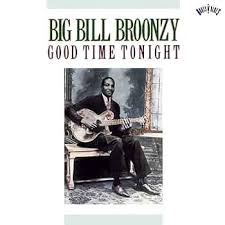
Good Time Tonight by Big Bill Broonzy
Good Time Tonight was released on Columbia Records (catalog number CK 46219) in 1990. Produced (compiled) by Lawrence Cohn. All tracks recorded in Chicago, 1930–1940, except Track 18 (Carnegie Hall, New York City, February 5, 1939). All compositions written by Big Bill Broonzy unless otherwise noted. Principal personnel: Big Bill Broonzy (vocals, guitar); Joshua Altheimer (piano, 1937–1939 sessions); Blind John Davis (piano, various sessions); Ransom Knowling (bass, 1938–1940 sessions); Odell Rand (clarinet, various sessions); Ernest "Punch" Miller (trumpet, various sessions); Joseph "Buster" Bennett (alto saxophone, 1938 sessions); Walter Williams (trumpet, Memphis Five sessions); George Barnes (electric guitar, March 1938 session); Albert Ammons (piano, Carnegie Hall session); Walter Page (bass, Carnegie Hall session). Tracks 5, 7–12, and 13–20 were previously unissued. Big Bill Broonzy was inducted into the Blues Hall of Fame in 1980.*