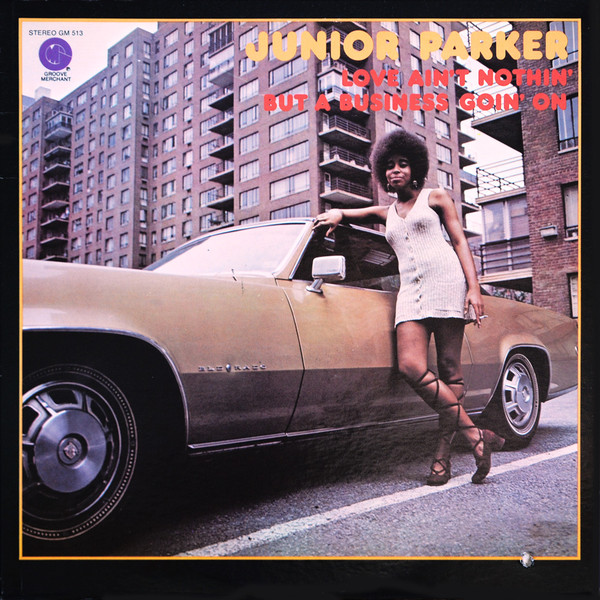
Love Ain't Nothin' But A Business Goin' On is the final studio album by Little Junior Parker (born Herman Parker Jr., March 27, 1932 – November 18, 1971), released in 1970 on Capitol Records (ST-382). Recorded primarily in Los Angeles during 1969 and early 1970, the album represents a dramatic departure from the raw Memphis blues and R&B that had defined Parker's earlier career on Sun Records and Duke Records. Produced by John Marascalco, the album recasts Parker's smoky, intimate baritone within lush, orchestrated soul and pop arrangements that reflect the musical landscape of the late 1960s and early 1970s.
The album is a fascinating and, in some respects, tragic document. It captures a supremely gifted vocalist attempting to navigate the rapidly shifting currents of American popular music at a moment when the blues-based R&B that had been his stock in trade was being displaced by funk, psychedelic soul, and the increasingly sophisticated productions of Motown and Philadelphia International. Parker died of complications from brain surgery in November 1971, barely a year after the album's release, making Love Ain't Nothin' But A Business Goin' On his final artistic statement and a poignant coda to a career that had begun in the juke joints of the Mississippi Delta nearly two decades earlier.
Background and Context
Little Junior Parker: From the Delta to Beale Street
Herman Parker Jr. was born in Coahoma County, Mississippi, near the town of Bobo, in the heart of the Delta blues region. He grew up in the same musical environment that produced Muddy Waters, Howlin' Wolf, and Ike Turner, absorbing the sounds of Delta blues, gospel, and the emerging electric R&B that was transforming the music of the postwar South. As a teenager, he moved to West Memphis, Arkansas, just across the river from Memphis, Tennessee, where he began performing in local clubs and on the vibrant Beale Street music scene.
Parker's professional career began in earnest in 1951 when he was discovered by Ike Turner, who was then working as a talent scout for the Bihari brothers' Modern Records. Turner brought Parker to the attention of Sam Phillips, the founder of Sun Records, who recorded Parker's debut single "You're My Angel" in 1952. The following year, Parker recorded "Mystery Train" for Sun, a haunting, mid-tempo blues that would later become one of the most famous songs in rock and roll history when Elvis Presley covered it in 1955. Parker's original version, with its eerie, chugging rhythm and Parker's breathy, intimate vocal, is now recognized as one of the foundational recordings of rock and roll, though it received only modest commercial attention at the time of its release.
In 1953, Parker signed with Duke Records, the Houston-based label owned by Don Robey, and it was at Duke that he achieved his greatest commercial success. Over the next decade, he recorded a string of R&B hits including "Feelin' Good" (1953), "Next Time You See Me" (1957), "Driving Wheel" (1961), and "In the Dark" (1961), establishing himself as one of the most popular and distinctive voices in postwar R&B. His vocal style—a warm, husky baritone that could shift effortlessly between tender crooning and gritty blues shouting—was immediately recognizable and deeply influential, particularly on the generation of soul singers who emerged in the 1960s.
The Transition to Capitol Records
By the late 1960s, Parker's commercial fortunes had begun to decline. The Duke Records era had ended, and his subsequent recordings for Blue Rock (a subsidiary of Mercury) and Mercury itself had failed to recapture the success of his Duke hits. The musical landscape had changed dramatically: the British Invasion, the rise of Motown and Stax, and the emergence of funk and psychedelic soul had transformed the R&B market, and many of the blues-based artists who had dominated the 1950s found themselves struggling to maintain their relevance.
In 1969, Parker signed with Capitol Records, one of the major American labels, which was then home to the Beatles, the Beach Boys, and a diverse roster of pop, rock, and R&B artists. The signing represented a significant opportunity for Parker to reach a wider audience, but it also placed him in a commercial environment that was far removed from the intimate, blues-oriented world of Duke Records. Capitol paired him with producer John Marascalco, a songwriter and producer best known for his collaborations with Little Richard (he co-wrote "Rip It Up," "Ready Teddy," and "Good Golly Miss Molly") and his work with various rock and R&B artists during the 1960s.
The Sessions
Recording Details
The recordings for Love Ain't Nothin' But A Business Goin' On were made primarily in Los Angeles during 1969 and early 1970, at studios associated with Capitol Records' West Coast operations. The specific studio locations are not always documented in the available discographical literature, but the recordings are consistent with the professional, well-equipped facilities that Capitol maintained in Hollywood during this period.
The sessions represented a significant departure from Parker's previous recording practices. At Duke Records in the 1950s and early 1960s, Parker had typically recorded with a small, tight ensemble of Memphis or Houston session musicians, working quickly and efficiently to capture the raw energy of his live performances. The Capitol sessions, by contrast, employed the full resources of a major label production: orchestral string and horn arrangements, background vocal groups, and the polished, multi-layered sound that characterized mainstream pop and soul production in the late 1960s.
Production
The album was produced by John Marascalco (1931–2020), a Mississippi-born songwriter, producer, and music publisher who had been active in the music industry since the mid-1950s. Marascalco's most famous contributions were his songwriting collaborations with Little Richard, but he had also worked as a producer and A&R man for various labels throughout the 1960s, developing a reputation for his ability to craft commercially oriented pop and R&B productions.
Marascalco's production approach on Love Ain't Nothin' But A Business Goin' On was firmly rooted in the late-1960s pop-soul aesthetic. He surrounded Parker's voice with elaborate arrangements featuring strings, horns, electric pianos, and background vocalists, creating a lush, sophisticated sound that was designed to appeal to the contemporary pop and R&B market. This approach was a deliberate commercial strategy: Capitol Records wanted to position Parker as a crossover artist who could compete with the likes of Bobby Bland, Isaac Hayes, and the emerging Philadelphia soul sound, rather than as a niche blues performer.
The production has been a source of debate among critics and fans. Some have praised Marascalco's arrangements for showcasing the versatility and sophistication of Parker's voice, arguing that the lush settings reveal dimensions of his artistry that the sparser Duke recordings could not accommodate. Others have criticized the production as overwrought and commercially calculated, arguing that the orchestral arrangements and pop-oriented song selections obscure the raw, blues-based qualities that made Parker's music distinctive in the first place.
Musicians
The specific personnel on the album are not comprehensively documented in the original Capitol release, which was typical of the era's crediting practices for session musicians. However, based on the sonic evidence of the recordings and the known practices of Capitol's Los Angeles studios during this period, the musicians likely included:
Little Junior Parker – lead vocals and harmonica (though harmonica is less prominent on this album than on his earlier recordings). Parker's voice is the album's central instrument, and his vocal performances are consistently excellent, demonstrating the full range of his baritone from its deepest, most intimate registers to its most powerful, gospel-inflected peaks.
Los Angeles session musicians – the instrumental backing was likely provided by members of the informal network of studio players who worked the Los Angeles recording scene during the late 1960s, possibly including members associated with the famous "Wrecking Crew" or similar ensembles. The arrangements feature electric guitar, electric bass, drums, keyboards (including electric piano and organ), and brass and woodwind sections.
String and horn arrangers – the orchestral arrangements that characterize many of the album's tracks were likely created by professional arrangers working under Marascalco's direction, though the specific arrangers are not always credited on the original release.
Background vocalists – several tracks feature background vocal groups that provide harmonies and call-and-response figures in the style of contemporary soul and pop productions.
Songwriters
The songwriting credits on the album reflect its eclectic, commercially oriented approach. The tracks include original compositions by John Marascalco, songs by the veteran R&B songwriter Joe Scott (who had written extensively for Parker and Bobby Bland during the Duke Records era), covers of contemporary pop and rock hits, and reworkings of classic blues and R&B standards. This diversity of source material reflects Marascalco's strategy of positioning Parker as a versatile interpreter who could move fluidly between blues, soul, pop, and rock.
Track-by-Track Breakdown
"Love Ain't Nothin' But A Business Goin' On"
Songwriter: Joe Scott
The title track is the album's centerpiece and its most enduring song, a slow-burning, emotionally complex blues-soul ballad that showcases Parker's vocal artistry at its most nuanced and powerful. The song's central metaphor—love as a business transaction, a matter of negotiation, profit, and loss—is a sophisticated conceit that connects the personal to the economic in a way that resonates deeply with the African American experience of the late 1960s.
The arrangement is built on a slow, grinding groove with prominent electric piano, muted horns, and a string section that swells dramatically during the chorus. Parker's vocal performance is extraordinary, moving between a whispered, almost conversational delivery in the verses and a full-throated, gospel-inflected shout in the chorus. His phrasing is masterful, with subtle rhythmic displacements and melodic embellishments that reveal the depth of his musical intelligence.
The song's lyrical content is unusually sophisticated for a blues-R&B recording of this era, exploring the commodification of romantic relationships with a cynicism that is tempered by genuine emotional vulnerability. Parker sings about love as a marketplace where desire is currency and heartbreak is the cost of doing business, and his delivery conveys both the weariness of a man who has been through the transaction many times and the stubborn hope that the next deal might be different.
"Love Ain't Nothin' But A Business Goin' On" has become one of Parker's most frequently covered and sampled songs, appearing in the repertoires of numerous soul and blues artists and finding new life in the hip-hop era through sampling by producers who recognized the timeless quality of its groove and vocal performance.
"The Outside Man"
Songwriter: John Marascalco, Robert "Bumps" Blackwell
"The Outside Man" is a medium-tempo soul number that addresses the theme of romantic rivalry from the perspective of the "other man"—the lover who exists outside the boundaries of a committed relationship. The song's narrative is morally ambiguous, with the narrator acknowledging his role as an interloper while simultaneously asserting the authenticity of his feelings and the inadequacy of the woman's primary partner.
The arrangement features a driving, syncopated rhythm section with prominent electric guitar and a horn section that provides punchy, staccato accents. The production is more rhythmically aggressive than the title track, reflecting the influence of contemporary funk and Southern soul on Marascalco's arrangements. Parker's vocal delivery is confident and assertive, with a swaggering quality that suits the song's theme of romantic transgression.
The collaboration between Marascalco and Robert "Bumps" Blackwell (the legendary producer and songwriter who had worked extensively with Little Richard, Sam Cooke, and Ray Charles) gives the song a commercial polish that reflects both writers' deep understanding of the R&B market. The result is a track that sits comfortably alongside the contemporary soul productions of Stax and Atlantic while retaining Parker's distinctive vocal identity.
"Darling Depend on Me"
Songwriter: John Marascalco
"Darling Depend on Me" is a tender, romantic ballad that showcases the softer, more vulnerable side of Parker's vocal personality. The song is a straightforward declaration of devotion, with the narrator pledging his faithfulness and reliability to his beloved. The lyrical content is simple and direct, but Parker's delivery invests it with a depth of feeling that transcends the conventional nature of the material.
The arrangement is lush and orchestral, with sweeping string lines and gentle horn figures that create a warm, enveloping sonic backdrop for Parker's voice. The tempo is slow and unhurried, allowing Parker to stretch out his phrases and explore the full range of his baritone. The background vocalists provide soft, cushioning harmonies that reinforce the song's romantic mood.
The track demonstrates Marascalco's understanding of Parker's strengths as a ballad singer, providing him with a setting that allows his voice to shine without the distraction of overly busy arrangements. It is one of the album's most emotionally affecting performances, a reminder that Parker's artistry was not limited to the uptempo blues shouters for which he was best known.
"Taxman"
Songwriter: George Harrison
The album's most surprising track is a cover of George Harrison's "Taxman," originally recorded by the Beatles on their 1966 album Revolver. The decision to include a Beatles cover on a blues-soul album was a bold commercial gambit, reflecting Marascalco's desire to position Parker as a crossover artist who could appeal to the rock audience that had largely abandoned traditional blues and R&B.
Parker's version transforms Harrison's sardonic, guitar-driven rock song into a slow, grinding soul-blues workout. The arrangement replaces the Beatles' jangly guitars and tight harmonies with a heavy, funk-inflected groove featuring prominent electric piano, wah-wah guitar, and a horn section that provides dramatic, punctuating accents. Parker's vocal delivery is intense and slightly menacing, investing the lyrics about taxation and government overreach with a sense of genuine grievance that connects the song to the broader tradition of African American protest music.
The cover is a fascinating cultural artifact, demonstrating the complex interplay between rock and R&B during the late 1960s. Harrison's original had been influenced by the R&B and soul music that the Beatles had absorbed during their formative years, and Parker's reinterpretation effectively reclaims the song for the tradition from which it had originally drawn its energy. The result is a performance that is both a faithful tribute to the source material and a radical reimagining that reveals new dimensions of the song's emotional and political content.
"I Don't Know"
Songwriter: Willie Mabon
"I Don't Know" is a cover of the 1952 R&B hit by Willie Mabon, a Chicago-based pianist and vocalist whose deadpan, humorous delivery had made the song a jukebox favorite in the early 1950s. Mabon's original was a comic blues about a man's bafflement at the behavior of his woman, delivered with a laconic wit that made it one of the most charming novelty blues of the era.
Parker's version retains the song's humorous premise while updating its musical setting for the late-1960s soul market. The arrangement features a medium-tempo groove with prominent electric piano and a horn section that provides playful, jabbing accents. Parker's vocal delivery is warm and good-humored, with a quality of amused bewilderment that captures the spirit of Mabon's original while adding a layer of sophistication that reflects Parker's more mature vocal style.
The inclusion of "I Don't Know" on the album reflects Marascalco's strategy of balancing contemporary pop covers with classic R&B material, creating a diverse program that would appeal to both older listeners who remembered the original and younger audiences who were discovering the blues tradition through the folk and rock revivals.
"The Hurt"
Songwriter: John Marascalco
"The Hurt" is a slow, intensely emotional ballad that addresses the theme of romantic pain with a directness and vulnerability that is characteristic of Parker's best work. The song's title is its central conceit: the narrator attempts to describe the physical and emotional sensation of heartbreak, using the simple, monosyllabic word "hurt" as a vessel for feelings that are too complex and overwhelming to be expressed in more elaborate language.
The arrangement is spare and atmospheric by the album's standards, with a gentle electric piano figure, soft strings, and a restrained rhythm section that allows Parker's voice to occupy the center of the sonic landscape. The production is notably less busy than on the album's more uptempo tracks, suggesting that Marascalco recognized the power of Parker's voice to carry a performance without elaborate instrumental support.
Parker's vocal performance is among the album's most devastating, moving between a fragile, almost whispered delivery in the verses and a raw, anguished cry in the chorus. The emotional intensity of the performance is heightened by the knowledge that this would be one of Parker's final recordings, lending the song a valedictory quality that transcends its conventional lyrical content.
"I Need Your Love So Bad"
Songwriter: Little Willie John, Mertis John Jr.
"I Need Your Love So Bad" is a cover of the 1955 R&B classic by Little Willie John, whose original recording had been one of the defining performances of the early soul era. Little Willie John's version was a slow, desperate plea for romantic connection, delivered with a vocal intensity that bordered on the supernatural, and it had been covered by numerous artists including Fleetwood Mac (whose 1968 version, featuring Peter Green's guitar, had been a major hit in the UK).
Parker's interpretation is deeply respectful of the original while bringing his own distinctive vocal qualities to the material. The arrangement is slow and atmospheric, with a gentle string section and a restrained rhythm section that creates a mood of deep melancholy and longing. Parker's vocal delivery is deeply expressive, moving between a tender, almost fragile croon and a powerful, gospel-inflected shout that conveys the desperation of the lyrics with devastating force.
The track is a powerful demonstration of Parker's ability to inhabit a song completely, making it his own while honoring the tradition from which it emerged. His version of "I Need Your Love So Bad" stands comparison with the best recordings of the song, including Little Willie John's original and Fleetwood Mac's celebrated cover.
"Baby I Need Your Loving"
Songwriter: Holland-Dozier-Holland (Brian Holland, Lamont Dozier, Eddie Holland)
"Baby I Need Your Loving" is a cover of the Four Tops' 1964 Motown classic, written by the legendary songwriting and production team of Holland-Dozier-Holland. The Four Tops' original, with Levi Stubbs' impassioned lead vocal, had been one of the defining recordings of the Motown era, and its inclusion on Parker's album reflects Marascalco's desire to connect Parker's music to the contemporary soul mainstream.
Parker's version transforms the Four Tops' driving, uptempo arrangement into a slower, more contemplative soul ballad. The arrangement features lush strings, gentle horns, and a restrained rhythm section that allows Parker's voice to explore the emotional nuances of the lyrics. His vocal delivery is warm and deeply felt, with a quality of mature reflection that contrasts with the youthful urgency of Levi Stubbs' original.
The cover is a testament to Parker's versatility as a vocalist and his ability to find new emotional dimensions in familiar material. By slowing the tempo and stripping away the Motown production's characteristic density, he reveals the vulnerability and tenderness at the heart of the song that the Four Tops' more energetic arrangement had partially obscured.
"You're Gonna Need Me"
Songwriter: Joe Scott
The album closes with "You're Gonna Need Me," a slow, confident blues-soul declaration written by Joe Scott, the veteran songwriter and arranger who had been responsible for many of Parker's and Bobby Bland's greatest Duke Records hits. The song's message is one of self-assurance and inevitability: the narrator tells his departing lover that she will eventually realize his worth and return to him, and his delivery conveys a quiet, unshakable confidence that makes the prediction feel less like a boast than a statement of fact.
The arrangement is rich and orchestral, with sweeping strings and a prominent horn section that gives the track a grand, almost cinematic quality. The rhythm section provides a steady, unhurried groove that allows Parker to stretch out his phrases and explore the full range of his vocal expression. The background vocalists provide warm, supportive harmonies that reinforce the song's mood of quiet triumph.
Parker's vocal performance is among the album's most authoritative, projecting a sense of hard-won wisdom and emotional maturity that gives the song's central claim a depth of meaning that transcends its surface bravado. As a closing statement, "You're Gonna Need Me" provides a fitting conclusion to the album's exploration of love, loss, and resilience, ending on a note of quiet confidence that is deeply affecting given the circumstances of Parker's impending death.
Buy The Album
Significance and Legacy
The Final Chapter of a Blues-R&B Career
The most immediate significance of Love Ain't Nothin' But A Business Goin' On lies in its status as Little Junior Parker's final studio album. Parker died on November 18, 1971, at the age of thirty-nine, from complications following surgery for a brain tumor. His death cut short a career that had spanned two decades and that had produced some of the most important and influential recordings in the history of postwar R&B. The album thus serves as a valedictory statement, a final opportunity for Parker to demonstrate the full range of his artistry to an audience that had largely forgotten his contributions to the development of rock and roll and soul music.
The Crossover Ambition
The album is also significant for its ambitious attempt to bridge the gap between the blues-based R&B of the 1950s and the sophisticated soul and pop of the late 1960s and early 1970s. Marascalco's production strategy—surrounding Parker's blues-rooted voice with orchestral arrangements, contemporary pop covers, and funk-inflected rhythms—was a calculated effort to position Parker as a crossover artist who could compete in the mainstream pop market. The results are mixed but consistently interesting, revealing both the possibilities and the limitations of the crossover approach.
At its best, the album demonstrates that Parker's voice was capable of thriving in a wide range of musical settings, from the lush orchestral balladry of "Darling Depend on Me" to the funk-inflected groove of "Taxman." At its worst, the production occasionally overwhelms Parker's natural vocal qualities, burying the raw, intimate expressiveness that had been his greatest asset under layers of strings and horns.
The Title Track's Enduring Influence
The album's most lasting contribution to American music is the title track, "Love Ain't Nothin' But A Business Goin' On," which has become one of the most frequently covered and sampled songs in the blues-soul repertoire. The song's sophisticated metaphor, its hypnotic groove, and Parker's extraordinary vocal performance have ensured its continued relevance across multiple generations and genres. It has been covered by numerous soul and blues artists, and its instrumental backing has been sampled by hip-hop producers who recognized the timeless quality of its rhythmic and harmonic foundation.
The Historical Reassessment
In the decades since Parker's death, his critical reputation has undergone a significant reassessment. While he was long overshadowed by contemporaries like B.B. King, Bobby Bland, and Howlin' Wolf, recent scholarship and reissue campaigns have brought renewed attention to his contributions to the development of rock and roll and soul music. His 1953 recording of "Mystery Train" is now recognized as one of the foundational texts of rock and roll, and his Duke Records output is increasingly appreciated for its sophistication and emotional depth.
Love Ain't Nothin' But A Business Goin' On occupies a complex position within this reassessment. It is not the album that critics typically point to as Parker's definitive statement—that distinction belongs to his Duke Records recordings of the late 1950s and early 1960s—but it is an important document of his artistic evolution and a testament to his willingness to take creative risks in the final years of his life.
A Document of Musical Transition
More broadly, the album is a valuable document of the musical transition that was reshaping American popular music at the end of the 1960s. The juxtaposition of blues standards, Motown covers, Beatles reinterpretations, and original soul compositions reflects the increasingly fluid boundaries between genres that characterized the era, and Parker's attempts to navigate this shifting landscape provide a window into the challenges faced by the generation of blues-based R&B artists who came of age in the 1950s and found themselves struggling to maintain their relevance in the rapidly changing musical environment of the late 1960s and early 1970s.
The Unfinished Legacy
Ultimately, Love Ain't Nothin' But A Business Goin' On is a poignant reminder of what was lost when Little Junior Parker died at the age of thirty-nine. The album reveals a vocalist of extraordinary range, sophistication, and emotional depth who was still evolving and growing as an artist at the time of his death. One can only speculate about the music he might have created had he lived to navigate the funk, disco, and neo-soul movements of the 1970s and beyond. What remains is a body of work that includes some of the most beautiful and influential vocal performances in the history of American music, and Love Ain't Nothin' But A Business Goin' On is an essential, if imperfect, chapter in that story.
Album Details Summary:
- Artist: Little Junior Parker (Herman Parker Jr.)
- Album: Love Ain't Nothin' But A Business Goin' On
- Label: Capitol Records (ST-382)
- Recorded: 1969–1970, Los Angeles, California
- Released: 1970
- Producer: John Marascalco
- Personnel: Little Junior Parker (lead vocals, harmonica), Los Angeles session musicians (guitar, bass, drums, keyboards, horns, strings, background vocals)
- Genre: Soul, R&B, blues-soul, pop-soul