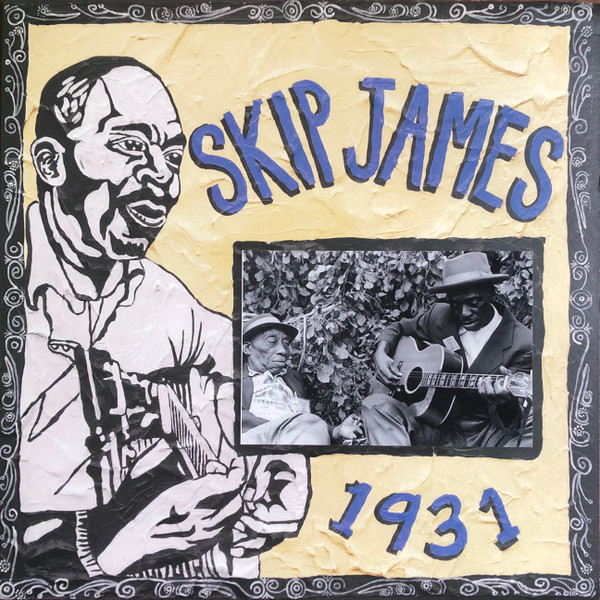
1931 is a compilation of the complete surviving recordings made by Skip James (born Nehemiah Curtis James, June 9, 1902 – October 3, 1969) during his legendary sessions for Paramount Records in Grafton, Wisconsin, in February 1931. Released in various configurations by labels including Yazoo Records (L-1071), Document Records (DOCD-5005), and others, the album assembles the approximately eighteen sides that constitute the entirety of James' pre-war recorded output and represent one of the most extraordinary and influential bodies of work in the entire history of American music.
These recordings capture a twenty-eight-year-old musician from the small community of Bentonia, Mississippi, performing in a style so idiosyncratic, so haunting, and so technically original that it defied categorization even within the diverse landscape of the pre-war Delta blues. James' use of open D minor tuning, his eerie falsetto vocal delivery, his intricate fingerpicking patterns, and his deeply personal songwriting created a body of music that sounded like nothing else being recorded at the time and that continues to astonish listeners nearly a century later. The Paramount sessions produced masterpieces like "Devil Got My Woman," "Hard Time Killing Floor Blues," "Cypress Grove Blues," and "I'm So Glad"—songs that have become cornerstones of the blues canon and that have influenced generations of musicians across every genre of popular music.
Background and Context
The Bentonia Blues Tradition
Skip James emerged from one of the most distinctive and least understood regional blues traditions in the American South. The Bentonia School, centered on the small Yazoo County community of Bentonia, Mississippi, produced a style of blues that was fundamentally different from the more widely documented Delta blues of the southern flatlands. Where the Delta blues of Charley Patton, Son House, and Robert Johnson was characterized by its percussive slide guitar, its aggressive rhythmic drive, and its relatively standardized twelve-bar harmonic structures, the Bentonia style was defined by its use of minor-key tunings, its delicate and intricate fingerpicking patterns, its haunting, almost spectral vocal qualities, and its preference for modal, drone-based harmonic frameworks that created an atmosphere of profound melancholy and otherworldly beauty.
The origins of the Bentonia style are obscure, but it appears to have been shaped by a small network of local musicians who developed their techniques in relative isolation from the commercial blues mainstream. James learned from Henry Stuckey, a Bentonia guitarist who is credited with introducing the minor-key tuning that would become the foundation of James' style, and from other local players whose names have been lost to history. The result was a musical language that was deeply rooted in the African American vernacular traditions of the rural South but that sounded unlike anything else being played in the region.
Skip James: Early Life and Musical Development
Nehemiah Curtis James was born in Bentonia in 1902, the son of Eddie James, a Baptist preacher and bootlegger who would later become one of the first ordained elders of the Church of Christ (Holiness) in the area. The younger James grew up surrounded by both sacred and secular music, absorbing the hymns and spirituals of his father's church alongside the blues and dance music of the local juke joints and house parties. This dual inheritance would shape his entire artistic identity, producing a body of work that moved fluidly between the sacred and the secular, between the devil's music and the Lord's, without any sense of contradiction.
James began playing guitar as a teenager and quickly developed a prodigious technical command of the instrument. He also learned to play piano, developing a distinctive style that translated the intricate fingerpicking patterns of his guitar work to the keyboard. By his mid-twenties, he was one of the most accomplished musicians in the Bentonia area, performing at local gatherings and developing the repertoire of original compositions that would eventually be captured on the Paramount recordings.
The Road to Grafton
James' path to the recording studio was facilitated by H.C. Speir (Henry Columbus Speir, 1895–1972), the Jackson, Mississippi furniture dealer and talent scout who was responsible for discovering and recording many of the most important Mississippi blues artists of the pre-war era. Speir had heard James perform in the Jackson area and was immediately struck by the younger man's extraordinary talent. He arranged for James to travel to Grafton, Wisconsin, the headquarters of Paramount Records, to audition for the label's recording director.
The journey from Bentonia to Grafton was a considerable one, covering more than a thousand miles by train through the heart of the segregated South and into the industrial Midwest. James arrived in Grafton in the dead of a Wisconsin winter, a young Black man from the rural Deep South entering the freezing, unfamiliar environment of a small factory town on the shores of the Milwaukee River. The Paramount studio was housed in a converted factory building, and the recording conditions were rudimentary even by the standards of the era.
The Sessions
Recording Details
The Paramount sessions took place in February 1931 at the label's studio in Grafton, Wisconsin. The exact dates are not precisely documented, but the sessions are believed to have occurred over a period of several days during the middle of the month. James recorded approximately eighteen sides during this period, performing solo on both guitar and piano.
The recording equipment at the Grafton studio was basic and, by the standards of the major labels, severely outdated. Paramount used a disc-cutting lathe that recorded performances directly onto wax masters, which were then used to produce the metal stampers for pressing 78-rpm shellac discs. The studio's acoustic environment was far from ideal, and the pressing quality of Paramount's records was notoriously poor—the label used a cheap shellac compound that produced excessive surface noise and rapid deterioration, even when the records were new.
Despite these technical limitations, the recordings captured the essential qualities of James' music with remarkable fidelity. His voice and guitar were recorded with a directness and clarity that preserved the full emotional impact of his performances, and the intimate, almost claustrophobic quality of the studio sound actually enhances the haunting, otherworldly atmosphere of the music.
Production
The sessions were overseen by the Paramount recording staff, with H.C. Speir serving as the intermediary who had brought James to the label's attention. The actual recording director was likely Art Laibly, Paramount's A&R man for race records, though the specific personnel involved in the Grafton sessions are not always clearly documented. The production approach was characteristically efficient and hands-off: James was set up before the microphone, asked to perform his repertoire, and recorded with minimal intervention from the studio staff.
This lack of producer involvement was, paradoxically, one of the greatest strengths of the Paramount sessions. James was left to perform his music exactly as he wished, without the interference of commercial considerations or artistic direction that might have diluted the radical originality of his sound. The result is a body of recordings that is as pure and uncompromising an expression of individual artistic vision as exists anywhere in the pre-war blues catalog.
Musicians
The recordings are solo performances throughout. Skip James provides all vocals, guitar, and piano, performing without any accompaniment. This self-sufficiency was not unusual for pre-war blues recordings, but in James' case it takes on a particular significance, because his musical style was so idiosyncratic and so harmonically unconventional that it would have been virtually impossible for another musician to accompany him without fundamentally altering the character of the music.
James' guitar technique is the most immediately striking aspect of the recordings. He played in an open D minor tuning (D-A-D-F-A-D, also known as "cross-note" tuning), a highly unusual choice that gave his music its characteristic dark, modal quality. In this tuning, the open strings produce a D minor chord, and James exploited the harmonic possibilities of the tuning to create droning, hypnotic textures that hover between major and minor tonalities, creating an atmosphere of profound ambiguity and unease. His right-hand technique featured a complex, syncopated fingerpicking pattern that combined a steady bass pulse with elaborate treble figures, producing a rich, layered texture from a single instrument.
His vocal delivery is equally distinctive and equally difficult to categorize. James sang in a high, keening falsetto that was virtually unique among male blues singers of his era. His voice had an eerie, almost genderless quality that seemed to float above the guitar accompaniment like a ghost, and his phrasing was characterized by long, sustained notes, sudden melismatic flourishes, and a rhythmic freedom that defied the conventional meter of the blues. The overall effect was one of supernatural beauty and deep emotional intensity, a sound that seemed to come from somewhere beyond the ordinary world of human experience.
On several tracks, James performed on piano rather than guitar, translating his intricate fingerpicking patterns to the keyboard with remarkable fluency. His piano style was as idiosyncratic as his guitar playing, featuring rolling, arpeggiated figures and a modal harmonic language that connected his music to the barrelhouse and boogie-woogie traditions while maintaining its distinctive Bentonia character.
Songwriters
All of the songs on the 1931 recordings are credited to Skip James, though the question of authorship in the blues tradition is characteristically complex. Several of the songs draw on traditional melodies, lyrical themes, and harmonic structures that were part of the shared vocabulary of the Mississippi blues community, and James' versions of these materials represent creative adaptations rather than wholly original compositions. "22-20 Blues," for example, is closely related to Roosevelt Sykes' "44 Blues," and "How Long Buck" draws on the well-known "How Long, How Long Blues" associated with Leroy Carr. At the same time, James' arrangements, vocal phrasings, and harmonic choices are so thoroughly personalized that even the most traditional material is transformed into something unmistakably his own.
The original compositions on the album—"Devil Got My Woman," "Hard Time Killing Floor Blues," "Cypress Grove Blues," and others—are among the most powerful and personal songs in the blues canon, drawing on James' own experiences of poverty, heartbreak, spiritual crisis, and the harsh realities of life in the Jim Crow South.
Track-by-Track Breakdown
"Devil Got My Woman"
Songwriter: Skip James
Recorded: February 1931, Grafton, Wisconsin (Paramount Records, matrix L-732)
"Devil Got My Woman" is the crowning achievement of Skip James' recording career and one of the most extraordinary performances in the entire history of American music. The song is a slow, brooding meditation on romantic betrayal and spiritual desolation, built on a hypnotic, cyclical guitar figure in open D minor tuning that creates an atmosphere of almost unbearable emotional intensity.
The opening guitar phrase is one of the most instantly recognizable in the blues canon: a descending, chromatic figure that slides from the upper register down to the open bass strings, producing a sound that seems to weep and moan with a human voice of its own. The harmonic language is radically unconventional, hovering between major and minor tonalities in a way that creates a pervasive sense of ambiguity and unease. The rhythmic feel is free and rubato, with James stretching and compressing the tempo in response to the emotional demands of the lyrics rather than any predetermined metric structure.
The vocal performance is devastating. James sings in his signature falsetto, his voice rising to a keening, almost inhuman pitch that conveys the anguish of the lyrics with a directness that transcends the boundaries of conventional musical expression. The famous opening line—"I'd rather be the devil than to be that woman's man"—delivers its emotional payload with a quiet, devastating understatement that is all the more powerful for its restraint.
The song's thematic content operates on multiple levels simultaneously. On the surface, it is a blues about a woman who has betrayed the narrator's love, driving him to a state of despair so profound that he would rather align himself with the devil than continue to suffer her cruelty. At a deeper level, the song engages with the African American religious tradition's understanding of the devil as a real and present force in the world, a tempter who preys on the vulnerable and the heartbroken. The narrator's willingness to embrace the devil is not a casual metaphor but a genuine expression of spiritual crisis, a moment when the pain of human existence becomes so overwhelming that even damnation seems preferable to continued suffering.
"Devil Got My Woman" has exerted an enormous influence on subsequent generations of musicians. Robert Johnson is believed to have drawn directly on James' recording when composing his own "Hellhound on My Trail," and the song's harmonic and melodic DNA can be traced through the work of countless blues, rock, and folk artists in the decades that followed. The British rock band Cream recorded a famous version of "I'm So Glad" that introduced James' music to a massive rock audience, but it is "Devil Got My Woman" that remains his most profound and enduring artistic statement.
"Hard Time Killing Floor Blues"
Songwriter: Skip James
Recorded: February 1931, Grafton, Wisconsin (Paramount Records)
"Hard Time Killing Floor Blues" is a stark, harrowing meditation on poverty, despair, and the crushing weight of economic hardship during the Great Depression. The "killing floor" of the title refers to the lowest point of existence, the place where life becomes so difficult that death seems like a relief, and the song chronicles the narrator's descent into this abyss with an unflinching honesty that is almost difficult to witness.
The guitar accompaniment is spare and atmospheric, built on a slow, droning figure in open D minor that creates a mood of profound desolation. James' fingerpicking is deliberate and measured, with each note given room to resonate and decay before the next is struck. The harmonic language is modal and ambiguous, with the minor-key tuning producing a dark, brooding texture that perfectly complements the emotional content of the lyrics.
The vocal performance is among James' most powerful, moving between his characteristic falsetto and a lower, more conversational register that gives the song a quality of intimate confession. The lyrics are spare and direct, describing the narrator's inability to find work, his hunger, his homelessness, and his growing sense that life itself has become unbearable. The famous refrain—"Hard times here, everywhere you go / Hard times here, everywhere you go / Times are harder than ever been before"—captures the universal experience of economic catastrophe with a simplicity and force that transcends the specific historical moment of the Depression.
The song's power lies in its refusal of consolation. There is no hope of redemption, no promise of better times, no religious framework to give meaning to the suffering. The narrator is simply enduring, surviving from moment to moment in a world that has become hostile and incomprehensible. This unflinching confrontation with despair is what gives the song its extraordinary emotional impact and its enduring relevance to anyone who has experienced the crushing weight of poverty and hopelessness.
"Cypress Grove Blues"
Songwriter: Skip James
Recorded: February 1931, Grafton, Wisconsin (Paramount Records)
"Cypress Grove Blues" is one of James' most beautiful and emotionally complex compositions, a slow, lyrical meditation on loss and longing that draws on the imagery of the Mississippi landscape to create a mood of profound melancholy. The "cypress grove" of the title evokes the dark, waterlogged forests of the Yazoo River basin, where cypress trees grow in standing water and the landscape takes on a funereal, almost Gothic quality that perfectly mirrors the emotional content of the song.
The guitar work is among James' most intricate and melodic on the 1931 recordings, featuring elaborate fingerpicking patterns that weave around the vocal line with the fluidity of a jazz instrumentalist. The open D minor tuning produces a rich, resonant texture, with the open bass strings droning beneath the melodic figures on the treble strings to create a layered, almost orchestral sound from a single instrument.
The vocal delivery is deeply expressive, with James' falsetto rising and falling in long, arching phrases that mirror the contours of the landscape described in the lyrics. The song's emotional content is complex and ambiguous, combining romantic longing with a deeper sense of existential displacement that connects the personal to the universal. The narrator is searching for something—a lover, a home, a sense of belonging—that remains perpetually out of reach, and the cypress grove becomes a symbol of the liminal space between presence and absence, life and death, hope and despair.
"I'm So Glad"
Songwriter: Skip James
Recorded: February 1931, Grafton, Wisconsin (Paramount Records)
"I'm So Glad" is the most upbeat and rhythmically driving track on the 1931 recordings, a fast, exuberant blues that showcases the more celebratory side of James' musical personality. The song's title and refrain express a sense of joy and liberation that provides a welcome contrast to the darker material that dominates the album, and the performance radiates an infectious energy that belies the technical complexity of the guitar work.
The guitar figure is one of James' most immediately recognizable, a rapid, syncopated pattern in open D minor that drives the music forward with a propulsive, almost danceable momentum. The right-hand technique is astonishing in its precision and speed, with the thumb maintaining a steady bass pulse while the fingers execute rapid-fire melodic figures on the treble strings that create the impression of multiple instruments playing simultaneously.
The vocal delivery is animated and enthusiastic, with James singing the lyrics of romantic celebration with a warmth and vitality that is deeply affecting. The song's emotional content is relatively straightforward—the narrator expresses his joy at being reunited with his lover—but the sheer virtuosity of the performance elevates the material to a level of artistic achievement that transcends the simplicity of the lyrics.
"I'm So Glad" achieved unexpected fame when the British rock band Cream recorded a powerful electric version on their 1966 debut album Fresh Cream, introducing James' music to a massive international rock audience. Eric Clapton's interpretation, while dramatically different in instrumentation and arrangement from James' original, preserved the essential melodic and rhythmic structure of the song and helped establish James as one of the foundational figures of the blues tradition.
"Special Rider Blues"
Songwriter: Skip James
Recorded: February 1931, Grafton, Wisconsin (Paramount Records)
"Special Rider Blues" is a medium-tempo blues that addresses the theme of the wandering man, the solitary traveler who moves through the world without roots or attachments. The "special rider" of the title is a figure of both freedom and isolation, a man who has chosen—or been forced—to live a life of perpetual motion, and the song explores the emotional costs and rewards of this existence with a nuance that reflects James' own experiences as an itinerant musician.
The guitar work features a rolling, rhythmic figure that evokes the movement of a train, connecting the song to the deep tradition of railroad imagery in the blues. The open D minor tuning gives the music a dark, brooding quality that contrasts with the relatively upbeat tempo, creating an emotional tension between the narrator's outward mobility and his inner restlessness.
The vocal delivery is confident and assertive, with James projecting the persona of a man who has made his peace with the wandering life and who takes a certain pride in his independence. The performance demonstrates the breadth of James' artistic range, revealing a dimension of his musical personality that is more extroverted and self-assured than the haunted, introspective quality of his slower blues.
"Drunken Spree"
Songwriter: Skip James
Recorded: February 1931, Grafton, Wisconsin (Paramount Records)
"Drunken Spree" is a rollicking, uptempo number that provides one of the album's most vivid glimpses into the social world of the rural juke joint and house party. The song chronicles the narrator's experiences during a night of heavy drinking, describing the escalating chaos and revelry with a humor and energy that is a welcome departure from the darker material that dominates the album.
The guitar work is among James' most rhythmically dynamic on the recordings, with a driving, syncopated fingerpicking pattern that gives the music an infectious, danceable quality. The tempo is brisk and the rhythmic feel is loose and swinging, reflecting the song's function as entertainment for social gatherings. The vocal delivery is animated and theatrical, with James singing about his drunken adventures with a self-aware humor that prevents the song from descending into mere novelty.
The track demonstrates that James' artistry was not limited to the slow, haunting blues for which he is most celebrated but encompassed a full range of emotional and musical expression, from the most devastating sorrow to the most exuberant celebration.
"Illinois Blues"
Songwriter: Skip James
Recorded: February 1931, Grafton, Wisconsin (Paramount Records)
"Illinois Blues" is a slow, atmospheric blues that draws on the imagery of migration and displacement to explore the emotional experience of leaving the familiar world of the South for the unknown territories of the North. The "Illinois" of the title likely refers to Chicago, the primary destination of the Great Migration and a city that represented both the promise of opportunity and the threat of alienation for the millions of African Americans who made the journey during the early twentieth century.
The guitar work is spare and evocative, with a slow, droning figure in open D minor that creates a mood of deep melancholy and contemplation. James' fingerpicking is delicate and nuanced, with sustained notes and subtle vibrato that evoke the vast, unfamiliar landscape of the North. The vocal delivery is introspective and deeply personal, with James singing about the experience of displacement with a quiet authority that reflects his own experiences as a traveling musician.
"Yola My Blues Away"
Songwriter: Skip James
Recorded: February 1931, Grafton, Wisconsin (Paramount Records)
"Yola My Blues Away" is one of the album's most spiritually charged performances, a song that addresses the theme of spiritual deliverance and the desire to be freed from the burdens of earthly suffering. The "yola" of the title is a dialectal rendering of "yodel" or "holler," and the song's central image—the act of singing or shouting one's blues away—connects it to the oldest layers of the African American musical tradition, the field hollers and work songs that served as vehicles for the expression and transcendence of pain.
The performance is built on a slow, hymn-like guitar figure that creates a mood of deep reverence and spiritual intensity. James' vocal delivery is among his most powerful on the recordings, moving between his characteristic falsetto and a lower, more declamatory register that evokes the cadences of the Baptist sermon. The song blurs the boundary between blues and spiritual, demonstrating the deep interconnection between sacred and secular traditions in African American music.
"Jesus Is a Mighty Good Leader"
Songwriter: Skip James (drawing on traditional gospel material)
Recorded: February 1931, Grafton, Wisconsin (Paramount Records)
"Jesus Is a Mighty Good Leader" is one of several sacred numbers that James recorded during the Paramount sessions, reflecting the deep religious faith that was a central dimension of his personal and artistic identity. The song is a straightforward declaration of Christian devotion, praising Jesus as a leader and guide through the difficulties of earthly life, and the performance is characterized by a sincerity and emotional directness that transcends the conventional boundaries of the gospel genre.
The guitar accompaniment is gentle and hymn-like, with a steady, processional rhythm that evokes the solemnity of the church service. James' vocal delivery is warm and reverent, with a quality of genuine spiritual conviction that makes the performance deeply affecting even for listeners who do not share the narrator's religious beliefs. The track demonstrates the seamless integration of sacred and secular elements in James' musical world, revealing a man for whom the blues and the gospel were not opposing forces but complementary expressions of the same deep well of human experience.
"22-20 Blues"
Songwriter: Skip James (drawing on the "44 Blues" tradition associated with Roosevelt Sykes and Lee Green)
Recorded: February 1931, Grafton, Wisconsin (Paramount Records)
"22-20 Blues" is James' interpretation of a well-known blues theme associated with the "44 Blues" family of songs, which had been recorded by Roosevelt Sykes and others in the late 1920s. The title refers to the .22-20 caliber rifle cartridge, and the song uses the imagery of firearms to explore themes of violence, retribution, and the desperate measures that a man will take when pushed to his limit.
James' version transforms the relatively conventional twelve-bar structure of the original into a dark, brooding meditation that is unmistakably his own. The guitar work is spare and atmospheric, with the open D minor tuning producing a haunting, modal quality that gives the music an almost supernatural intensity. The vocal delivery is intense and menacing, with James singing about violence and retribution with a quiet, controlled fury that is far more terrifying than any amount of shouting could be.
The track demonstrates James' ability to absorb traditional material and remake it in his own image, transforming a well-known blues standard into a vehicle for his uniquely personal artistic vision.
"If You Haven't Any Hay Get on Down the Road"
Songwriter: Skip James
Recorded: February 1931, Grafton, Wisconsin (Paramount Records)
"If You Haven't Any Hay Get on Down the Road" is a sardonic, medium-tempo blues that addresses the theme of economic self-sufficiency and the harsh realities of the sharecropping system. The "hay" of the title is both a literal reference to livestock feed and a metaphor for economic resources, and the song's central message—that those who cannot contribute to the communal enterprise had better move on—is delivered with a wry, unsentimental directness that reflects the pragmatic worldview of the rural South.
The guitar work is rhythmic and propulsive, with a driving fingerpicking pattern that gives the music a forward-moving energy. The vocal delivery is animated and slightly mocking, with James projecting the persona of a hard-nosed pragmatist who has no patience for freeloaders or dreamers. The track provides a welcome injection of humor and social commentary into the album's predominantly introspective emotional landscape.
"Cherry Ball Blues"
Songwriter: Skip James
Recorded: February 1931, Grafton, Wisconsin (Paramount Records)
"Cherry Ball Blues" is a slow, intensely emotional blues that explores the theme of romantic obsession with a directness and vulnerability that is characteristic of James' most powerful work. The "cherry ball" of the title is a metaphor for the beloved, and the song chronicles the narrator's desperate, all-consuming desire with an emotional intensity that borders on the pathological.
The guitar work is among James' most expressive on the recordings, with long, sustained notes and bent phrases that cry and moan in sympathy with the vocal. The open D minor tuning produces a dark, brooding texture that perfectly complements the emotional content of the lyrics, and the rhythmic feel is free and rubato, allowing James to stretch and compress the tempo in response to the demands of the moment.
The vocal performance is devastating, with James' falsetto rising to heights of almost unbearable intensity as he describes the depths of his romantic despair. The track is one of the album's most emotionally demanding performances, requiring the listener to confront the full force of James' artistic vision without the mediation of humor or narrative distance.
"Be Ready When He Comes"
Songwriter: Skip James (drawing on traditional gospel material)
Recorded: February 1931, Grafton, Wisconsin (Paramount Records)
"Be Ready When He Comes" is the second of the sacred numbers on the album, a song of eschatological warning that draws on the biblical imagery of the Second Coming and the Last Judgment. The song urges the listener to prepare for the return of Christ, warning that the time of reckoning is near and that those who are not spiritually prepared will face eternal damnation.
The performance is characterized by a solemn, almost funereal intensity, with James' guitar providing a slow, processional accompaniment that evokes the gravity of the subject matter. The vocal delivery is powerful and declamatory, with James singing in the cadences of the Baptist sermon, building to moments of almost overwhelming rhetorical force before pulling back to a quieter, more contemplative register.
The track reinforces the deep interconnection between sacred and secular traditions in James' musical world, demonstrating that the same voice that could sing about the devil and the killing floor could also deliver a sermon of terrifying spiritual urgency.
Significance and Legacy
The Most Original Voice in the Delta Blues
The most fundamental significance of the 1931 recordings lies in their demonstration of the extraordinary range and diversity of the Mississippi blues tradition. Skip James' music sounded like nothing else being recorded in the Delta or anywhere else in the American South during the early 1930s. His use of open D minor tuning, his falsetto vocal delivery, his intricate fingerpicking patterns, and his modal harmonic language represented a radical departure from the conventions of the Delta blues as practiced by his contemporaries, and his recordings challenged the emerging critical consensus that the blues was a relatively homogeneous genre defined by the twelve-bar structure and the slide guitar.
The Bentonia style that James embodied was a reminder that the blues was not a single tradition but a constellation of regional styles, each with its own distinctive characteristics and its own internal logic. James' music demonstrated that the blues could be delicate as well as aggressive, introspective as well as extroverted, harmonically complex as well as rhythmically driving, and his recordings expanded the definition of what the blues could be in ways that continue to resonate with musicians and listeners today.
The Rediscovery and the Folk Revival
The 1931 recordings achieved their greatest cultural impact not during the Depression era when they were first released but during the folk and blues revival of the 1960s, when a new generation of listeners discovered James' music through reissues and compilation albums. The original Paramount 78s had been pressed in tiny quantities and had sold poorly even during their initial release, making them among the rarest and most sought-after records in the entire blues discography. By the early 1960s, only a handful of copies were known to exist, and the recordings had achieved an almost mythical status among collectors and enthusiasts.
In 1964, the guitarist John Fahey, together with Bill Barth and Henry Vestine (later of Canned Heat), tracked James down in a hospital in Tunica, Mississippi, where he was recovering from cancer surgery. The rediscovery launched the final chapter of James' career, a remarkable Indian summer that saw him performing at the Newport Folk Festival in 1964, recording new albums for Vanguard and Biograph Records, and receiving the recognition that had eluded him for more than three decades.
The 1931 recordings were reissued on LP by Yazoo Records and other labels during the late 1960s and early 1970s, introducing James' music to a massive new audience of folk, blues, and rock enthusiasts. The impact was immediate and profound. Musicians who had been steeped in the Delta blues of Robert Johnson and Son House were astonished to discover a body of work that was equally powerful and yet fundamentally different in its harmonic language, vocal style, and emotional sensibility.
Influence on Rock Music
The influence of the 1931 recordings on the development of rock music has been enormous and far-reaching. Cream's 1966 recording of "I'm So Glad" introduced James' music to a global rock audience and helped establish the blues as a foundational element of the emerging rock canon. Robert Johnson, who is widely believed to have heard James' recordings or to have encountered James personally during their overlapping years in the Delta, drew heavily on James' harmonic and melodic vocabulary in developing his own revolutionary guitar style, and through Johnson, James' influence can be traced into the work of virtually every major rock and blues artist of the postwar era.
In the decades since the rediscovery, James' music has been cited as an influence by artists as diverse as Eric Clapton, Lucinda Williams, Beck, Cassandra Wilson, Rory Block, and Chris Thomas King, all of whom have drawn on his harmonic innovations, his vocal techniques, and his emotional intensity in developing their own musical vocabularies. The 2003 film Ghost World featured a memorable scene in which the protagonist listens to "Devil Got My Woman" on a scratchy 78, introducing James' music to yet another generation of listeners.
The Technical Innovation
The 1931 recordings are also significant for their technical innovation, particularly in the area of guitar tuning and harmonic language. James' use of open D minor tuning was virtually unique among pre-war blues guitarists, and his exploitation of the tuning's harmonic possibilities anticipated many of the developments in American guitar music that would emerge in the decades following his death. The modal, drone-based quality of his playing connects his music to the broader traditions of world music, including the raga traditions of India and the modal folk music of the British Isles, and his recordings have been cited as an important precursor to the "American Primitive" guitar style developed by John Fahey and his followers.
A Testament to Artistic Integrity
Ultimately, the 1931 recordings stand as a testament to the power of individual artistic vision to transcend the limitations of time, technology, and commercial circumstance. Skip James recorded his music in a freezing factory building in rural Wisconsin, for a label that was on the verge of bankruptcy, using equipment that was primitive even by the standards of the era. The records sold poorly, and James spent the next three decades in obscurity, working manual labor jobs and largely abandoning his musical career. And yet the music that he committed to wax in those few days in February 1931 has survived the collapse of the label, the destruction of the masters, the death of the artist, and the passage of nearly a century to emerge as one of the most celebrated and influential bodies of work in the history of American music.
The recordings endure because they speak to something fundamental and universal in the human experience—the experience of suffering, of longing, of spiritual crisis, of the search for meaning in a world that often seems indifferent or hostile to human aspirations. James' music gives voice to these experiences with a directness, a beauty, and an emotional honesty that transcends the specific historical and cultural circumstances of their creation, and it continues to move and astonish listeners who encounter it for the first time, nearly a century after a young man from Bentonia, Mississippi, sat down before a microphone in a frozen Wisconsin factory and began to sing.
Album Details Summary:
- Artist: Skip James (Nehemiah Curtis James)
- Album: 1931 (various compilation titles including The Complete 1931 Recordings)
- Label: Yazoo Records (L-1071), Document Records (DOCD-5005), and others
- Recorded: February 1931, Paramount Records studio, Grafton, Wisconsin
- Released: Original 78s released 1931; LP compilations released 1960s–1970s
- Original A&R: H.C. Speir (talent scout), Art Laibly (Paramount recording director)
- Compilation Production: Nick Perls and Stephen Calt (Yazoo), Johnny Parth (Document)
- Personnel: Skip James (vocals, guitar, piano)
- Genre: Delta blues, Bentonia blues, country blues, gospel blues, pre-war acoustic blues