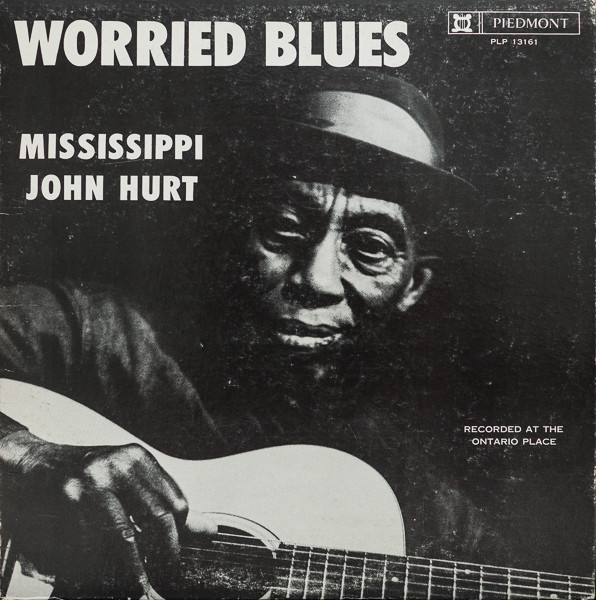
Worried Blues is an album by Mississippi John Hurt (John Smith Hurt, March 8, 1893 – November 2, 1966) that documents the first recordings of his rediscovery period. Recorded in the field in 1963 and released in early 1964 on Piedmont Records (PLP 13161), it is the second of the two Piedmont LPs cut immediately after Hurt was located alive in Avalon, Mississippi, nearly thirty-five years after his commercial career had ended.
Where Hurt's famous 1928 Okeh 78s were made inside a professional studio in Memphis and New York under the supervision of producer Tommy Rockwell, Worried Blues is the opposite: a portable-tape document of a seventy-year-old sharecropper playing on his front porch and in a small Washington, D.C. apartment, performing the songs he had carried in memory through decades of farm labor. Along with its companion LP Folk Songs and Blues (Piedmont PLP 13157, 1963), Worried Blues is the audio record of the folk revival's most celebrated rediscovery, and the repertoire it preserves became the foundation of Hurt's triumphant second career at the Newport Folk Festival and on Vanguard Records.
Later reissued in the UK and Europe on Flyright Records (FLY 541) and on CD as Worried Blues – The Piedmont Sessions, the album is frequently grouped with the Piedmont field tapes as the most intimate and unmediated portrait Hurt ever left on record.
Background and Context
By February 1928, John Hurt had traveled twice to make commercial records for Okeh: first to a field session in Memphis, then to New York City in December 1928, where he cut "Louis Collins," "Avalon Blues," "Candy Man Blues," "Spike Driver Blues" and eight other sides. The records sold poorly, the Depression ended Okeh's race series, and Hurt returned to Avalon. He farmed, picked cotton, and, in the language he used himself, "quit musicking for money."
His music survived only as collector's items. Two of the 1928 performances — "Frankie" and "Spike Driver Blues" — were chosen by Harry Smith for his Anthology of American Folk Music in 1952, where a generation of young northern players including Bob Dylan, Dave Van Ronk, John Fahey and Stefan Grossman heard a guitar style unlike anything else in pre-war blues: a gentle, almost whispered baritone over a bright, ragtime-inflected fingerpicking completely distinct from the slide-driven Delta style of Charley Patton or Son House.
In January 1963, Piedmont Records founder Tom Hoskins followed a clue hidden in plain sight. Hurt had closed his 1928 "Avalon Blues" with the line "Avalon's my home town, always on my mind." Using a 1878 postal atlas, Hoskins located Avalon, an unincorporated hamlet in Carroll County, drove there, and asked at the general store for a man who once made records. Directed to a shotgun house, he found Hurt tuning a battered Harmony Sovereign guitar he had bought for $1.50. Hoskins taped him on the spot, persuaded him to come north, and with Washington folklorist Dick Spottswood became his manager, booking agent and record producer.
Worried Blues is drawn from that first burst of rediscovery activity. It is not a contrived studio album but a field archive, sequenced for LP.
The Sessions
Recording Details
The recordings compiled on Worried Blues were made on a portable monaural tape recorder — Hoskins' Ampex and Spottswood's Uher — in two distinct locations during 1963:
Session One: Washington, D.C., April 1963. Immediately after his rediscovery, Hurt was brought to stay with Hoskins in the Washington area. Several performances were taped in Hoskins' apartment on 39th Street and in the living room of Spottswood's home, with rugs on the floor to damp reflections and the windows closed against traffic. These recordings are slightly drier and closer-miked.
Session Two: Avalon, Mississippi, July 1963. Hoskins and Spottswood traveled with Hurt back to his home between Avalon and Teoc. Performances were recorded on Hurt's screened porch and in his front room, with ambient sounds — cicadas, distant hounds, children in the yard — occasionally audible at the tape head. Hurt, who had not played regularly for years, was already regaining speed and repertoire, asking Spottswood to remind him of words to songs he had not sung since the 1920s.
Both sets were recorded at 7.5 ips on Scotch 111 tape, with a single Electro-Voice dynamic microphone placed eighteen inches from the guitar's soundhole and slightly favoring the voice. No second takes were requested for artistic reasons; Hoskins preferred to let Hurt play through his natural set as he would for visitors on the porch.
Production
The album was produced by Tom Hoskins and Dick Spottswood for Piedmont Records, the micro-label Hoskins and Spottswood had formed specifically to issue Hurt's rediscovery material, assisted by Ed Denson in pressing and distribution. Spottswood, already established as a discographer and field recordist, wrote the original liner notes, which for the first time provided accurate biographical information on Hurt, correcting three decades of rumor that he was dead or imprisoned.
The Piedmont aesthetic was intentionally non-interventionist. There was no reverberation added, no editing within performances, and no attempt to retune or pitch-correct Hurt's guitar, which he habitually tuned slightly flat of concert pitch to ease string tension on his fingers. The tapes were mastered for LP at Custom Recorders in Washington with minimal equalization, preserving the natural room tone. This approach, deliberate poverty of means, is why Worried Blues sounds more immediate and domestic than Hurt's later Vanguard studio albums Today! (1964) and The Immortal Mississippi John Hurt (1967), which were recorded with professional condenser microphones and light compression.
Musicians
Mississippi John Hurt — lead vocal and acoustic guitar on all tracks.
The album is entirely solo. Hurt played his mid-1930s Harmony Sovereign and occasionally a borrowed Guild F-30, both strung with light-gauge Black Diamond strings. He played in standard tuning (E-A-D-G-B-E) throughout, capoed at the second fret for several numbers to suit his vocal range, using a three-finger right-hand technique: thumb alternating on the fourth, fifth and sixth strings, index and middle fingers picking syncopated melodies on the treble strings.
There is no second instrument, no overdub, and no harmonic support. The completeness of Hurt's self-accompaniment — bass, harmony and melody generated simultaneously by one pair of hands — is the central musical fact of the album.
Songwriters
As with the 1928 sessions, the question of authorship is layered. The LP credits divide roughly into three categories:
Original compositions by Hurt built on traditional forms, including "Louis Collins," "Avalon Blues," and "Worried Blues" itself. Traditional ballads and folk songs arranged by Hurt, including "Frankie," "Stack O' Lee Blues," "Spike Driver Blues" and "Casey Jones." And popular ragtime and hokum songs absorbed from medicine shows and early records, including "Candy Man Blues" and "My Creole Belle."
Hurt did not compose in the Tin Pan Alley sense. He inherited floating verses, refashioned them to fit his alternating-bass guitar patterns, and made them personal through phrasing and timing. The liner notes therefore credit "Traditional, arranged by Mississippi John Hurt" where the provenance was communal, and "Hurt" where the narrative was identifiably his own.
Track-by-Track Breakdown
The Piedmont LP contained twelve titles. Flyright and later CD reissues vary by one or two alternates, but the core program remains consistent. All performances are 1963 field recordings by Hoskins and Spottswood.
1. "Worried Blues"
Songwriter: Mississippi John Hurt
Recorded in Washington, D.C., April 1963. The title track is not the 1928 Okeh coupling but a newly arranged piece Hurt had refined for house parties in the 1940s and 1950s. Played in C position, capo two sounding D, it features a lilting 8-bar progression that moves from C to C7 to F with a characteristic walk-down on the sixth string between verses. The alternating thumb is exceptionally steady, providing a marching quarter-note pulse over which Hurt picks a repeating two-bar treble motif. Lyrically it is a quintessential Hurt lament — not anguished but resigned and conversational — about a man who cannot sleep for thoughts of his woman. The performance on Worried Blues became the definitive version and gave the album its name.
2. "Slidin' Delta"
Songwriter: Mississippi John Hurt
Recorded Avalon, July 1963. An instrumental ragtime blues that Hurt used as a warm-up and as a dance number for local square dances. In G position, it showcases the fiddle-tune aspect of the Mississippi hill country string-band tradition Hurt learned from white fiddler Willie Narmour. The A section is a repeating 16-bar rag progression with a descending bass run on the sixth string that anticipates the Piedmont guitar style of Blind Blake. Spottswood later noted that Hurt called this his "showoff piece" and would grin whenever a northern folk guitarist tried to follow it.
3. "Frankie"
Songwriter: Traditional, arranged by Mississippi John Hurt
Recorded Washington, D.C., April 1963. This is the same murder ballad Hurt cut for Okeh in February 1928 — "Frankie was a good woman, everybody knows" — derived from the 1899 St. Louis killing of Albert Britt by Frankie Baker. The 1963 version is slower by nearly fifteen beats per minute, and the guitar is warmer than the brittle 1928 electric 78. Where the Okeh take is crisp and almost schoolroom-exact, the Piedmont take is looser, with Hurt humming the treble melody before entering and inserting a spoken aside — "this is a true story, it happen in St. Louis" — reflecting his medicine-show patter.
4. "My Creole Belle"
Songwriter: Mississippi John Hurt
Recorded Avalon, July 1963. The one great love song in Hurt's repertoire, written about his wife Jessie in the early 1920s. Hurt considered it his favorite composition and often requested that it not be interrupted. Played in A position, it features a delicate arpeggiated introduction with hammer-ons on the second string that imitate a music box. The lyric is notably tender and domestic for pre-war blues — a celebration of fidelity rather than betrayal — and the vocal is sung almost entirely in Hurt's soft head voice, barely above a whisper. Gary Davis later cited the song's harmonic movement as a direct influence on his own gospel-blues arrangements.
5. "Avalon Blues"
Songwriter: Mississippi John Hurt
Recorded Avalon, July 1963. The autobiographical E-position blues that had led Hoskins to Hurt's door. The lyric — "Avalon's my home town, always on my mind" — is delivered with audible amusement in 1963, as Hurt was now sitting thirty feet from where he had composed it in 1928. The guitar arrangement is one of his most driving, with a thumping open sixth-string drone that he dampens with the palm to produce a dry, percussive thud. The Field recordings reveal subtle melodic variations not present on the Okeh original, evidence that the tune had continued to evolve in his private playing during the silent decades.
6. "Nobody's Dirty Business"
Songwriter: Traditional, arranged by Mississippi John Hurt
Recorded Washington, D.C., April 1963. A descendant of the "Ain't Nobody's Business" family that stretches from Anna Myers' 1922 record through Jimmy Witherspoon. Hurt's version had been the B-side of his first 1928 Okeh 78. In G, with a characteristic alternating bass that walks from G to G7 to C, it is notable for Hurt's sly, almost comedic timing. He delivers the refrain — "If that man a-quit you, ain't nobody's business" — with a conspiratorial chuckle that reveals the song's function as social advice for a small, gossiping rural community.
7. "Louis Collins"
Songwriter: Mississippi John Hurt
Recorded Washington, D.C., April 1963. Hurt's original murder elegy, written about a local Avalon man who was shot during a dispute in 1928. Unlike "Frankie" or "Stack O' Lee," this is not folklore but neighborhood journalism, named for a real victim buried in the Avalon cemetery where Hurt would himself be buried three years later. Played in C, it features Hurt's most elaborate prelude — a thirty-second instrumental verse in harmonics and open strings that he had polished for the Vanguard sessions. The vocal is unusually solemn; Hurt never smiled through this one.
8. "Candy Man Blues"
Songwriter: Mississippi John Hurt
Recorded Avalon, July 1963. The hokum double-entendre that was Hurt's most requested number on the festival circuit. Though credited to Hurt on the Piedmont sleeve, the lyric floats from older "Candy Man" verses recorded by Gary Davis and Papa Charlie Jackson. Hurt's 1963 arrangement in A is definitive: a bright, almost major-key rag with a syncopated treble tag that imitates a candy vendor's call. The Piedmont take is slightly more suggestive than the Okeh original, as Hurt, freed from 1928 censorship concerns, lingers on the line "he's got a stick of candy nine inches long" with a deliberate, amused pause.
9. "Spike Driver Blues"
Songwriter: Traditional, arranged by Mississippi John Hurt (from the "John Henry" ballad cycle)
Recorded Avalon, July 1963. Also titled "John Henry" on some pressings. While included on Smith's Anthology from the 1928 Okeh take, the 1963 version is fundamentally re-conceived. Hurt abandons the hammered quarter-note bass of 1928 for a rolling, two-beat ragtime bass that physically mimics the swing of a nine-pound hammer. His vocal reframes the ballad: where most versions celebrate John Henry's triumph over the steam drill, Hurt identifies with the man who "takes sick and dies," singing with quiet sympathy for labor's cost. It remained his opening festival number through 1965.
10. "Stack O' Lee Blues"
Songwriter: Traditional, arranged by Mississippi John Hurt
Recorded Washington, D.C., April 1963. Hurt's reconstitution of the Stagolee legend, distinct from both the Delta version by Mississippi John Hurt's contemporary Furry Lewis and the hit by Lloyd Price. In D position, capo two sounding E, Hurt's version is remarkably non-violent and almost sympathetic to both men. The guitar plays a repeating four-bar phrase that circles Mixolydian and major intervals, giving the murder narrative a curiously sweet, lullaby-like cast. The irony between the bloody text and the gentle musical setting is the essence of Hurt's art.
11. "Coffee Blues"
Songwriter: Mississippi John Hurt
Recorded Avalon, July 1963. Also known as "Spike Driver Blues" is not to be confused with "Coffee Blues," a 1928 Maxwell House advertising jingle that Hurt transformed into a Piedmont guitar showcase. Played in G with a rapid, stuttering bass that imitates a gurgling percolator, it features Hurt's only extended percussive technique on the album — he taps the guitar body on beats two and four while maintaining the alternating bass. The lyric is a comically desperate plea for the correct blend of coffee, and Hurt delivers it with the timing of a vaudevillian.
12. "Casey Jones"
Songwriter: Traditional, arranged by Mississippi John Hurt (words by Wallace Saunders, music by Eddie Newton)
Recorded July 1963, Avalon. Often sequenced as the closing track, this train ballad allowed Hurt to display the string-band fiddle-tune sensibility he learned accompanying Willie Narmour. In C, the guitar imitates a locomotive bell with a repeating open first-string figure while the bass walks chromatically from C to F. Hurt's vocal adopts a mock-engineer bellow on the famous "Fireman, please don't jump" verse, recalling his days entertaining railroad section crews near Avalon.
Significance and Legacy
Worried Blues occupies a peculiar and crucial place in American music history. It is neither a pre-war artifact nor a polished late-career studio album. It captures the exact hinge moment between obscurity and revival.
Its first significance is documentary. The Piedmont field tapes preserve Hurt's repertoire at the moment of rediscovery before professional studio pressures, festival setlists and audience expectations standardized his performances. Tempos are freer, verses are ordered differently than on the later Vanguard recordings, and Hurt occasionally forgets a line and laughs. For scholars of Piedmont and Mississippi hill country fingerpicking, these are the most naturalistic examples of a style that had evolved entirely outside the commercial recording industry.
Second, the album established the model for how the rediscovery blues would be presented to the 1960s folk audience. Vanguard's later productions would add tasteful room ambience and careful microphone placement; Arhoolie and Blue Goose would follow the Piedmont field-tape example with Skip James and Fred McDowell. Hoskins and Spottswood demonstrated that a single microphone, a porch, and a respectful silence could yield recordings that felt more authoritative than a Manhattan studio.
Third, the repertoire codified here became the standard curriculum for a generation of fingerstyle guitarists. Stefan Grossman transcribed "Candy Man Blues" and "My Creole Belle" note-for-note for his early Oak Publications instruction books. John Fahey cited the 1963 "Avalon Blues" as the track that taught him that alternating bass could be a meditation rather than a technical exercise. Jerry Garcia, who studied directly with Hurt at the 1964 Berkeley Folk Festival, built his acoustic arrangements of "Spike Driver Blues" and "Louis Collins" from the Worried Blues voicings.
Finally, the album's quiet commercial success — it never charted nationally but sold steadily through folk and college shops for fifteen years — helped fund Hurt's medical care in his final years and enabled Piedmont to issue further field recordings by Skip James and Rose Hemphill. Hurt, who had earned a flat $20 per side in 1928, finally received royalties at age seventy.
When Hurt died of a myocardial infarction on November 2, 1966, in Grenada, Mississippi, Worried Blues was still in print on Piedmont, and Today! was in the Billboard folk chart. Together they ensured that his gentle, syncopated alternative to Delta blues entered the permanent American songbook, not as a nostalgic curiosity but as a living, teachable guitar language.
Album Details Summary:
Artist: Mississippi John Hurt
Album: Worried Blues
Label: Piedmont Records PLP 13161, later Flyright FLY 541, Stax / Fantasy reissues
Recorded: April 1963, Washington, D.C. and July 1963, Avalon, Mississippi
Released: Early 1964
Producers: Tom Hoskins and Dick Spottswood
Personnel: Mississippi John Hurt, vocals and acoustic guitar, solo throughout
Genre: Piedmont blues, country blues, folk blues, American songster tradition