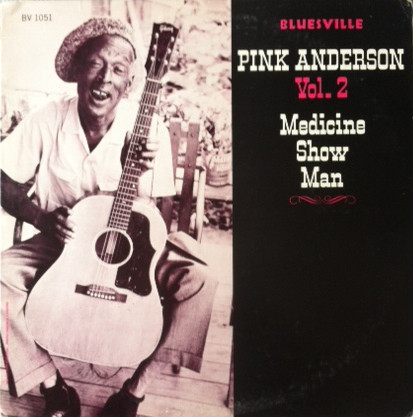
Vol. 2: Medicine Show Man is a solo acoustic album by Pink Anderson (February 12, 1900 – October 12, 1974), recorded on May 29, 1961, in New York City and released the following year on Bluesville Records (BVLP 1051), a subsidiary of the prestigious Prestige jazz label. The album is the second in a series of three solo LPs that Anderson recorded for Bluesville during the early 1960s, and it stands as one of the most vivid and historically valuable documents of the American medicine show tradition ever committed to tape.
Anderson was a native of Spartanburg, South Carolina, and a lifelong practitioner of the Piedmont fingerpicking guitar style that flourished in the southeastern United States during the first half of the twentieth century. Unlike the raw, slide-driven intensity of the Mississippi Delta blues, the Piedmont tradition was characterized by its syncopated, ragtime-inflected fingerpicking, its bright and melodic tonalities, and its deep connections to the traveling entertainment circuits—medicine shows, carnivals, and tent revues—that crisscrossed the rural South from the 1890s through the 1930s. Anderson spent nearly four decades performing in these medicine shows, and Medicine Show Man is his most sustained musical testament to that vanished world.
The album captures a man in his early sixties performing the songs he had sung on street corners and makeshift stages across the Carolinas, Georgia, and Virginia since his youth. There is no band, no studio artifice, and no concession to contemporary musical fashion. What the listener encounters is a single voice and a single guitar, preserving a repertoire and a performance tradition that was already ancient when the recordings were made and that has since disappeared almost entirely from living memory.
Background and Context
Pink Anderson and the Medicine Show Tradition
Pink Anderson's life story is inseparable from the history of the American medicine show, one of the most important and least documented institutions in the cultural history of the rural South. Medicine shows were traveling theatrical productions that combined musical performances, comic routines, juggling, magic tricks, and dramatic sketches with the sale of patent medicines—tonics, elixirs, liniments, and cure-alls whose therapeutic claims were almost entirely fictitious but whose commercial appeal was enormous in communities with limited access to professional medical care.
Anderson joined his first medicine show as a teenager in the 1910s, working with Dr. Kerr's Medicine Show, a traveling outfit that toured the small towns and rural crossroads of the Southeast. He quickly became one of the show's featured performers, singing comic songs, playing guitar, and engaging in the kind of crowd-pleasing banter that was essential to holding an audience's attention long enough to sell the merchandise. Over the following decades, Anderson worked with numerous medicine show troupes, including the famous Dr. W.R. Kerr Indian Medicine Show, and he continued performing in this context well into the 1950s, long after the medicine show tradition had been rendered obsolete by radio, television, and the regulation of patent medicines.
The medicine show repertoire was extraordinarily diverse, reflecting the eclectic tastes of rural Southern audiences. A typical show might include blues numbers, ragtime instrumentals, Tin Pan Alley popular songs, minstrel-show comedy routines, gospel hymns, sentimental ballads, and novelty songs, all performed in rapid succession by a small troupe of musicians and entertainers. This diversity is reflected in the track listing of Medicine Show Man, which moves freely between blues, ragtime, comic novelties, and spiritual material without any sense of generic boundary or hierarchy.
Anderson's Musical Style
Anderson's guitar playing is a textbook example of the Piedmont blues style, though the term "blues" is somewhat misleading when applied to a musician whose repertoire extended far beyond the twelve-bar form. The Piedmont style, associated with the southeastern seaboard states from Virginia to Georgia, is characterized by a sophisticated fingerpicking technique in which the thumb maintains a steady alternating bass pattern on the lower strings while the index and middle fingers pick out syncopated melodic figures on the treble strings. The result is a bright, buoyant, and rhythmically complex sound that owes as much to ragtime piano and parlor guitar traditions as to the blues.
Anderson's particular approach to the Piedmont style is notable for its relaxed, unhurried quality. Where some Piedmont guitarists—Blind Blake, for example—played with a dazzling, almost virtuosic speed, Anderson favored a more measured, conversational pace that allowed each note and phrase to register clearly. His right-hand technique is precise and controlled, his bass lines are steady and propulsive, and his treble melodies are clean and melodically inventive. His vocal delivery is equally distinctive: warm, slightly nasal, and inflected with the easy humor and theatrical timing of a man who spent his life entertaining crowds on street corners and in makeshift theaters.
The Folk Revival and Anderson's Rediscovery
Anderson's recording career began in 1950, when the folklorist Paul Clayton recorded him in Spartanburg for a Folkways Records release. These early recordings brought Anderson to the attention of the growing folk revival movement, and in 1956 he recorded a set of shared sides with Reverend Gary Davis for Riverside Records, released as American Street Songs. The Riverside sessions introduced Anderson to a wider audience and established him as one of the surviving links to the pre-war Southern entertainment tradition.
By the early 1960s, the folk revival was at its peak, and record labels were eager to document the remaining practitioners of traditional American music before they passed from the scene. Samuel Charters, the blues historian and producer whose 1959 book The Country Blues had been instrumental in catalyzing the revival's interest in pre-war African American music, arranged for Anderson to record a series of solo albums for the Bluesville label. The result was a trilogy of LPs—Carolina Blues Man (Vol. 1, 1961), Medicine Show Man (Vol. 2, 1962), and The Blues of Pink Anderson (Vol. 3, 1963)—that collectively represent the most comprehensive documentation of Anderson's artistry.
The Sessions
Recording Details
The sessions for Medicine Show Man took place on a single day, May 29, 1961, in New York City. The recording was made at the studios used by Prestige Records, likely at the Van Gelder Studio in Englewood Cliffs, New Jersey, or at Prestige's Manhattan facilities, though the exact location is not always specified in the discographical literature. The single-day format was typical of Bluesville's recording practices, which favored quick, economical sessions that captured the artist's natural performance style without the interference of elaborate production techniques.
Anderson traveled from Spartanburg to New York for the session, bringing with him the repertoire of songs he had been performing for decades. The recordings were made in a straightforward, documentary fashion: Anderson sat before a microphone with his acoustic guitar and performed the songs he knew, with minimal direction or intervention from the production team. The result is an album of remarkable immediacy and authenticity, preserving the sound of a medicine show performance in all its spontaneity and variety.
Production
The album was produced by Samuel Charters (1929–2015), one of the most important figures in the documentation and popularization of American vernacular music. Charters had been recording traditional blues and folk artists since the 1950s, and his approach to production was characterized by a deep respect for the integrity of the performer's art. He understood that his role was not to shape or improve the music but to capture it as faithfully as possible, and his sessions with Anderson reflect this philosophy.
Charters' production on Medicine Show Man is transparent and unobtrusive. The recordings have a clean, intimate quality that places Anderson's voice and guitar in sharp focus, with no reverb, echo, or other studio effects to distance the listener from the performance. The audio quality is excellent by the standards of early 1960s acoustic recording, and the transfers to the original LP format preserved the warmth and presence of Anderson's sound with commendable fidelity.
Charters also wrote the liner notes for the original release, providing valuable context about Anderson's life, the medicine show tradition, and the origins of the songs on the album. His notes are among the most informative primary sources available on the subject of medicine show entertainment, and they remain essential reading for anyone interested in this chapter of American cultural history.
Musicians and Songwriters
The album is a solo performance throughout. Pink Anderson provides all vocals and acoustic guitar, with no accompaniment of any kind. This self-sufficiency was a hallmark of the medicine show performer, who had to be able to hold an audience's attention with nothing more than a guitar, a voice, and a repertoire of songs and stories.
The question of songwriting on Medicine Show Man is complex and resists simple attribution. Most of the songs on the album are drawn from the shared repertoire of the medicine show and vaudeville traditions, and their origins are often obscure or disputed. Some of the songs are traditional folk and blues numbers that had been circulating orally for decades before Anderson learned them. Others are adaptations of Tin Pan Alley popular songs, minstrel-show standards, or comic novelties that Anderson absorbed during his years on the road and made his own through years of performance. A few may be Anderson's original compositions, though the line between original creation and creative adaptation is difficult to draw in a tradition that valued personal interpretation over fixed authorship.
The album credits the songs variously to "Traditional," to Anderson himself, or to specific composers where the origins are known. In practice, Anderson's versions of these songs are so thoroughly personalized—so deeply shaped by his individual vocal phrasing, guitar arrangements, and performative sensibility—that they function as original artistic statements regardless of their ultimate provenance.
Track-by-Track Breakdown
"I Got Mine"
Songwriter: Traditional, arranged by Pink Anderson
The album opens with "I Got Mine," a sprightly, good-humored number that immediately establishes the tone of the record. The song belongs to a family of boastful, self-satisfied blues and folk songs in which the narrator declares his contentment with his lot in life despite the opinions or criticisms of others. The "mine" of the title is deliberately ambiguous—it could refer to a woman, a way of life, a philosophical outlook, or simply the satisfaction of self-possession—and Anderson delivers the lyrics with a wry, knowing smile that invites the listener to share in his amusement.
The guitar work is a model of Piedmont fingerpicking clarity. Anderson's thumb maintains a steady, bouncing bass line that gives the song its forward momentum, while his fingers pick out a bright, syncopated melody on the treble strings that dances around the vocal phrases with effortless grace. The rhythmic feel is closer to ragtime than to blues, with a lilting, almost jaunty quality that reflects the song's comic origins in the medicine show repertoire. Anderson's vocal delivery is relaxed and conversational, with the easy timing of a performer who has told this particular joke a thousand times and still finds it funny.
"Greasy Greens"
Songwriter: Traditional, arranged by Pink Anderson
"Greasy Greens" is one of the album's most distinctive and historically revealing tracks, a comic song about the dietary staples of the rural Southern poor. "Greasy greens" refers to collard greens, turnip greens, and other leafy vegetables cooked with fatback or salt pork—a humble but nutritious dish that was a cornerstone of the African American diet in the Jim Crow South. The song treats this subject with affectionate humor, celebrating the pleasures of simple food while acknowledging the economic circumstances that made such simplicity a necessity rather than a choice.
Anderson's performance is animated and theatrical, with vocal inflections and rhythmic accents that suggest the physical comedy of the medicine show stage. The guitar accompaniment is bouncy and propulsive, with a rhythmic drive that evokes the energy of a live performance before an enthusiastic crowd. The song's humor is rooted in the specific material realities of Southern working-class life, and Anderson's delivery conveys both the genuine pleasure of the food described and the ironic awareness of the social conditions that made it a dietary staple.
The track is a valuable document of the comic and satirical dimensions of the medicine show tradition, which often used humor about food, money, and daily life to create a sense of shared experience and communal solidarity among its audiences.
"I Got a Woman 'Way Cross Town"
Songwriter: Traditional, arranged by Pink Anderson (thematically related to the broader blues tradition of songs about distant lovers, though distinct from Ray Charles' later R&B hit of a similar title)
This medium-tempo blues addresses one of the most enduring themes in the tradition: the complications of romantic geography. The narrator's woman lives "way cross town," a distance that is both literal and metaphorical, suggesting the obstacles and inconveniences that separate the lovers and complicate their relationship. The song's treatment of this theme is characteristically lighthearted, with Anderson approaching the material as a comic complaint rather than a tragic lament.
The guitar work features a relaxed, swinging feel that sits comfortably between blues and ragtime, with Anderson's fingerpicking providing a steady rhythmic foundation while his vocal delivery adds layers of humor and personality. The performance has the casual, improvisational quality of a medicine show routine, with Anderson stretching phrases, adding spoken asides, and varying his rhythmic emphasis in ways that suggest a performer responding to the energy of a live audience even in the controlled environment of the recording studio.
"Travelin' Man"
Songwriter: Traditional, arranged by Pink Anderson
"Travelin' Man" is a song that speaks directly to Anderson's own life experience as a itinerant performer who spent decades on the road with medicine shows and traveling troupes. The theme of the wandering man—restless, rootless, unable or unwilling to settle in one place—is one of the great archetypes of American vernacular music, appearing in countless blues, folk, and country songs from the earliest recordings to the present day.
Anderson's version is notable for its autobiographical resonance. When he sings about the pleasures and hardships of the traveling life, he is drawing on four decades of firsthand experience, and the performance carries a weight of authenticity that transcends the conventional nature of the lyrics. The guitar work is steady and driving, with a walking bass line that physically embodies the act of movement, and the vocal delivery is warm and reflective, suggesting a man looking back on a life of constant motion with a mixture of pride and weariness.
The track is one of the album's most emotionally complex performances, balancing the romantic allure of the open road against the loneliness and instability that accompanied it. Anderson's ability to hold these contradictory emotions in tension within a single performance is a testament to the depth of his artistry.
"Ain't Nobody Home But Me"
Songwriter: Traditional, arranged by Pink Anderson
This slow, contemplative blues is one of the album's most poignant moments, a meditation on solitude and self-reliance that resonates with the experience of an aging performer whose world has changed dramatically around him. The lyrics describe a state of radical aloneness—the narrator returns home to find that everyone else has left, and he is the sole occupant of his own life. The sentiment is delivered without self-pity or melodrama, with Anderson's characteristic understatement lending the song a quiet dignity that is deeply affecting.
The guitar accompaniment is spare and deliberate, with Anderson allowing space and silence to play a significant role in the arrangement. The fingerpicking is slower and more measured than on the uptempo numbers, with each note given room to resonate and decay before the next is struck. The vocal delivery is intimate and confessional, with Anderson singing as if to himself rather than to an audience, creating a sense of private reflection that is rare in the more extroverted medicine show repertoire.
The track demonstrates that Anderson's artistry extended far beyond the comic novelties and crowd-pleasing showpieces for which the medicine show tradition is best remembered. His slow blues performances reveal a depth of feeling and a subtlety of expression that place him among the most accomplished acoustic blues artists of his generation.
"That's No Way to Do"
Songwriter: Traditional, arranged by Pink Anderson
"That's No Way to Do" is a gently admonishing blues in which the narrator critiques the behavior of a lover or acquaintance whose conduct falls short of acceptable standards. The song's tone is more amused than angry, with Anderson delivering the reprimand with the easy authority of an elder who has seen enough of the world to know how things ought to be done.
The guitar work is bright and rhythmic, with a syncopated feel that gives the song a playful, almost teasing quality. Anderson's fingerpicking is particularly nimble on this track, with rapid treble figures that weave around the vocal melody in a manner that suggests the influence of ragtime piano transcriptions for guitar. The vocal delivery is conversational and slightly sardonic, with Anderson emphasizing key phrases through subtle shifts in timing and dynamics that reveal his mastery of performative nuance.
"In the Jailhouse Now"
Songwriter: Jimmie Rodgers (originally recorded 1928), adapted by Pink Anderson
"In the Jailhouse Now" is the album's most famous track and one of the most widely recognized songs in the entire American folk and country repertoire. The song was originally popularized by Jimmie Rodgers, the "Singing Brakeman" and one of the founding figures of country music, who recorded it in 1928 for Victor Records. Rodgers' version became a massive hit and has been covered by hundreds of artists across every genre of American music, from bluegrass to rock and roll.
The song tells the story of a man named Ramblin' Bob who gambles, drinks, and generally lives beyond the bounds of respectability until he inevitably lands in jail. The moral is delivered with comic understatement: "He's in the jailhouse now." The song's enduring appeal lies in its combination of narrative simplicity, melodic catchiness, and the universal human fascination with transgression and its consequences.
Anderson's version transforms the song from a country novelty into a Piedmont blues showcase. His fingerpicking arrangement is considerably more complex than Rodgers' straightforward strumming, with intricate bass-treble interplay and syncopated rhythmic accents that give the familiar melody a new harmonic richness. The vocal delivery is warm and unhurried, with Anderson savoring the comic details of the narrative and delivering the punchline of each verse with impeccable timing. The performance demonstrates Anderson's ability to absorb material from outside the blues tradition and remake it in his own image, a skill that was essential to the medicine show performer who had to be able to play whatever the audience wanted to hear.
"South Forest Boogie"
Songwriter: Pink Anderson
"South Forest Boogie" is one of the album's instrumental highlights, a driving, uptempo guitar piece that showcases Anderson's technical command of the Piedmont fingerpicking style. The "boogie" of the title refers to the rhythmic feel of the piece—a propulsive, eight-to-the-bar pulse that drives the music forward with irresistible momentum. The "South Forest" reference connects the piece to the rural landscape of the South Carolina Piedmont, the region where Anderson grew up and spent much of his performing life.
The guitar work on this track is among Anderson's most impressive on record. His thumb maintains a rock-steady bass line that provides the rhythmic foundation, while his fingers execute rapid, syncopated treble figures that create the illusion of multiple instruments playing simultaneously. The piece moves through a series of variations on its central theme, with Anderson introducing new melodic ideas, rhythmic shifts, and harmonic embellishments that keep the music fresh and engaging throughout its duration.
The track is a reminder that the Piedmont guitar tradition was not merely an accompaniment style for vocal blues but a fully developed instrumental art form in its own right, capable of sustaining extended solo performances of considerable complexity and excitement. Anderson's boogie pieces connect the Piedmont tradition to the broader history of American guitar music, anticipating the solo instrumental styles that would later be developed by artists like John Fahey and Leo Kottke.
"Chicken"
Songwriter: Traditional, arranged by Pink Anderson
"Chicken" is a lighthearted comic novelty that belongs to a long tradition of African American folk songs about poultry—theft, preparation, consumption, and the general chaos that chickens introduce into rural life. Songs about chickens were staples of the medicine show repertoire, providing easy laughs and a sense of shared cultural reference that connected performers and audiences across class and regional lines.
Anderson's performance is delivered with evident relish, his voice carrying the playful, slightly mischievous tone of a man telling a story he knows will get a laugh. The guitar accompaniment is bouncy and rhythmic, with a syncopated feel that suggests the frantic, fluttering energy of the barnyard subject matter. The track is a vivid reminder of the comic and theatrical dimensions of the medicine show tradition, which relied as much on humor and audience interaction as on musical virtuosity to hold a crowd's attention.
"I'm Going to Walk Through the Streets of the City"
Songwriter: Traditional, arranged by Pink Anderson (drawing on gospel and spiritual traditions)
The album closes with a spiritual number that provides a striking contrast to the secular and often comic material that precedes it. "I'm Going to Walk Through the Streets of the City" draws on the imagery of the Book of Revelation, envisioning the narrator's arrival in the New Jerusalem—the heavenly city described in Christian eschatology as the ultimate destination of the faithful. The song belongs to the rich tradition of African American sacred music that coexisted with the secular blues and folk repertoire throughout the South, and its inclusion on the album reflects the holistic nature of Anderson's musical world, in which sacred and secular were not opposing categories but complementary dimensions of a single cultural experience.
Anderson's vocal delivery on this track is reverent and deeply felt, with a sincerity that stands in marked contrast to the playful irony of the comic numbers. The guitar accompaniment is gentle and hymn-like, with a steady, processional rhythm that evokes the act of walking toward a distant but certain destination. The performance has a quiet, valedictory quality that makes it a fitting conclusion to the album, suggesting a man who has spent his life traveling the roads of the rural South and who now looks forward to a final journey of a different kind.
The track also serves as a reminder that the medicine show tradition, for all its emphasis on entertainment and commerce, was embedded in a broader cultural context that included the church, the family, and the community. Anderson's ability to move seamlessly between sacred and secular material reflects the integrated nature of African American musical culture in the pre-war South, where the boundaries between gospel, blues, folk, and popular music were far more porous than later genre categories would suggest.
Buy The Album
Significance and Legacy
The Preservation of the Medicine Show Tradition
The most important legacy of Medicine Show Man is its role as a document of a vanished cultural institution. The American medicine show was one of the primary vehicles for the dissemination of popular music, comedy, and theatrical entertainment in the rural South during the first half of the twentieth century, and its influence on the development of blues, country, and early rock and roll was profound. Yet the medicine show tradition was almost entirely undocumented during its heyday, and by the time folklorists and record producers began to take an interest in it during the 1950s and 1960s, the tradition had effectively disappeared.
Anderson was one of the very last surviving medicine show performers, and his Bluesville recordings represent the most detailed and authentic musical documentation of the tradition that exists. The songs on Medicine Show Man—with their mixture of blues, ragtime, comic novelties, popular standards, and spirituals—provide a vivid picture of the eclectic, genre-defying repertoire that characterized the medicine show stage. Without Anderson's recordings, our understanding of this crucial chapter in American entertainment history would be significantly poorer.
The Piedmont Blues Tradition
The album is also a landmark document of the Piedmont blues style, one of the major regional traditions of African American acoustic guitar music. While the Delta blues has received the lion's share of critical and popular attention, the Piedmont tradition—with its ragtime-influenced fingerpicking, its melodic sophistication, and its connections to the broader currents of American popular music—represents an equally important and arguably more musically diverse branch of the blues family tree.
Anderson's guitar work on Medicine Show Man demonstrates the full range and complexity of the Piedmont style, from the driving boogie patterns of "South Forest Boogie" to the delicate, hymn-like accompaniments of the closing spiritual. His playing reveals a tradition that was technically demanding, harmonically adventurous, and rhythmically sophisticated, challenging the stereotype of the country blues as a primitive or unschooled art form.
The Pink Floyd Connection
In a curious footnote to music history, Pink Anderson's name achieved a kind of immortality through its connection to the British rock band Pink Floyd. In 1965, the young Syd Barrett, then the leader of a Cambridge-based R&B band called the Tea Set, discovered that another band on the local circuit was also using that name. Searching for an alternative, Barrett combined the first names of two blues musicians whose records he admired: Pink Anderson and Floyd Council (a Piedmont blues guitarist from Chapel Hill, North Carolina, who had recorded with Blind Boy Fuller in the 1930s). The resulting name—Pink Floyd—became one of the most famous in the history of popular music, ensuring that Anderson's name would be known to millions of listeners who might never have encountered his actual recordings.
This connection, while largely coincidental, has helped draw attention to Anderson's music and to the broader Piedmont blues tradition from which he emerged. Many rock fans who first encountered the name "Pink Anderson" through the Pink Floyd connection have gone on to discover his recordings and to appreciate the rich musical heritage that lies behind the band's name.
Influence on the Folk Revival and Beyond
Medicine Show Man and Anderson's other Bluesville recordings have been influential among folk and acoustic blues musicians since their initial release. His fingerpicking style has been studied and emulated by generations of guitarists, and his repertoire of medicine show songs has been drawn upon by performers seeking to expand their understanding of the pre-war Southern tradition. The album's emphasis on the diversity and eclecticism of the medicine show repertoire has also helped to broaden the conception of what "the blues" means, challenging the narrow, Delta-centric narrative that has dominated much blues scholarship and popular discourse.
The album has been reissued multiple times on CD and digital formats, most notably by the Fantasy Records group (which acquired the Prestige/Bluesville catalog) and by various European reissue labels. These reissues have ensured that Anderson's music remains accessible to new generations of listeners and scholars, and they have contributed to a growing appreciation of the Piedmont tradition and the medicine show legacy within the broader blues and folk communities.
A Document of Cultural Resilience
Beyond its musical and historical significance, Medicine Show Man is a document of extraordinary cultural resilience. Pink Anderson was born into the Jim Crow South, spent his life performing in a tradition that was marginalized and eventually rendered obsolete by technological and social change, and yet he maintained his artistry, his repertoire, and his sense of humor through decades of hardship and neglect. The music on this album is the product of a life lived entirely outside the mainstream of American commercial culture, and its survival is a testament to the power of oral tradition, community memory, and individual dedication.
Listening to Medicine Show Man more than sixty years after its recording, one is struck not by the distance between Anderson's world and our own but by the immediacy and vitality of the performances. The songs are funny, moving, technically accomplished, and emotionally honest, and they communicate their meanings with a directness that requires no historical context or scholarly apparatus to appreciate. This is the ultimate achievement of the album: it preserves a vanished world not as a museum exhibit but as a living, breathing artistic experience that continues to resonate with listeners who have never set foot on a medicine show stage and who may never have heard of the Piedmont blues before pressing play.
Album Details Summary:
- Artist: Pink Anderson
- Album: Vol. 2: Medicine Show Man
- Label: Bluesville Records (BVLP 1051), a subsidiary of Prestige Records
- Recorded: May 29, 1961, New York City area
- Released: 1962
- Producer: Samuel Charters
- Format: Solo acoustic performance (vocals and guitar)
- Personnel: Pink Anderson (vocals, acoustic guitar)
- Genre: Piedmont blues, folk blues, medicine show music, ragtime guitar, traditional American folk