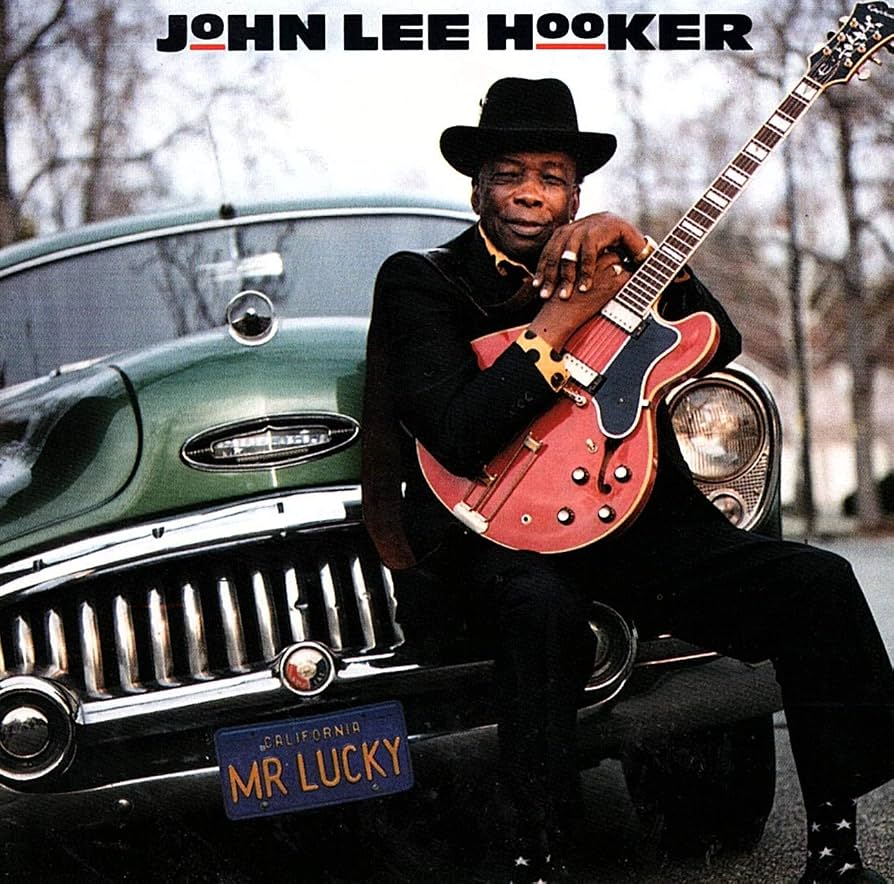
Mr. Lucky, released in 1991 on Pointblank Records (a subsidiary of Virgin Records), is the second album of John Lee Hooker's extraordinary late-career renaissance, following the massive commercial and critical triumph of The Healer (1989). Where The Healer had stunned the music world by pairing the seventy-two-year-old blues patriarch with a roster of rock and blues luminaries and delivering Hooker his first gold record and a Grammy Award, Mr. Lucky consolidated that success, proving that the comeback was no fluke and that Hooker's creative powers remained formidable well into his eighth decade.
Produced by guitarist Ry Cooder and Hooker's longtime musical director Roy Rogers, the album reprised the collaborative formula of its predecessor, surrounding Hooker's unmistakable voice and hypnotic guitar with an all-star cast that included Albert Collins, Robert Cray, Carlos Santana, Keith Richards, Johnny Winter, and Johnnie Johnson. The result was an album that reached the Top 10 in the United Kingdom and charted strongly across Europe, further cementing Hooker's status as a living legend whose music could bridge generations and genres with effortless authority.
Background and Context
The Healer and the Late-Career Resurgence
To understand Mr. Lucky, one must first understand the remarkable trajectory that brought John Lee Hooker to this point. By the mid-1980s, Hooker's career had entered a period of relative decline. While he remained a revered figure among blues connoisseurs and continued to tour regularly, his commercial profile had diminished significantly since his peak years with Vee-Jay Records in the late 1950s and early 1960s. The blues revival of the 1960s had given way to rock, funk, disco, and eventually hip-hop, and the aging blues masters who had inspired those movements found themselves increasingly marginalized by the very industry they had helped create.
Everything changed in 1989 when producer and guitarist Roy Rogers, who had been playing in Hooker's Coast to Coast Blues Band since the early 1980s, conceived the idea of pairing Hooker with a series of high-profile guest artists for a studio album. The resulting record, The Healer, featured collaborations with Carlos Santana, Bonnie Raitt, Robert Cray, George Thorogood, Charlie Musselwhite, and Los Lobos, among others. The album was a sensation, selling over a million copies, winning a Grammy for the title track (featuring Bonnie Raitt), and introducing Hooker's music to a massive new audience of younger listeners who had never encountered his work before.
The success of The Healer created enormous pressure for a follow-up, and Pointblank Records—a newly established blues imprint within the Virgin Records empire, created specifically to capitalize on the resurgence of interest in traditional blues—moved quickly to bring Hooker back into the studio.
The Pointblank Records Strategy
Pointblank Records was founded in 1990 by John Wooler and Kevin Eggers as a dedicated blues label within the Virgin Records family. The label's strategy was to sign established blues legends and pair them with contemporary producers and guest musicians who could bring fresh energy to traditional material while maintaining the authenticity that made the music compelling in the first place. Hooker was the label's flagship artist, and Mr. Lucky was one of its earliest and most important releases.
The label understood that the collaborative formula of The Healer was the key to Hooker's renewed commercial viability, and they gave Rogers and Cooder the resources and freedom to assemble an even more impressive roster of guest musicians for the new album. The result was a record that was simultaneously a celebration of Hooker's legacy and a demonstration of his continuing relevance to contemporary music.
The Sessions
Recording Details
The sessions for Mr. Lucky took place primarily at The Plant Recording Studios in Sausalito, California, during 1990 and early 1991. The Plant was a well-equipped professional facility that had hosted recordings by numerous major artists, and its comfortable, spacious tracking rooms were well suited to the ensemble-oriented approach that Rogers and Cooder envisioned for the album.
Additional recording and overdubbing may have taken place at other Bay Area studios, reflecting the logistical complexities of coordinating the schedules of the many high-profile guest musicians involved in the project. The sessions were conducted in a relaxed, unhurried atmosphere that allowed Hooker to perform at his own pace—a crucial consideration given his age and his famously idiosyncratic approach to rhythm and song structure.
Production
The album was co-produced by Ry Cooder and Roy Rogers, a partnership that brought together two very different but complementary musical sensibilities.
Roy Rogers (born Roy Lee Rogers, not to be confused with the singing cowboy of the same name) was a slide guitarist and musical director who had been working with Hooker since 1982 as a member of the Coast to Coast Blues Band. Rogers understood Hooker's musical personality more intimately than perhaps any other living musician, having spent nearly a decade learning to anticipate and accommodate the older man's unpredictable timing, spontaneous structural changes, and instinctive approach to performance. His role as co-producer was essential in creating an environment in which Hooker could function naturally, without the constraints that a more conventional producer might have imposed.
Ry Cooder brought a different set of qualifications to the project. As one of the most respected and knowledgeable guitarists in American music, Cooder possessed an encyclopedic understanding of blues, folk, gospel, and roots traditions that made him an ideal collaborator for Hooker. His production style was characterized by warmth, spaciousness, and a deep respect for the organic qualities of live performance. Cooder's involvement lent the project considerable prestige and helped attract the high-caliber guest musicians who contributed to the album.
The production approach on Mr. Lucky was deliberately organic and uncluttered. Rather than imposing elaborate arrangements or modern studio techniques on Hooker's music, Cooder and Rogers sought to create a sonic environment that highlighted the raw power and emotional directness of his performances. The recordings have a warm, analog quality that places Hooker's voice and guitar at the center of the mix, with the guest musicians and rhythm section providing supportive coloration rather than competing for attention.
Musicians
The core rhythm section for the album consisted of musicians drawn from Hooker's Coast to Coast Blues Band and from the broader Bay Area blues community:
Roy Rogers served as musical director and played slide guitar and rhythm guitar throughout the sessions, providing the musical foundation that allowed Hooker to perform with maximum freedom. His deep familiarity with Hooker's style meant that he could anticipate the older man's rhythmic shifts and structural detours, guiding the ensemble through performances that might otherwise have dissolved into chaos.
Johnnie Johnson, the legendary pianist best known for his decades-long collaboration with Chuck Berry, contributed piano and keyboards on several tracks. Johnson's rolling, boogie-woogie-inflected piano style was a natural fit for Hooker's music, and his presence on the album connected Hooker to the broader tradition of postwar rhythm and blues.
The guest musicians who contributed to individual tracks included Albert Collins, the "Master of the Telecaster," whose icy, stinging guitar tone provided a dramatic contrast to Hooker's warmer, more percussive approach; Robert Cray, the smooth-voiced modern blues star whose clean, precise guitar work complemented Hooker's rougher textures; Carlos Santana, whose soaring, sustain-laden lead guitar added a Latin-tinged melodic dimension; Keith Richards, whose loose, swaggering rhythm guitar brought the Rolling Stones' deep blues roots into direct conversation with one of the tradition's founding figures; and Johnny Winter, whose fiery, high-energy slide guitar provided some of the album's most electrifying moments.
Additional musicians included bass players, drummers, and keyboardists from the Bay Area session community, all of whom were experienced in the art of accompanying idiosyncratic blues performers and who understood the importance of listening and responding to Hooker's musical cues rather than imposing predetermined structures.
Track-by-Track Breakdown
"Rockin' Chair"
Songwriter: John Lee Hooker
The album opens with "Rockin' Chair," a medium-tempo blues that immediately establishes the warm, inviting sonic world of the record. The song is built on one of Hooker's characteristic one-chord grooves—a hypnotic, repetitive guitar figure that cycles with the inevitability of a heartbeat while Hooker's voice rides over the top with the conversational ease of a man telling stories on his front porch.
The "rockin' chair" of the title is both a literal image and a metaphor for the contemplative, unhurried perspective of a man who has lived long enough to see the world turn many times. Hooker's vocal delivery is relaxed and authoritative, moving between singing and speaking with the fluid naturalness that had always been his hallmark. The rhythm section provides a steady, unobtrusive foundation, and the guitar tones are warm and full, with Roy Rogers' slide work adding subtle coloration in the spaces between Hooker's vocal phrases.
As an opening statement, "Rockin' Chair" signals that Mr. Lucky will not be a frantic attempt to recapture the commercial energy of The Healer but rather a more measured, reflective continuation of Hooker's artistic journey. The song has the comfortable authority of a master who knows he has nothing left to prove.
"Playin' the Blues"
Songwriter: John Lee Hooker
Featured Guest: Albert Collins (guitar)
"Playin' the Blues" is one of the album's most dynamic tracks, pairing Hooker with the great Albert Collins, whose razor-sharp Telecaster tone and unconventional minor-key tunings made him one of the most distinctive guitarists in postwar blues. The collaboration is a study in contrasts: Hooker's warm, droning, rhythmically free approach against Collins' icy, precise, harmonically adventurous style.
The song is a celebration of the blues itself—a meta-commentary on the act of playing the music that had sustained both men throughout their lives. Hooker's vocal delivery is enthusiastic and engaged, and his guitar work has a driving energy that pushes the track forward with considerable momentum. Collins' contributions are characteristically striking, with his trademark "ice pick" tone cutting through the mix like a blade, providing sharp, angular lead lines that contrast dramatically with Hooker's more rounded, percussive figures.
The interplay between the two guitarists is the highlight of the track, creating a dialogue between two very different approaches to the blues that is both exciting and illuminating. Collins represents the modern, technically sophisticated end of the blues guitar tradition, while Hooker embodies its deepest, most primal roots. Together, they demonstrate the extraordinary range and adaptability of the blues as a musical language.
"Baby Lee"
Songwriter: John Lee Hooker
Featured Guest: Robert Cray (guitar)
"Baby Lee" is a re-recording of one of Hooker's most beloved Vee-Jay-era classics, originally recorded in the late 1950s and included on the landmark I'm John Lee Hooker album of 1959. The decision to revisit this material was a deliberate act of self-reference, connecting the new album to the most celebrated period of Hooker's earlier career and reminding listeners of the deep catalog from which his late-career resurgence drew its strength.
The 1991 version of "Baby Lee" is slower and more spacious than the original, with a lush, contemporary production that gives the familiar melody a new emotional depth. Robert Cray's guitar work is clean, tasteful, and melodically precise, providing a smooth counterpoint to Hooker's rougher textures. Cray's presence on the track represents the generational bridge that the album seeks to build: a younger blues star, steeped in the tradition that Hooker helped create, paying homage to the master by lending his talents to a classic performance.
Hooker's vocal on this version is warmer and more reflective than on the original, carrying the weight of three additional decades of experience. The song's romantic sentiment—the narrator's tender address to his beloved—takes on a new poignancy when delivered by a man in his mid-seventies, and the performance has a gentle, autumnal beauty that distinguishes it from the more energetic original.
"Strike Like Lightning"
Songwriter: John Lee Hooker and Ry Cooder
Featured Guest: Ry Cooder (guitar)
"Strike Like Lightning" is one of the album's most dramatic and atmospheric tracks, featuring a rare co-writing credit for Ry Cooder alongside Hooker. The song's title evokes sudden, overwhelming force—the kind of elemental power that the blues has always sought to channel—and the performance lives up to that promise with a brooding, intense energy that builds steadily throughout its duration.
Cooder's guitar work on this track is extraordinary, employing the slide techniques and open tunings that have been his trademark since the late 1960s. His playing has a spectral, almost otherworldly quality, with sustained notes and shimmering harmonics that create a sense of vast, open space around Hooker's more grounded, earthbound performance. The interplay between Cooder's ethereal slide lines and Hooker's percussive, rhythmic guitar creates a sonic landscape that is both ancient and modern, rooted in the Delta tradition while reaching toward something more expansive and cinematic.
Hooker's vocal delivery is among his most powerful on the album, with a deep, rumbling intensity that conveys the song's apocalyptic imagery with convincing force. The rhythm section drives the track forward with a steady, insistent pulse, and the overall effect is one of gathering storm—a musical embodiment of the lightning strike promised by the title.
"I Can't Believe"
Songwriter: John Lee Hooker
"I Can't Believe" is a slow, deeply personal blues that showcases Hooker's ability to sustain emotional intensity over an extended duration. The song deals with the theme of romantic disbelief—the narrator's inability to accept the reality of a lover's betrayal or departure—and Hooker's vocal delivery is raw, anguished, and deeply affecting.
The arrangement is spare and atmospheric, with the rhythm section pulling back to create space for Hooker's voice and guitar to breathe. The guitar work is minimal and deliberate, with each note weighted with significance and each phrase shaped to maximize its emotional impact. This is Hooker at his most vulnerable and exposed, stripping away the boogie rhythms and driving grooves that characterize his more upbeat material to reveal the deep well of sorrow that has always been at the heart of the blues.
The track demonstrates that Hooker's artistry was not limited to the hypnotic one-chord boogies for which he was most famous. His slow blues performances, though less celebrated, were among his most profound achievements, and "I Can't Believe" stands as one of the finest examples of this dimension of his work.
"High Rise"
Songwriter: John Lee Hooker and Roy Rogers
Featured Guest: Roy Rogers (slide guitar)
"High Rise" is an uptempo, driving number that showcases the tight musical chemistry between Hooker and his longtime collaborator Roy Rogers. The song's title suggests urban ambition and upward mobility, and the performance has a confident, forward-moving energy that reflects the optimism of its subject matter.
Rogers' slide guitar work is prominent throughout the track, providing a bright, singing counterpoint to Hooker's rhythm guitar and vocal. The interplay between the two guitarists is seamless and intuitive, reflecting their decade of shared performance experience. Rogers understands instinctively when to push and when to pull back, when to fill the spaces between Hooker's vocal phrases and when to lay out entirely, and his contributions give the track a richness and complexity that elevates it above a standard blues shuffle.
Hooker's vocal delivery is energetic and good-humored, with a playful quality that suggests a man enjoying the act of performance for its own sake. The rhythm section drives the track forward with a propulsive, danceable groove, and the overall effect is one of joyous, uninhibited celebration.
"Mr. Lucky"
Songwriter: John Lee Hooker
The title track is a slow, swaggering blues that serves as the album's thematic centerpiece. The "Mr. Lucky" of the title is a self-portrait—Hooker's wry, self-aware acknowledgment of the extraordinary good fortune that had brought him from the cotton fields of Coahoma County, Mississippi, to the pinnacle of international musical fame in his eighth decade of life.
The performance is built on a slow, grinding groove that gives Hooker ample space to stretch out vocally. His delivery is unhurried and deliberate, with each phrase shaped for maximum dramatic effect. The lyrics move between boasting and reflection, between the confident assertion of the title character's good fortune and the quieter acknowledgment of the struggles and losses that preceded it.
The arrangement is rich and atmospheric, with the full ensemble providing a warm, enveloping sonic backdrop for Hooker's vocal and guitar. The track has a cinematic quality that suggests the scope and sweep of Hooker's life story, and it stands as one of the most emotionally resonant performances on the album.
"My Dream"
Songwriter: John Lee Hooker
"My Dream" is a gentle, contemplative ballad that reveals the tender, romantic side of Hooker's musical personality. The song describes the narrator's vision of an ideal life—a life of love, peace, and simple contentment—and Hooker's vocal delivery is soft, warm, and deeply sincere.
The arrangement is understated and lyrical, with the rhythm section providing a gentle, swaying foundation and the guitar work focusing on melodic beauty rather than rhythmic drive. The track provides a welcome change of pace within the album's sequencing, offering a moment of quiet reflection amid the more energetic and dramatic performances that surround it.
"My Dream" demonstrates that Hooker's emotional range extended far beyond the menacing boogies and anguished slow blues for which he was best known. His ability to convey tenderness and vulnerability was one of the most underrated aspects of his artistry, and this track is one of the clearest expressions of that quality on the album.
"No Substitute"
Songwriter: John Lee Hooker
"No Substitute" is a medium-tempo blues built on the assertion that there is no replacement for the real thing—whether in love, in music, or in life. The song has a confident, self-assured quality that reflects Hooker's awareness of his own irreplaceable status within the blues tradition.
The performance features a tight, driving groove with prominent piano work from Johnnie Johnson, whose rolling, boogie-woogie-inflected figures add a layer of rhythmic and harmonic complexity to the arrangement. Johnson's presence on the track connects Hooker to the broader tradition of postwar rhythm and blues, and the interplay between his piano and Hooker's guitar creates a rich, textured sound that recalls the great blues combos of the 1950s.
Hooker's vocal delivery is assertive and commanding, with a quality of hard-won wisdom that gives the song's central claim—there is no substitute—the weight of lived experience. The track is one of the album's most satisfying ensemble performances, demonstrating the power of the collaborative approach that Cooder and Rogers had developed for the project.
"Stormy Monday"
Songwriter: T-Bone Walker (Aaron Thibeaux Walker)
Featured Guest: Albert Collins (guitar)
The album closes with a rendition of T-Bone Walker's immortal "Stormy Monday" (originally recorded in 1947 as "Call It Stormy Monday (But Tuesday Is Just as Bad)"), one of the most covered songs in the entire blues repertoire. The choice of this material is significant: Walker's sophisticated, jazz-inflected approach to the blues represented a different branch of the tradition from Hooker's raw, Delta-derived style, and the performance serves as a bridge between the two great currents of postwar blues.
Albert Collins returns for his second appearance on the album, and his contributions to this track are particularly effective. His icy, stinging guitar lines provide a dramatic contrast to the warm, melancholy mood of the song, creating a tension between sorrow and defiance that gives the performance its emotional power. Hooker's vocal delivery is deeply felt and unhurried, with a quality of weary resignation that suits the song's famous lyrics about the relentless grind of the working week.
The arrangement is slow and spacious, allowing each musician room to express the song's emotional content without rushing or cluttering the performance. The rhythm section provides a gentle, swaying foundation, and the overall effect is one of profound, contemplative beauty. As a closing track, "Stormy Monday" provides a fitting conclusion to the album's journey through the many dimensions of Hooker's artistry, ending on a note of quiet, hard-won grace.
Buy The Album
Significance and Legacy
Consolidation of the Comeback
The most immediate significance of Mr. Lucky was its role in consolidating the commercial and critical success of The Healer. The earlier album could have been dismissed as a one-off novelty—a feel-good story of an aging blues legend enjoying a final moment in the spotlight before fading into comfortable retirement. Mr. Lucky demonstrated that Hooker's late-career resurgence was a sustained artistic achievement rather than a fleeting phenomenon, and it established the collaborative formula as a viable long-term strategy for keeping his music vital and commercially relevant.
The album's commercial performance confirmed this assessment. It reached the Top 10 in the United Kingdom and charted strongly across Europe, demonstrating that Hooker's appeal extended well beyond the American blues market and that the collaborative approach had genuine international resonance.
The Collaborative Model
Mr. Lucky helped establish a collaborative model that would become increasingly common in the blues and roots music world during the 1990s and 2000s. The idea of pairing a legendary older artist with a roster of younger, high-profile guest musicians—essentially using the star power of the guests to draw attention to the master—became a standard strategy for labels seeking to revitalize the careers of aging blues, jazz, and folk artists. While this approach has sometimes been criticized for subordinating the artistic vision of the featured artist to the commercial imperatives of the guest roster, in Hooker's case the collaborations were genuinely productive, generating performances that honored his musical personality while bringing fresh energy and perspective to his work.
The success of Mr. Lucky and The Healer paved the way for Hooker's subsequent Pointblank albums, including Boom Boom (1992) and Chill Out (1995), as well as similar projects by other blues legends such as B.B. King's Deuces Wild (1997) and Pinetop Perkins' collaborations with various guest artists.
Bridging Generations and Genres
One of the album's most important achievements was its success in bridging the generational and generic divides that had increasingly fragmented the American musical landscape by the early 1990s. At a time when the popular music world was being reshaped by grunge, hip-hop, and electronic dance music, Mr. Lucky demonstrated that the blues could still speak to contemporary audiences when presented with imagination, respect, and genuine artistic integrity.
The presence of Keith Richards on the album was particularly significant in this regard. As a founding member of the Rolling Stones—one of the most successful and influential rock bands in history—Richards represented the direct lineage from Hooker's Delta blues to the British Invasion rock that had transformed popular music in the 1960s. His participation in the project was a powerful symbolic gesture, acknowledging the debt that rock and roll owed to the blues tradition that Hooker embodied.
The Final Chapter of a Remarkable Career
In retrospect, Mr. Lucky occupies a crucial position in the final chapter of Hooker's extraordinary career. The albums he recorded for Pointblank between 1989 and 1995—The Healer, Mr. Lucky, Boom Boom, and Chill Out—represent the most commercially successful and widely heard music of his entire life, reaching audiences that dwarfed anything he had experienced during his earlier peak in the 1950s and 1960s.
This late-career triumph was not merely a commercial phenomenon but a genuine artistic achievement. Hooker's performances on Mr. Lucky reveal a musician who, despite his advanced age, remained fully engaged with his art, capable of delivering performances of remarkable power, subtlety, and emotional depth. His voice, though rougher and more weathered than in his youth, had acquired a depth of expression that only decades of lived experience could provide, and his guitar playing retained the hypnotic, rhythmic drive that had been the foundation of his music since the late 1940s.
Influence on Contemporary Blues and Roots Music
The collaborative approach pioneered on The Healer and refined on Mr. Lucky has had a lasting influence on the blues and roots music world. The album helped demonstrate that the blues was not a museum piece to be preserved in amber but a living, evolving tradition capable of generating vital new work through cross-generational and cross-generic collaboration. This insight has informed the work of numerous contemporary blues and roots artists, from Gary Clark Jr. to the Black Keys, who have sought to honor the tradition while pushing it in new directions.
The album also contributed to the broader cultural reassessment of the blues that took place during the 1990s, as a new generation of listeners and musicians began to rediscover the music's power and relevance. Hooker's late-career success helped open doors for other aging blues artists, creating opportunities for renewed recognition and commercial viability that might not otherwise have existed.
The Human Story
Beyond its musical and commercial significance, Mr. Lucky is ultimately a deeply human document—a record made by a man in his mid-seventies who had survived poverty, racial oppression, personal loss, and professional marginalization to emerge, against all odds, as one of the most celebrated and beloved musicians in the world. The title is not ironic: Hooker was, by any reasonable measure, extraordinarily lucky to have lived long enough to experience the recognition and adulation that had eluded him for so much of his life. But the album also makes clear that luck alone was not responsible for his triumph. The music on Mr. Lucky is the product of a lifetime of dedication, discipline, and creative vision, and it stands as a testament to the enduring power of the blues to transform suffering into beauty and despair into joy.
Album Details Summary:
- Artist: John Lee Hooker
- Album: Mr. Lucky
- Label: Pointblank Records / Virgin Records
- Recorded: 1990–1991, primarily at The Plant Recording Studios, Sausalito, California
- Released: 1991
- Producers: Ry Cooder and Roy Rogers
- Core Personnel: John Lee Hooker (vocals, guitar), Roy Rogers (guitar, musical direction), Johnnie Johnson (piano), with guest appearances by Albert Collins, Robert Cray, Carlos Santana, Keith Richards, and Johnny Winter
- Genre: Electric blues, contemporary blues, blues-rock