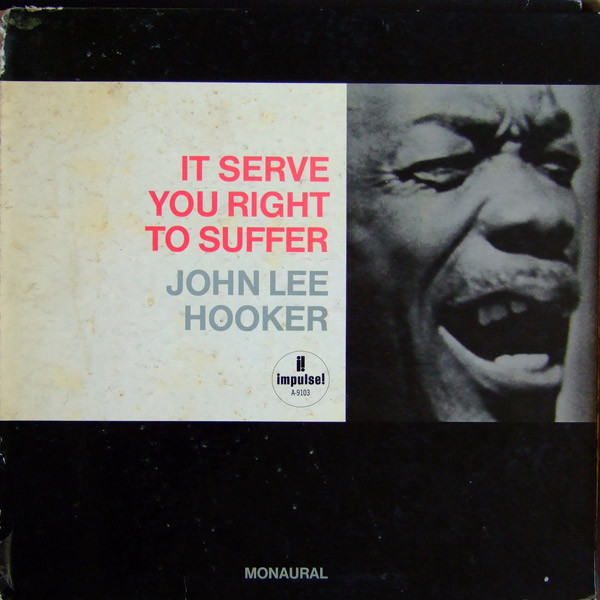
John Lee Hooker's It Serves You Right to Suffer occupies a unique place in blues history. Released in 1966 on Impulse! Records, it was the only album Hooker recorded specifically for the legendary jazz label and remains one of the finest examples of his music being successfully integrated with a sophisticated studio ensemble. Rather than attempting to "modernize" Hooker's music, producer Bob Thiele surrounded him with experienced New York jazz musicians who instinctively learned to follow Hooker's famously elastic sense of rhythm rather than forcing him into conventional blues structures.
The result is one of the greatest electric blues albums ever recorded—a masterpiece of restraint, atmosphere and groove that sounds as fresh today as it did nearly sixty years ago. The album was recorded during a single session on 23 November 1965 at Capitol Studios in New York City before being released in early 1966.
Historical Background
By 1965 Hooker had already spent almost two decades redefining electric blues.
His recordings for Modern, Sensation, Vee-Jay, Riverside and Chess had established him as perhaps the most individual blues artist of the post-war era. Unlike many Chicago bluesmen, Hooker rarely adhered to the traditional twelve-bar blues form. His songs frequently revolved around a single chord, with rhythmic changes dictated by his singing rather than harmonic progression. This made him notoriously difficult to accompany.
Many previous band recordings sound as though the musicians are constantly guessing where Hooker intends to go next. Conventional blues sidemen naturally expected chord changes at familiar places; Hooker often ignored those expectations entirely. Bob Thiele understood this problem.
Rather than hiring blues musicians, he chose jazz veterans accustomed to listening carefully and reacting instantly. The concept proved brilliant. Instead of trying to lead Hooker, the musicians followed him, creating music that feels simultaneously spontaneous and remarkably disciplined.
The Recording Session
Recording Date
23 November 1965
Studio
Capitol Records Studios, New York City
Producer
Bob Thiele
Engineer
Bob Arnold
The album was completed in a single day. Unlike many blues LPs assembled from previously released singles, It Serve You Right to Suffer was conceived as an album from the outset.
Thiele deliberately kept the arrangements sparse. Most performances were essentially live takes with very little overdubbing. The atmosphere resembles a relaxed nightclub performance rather than a carefully constructed studio production.
The musicians reportedly received one important instruction from Hooker:
Relax.
That simple approach became the key to the entire session. Rather than anticipating changes, they simply listened.
Personnel
John Lee Hooker
- vocals
- electric guitar
Barry Galbraith
- second guitar
One of New York's premier jazz session guitarists whose tasteful rhythm playing never competes with Hooker's lead.
Milt Hinton
- bass
Perhaps the most recorded bassist in jazz history, Hinton provides enormous warmth and stability despite Hooker's unpredictable phrythm.
Panama Francis
- drums
An outstanding swing drummer who avoids flashy fills and instead locks onto Hooker's foot-stomping pulse.
William Wells
- trombone (appears only on "Money")
The lone horn on the record, giving the album's only cover version a subtle R&B flavor.
Songwriters
Seven of the album's eight songs were written by John Lee Hooker, although several were new interpretations of songs he had recorded previously under different arrangements.
The only outside composition is:
Money (That's What I Want)
Written by:
- Berry Gordy
- Janie Bradford
Originally recorded by Barrett Strong for Motown in 1959.
Track-by-Track Analysis
1. Shake It Baby
Writer: John Lee Hooker
The opening number immediately establishes the philosophy behind the entire album.
Hooker's hypnotic guitar riff dominates from the first seconds while Panama Francis quietly establishes a rolling groove beneath him.
Barry Galbraith avoids soloing entirely. Instead, he shadows Hooker's rhythm with understated chord punctuations.
Hooker's vocal performance is relaxed but commanding. Rather than telling a straightforward story, he creates momentum through repeated phrases, subtle rhythmic variation and his unmistakable conversational singing style.
This performance demonstrates why Hooker never required complex harmonic movement.
Everything comes from rhythm.
Musically, the piece feels closer to African-derived trance music than conventional Chicago blues.
2. Country Boy
Writer: John Lee Hooker
One of the album's longest performances.
The tempo slows dramatically.
Hooker sings with extraordinary emotional depth about identity, rural life and perseverance.
Milt Hinton deserves particular praise.
Rather than outlining changing chords, he anchors the music around Hooker's rhythmic center, allowing the groove to breathe naturally.
Galbraith contributes delicate fills between vocal lines that never distract from Hooker's narrative.
The song perfectly illustrates Hooker's ability to create enormous dramatic tension using remarkably little harmonic movement.
3. Bottle Up and Go
Writer: John Lee Hooker
Originally rooted in older Delta blues traditions associated with artists such as Tommy McClennan, Hooker's version transforms the song into a driving electric boogie.
This is arguably the album's most energetic performance.
Panama Francis follows every rhythmic twist with astonishing sensitivity.
Rather than imposing a steady backbeat, he mirrors Hooker's constantly shifting pulse.
The interaction between the two guitarists becomes especially noticeable.
Galbraith carefully doubles Hooker's accents, making the groove feel larger without becoming cluttered.
4. You're Wrong
Writer: John Lee Hooker
One of the album's darkest emotional performances.
Hooker delivers accusations with restrained anger rather than theatrical outrage.
The spacious arrangement allows every vocal phrase to resonate.
Galbraith's restrained rhythm guitar adds harmonic color while Hinton supplies subtle walking bass passages whenever Hooker's rhythm permits.
The recording demonstrates Bob Thiele's excellent production philosophy.
Nothing unnecessary appears in the mix.
Silence becomes as important as sound.
5. Sugar Mama
Writer: John Lee Hooker
A lighter performance centered around playful lyrics.
Although shorter than several other tracks, it contains some of the album's most infectious rhythmic interplay.
Francis provides delicate swing influences beneath Hooker's earthy boogie guitar.
Rather than sounding like polished jazz musicians playing blues, the rhythm section successfully disappears into Hooker's musical world.
That achievement represents the greatest success of the session.
6. Decoration Day
Writer: John Lee Hooker
One of Hooker's oldest themes, dating back to earlier recordings.
Here it receives one of its finest interpretations.
The tempo is almost funeral-like.
Hooker's vocal phrasing stretches freely across the beat.
Every pause increases the emotional weight.
Hinton's bass becomes especially expressive, responding almost conversationally to Hooker's guitar phrases.
The performance exemplifies Hooker's remarkable ability to generate emotional intensity without raising his voice.
7. Money (That's What I Want)
Writers:
- Berry Gordy
- Janie Bradford
The album's greatest surprise.
Rather than attempting to recreate the famous Motown hit, Hooker transforms it completely.
William Wells' trombone introduces a subtle jazz coloration absent from the rest of the album.
Instead of emphasizing youthful excitement, Hooker turns the song into a weary blues meditation on financial hardship.
The familiar lyrics take on entirely different emotional meaning through Hooker's slower tempo and understated delivery.
It stands as one of the most original reinterpretations of a Motown classic ever recorded.
8. It Serve You Right to Suffer
Writer: John Lee Hooker
The masterpiece of the album.
Hooker had performed earlier versions under slightly different titles ("It Serves Me Right to Suffer"), but here he shifts the perspective, addressing another person rather than himself.
The performance unfolds slowly over more than five minutes.
Every note feels inevitable.
Barry Galbraith's muted guitar accompaniment creates a haunting atmosphere.
Hinton's bass barely moves, emphasizing weight rather than motion.
Francis limits himself almost entirely to pulse.
Hooker's vocal becomes increasingly conversational.
He almost whispers parts of the lyric, creating an intimacy rarely heard in blues recordings.
Rather than ending with a dramatic climax, the performance quietly dissolves into silence.
It remains one of the greatest blues recordings of the twentieth century.
Production Analysis
Bob Thiele deserves enormous credit.
Many producers would have attempted to "fix" Hooker's unconventional timing.
Instead, Thiele understood that Hooker's rhythmic freedom was the essence of his artistry.
The recording quality is unusually warm for a mid-1960s blues album.
Each instrument occupies its own acoustic space.
Hooker's guitar sits prominently without overwhelming the ensemble.
The bass possesses remarkable depth, while Panama Francis' drums remain natural and uncompressed.
Even today, audiophiles frequently cite this album as one of the finest-sounding blues recordings ever released.
Musical Significance
Several elements distinguish this album from nearly every other John Lee Hooker recording:
- It is his only album for Impulse! Records.
- It features an all-star New York jazz rhythm section.
- It was recorded almost entirely live in one day.
- The musicians adapt completely to Hooker's rhythmic conception instead of the reverse.
- The arrangements remain extraordinarily minimalist.
Perhaps most importantly, the album demonstrates that Hooker's seemingly idiosyncratic style could coexist perfectly with highly trained musicians—provided they listened rather than imposed conventional structures.
Buy the Album
Legacy
Although It Serve You Right to Suffer was not a major commercial success upon release, its reputation has steadily grown. Critics, musicians, and collectors now frequently rank it among Hooker's greatest studio albums alongside Burnin', Travelin', The Country Blues of John Lee Hooker, and Hooker 'n Heat. It has also become a benchmark recording for electric blues production, admired for its natural sound, intimate atmosphere, and the exceptional chemistry between Hooker and his jazz accompanists.
In retrospect, the album represents a rare convergence of artistic vision, sympathetic production, and flawless musicianship. Bob Thiele's decision to pair Hooker with Barry Galbraith, Milt Hinton, and Panama Francis produced a recording that neither diluted Hooker's raw, hypnotic style nor constrained it within conventional blues forms. Instead, It Serve You Right to Suffer captured John Lee Hooker at the height of his expressive powers, creating an album that remains one of the definitive statements of modern electric blues and one of the finest blues LPs of the 1960s.