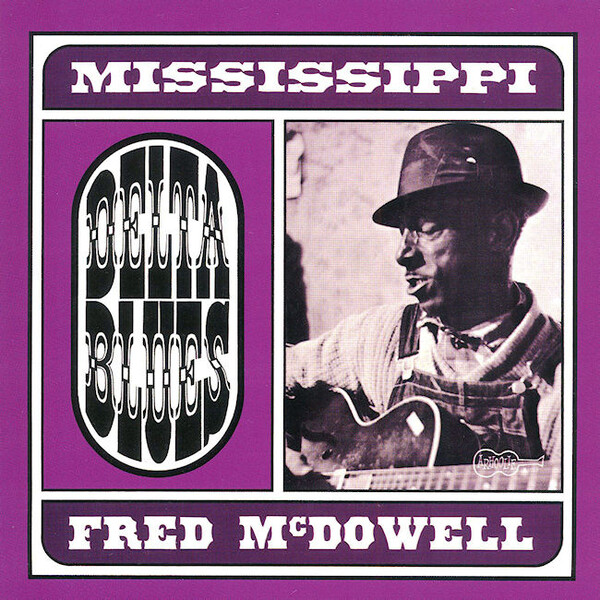
Delta Blues (Arhoolie F 1021) is the debut studio album by Mississippi Fred McDowell, released in 1964 on Chris Strachwitz's Arhoolie Records label. Recorded on a single day — February 13, 1964 — in Como, Panola County, Mississippi, with nothing more than one condenser microphone, it captures McDowell performing entirely solo: vocal, acoustic guitar, and the glass bottleneck slide he wore on his ring finger. The album is now regarded as one of the foundational documents of North Mississippi hill country blues and has since been inducted into the Blues Hall of Fame. Later reissued under the alternate title Mississippi Delta Blues (Arhoolie CD 304), the record brought McDowell's fiercely individual style to a national and eventually international audience, and directly inspired Bonnie Raitt, the Rolling Stones, and a generation of slide guitarists.
Background: The Artist
Fred McDowell (January 12, 1904 – July 3, 1972) was born in Rossville, Tennessee, not Mississippi, though he spent the majority of his adult life and performing career in Como, Mississippi, where he had settled around 1940 as a farmworker. His parents died while he was young; he took up the guitar at fourteen, playing dances around Rossville, and later moved to Memphis in 1926 before drifting to Mississippi to pick cotton. He first learned to fret with a bottleneck after seeing a relative play with a steak bone, later adopting a polished beef rib bone, and ultimately settling on the glass bottleneck slide that became his trademark. A neighbor and friend named Eli Green — himself a significant local musician — was an important early influence and musical collaborator; Green's song "Write Me a Few Lines" would become one of McDowell's most celebrated signature pieces.
Despite decades of performing at local fish fries, juke joints, house parties, and dances in the north Mississippi hills, McDowell had never been recorded commercially before 1959, when Alan Lomax and British folksinger Shirley Collins came through on a Southern field-recording journey. Lomax reportedly wrote just one word in his journal that night: "Perfect." Those Lomax field recordings circulated among folk music enthusiasts and scholars and caught the ear of Arhoolie Records' founder Chris Strachwitz, who traveled to Como in early 1964 to record McDowell properly for the first time.
The Sessions
The entire album was recorded on February 13, 1964, in Como, Mississippi — not in any commercial studio but in the informal, domestic field-recording tradition Strachwitz had developed since founding Arhoolie in 1960. The label's practice, explicitly modeled on the approach of Alan Lomax before him, was to capture artists in or close to their natural performing environment, avoiding the artificiality and polish of professional studio conditions.
The technical setup was intentionally minimal: one Capps condenser microphone, placed close to McDowell, picking up guitar and voice together in a single mono signal. There was no separation of instruments, no overdubbing, no second microphone for ambience. As a result, the record sounds as intimate and direct as a field recording — the listener hears the pick of McDowell's thumbnail on the strings, the slight scrape of the glass bottleneck along the frets, the creak of his guitar body — yet the Capps microphone captured McDowell's vocal and instrument with a warmth and presence that a crude field recorder could not have achieved. The recording appeared in original pressings as a mono LP (the nominal "stereo" version on certain later pressings was an electronic rechanneling of the original mono source).
The album was first pressed with the address Box 5073, Berkeley, California on the sleeve (the original 1964 pressing) and later reissued with the address Box 9195, Berkeley, California 94719, allowing collectors to distinguish between the two versions. The cover was a simple paste-on sleeve, typical of Arhoolie's early releases, which Strachwitz and graphic designer Wayne Pope assembled by hand in small quantities. The record was originally released under the title Delta Blues (Arhoolie F 1021); subsequent reissues, including the 1989 CD, carried the title Mississippi Delta Blues.
The Producer
Chris Strachwitz (July 1, 1931 – May 5, 2023) served as producer, recording engineer, photographer, and liner-note writer on the album — in the Arhoolie manner, all functions combined in one person. Born into a prominent German-Silesian family, Strachwitz immigrated to the United States in 1947 and became obsessed with American vernacular music, collecting 78-rpm records and eventually founding Arhoolie Records in 1960. His philosophy of production was one of radical non-intervention: "My stuff isn't produced. I just catch it as it is," he told a documentary filmmaker. He despised commercial studio polish — what he called "mouse music" — and modeled his recording approach explicitly on the field-recording tradition of Lomax and others, taping artists in their home environments rather than in purpose-built studios.
Strachwitz had founded Arhoolie in 1960, establishing it as one of the leading labels recording and issuing blues, Cajun, norteño, and other forms of roots music. His first Arhoolie release had been Mance Lipscomb's Texas Sharecropper and Songster (1960); the McDowell sessions in 1964 represented another defining moment in the label's mission. Strachwitz also won royalties for Fred McDowell from the Rolling Stones' performance of "You Gotta Move" on their Sticky Fingers album — a rights battle that helped secure McDowell's financial recognition in his final years.
Wayne Pope — Strachwitz's graphic designer friend who had created the guitar-shaped Arhoolie logo — handled the cover design. The liner notes, written by Strachwitz himself, provided the first substantial biographical and contextual account of McDowell's life and music available to a general audience.
The Songwriters
The album's songwriting credits (as stated on the LP label and subsequent reissue sleeves) read: "All songs composed or arranged by Fred McDowell — except where noted." In practice, the songbook draws from three distinct sources:
Original compositions by McDowell: Several tracks are McDowell's own original blues, bearing lyrics and melodic shapes he developed over decades of performing. These include "Louise," "I Heard Somebody Call," "Fred's Worried Life Blues," "You Gonna Be Sorry," "My Trouble Blues," "Black Minnie," and "That's Alright." McDowell's originals tend to follow the floating-verse tradition of blues composition, where lyric fragments from the common blues pool are assembled and personalized rather than constructed as rigidly fixed songs.
Songs learned from neighbors and local tradition: "Write Me a Few Lines" was learned from McDowell's neighbor and musical mentor Eli Green, and became so closely associated with McDowell over the years that it is now considered his signature piece. "61 Highway" and "Mama Don't Allow Me" are rooted in the north Mississippi oral tradition, McDowell's arrangements being his own highly personal inflections of widely shared material.
Traditional and pre-existing compositions arranged by McDowell:
- "Kokomo Blues" traces back ultimately to Scrapper Blackwell's early recordings and was popularized as a signature piece by Kokomo Arnold (James Arnold), who recorded "Old Original Kokomo Blues" in 1934, making it his trademark tune. McDowell's version is his own deeply personal reworking with a slow, hypnotic slide guitar arrangement.
- "Shake 'Em On Down" was written and originally recorded by Bukka White in Chicago in September 1937 for Vocalion Records. The song entered the folk tradition and became popular in the northern Mississippi hills, played by musicians like Fred McDowell, Compton Jones, and Ranie Burnette. McDowell's slide-guitar arrangement diverges substantially from White's original, transforming it through the hill country's characteristic modal, drone-based approach.
- "When I Lay My Burden Down" is a 19th-century African American spiritual, part of the oldest layer of the Black sacred song tradition, here adapted by McDowell as a slow, meditative closer.
The Musicians
Delta Blues is, without exception, a solo performance by Fred McDowell: acoustic guitar with glass bottleneck slide, and lead vocal. There are no additional musicians, no rhythm section, no harmonica, no second guitar, and no accompaniment of any kind. This was not a commercial concession but a faithful reflection of McDowell's actual performing style in its most essential form. In the north Mississippi hill country tradition in which McDowell worked, a solo performer was expected to supply the entire musical fabric — rhythm, melody, harmony, and texture — through simultaneous use of thumb, fingers, and slide, and McDowell's technique accomplished exactly that, generating a full, rolling, self-sufficient sound from a single acoustic guitar.
McDowell's guitar technique was highly distinctive and immediately identifiable:
- Bottleneck/slide: He wore a glass bottleneck on the ring finger of his fretting hand, using it to produce sustained, vocal-quality pitch bends and the wavering, keening tone associated with Delta and hill country blues.
- Drone bass: His right thumb maintained a steady, driving alternating or rolling bass pattern throughout, anchoring the rhythm while his fingers executed the slide melody above.
- Open tuning: McDowell played in open tunings (most often open E or open G) that allowed the slide to operate freely across all strings, producing chords and single-note lines with equal facility.
- The instrument: An acoustic steel-string guitar, recorded in its natural acoustic state — not amplified, not processed. McDowell did not adopt the electric guitar until his 1969 Capitol album I Do Not Play No Rock 'n' Roll.
Track-by-Track Breakdown
Side One
1. "Write Me a Few Lines" The album's opening track and, arguably, the single most celebrated piece in Fred McDowell's entire catalogue. The song was originally learned from McDowell's longtime neighbor and mentor Eli Green, a guitarist of the Como area who was said to possess musical gifts his local community described in almost supernatural terms. McDowell made the song definitively his own across decades of performance, and by the time of this 1964 recording it had been refined to a state of hypnotic precision. The guitar introduction immediately establishes McDowell's technique: a rolling, drone-like bass in open tuning, over which the slide traces a mournful, wordless melodic figure before the vocal enters. The lyric asks a departing lover to write back — a simple premise delivering a profound emotional weight through McDowell's delivery. Bonnie Raitt later recorded her own celebrated version of this song, having learned it directly from McDowell. Solo guitar and vocal; arrangement by McDowell from Eli Green's original.
2. "Louise" An original McDowell blues addressed to a woman, one of several on the album that demonstrate his capacity to build a coherent and emotionally direct lyric from the floating-verse tradition, anchoring well-worn blues images and phrases to a specific, personal narrative. The guitar part deploys McDowell's characteristic thick bass line and slide-ornamented treble, creating a churning, insistent rhythm that propels the song forward with an almost physical momentum. Solo performance.
3. "I Heard Somebody Call" A mid-tempo original blues rooted in the imagery of separation, travel, and longing. The guitar figure here is particularly mobile, the slide moving fluidly between positions in a way that suggests a restless, searching quality mirroring the lyric. McDowell's vocal sits comfortably in the middle of his range — he is not straining for effects but simply narrating, in his characteristic tone of weary authority. Solo guitar and vocal.
4. "61 Highway" One of the album's most explicitly road-song-structured blues, drawing on the long tradition of songs organized around US Highway 61 — the "Blues Highway" running from New Orleans north through the Mississippi Delta all the way to Minnesota — as a metaphor for travel, escape, and longing. McDowell's lyric weaves in images of Greyhound buses, West Memphis, and a pony "that can pace, fox-trot and run," all in the fluid, improvised-feeling manner of the traditional singer who is as much assembler as original author. The guitar part is among the most propulsive on the album. Traditional material arranged by McDowell; solo performance.
5. "Mama Don't Allow Me" An adaptation of the widely known traditional blues refrain "Mama don't allow no [X] in here" — a song format with roots deep in the 19th-century rural Black tradition, heard in countless variants across the South. McDowell's version is relaxed and almost playful in tone relative to the heavier blues elsewhere on the album, with a slightly faster tempo and a lighter touch on the slide, though his rhythmic drive remains fully in evidence. Traditional arrangement; solo guitar and vocal.
6. "Kokomo Blues" The final track on Side One is one of the album's most musically commanding performances. "Kokomo Blues" traces its lineage back through Kokomo Arnold's 1934 recording of "Old Original Kokomo Blues" and ultimately to earlier versions by Scrapper Blackwell. The song's imagery — a mysterious and distant place called "Kokomo" associated with escape, a woman, and freedom — had circulated widely through the blues tradition before McDowell encountered it. His 1964 version is among the slowest and most sombre in the song's recorded history, the bottleneck carrying the melodic line with a weight and gravity that lifts the material from barroom blues into something closer to a modal lament. Bonnie Raitt recorded her own version of McDowell's "Kokomo Blues" in 1973, acknowledging him as the direct source. Traditional; arrangement by McDowell. Solo performance.
Side Two
7. "Fred's Worried Life Blues" McDowell's own worries-blues, a genre with a distinguished pedigree (Big Maceo Merriweather's "Worried Life Blues" being the best-known example) but here rendered in an entirely personal idiom. The song is among the more conventionally structured 12-bar blues on the album, demonstrating that McDowell's vocabulary was not limited to the drone-based, modal approach of the hill country but encompassed the broader Delta blues tradition as well. Short by the album's standards, it functions as a brisk, no-frills statement of hard-luck philosophy. Original composition; solo guitar and vocal.
8. "You Gonna Be Sorry" At over six minutes the album's longest track and one of its most remarkable: a slow, open-ended performance that builds in intensity through repetition and variation in a manner that prefigures the "hypnotic drone" approach later scholars would identify as the hallmark of north Mississippi hill country blues. McDowell's slide work here achieves a quality of almost incantatory intensity, the same melodic figure returning again and again in slightly varied form, each repetition seeming to dig deeper into the emotional content of the lyric. This is the track most clearly audible as a forerunner of the style developed by McDowell's neighbor R.L. Burnside a decade later. Original composition; solo performance.
9. "Shake 'Em On Down" The album's most directly traditional track in the sense of being an adaptation of a previously recorded and widely known blues. Bukka White wrote and recorded the original "Shake 'Em On Down" for Vocalion Records in Chicago on September 2, 1937. White recorded "Shake 'Em On Down" with an unidentified second guitarist, and the song became a best-seller, earning White the status of a celebrity. The song entered the folk tradition and became popular in the northern Mississippi hills, played by musicians like Fred McDowell, Compton Jones, and Ranie Burnette — unlike Bukka White's version, hill musicians typically use slide guitar. McDowell's version is transformed almost entirely by his approach: where White's original is an uptempo, propulsive 12-bar with two guitars, McDowell slows the tempo, strips it to a single instrument, and applies his slide technique to produce a version that sounds as if it comes from an entirely different blues tradition. He also earned the nickname "Shake 'Em" from his association with this song. Solo performance; composed by Bukka White, arranged by McDowell.
10. "My Trouble Blues" A mid-tempo original blues built around the troubles-and-hardship lyric tradition common to countless performers across the South. McDowell's slide guitar here traces an especially fluid, song-like melody, at moments almost seeming to sing the same lyric as the vocal but an octave below or in counterpoint. The interplay between his voice — rough, grainy, precise — and the glass bottleneck's smooth, sustained tones is particularly vivid on this track. Original composition; solo guitar and vocal.
11. "Black Minnie" One of the most lyrically distinctive original pieces on the album — a song about a specific woman (called "Black Minnie"), drawn with the characteristic economy of blues portraiture: a few concrete details, the emotional statement large and unmistakable beneath them. The guitar accompaniment is among the most percussive on Side Two, McDowell's thumb driving a thick, almost drumlike bass pattern that gives the performance a physical urgency. Solo performance. Original composition.
12. "That's Alright" A blues of acceptance and resilience — the lyric built around the repeated reassurance "that's alright, baby, that's alright for you" — that draws on one of the most widely shared formulas in the blues tradition. Dozens of artists have used the "that's alright" framework, from Big Boy Crudup's "That's All Right Mama" (later made famous by Elvis Presley) to innumerable others; McDowell's version is his own arrangement, drawing the universal material through the particular filter of his slide-guitar style and vocal personality. Solo guitar and vocal; arrangement by McDowell.
13. "When I Lay My Burden Down" The album closes with a performance of the ancient African American spiritual "When I Lay My Burden Down," here stripped of any formal church arrangement and delivered as a slow, contemplative solo with McDowell's slide carrying the hymn's simple melodic line with an almost unbearable solemnity. The lyric — built on the repeated phrase "when I lay my burden down" and images of going home to glory — places the album's closing moments in the long tradition of the sacred song, and reveals the deep gospel influence that ran beneath McDowell's secular blues throughout his career. Traditional spiritual; arrangement by McDowell. Solo performance.
Legacy
Delta Blues entered a world primed to receive it: the early 1960s folk revival had made blues authenticity a commercial and cultural value, Alan Lomax's field recordings had already circulated McDowell's name among scholars, and Arhoolie Records' reputation for capturing real, unmediated country music had grown with each successive release. The album went on to exercise an influence entirely disproportionate to its modest original pressing quantities.
Alan Lomax had described McDowell as "a bluesman quite the equal of Son House and Muddy Waters, but, musically speaking, their granddaddy." The album bore that assessment out. McDowell's neighbors in Panola County, Mississippi — chief among them R.L. Burnside, who reportedly started out by playing McDowell's guitar at a house party — absorbed his modal, drone-based approach and carried it into the next generation and beyond, making Como, Mississippi a center of what scholars would eventually codify as "hill country blues."
Green's song "Write Me a Few Lines" became a McDowell signature piece and was later recorded by one of McDowell's biggest admirers, Bonnie Raitt. Raitt spent time with McDowell in the late 1960s and early 1970s, receiving direct instruction in slide guitar technique, and his influence on her playing and on her repertoire choices shaped some of the most celebrated work of her career.
The Rolling Stones — particularly Keith Richards — became devoted admirers of the Arhoolie recordings. Strachwitz taped more than a dozen songs by McDowell, including McDowell's version of an old spiritual, "You Gotta Move." The Stones sang a few lines from it during the 1970 documentary Gimme Shelter and recorded a cover that appeared on their acclaimed 1971 album Sticky Fingers.
Delta Blues was inducted into the Blues Hall of Fame, affirming its status as not merely a landmark in one man's career but as a defining document of American vernacular music: a record made for almost nothing, by one man with one guitar and one microphone, that changed what a generation of musicians thought was possible.