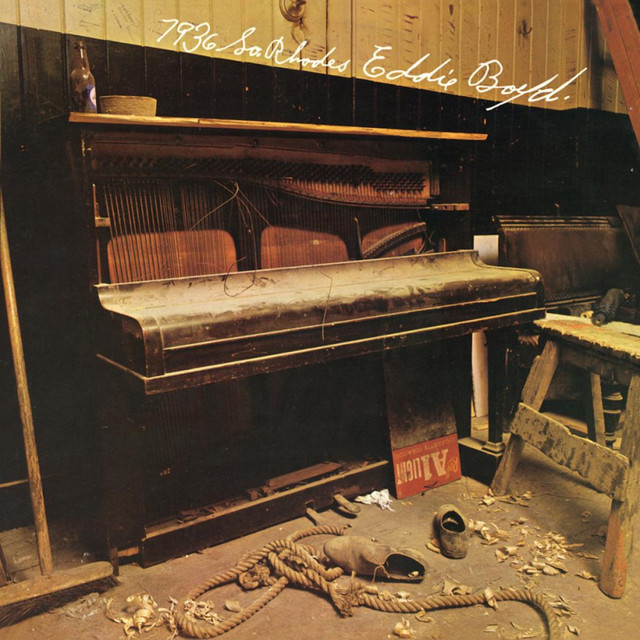
7936 South Rhodes is a landmark blues album recorded by Eddie Boyd (born Edward Riley Boyd, November 25, 1914 – July 13, 1994) in London, England, in February 1967, and released later that year on Blue Horizon Records (7-63202). The album is one of the most significant documents of the transatlantic blues collaboration that defined the late-1960s British blues boom, pairing a veteran Chicago blues pianist and vocalist with members of Fleetwood Mac—Peter Green, John McVie, and Mick Fleetwood—at the very moment when that band was emerging as one of the most important forces in British blues.
The album's title is deeply personal and specifically autobiographical: 7936 South Rhodes Avenue was the actual street address of Boyd's apartment in Chicago, where he had lived for many years during his most productive period as a Chess Records recording artist. By naming the album after this address, Boyd was making an explicit statement about identity, place, and the roots of his music, grounding the London recordings in the specific geography of the South Side Chicago blues world that had shaped him. The gesture also carried an elegiac quality, as Boyd had by this point largely abandoned Chicago for a new life in Europe, where he would eventually settle permanently in Helsinki, Finland, finding a level of respect and economic stability that had eluded him in the United States.
The album stands as both a mature artistic statement by one of the most sophisticated bluesmen of his generation and a crucial document of the moment when British musicians were not merely imitating American blues but engaging with it as equal creative partners, producing recordings that honored the tradition while contributing something genuinely new to its continuing evolution.
Background and Context
Eddie Boyd: From Mississippi to Chicago
Eddie Boyd was born in Stovall, Mississippi, on November 25, 1914, on the same plantation where the young Muddy Waters would be recorded by Alan Lomax some twenty-six years later. The Stovall Plantation, located in Coahoma County near Clarksdale, was one of the great cradles of the Mississippi Delta blues, and Boyd grew up surrounded by the musical culture that would shape the postwar electric blues revolution. He began playing piano as a teenager, developing a style that drew on the barrelhouse and boogie-woogie traditions of the Delta jukes while absorbing elements of the more sophisticated urban blues piano styles that filtered down from Memphis and St. Louis.
In his twenties, Boyd migrated to Memphis, Tennessee, where he performed in the city's thriving blues and jazz scene before moving north to Chicago in the early 1940s. Chicago in the postwar period was the epicenter of the electric blues revolution, and Boyd quickly established himself as one of the most sought-after sidemen in the city's blues community. He played piano on recordings by Muddy Waters, Johnny Shines, and numerous other Chicago blues artists during the late 1940s and early 1950s, developing a reputation as a technically accomplished and musically sensitive accompanist whose playing could enhance any session without overwhelming the lead vocalist.
Boyd's breakthrough as a solo artist came in 1952, when he recorded "Five Long Years" for the small J.O.B. Records label. The song, a slow, deeply emotional blues about the hardships of working in a steel mill to support an unfaithful woman, became a surprise hit, reaching number one on the Billboard R&B chart and establishing Boyd as a major blues artist in his own right. "Five Long Years" has since become one of the most frequently covered songs in the entire blues canon, recorded by artists as diverse as B.B. King, Buddy Guy, Eric Clapton, Muddy Waters, and countless others, and its enduring popularity is a testament to the universal resonance of its themes of economic struggle, romantic betrayal, and masculine endurance.
Following the success of "Five Long Years," Boyd signed with Chess Records, Chicago's premier blues label, where he recorded a series of singles throughout the 1950s. His Chess output included "24 Hours" (1953), another major R&B hit that showcased his sophisticated piano work and smoky, intimate vocal style, and "Third Degree" (1953), co-written with Willie Dixon, which became another frequently covered blues standard. Despite these commercial successes, Boyd's relationship with Chess was often difficult, and he grew increasingly frustrated with what he perceived as the label's exploitative business practices and its favoritism toward other artists.
The Move to Europe
By the mid-1960s, Boyd had become disillusioned with the American music industry and the social conditions of life as a Black American in the pre-Civil Rights era. The blues boom in Europe, which had been building throughout the 1960s as a result of touring American blues artists and the enthusiastic reception of their music by British and continental audiences, offered Boyd both a receptive audience and the possibility of escape from the racial oppression that constrained his life in the United States.
In 1965, Boyd participated in the American Folk Blues Festival tour of Europe, an annual showcase organized by the German promoters Horst Lippmann and Fritz Rau that brought American blues artists to European audiences. The tour was a revelation for Boyd, who found himself treated with a respect and appreciation that he had rarely experienced in the United States. European audiences were serious, knowledgeable, and deeply enthusiastic, and the economic opportunities for touring and recording were substantial. Over the following years, Boyd gradually relocated his career—and eventually himself—to Europe, performing extensively throughout the continent and recording for various European labels before finally settling in Helsinki, Finland, in the early 1970s.
Blue Horizon Records and the British Blues Boom
Blue Horizon Records was founded in 1965 by Mike Vernon, a British blues enthusiast, producer, and journalist who had been one of the most important advocates for American blues music in the United Kingdom. Vernon had worked as a recording engineer and producer at Decca Records, where he had been involved in sessions for John Mayall's Bluesbreakers and other British blues acts, and he founded Blue Horizon specifically to document and promote both American blues veterans and the emerging British blues scene.
By 1967, Blue Horizon had become one of the most important labels in the British blues world. Its roster included Fleetwood Mac (whose eponymous debut album, released in February 1968, would become a defining document of the British blues boom), Chicken Shack, Duster Bennett, and various American blues artists who recorded for the label during European tours. Vernon's production philosophy was characterized by his deep respect for the blues tradition and his commitment to capturing authentic performances with minimal studio interference.
The confluence of Boyd's European career and the rising prominence of Blue Horizon created the conditions for the 7936 South Rhodes sessions. Vernon recognized the opportunity to pair a veteran American blues artist with the finest young British blues musicians, creating recordings that would benefit from both the authenticity of American blues tradition and the fresh energy of the British blues revival.
The Sessions
Recording Details
The recordings for 7936 South Rhodes were made in February 1967 at Decca Studios in West Hampstead, London. The exact dates of the sessions have been variously reported, but the recordings are generally understood to have taken place over the course of two or three days, with the entire album being completed in a relatively compressed timeframe.
Decca Studios was one of the most important recording facilities in London during the 1960s, having hosted sessions for the Rolling Stones, the Moody Blues, Them, and numerous other major British acts. The studio was well-equipped with professional recording equipment and had an experienced engineering staff capable of capturing the full dynamic range and tonal complexity of a blues ensemble. The acoustic environment was warm and intimate, well-suited to the kind of live-in-the-studio recording approach that Vernon favored.
The recording process was characteristically direct and economical. The musicians were set up in a standard configuration with Boyd's piano and vocal microphone at the center of the room, with the guitar, bass, drums, and other instruments arranged around him. Most of the tracks were recorded live with the entire ensemble playing together, allowing for the kind of spontaneous interplay and dynamic responsiveness that is impossible to achieve through overdubbing. The sessions proceeded quickly, with most songs completed in one or two takes, reflecting both the professional capabilities of the musicians and the time constraints of the recording budget.
Production
The album was produced by Mike Vernon, whose production approach on the sessions was shaped by his deep knowledge of the blues tradition and his understanding of what made Boyd's music distinctive. Vernon recognized that Boyd was not just another postwar Chicago blues artist but a musician of exceptional sophistication whose piano playing drew on jazz, boogie-woogie, and gospel traditions in addition to the straight blues, and whose vocal style was characterized by an understated, intimate quality that required careful microphone placement and sensitive accompaniment to be captured effectively.
Vernon's production philosophy emphasized the integrity of the live performance over studio artifice. He resisted the temptation to add overdubs, elaborate arrangements, or studio effects, preferring to let the chemistry of the ensemble carry the recordings. The result is an album that sounds remarkably direct and present, with each musician clearly audible and the natural dynamics of their interaction preserved intact.
The engineering was handled by Decca staff engineers, likely including Mike Smith or Gus Dudgeon, both of whom were associated with Decca during this period. The recording quality is excellent by the standards of 1967, with warm, full-bodied piano tones, present and detailed vocals, and well-balanced instrumental support that allows every element of the ensemble to be heard clearly.
Musicians
The core ensemble on 7936 South Rhodes represents one of the most intriguing cross-generational and cross-Atlantic collaborations in blues history:
Eddie Boyd – lead vocals and piano on all tracks. Boyd's performances on the album demonstrate the full range of his artistry, from the delicate, almost classical touch he brings to slow ballads to the driving, percussive attack of his uptempo numbers. His piano style combines elements of the Chicago blues tradition with jazz-influenced harmonic sophistication and the deep gospel feeling of his Mississippi roots.
Peter Green – guitar. Green (born Peter Allen Greenbaum, 1946–2020) was at this time the lead guitarist for Fleetwood Mac, having recently left John Mayall's Bluesbreakers (where he had replaced the departed Eric Clapton). Green was in the midst of what would become recognized as one of the greatest periods of guitar playing in the history of the blues, and his contributions to 7936 South Rhodes reveal his remarkable sensitivity as an accompanist and his deep understanding of the blues tradition. His guitar work on the album is restrained and tasteful, providing melodic and rhythmic support that enhances Boyd's piano and vocal without ever overwhelming them.
John McVie – bass. McVie (born 1945) was the bassist for Fleetwood Mac and had been a member of John Mayall's Bluesbreakers before that. His playing on the album is characterized by its warm tone, melodic sensibility, and rock-solid rhythmic foundation. McVie's bass lines interlock with Boyd's piano in a way that reflects his years of experience playing with sophisticated keyboard players.
Mick Fleetwood – drums. Fleetwood (born 1947) was the drummer for the newly formed Fleetwood Mac, and his contributions to 7936 South Rhodes reveal the understated musicality that would make him one of the most respected drummers in rock music. His playing is sensitive and dynamic, responding to the ebb and flow of Boyd's performances with a nuance that belies his relative youth.
Peter Bardens – organ (on selected tracks). Bardens (1945–2002) was a session musician and later a founding member of the progressive rock band Camel. His organ contributions add additional harmonic richness to several tracks without competing with Boyd's piano.
The chemistry between Boyd and the young British musicians is one of the album's greatest strengths. Despite the significant age gap—Boyd was fifty-two at the time of recording, while the Fleetwood Mac musicians were all in their early twenties—the ensemble achieves a remarkable level of musical communication and mutual respect. The British musicians clearly recognized that they were in the presence of a master, and they responded with performances that balance deference with genuine creative engagement.
Songwriters
The songs on 7936 South Rhodes are all original compositions by Eddie Boyd, reflecting his status as not only a performer but also a prolific songwriter with a distinctive compositional voice. Boyd's songs are characterized by their emotional directness, their harmonic sophistication, and their frequent engagement with themes of economic hardship, romantic complexity, and the challenges of African American life in the mid-twentieth century. Several of the songs on the album are new compositions written specifically for the sessions, while others are reworkings of material Boyd had performed and recorded in various forms throughout his career.
Track-by-Track Breakdown
"The Big Boat"
Songwriter: Eddie Boyd
The album opens with "The Big Boat," a slow, atmospheric blues that establishes the sophisticated musical world of the recording. The song's title and imagery evoke the great steamboats that once plied the Mississippi River, carrying goods, passengers, and musical traditions between the Delta and the industrial North. For Boyd, who had made the migration from Mississippi to Chicago himself, the big boat is both a literal memory and a metaphor for the journey of African American migration that transformed the demographic and cultural landscape of twentieth-century America.
The arrangement is spacious and atmospheric, with Boyd's piano providing a gentle, rolling foundation over which Peter Green's guitar weaves delicate, melodic figures. McVie's bass is warm and unobtrusive, while Fleetwood's drums are brushed softly, creating a mood of quiet contemplation rather than driving momentum. The overall effect is reminiscent of the sophisticated late-night blues that Charles Brown and other West Coast blues artists had pioneered in the 1940s and 1950s, but with the additional depth and texture that the British rhythm section brings to the arrangement.
Boyd's vocal performance is deeply expressive, moving between a conversational, almost spoken delivery in the verses and a more impassioned, blues-shouting intensity in the climactic passages. His phrasing is masterful, with subtle rhythmic displacements and melodic embellishments that reveal the deep musical intelligence that characterizes his best work.
"The Blues Is Here to Stay"
Songwriter: Eddie Boyd
"The Blues Is Here to Stay" is a medium-tempo blues that functions as both a musical statement and a philosophical declaration. The song's title and lyrics articulate Boyd's conviction that the blues, despite the changing musical fashions of the 1960s, would endure as a vital artistic tradition. The song can be read as a response to the perception that the rise of rock, soul, and other popular music genres was displacing the traditional blues from its position of cultural prominence, and Boyd's assertion that "the blues is here to stay" is both a defense of the tradition and a prophecy that has been borne out by the subsequent half-century of blues history.
The arrangement features a driving, mid-tempo shuffle rhythm with prominent piano, guitar, and rhythm section. Boyd's piano work is particularly impressive on this track, with rolling, boogie-woogie-inflected figures that showcase his technical command of the instrument. Peter Green's guitar provides sharp, punctuating accents that respond to Boyd's piano phrases, creating a dialogue between the two instruments that is one of the album's most dynamic musical interactions.
The vocal delivery is confident and assertive, with Boyd projecting the authority of a man who has lived through decades of changing musical fashions and emerged with his artistic convictions intact. The performance is a declaration of faith in the blues tradition, delivered with the conviction of a man who knows that his music will outlast the trends that have threatened it.
"You Got to Reap"
Songwriter: Eddie Boyd
"You Got to Reap" is a moralistic blues that draws on the biblical principle that one must reap what one has sown—that actions have consequences, and that the choices one makes in life inevitably return to shape one's destiny. The theme is a familiar one in the blues tradition, which has long engaged with questions of karma, justice, and the moral order of the universe, but Boyd's treatment is characteristically sophisticated and emotionally nuanced.
The arrangement is slow and contemplative, with Boyd's piano providing a stately, hymn-like foundation that evokes the gospel tradition. Peter Green's guitar is used sparingly, providing subtle melodic commentary rather than aggressive lead work. The rhythm section creates a solemn, deliberate pulse that reinforces the song's thematic gravity.
Boyd's vocal delivery is deeply reverent, with a quality of spiritual conviction that transcends the conventional boundaries between blues and gospel. The performance demonstrates the integrated nature of Boyd's musical world, in which the sacred and secular traditions are not opposing forces but complementary expressions of the same deep well of African American musical and spiritual experience.
"Dust My Broom"
Songwriter: Elmore James, Robert Johnson (traditional, as adapted by Elmore James and often credited to James due to his definitive 1951 recording; original melodic framework by Robert Johnson)
"Dust My Broom" is Boyd's interpretation of one of the most iconic songs in the postwar blues canon, most closely associated with Elmore James, whose 1951 recording with its distinctive slide guitar riff became one of the defining recordings of the Chicago blues era. The song itself has deep roots in the pre-war blues tradition, with elements traceable to Robert Johnson's 1936 recording "I Believe I'll Dust My Broom," and it has been covered by countless artists in the decades since Elmore James made it famous.
Boyd's version is a radical reinterpretation that strips away the song's association with slide guitar and reconstructs it as a piano-driven blues featuring his sophisticated keyboard work. The famous Elmore James riff is translated into piano figures that preserve the melodic contour while giving the song an entirely different sonic character. Peter Green's guitar work is understated and tasteful, providing rhythmic and harmonic support rather than attempting to recreate the Elmore James slide approach.
The vocal delivery is more subtle and nuanced than the typical shouted treatments of the song, revealing dimensions of the lyrics that the more aggressive versions tend to obscure. Boyd's interpretation reminds the listener that beneath its iconic surface, "Dust My Broom" is a complex song about departure, independence, and the search for a better life, themes that resonated deeply with Boyd's own experiences of migration and relocation.
"Save Her, Doctor"
Songwriter: Eddie Boyd
"Save Her, Doctor" is a dramatic, slow blues that uses the imagery of medical crisis as a metaphor for romantic desperation. The narrator pleads with a doctor to save his beloved, who is dying—whether from literal illness or from the metaphorical sickness of a troubled relationship is left deliberately ambiguous. The imagery of medicine and healing has deep roots in the African American vernacular tradition, where healers, root doctors, and medical practitioners occupy a privileged position in the cultural imagination.
The arrangement is slow and emotionally charged, with Boyd's piano providing a mournful, almost funereal foundation that creates a mood of profound anxiety and grief. Peter Green's guitar work is at its most expressive on this track, with long, sustained notes and bent phrases that cry and moan in sympathy with the vocal. The rhythm section is restrained and respectful, allowing the emotional intensity of the performance to develop without rhythmic distraction.
Boyd's vocal performance is among the album's most powerful, moving between a quiet, pleading delivery in the verses and a raw, anguished shout in the climactic passages. The performance demonstrates his mastery of the slow blues form, in which emotional intensity must be sustained over an extended duration without the support of a driving rhythm or elaborate instrumental embellishment.
"The Thrill Is Gone"
Songwriter: Rick Darnell, Roy Hawkins (originally recorded by Roy Hawkins in 1951)
"The Thrill Is Gone" is a slow, elegant blues that would, several years after Boyd's recording, become one of the most famous songs in the entire blues canon through B.B. King's iconic 1969 recording. The song had originally been written and recorded by Roy Hawkins in 1951, but it remained relatively obscure until King's version transformed it into a blues standard and brought it to a massive international audience.
Boyd's 1967 interpretation predates the King version and represents a different approach to the material. Where King's recording emphasizes the song's melodic beauty and romantic melancholy, Boyd's version is darker and more introspective, treating the song as a meditation on loss and the irreversible passage of time. The arrangement is spare and atmospheric, with Boyd's piano creating a shimmering, almost impressionistic sonic landscape.
Peter Green's guitar work on this track anticipates some of the melodic ideas that would later characterize his own recordings with Fleetwood Mac, particularly the sensitivity to tone and the preference for melodic economy over technical display. McVie and Fleetwood provide understated rhythmic support that allows the emotional content of the performance to breathe.
"Key to the Highway"
Songwriter: Big Bill Broonzy, Charles Segar (originally recorded by Charles Segar in 1940, then popularized by Big Bill Broonzy in 1941)
"Key to the Highway" is one of the most durable standards in the entire blues repertoire, written and recorded by Charles Segar in 1940 and then famously covered by Big Bill Broonzy in 1941 in the version that established the song's standard arrangement. The song's title and central image—the key to the highway, which gives the traveler the freedom to move at will—has made it one of the great anthems of the blues tradition's engagement with mobility, migration, and the search for freedom.
Boyd's interpretation is faithful to the song's traditional structure while bringing his own distinctive piano style and vocal personality to the performance. The arrangement features a medium-tempo rolling rhythm that evokes the movement of the open road, with Boyd's piano providing the rhythmic and harmonic foundation and Peter Green's guitar adding melodic commentary. The vocal delivery is reflective and world-weary, with Boyd singing about the key to the highway with the authority of a man who has used that key many times in his own life.
"Nothing But Trouble"
Songwriter: Eddie Boyd
"Nothing But Trouble" is an uptempo, rhythmically driving blues that showcases the more energetic side of Boyd's musical personality. The song's lyrics address the familiar blues theme of persistent adversity—the sense that trouble follows the narrator wherever he goes, that difficulty and misfortune are the constant companions of his life.
The arrangement is one of the album's most dynamic, with Boyd's piano providing a propulsive boogie-woogie foundation and the Fleetwood Mac rhythm section locking in with a driving, danceable groove. Peter Green's guitar work is more aggressive on this track than on the slower numbers, with sharp, punchy fills and brief solo passages that demonstrate his technical command. The overall effect is one of controlled energy, with the ensemble generating considerable rhythmic power while maintaining the tasteful restraint that characterizes the album as a whole.
Boyd's vocal delivery is animated and theatrical, with a quality of wry humor that transforms the lyrics' expression of persistent trouble into a kind of defiant celebration. The performance reveals the resilience and good humor that enabled Boyd to survive and transcend the many difficulties of his life and career.
"I Had to Let Her Go"
Songwriter: Eddie Boyd
"I Had to Let Her Go" is a slow, deeply emotional blues that addresses the theme of romantic loss with a mature, reflective sensibility that characterizes Boyd's best work. The song's title and lyrics describe the narrator's decision to end a relationship, framed not as a bitter rejection but as a sorrowful but necessary acknowledgment that the connection has become unsustainable.
The arrangement is spare and intimate, with Boyd's piano providing a delicate, almost meditative foundation. Peter Green's guitar is used sparingly and with great sensitivity, providing melodic commentary that complements rather than competes with the vocal. The rhythm section maintains a slow, hypnotic pulse that creates a mood of profound contemplation.
Boyd's vocal performance is one of the album's most tender and emotionally nuanced moments, revealing the capacity for romantic vulnerability that lies beneath the more conventional blues imagery of his uptempo numbers. The performance demonstrates the full range of his artistic maturity, his ability to inhabit complex emotional states and communicate them with directness and dignity.
"Blue Monday Blues"
Songwriter: Eddie Boyd
The album closes with "Blue Monday Blues," a medium-tempo blues that addresses the universal experience of the Monday morning return to the working week after the brief respite of the weekend. The song connects Boyd's music to the long tradition of blues numbers that document the experience of labor, exploitation, and the grinding routine of life for the working poor.
The arrangement features a steady, rolling rhythm with prominent piano, guitar, and rhythm section. Boyd's piano work is particularly expressive on this track, with rolling figures that evoke the sense of forward motion and the inevitability of the working week. Peter Green's guitar provides tasteful fills and brief solo passages that complement the piano without overwhelming it.
Boyd's vocal delivery is reflective and slightly weary, with a quality of hard-won acceptance that captures the ambivalent emotional landscape of the song's subject matter. As a closing statement, "Blue Monday Blues" provides a fitting conclusion to the album's exploration of the complex emotional terrain of African American working-class life, ending on a note of resigned endurance that is characteristic of the deepest currents of the blues tradition.
Buy The Album
Significance and Legacy
A Transatlantic Masterpiece
The most immediate significance of 7936 South Rhodes lies in its status as one of the finest documents of the transatlantic collaboration that defined the late-1960s British blues boom. The album pairs an American master with young British musicians who were in the process of transforming the global understanding of blues music, and the chemistry between them produced recordings that honor the Chicago blues tradition while contributing something genuinely new to its continuing evolution.
The pairing was not merely a commercial opportunity but a genuine artistic collaboration. Peter Green, John McVie, and Mick Fleetwood were not simply backing musicians fulfilling a session assignment; they were deeply knowledgeable students of the blues tradition who approached the sessions with reverence, humility, and genuine creative engagement. Their contributions to the album demonstrate that the British blues movement, at its best, was not an exercise in cultural appropriation but a sincere effort to extend and enrich the tradition they had inherited from the American masters.
Peter Green's Development
The album is particularly significant for the opportunity it provides to hear Peter Green at a crucial moment in his artistic development. Green had recently left John Mayall's Bluesbreakers to form Fleetwood Mac, and he was in the midst of what would become recognized as one of the most remarkable creative periods in the history of the electric blues guitar. His playing on 7936 South Rhodes reveals the qualities that would soon make him one of the most admired guitarists in the world: his impeccable sense of tone, his melodic sensitivity, his restraint and tastefulness, and his ability to serve the music rather than his own virtuosic impulses.
The sessions came just months before Fleetwood Mac released their eponymous debut album in February 1968, which would establish the band as one of the leading forces in the British blues movement. Hearing Green in a sideman role on 7936 South Rhodes provides essential context for understanding the development of his style and the sources of his artistic vision.
Eddie Boyd's Artistic Vindication
For Boyd himself, 7936 South Rhodes represented a significant artistic vindication after years of frustration with the American music industry. The album demonstrated that his music, when given the proper setting and respect, could achieve a level of artistic sophistication that transcended the commercial limitations of the blues market. The British musicians treated him as the master he was, and the resulting recordings showcase his talents in a way that his earlier Chess sessions, for all their commercial success, had not always allowed.
The album also marked a key moment in Boyd's European career, confirming his decision to relocate his life and work to the continent and establishing the model of transatlantic collaboration that would define his subsequent recordings and performances. He would go on to record several more albums in Europe, settling permanently in Finland and continuing to perform and record until his death in Helsinki in 1994.
The Blue Horizon Legacy
The album is also an important document in the history of Blue Horizon Records, which under Mike Vernon's guidance became one of the most important blues labels of the late 1960s. Blue Horizon's catalog—which included recordings by Fleetwood Mac, Chicken Shack, Duster Bennett, and numerous American blues veterans—represents a crucial chapter in the history of the British blues movement and the broader project of preserving and extending the blues tradition during a period of significant commercial and cultural change.
Vernon's production on 7936 South Rhodes is a model of sensitive, respectful blues recording, demonstrating that it was possible to create commercially viable recordings while maintaining the artistic integrity and emotional authenticity of the music. His approach has influenced subsequent generations of blues producers and remains a touchstone for anyone attempting to document traditional blues artists in a contemporary studio setting.
A Document of Cultural Exchange
More broadly, 7936 South Rhodes stands as a document of the complex cultural exchange that defined the relationship between American blues and British rock during the 1960s. The album captures a moment when young British musicians, inspired by their deep love of American blues, were given the opportunity to work directly with the American masters who had inspired them. The results demonstrated that this cross-cultural dialogue could produce recordings of lasting artistic value, enriching both the blues tradition and the emerging rock music that would dominate the following decade.
The album's title—a specific Chicago street address—serves as a reminder that despite the London setting of the recordings, the music is rooted in the particular geography and social experience of African American life in the American industrial city. Boyd carried that experience with him across the Atlantic, and the British musicians who joined him in the studio approached the material with an understanding of its origins that elevated the sessions beyond mere musical competence to the level of genuine cultural engagement.
Enduring Relevance
More than fifty years after its release, 7936 South Rhodes remains a touchstone recording for anyone interested in the intersection of American blues and British rock, in the sophisticated piano blues tradition that Boyd represented, or in the early career of Peter Green and his colleagues in Fleetwood Mac. The album has been reissued multiple times on CD and digital formats, ensuring its continued availability to new generations of listeners who are discovering its particular combination of emotional depth, musical sophistication, and cross-cultural collaboration.
The recordings continue to influence contemporary blues and roots musicians, who find in Boyd's piano playing a model of sophisticated blues keyboard work and in the ensemble's collective performances a demonstration of what can be achieved when musicians of different backgrounds and generations approach their shared material with genuine respect and creative engagement. 7936 South Rhodes stands as a testament to the enduring power of the blues to transcend the boundaries of geography, generation, and genre, uniting musicians from different worlds in the common pursuit of artistic truth.