Overview
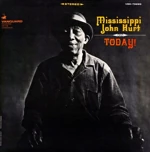
Today! is the third body of recorded work, and second proper studio album, by the Mississippi country-blues songster Mississippi John Hurt (born John Smith Hurt, July 3, 1893, in Teoc, Mississippi; died November 2, 1966, in Grenada, Mississippi). Released by Vanguard Records in 1966, it was Hurt's first album for that label and one of the earliest commercial documents of his remarkable late-career "rediscovery." In 2009 it was inducted into the Library of Congress's National Recording Registry as a recording of lasting cultural and historical significance.
Hurt had originally recorded eight sides for Okeh Records in Memphis and New York in February 1928, of which only a handful were released; the records sold poorly and Hurt returned to a life of farm labor in Avalon, Mississippi, remaining obscure for over three decades. His fortunes changed when folklorist and blues researcher Tom Hoskins, guided by the lyric "Avalon, my hometown" in Hurt's old Okeh recording "Avalon Blues" and aided by fellow enthusiast Dick Spottswood, tracked him down in Avalon in 1963. Hoskins persuaded Hurt to relocate to Washington, D.C., where he cut his first post-war sides (released as Folk Songs and Blues on the small Piedmont/Gryphon label) and where he soon found himself an unlikely sensation of the folk revival. His July 1963 appearance at the Newport Folk Festival, met with rapturous reception as a "living legend," opened the door to a busy schedule of college concerts, coffeehouse dates, and festival bookings that occupied the final three years of his life.
Vanguard Records — flush with the commercial success of Joan Baez and active in cultivating other blues artists such as Buddy Guy — signed Hurt to a recording contract, and in July 1964, not long after his second Newport appearance, he entered the studio for the label for the first time. Material accumulated from these and subsequent 1965–66 sessions eventually filled three albums: Today! (1966), The Immortal Mississippi John Hurt (1967), and the posthumously issued Last Sessions (1972).
The Sessions
The recordings that became Today! were made in New York in 1965 and 1966, with engineering work carried out partly at the Manhattan Towers Hotel and partly at Vanguard's own studio facilities. The sound is intimate and largely unadorned: Hurt seated with his guitar, close-miked, the recordings capturing a warm, present midrange with little studio ambience — closer to a private performance than a polished pop production. Although Vanguard issued a "stereo" pressing of the LP, the source material was effectively monaural, a fact later reissues (such as Craft Recordings' Bluesville series restoration) have preserved rather than tried to falsely "fix."
Almost the entirety of the album is solo: Hurt alone on guitar and vocals, a deliberate production choice that let his fingerpicking — by then refined over six decades of playing — stand entirely on its own. This is in contrast to some of his other Vanguard-era sessions (heard on Last Sessions), where producer Patrick Sky occasionally added a second guitar.
The Producer
The album was produced by Patrick Sky, an American singer-songwriter who was himself a Vanguard recording artist working in the contemporary folk idiom. Sky's role with Hurt extended beyond a typical producer's chair: he was a friend and advocate who helped shepherd Hurt's recordings for Vanguard across all three albums in the trilogy, and on selected tracks elsewhere in the Vanguard sessions (not on Today! itself, but on cuts that eventually surfaced on Last Sessions) he picked up a second guitar to fill out the arrangement. On Today!, however, his contribution was specifically as producer/supervisor, overseeing a hands-off approach that prioritized preserving Hurt's music as close to its essential, solo-performance form as possible — fitting, given that the folk audience of the time prized authenticity over studio polish, especially for a performer whose appeal rested on the unforced warmth of his voice and the seeming effortlessness of his guitar work.
The original LP's liner notes were written by the noted jazz and folk critic Nat Hentoff; the album's design was by Jules Halfant, with cover photography credited to Eddie Freeman.
The Songwriter
Unlike many of his blues contemporaries who interpreted a shared pool of traditional material, Hurt was unusual in being a genuine songster-songwriter who composed distinctive original blues and could just as fluently render inherited folk and gospel material. Today! mixes both strands: several songs are original to Hurt or are his personal, decades-old arrangements of earlier compositions (some dating back to his 1928 Okeh sessions), while five others are explicitly traditional, public-domain pieces that had been common currency among folk, blues, and minstrel performers for generations — "Make Me a Pallet on Your Floor," "Corrinna, Corrinna," "Hot Time in the Old Town Tonight," "Spike Driver Blues" (credited as traditional but arranged by Hurt), and "Beulah Land."
The Musicians
The instrumental personnel on Today! is, almost without exception, Mississippi John Hurt alone — guitar (acoustic fingerstyle) and lead vocal. This was a conscious presentational choice reflecting both Hurt's working method (he had always been essentially a solo performer in his post-rediscovery touring life) and the folk-revival aesthetic of authenticity that Vanguard and Sky were catering to. There is no rhythm section, no harmonica, no second guitar, and no overdubbing; the recording is, in essence, a documentary capture of Hurt's live solo repertoire.
Track-by-Track Breakdown
Side One
1. "Pay Day" An original blues likely drawn from or related to Hurt's own older repertoire, dealing with the working man's ritual of getting paid and the temptations that follow. Hurt's fingerpicked bass-and-treble alternation is in full evidence, with his voice delivering the lyric in his characteristically relaxed, conversational style rather than with overt vocal drama. Performed solo, guitar and voice.
2. "I'm Satisfied" A warm, good-humored original number that typifies the gentle, contented persona for which Hurt became known among the folk audience — a contrast to the more anguished "deep blues" style of contemporaries like Skip James or Son House. Solo guitar and vocal; the song's loping rhythm showcases Hurt's signature thumb-and-finger independence.
3. "Candy Man" One of Hurt's best-known songs and a direct re-recording of a piece he had first cut for Okeh in 1928 (released on that earlier label as "Candy Man Blues"). The 1966 version is, remarkably, performed at nearly the same tempo and with essentially the same arrangement as the original take made thirty-eight years earlier — a testament to how little Hurt's technique had drifted across the intervening decades of obscurity. Lyrically it is a double-entendre-laden, comic depiction of a traveling peddler, delivered with sly understatement. Solo performance.
4. "Make Me a Pallet on the Floor" (traditional) A widely circulated traditional blues/folk song that had been recorded by numerous artists going back to the early 20th century. Hurt's interpretation, one of the album's longer tracks at over four minutes, is slow, intimate, and unhurried, allowing space for his fingerpicked variations between vocal lines. Public domain composition; arrangement and performance by Hurt alone.
5. "Talking Casey" Hurt's idiosyncratic, narrative reworking of the "Casey Jones" railroad-disaster legend, delivered in a semi-spoken, storytelling style accompanied by subtle, mournful slide-inflected guitar work — closer to "folk" narrative balladry than conventional blues form. At over five minutes, it is the album's longest track, reflecting its episodic, story-song structure. Solo guitar and vocal.
6. "Corrinna, Corrinna" (traditional) A traditional blues/folk standard recorded by countless artists across the 20th century, here given one of its most often-praised interpretations: a flowing right-hand fingerpicked rhythm laid against an almost stomping alternating bass line from the thumb. Brief by the album's standards (under two minutes), it functions as a graceful, compact closer to side one. Public domain; Hurt's arrangement.
Side Two
7. "Coffee Blues" An original Hurt composition notable for a lyric referencing "Maxwell House" coffee and the now-famous line about a "lovin' spoonful" — the very phrase that inspired John Sebastian to name his 1960s rock group the Lovin' Spoonful after hearing Hurt perform the song. A loose, conversational blues full of small narrative asides, it is one of the most celebrated tracks in Hurt's catalogue. Solo guitar and vocal.
8. "Louis Collins" Another re-recording of a song from Hurt's original 1928 Okeh sessions (where it had been issued, in part, as "Louis Collins"/related to "Spike Driver Blues" material), a mournful narrative ballad about the death and mourning of a man named Louis Collins, delivered with a gentle, almost lullaby-like fingerstyle accompaniment that belies its somber subject matter. Solo performance, with the arrangement essentially unchanged from the original 1928 version.
9. "Hot Time in the Old Town Tonight" (traditional) An adaptation of the 1896 pop standard "There'll Be a Hot Time in the Old Town Tonight," a song with roots stretching back to the late 19th-century popular and minstrel stage and famously associated with later recordings such as Bessie Smith's 1927 version, from which Hurt likely drew his swinging, ragtime-inflected arrangement. Hurt transforms the old chestnut into an easy, syncopated, almost jazzy fingerpicked piece. Public domain; solo guitar and vocal.
10. "If You Don't Want Me, Baby" An original blues of romantic ultimatum and resignation, performed in Hurt's typically understated, unhurried manner — emotionally direct lyrics delivered without melodrama, underscored by his steady alternating-bass guitar pattern. Solo performance.
11. "Spike Driver's Blues" (traditional, arranged by John Hurt) A railroad work-song lineage piece related to the John Henry legend, credited as traditional but bearing Hurt's own distinctive arrangement — indeed a direct continuation of the version he had recorded for Okeh in 1928. The song's loping, syncopated guitar figure is one of Hurt's most widely imitated by later fingerstyle guitarists (including John Fahey, who counted Hurt among his chief influences). Solo guitar and vocal.
12. "Beulah Land" (traditional) A 19th-century gospel hymn ("Sweet Beulah Land"), closing the album on a spiritual note that reflects the deep influence of church music on Hurt's worldview and repertoire, despite his reputation primarily as a secular songster. Delivered with restrained, heartfelt emotion rather than overt religious fervor, it brings Today! to a reflective, devotional close. Public domain; solo performance, guitar and vocal.
Critical Legacy
Today! has come to be regarded by many critics and listeners as the high point of Hurt's three Vanguard albums and arguably the definitive studio summation of his art: a balance of original compositions and inherited folk/gospel/pop material, performed with a technical command that had scarcely diminished across nearly four decades since his first, commercially unsuccessful recordings. Its inclusion in the National Recording Registry in 2009 affirmed its status not merely as a beloved folk-blues record but as a document of broader American musical and cultural importance. Hurt died on November 2, 1966, only months after the album's release, lending Today! — somewhat ironically, given its title — the character of a late testament from an artist whose true reputation, after decades of obscurity, was only beginning to take its lasting shape.