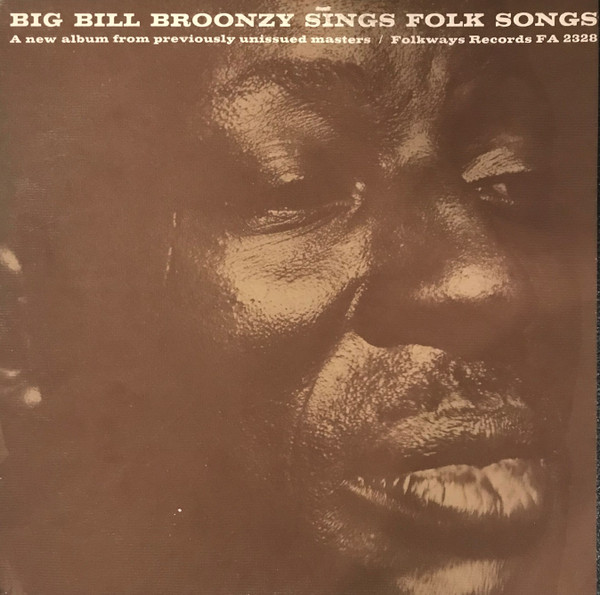
Released in 1962 on Folkways Records (catalog number FA 2328), Big Bill Broonzy Sings Folk Songs is a posthumous collection that stands as one of the most powerful testaments to the artistry of one of America's greatest songsters. The album arrived four years after Broonzy's death on August 15, 1958, assembled by Folkways founder Moses Asch from unreleased studio recordings made at the Folkways studio in New York during the mid-1950s, combined with live recordings from a concert at Northwestern University in Chicago on October 25, 1956. Asch released the album as a memorial to the blues icon, preserving some of the most intimate and affecting performances of Broonzy's storied career.
The album captures Broonzy during a pivotal period. By the mid-1950s, he had largely transitioned from the electric Chicago blues sound that had made him famous in the 1930s and 1940s to a solo acoustic folk-blues approach that resonated with the burgeoning American and European folk revival audiences. This reinvention was not merely commercial strategy — though Broonzy was savvy enough to recognize that white audiences wanted what they considered "authentic" acoustic blues — but also a return to his roots. Born Lee Conley Bradley (June 26, 1893 or 1903 — sources vary) in Scott, Mississippi, Broonzy grew up with the folk music, spirituals, work songs, and country blues of the rural South before moving to Chicago in the 1920s.
The 1950s found Broonzy at the height of his international fame. He had toured Europe extensively starting in 1951, becoming the first Chicago blues artist to perform for European audiences. His acoustic performances in British folk and jazz clubs profoundly influenced a generation of British musicians including Pete Townshend, Keith Richards, Ray Davies, and Eric Clapton — the latter described seeing Broonzy perform as feeling "like I was looking into heaven." In America, Broonzy was a prominent figure in the folk revival, performing at Carnegie Hall (where he debuted "Just a Dream" in 1938), collaborating with Pete Seeger, and appearing on Studs Terkel's WFMT radio programs in Chicago.
Yet these recordings were made against the backdrop of declining health. Broonzy was diagnosed with throat and lung cancer, and by late 1957 he was forced to retire from performing. He died in August 1958. The performances on Sings Folk Songs, made when Broonzy was already in failing health, show no sign of diminishment — they are powerful, authoritative, and emotionally rich documents of a master at work.
The Producer: Moses Asch
Moses Asch (1905–1986) was the founder of Folkways Records, one of the most important independent record labels in American history. Established in 1948, Folkways was dedicated to documenting the full spectrum of human sonic experience — folk music, blues, jazz, spoken word, children's music, and sounds from around the world. Asch's philosophy was simple but radical: record everything, keep everything in print. Unlike commercial labels that dropped titles that didn't sell, Folkways maintained its entire catalog indefinitely, ensuring that important recordings remained available.
Asch had a particular affinity for blues and folk music. He recorded extensively with Lead Belly, Woody Guthrie, Pete Seeger, and Sonny Terry and Brownie McGhee, among many others. His approach to recording was deliberately unadorned — basic monaural techniques, no overdubs, minimal post-production. Asch believed that the role of the recordist was to capture the performance as faithfully as possible, letting the artist's voice and instrument speak for themselves.
Asch's relationship with Broonzy began in the mid-1950s. He produced Broonzy's His Story (1956), Big Bill Broonzy Sings Country Blues (1957, FA 2326), and Blues with Big Bill Broonzy, Sonny Terry and Brownie McGhee (1959, FS 3817). The material on Sings Folk Songs came from the same period — studio sessions at Folkways' New York facility and the live Northwestern University concert. Asch held these recordings in reserve, releasing them in 1962 as a memorial tribute after Broonzy's passing.
New York-based jazz critic Charles Edward Smith worked closely with Asch on the Broonzy sessions, helping arrange the recordings and writing the original liner notes for the album. His 1962 tribute essay is included in the album's original packaging. Ronald Clyne designed the cover artwork.
The Recording Sessions
The album draws from two distinct recording sources:
Studio Sessions — Folkways Records, New York (mid-1950s)
The bulk of the album's tracks were recorded at the Folkways Records studio in New York City during the mid-1950s (approximately 1955–1957). These sessions were produced by Moses Asch with Charles Edward Smith, featuring Broonzy performing solo on acoustic guitar and vocals. The recordings were made using basic monaural techniques — a single microphone capturing both voice and guitar in a sparse, intimate setting. No overdubs, no effects, no studio trickery. The result is a series of performances of remarkable immediacy, with Broonzy's voice and guitar filling the sonic space with undeniable authority.
Live Concert — Northwestern University, October 25, 1956
Several tracks were recorded at Cahn Auditorium, Northwestern University, Evanston, Illinois (Chicago), during a concert presented by WFMT radio. The concert featured Broonzy alongside folk singer Pete Seeger, and the recordings were made by legendary Chicago broadcaster and oral historian Studs Terkel for WFMT. The live setting provides a different atmosphere — you can hear the hall's ambience, audience reactions, and the spontaneous energy of a performance in progress. Broonzy and Seeger shared the stage, finding common ground on songs that bridged blues and folk traditions.
Remastering
The album was remastered for CD release by Dr. Toby Mountain at Northeastern Digital. In 2016, Grammy Award-winning engineer Pete Reiniger remastered the album for vinyl reissue, working from the original analog master tapes. The 2016 Vinyl Me, Please reissue features an eight-page booklet with original liner notes, complete lyrics, Charles Edward Smith's 1962 tribute essay, and a new essay by Broonzy biographer Bob Riesman (author of I Feel So Good: The Life and Times of Big Bill Broonzy).
The Musicians
Big Bill Broonzy (Vocals, Guitar)
Big Bill Broonzy (1893/1903–1958) was one of the most important and versatile figures in American blues. Over a career spanning more than three decades, he recorded over 250 sides for labels including Paramount, Bluebird, Chess, and Mercury, and copyrighted more than 300 songs. He began as a country blues artist in the 1920s, transitioned to urban blues and jazz-influenced sounds in the 1930s and 1940s (employing electric instruments as early as 1942), and reinvented himself as a folk-blues solo performer in the 1950s. His repertoire encompassed ragtime, hokum, country blues, urban blues, spirituals, folk songs, and protest songs. In 1980, he was inducted into the first class of the Blues Hall of Fame.
Pete Seeger (Banjo, Vocals — on "John Henry")
Pete Seeger (1919–2014) was one of the most influential figures in American folk music. A member of the Weavers, a solo artist, and a lifelong activist, Seeger was a pivotal force in the folk revival of the 1950s and 1960s. He had performed with Broonzy at various concerts and hootenannies since the 1940s, including a July 4, 1954 concert at Circle Pines Center in Delton, Michigan, that was recorded for WFMT. At the Northwestern University concert, Seeger joined Broonzy on banjo and vocals for "John Henry," creating a rare documented collaboration between two giants of American roots music.
The Songwriters
Bessie Smith
The "Empress of the Blues" (1894–1937) wrote "Backwater Blues" in 1927. Her original Columbia recording is one of the classic blues records of the 1920s.
Hughie Cannon
Cannon (1877–1912) wrote "(Won't You Come Home) Bill Bailey" in 1902. It became one of the most popular songs of the early 20th century.
Woody Guthrie
Guthrie (1912–1967) popularized "This Train" in the folk revival, adapting the traditional spiritual and titling his autobiography Bound for Glory after the song's subtitle.
Charles Edward Smith
Smith was a New York-based jazz critic who worked closely with Moses Asch on the Broonzy sessions and wrote the original liner notes.
Track-by-Track Analysis
Side One
1. "Backwater Blues" — 2:50
Composer: Bessie Smith (based on Lead Belly's arrangement) Recorded at: Folkways studio, New York (mid-1950s) Musicians: Big Bill Broonzy — vocals, guitar
The album opens with a song indelibly associated with Bessie Smith, whose 1927 Columbia recording of "Backwater Blues" stands as one of the defining documents of classic female blues. Written in the wake of the catastrophic Mississippi River floods that devastated the South in 1927, Smith's original captured the personal losses and tragedies wrought by nature's indifference. Broonzy's version, based on Lead Belly's arrangement, strips the song to its emotional core — just his voice and acoustic guitar. His plaintive vocal commands attention from the first line, accompanied by fine, detailed guitar picking. The remastered mono recording places singer and guitar right in the listener's space with remarkable depth. Broonzy's interpretation eschews the dramatic piano flourishes of Smith's version in favor of a more meditative, sorrowful approach. The lyrics — "When it rains five days and the sky turns dark as night" — are delivered with the gravity of someone who understood the Mississippi Delta's capacity for destruction. As a bonus, the track's inclusion here implicitly links Broonzy to two other giants of American roots music — Bessie Smith and Lead Belly — positioning him as part of a continuum of African-American musical genius.
2. "This Train" — 3:00
Composer: Traditional (also known as "This Train Is Bound for Glory") Recorded at: Northwestern University concert, October 25, 1956 (live, WFMT broadcast) Musicians: Big Bill Broonzy — vocals, guitar; audience participation
"This Train" is a traditional African-American spiritual that had already become central to the folk music world through Woody Guthrie's performances and his autobiography Bound for Glory (1943). Broonzy's live version transforms the song into something between a spiritual and a civil rights anthem. His driving guitar establishes a propulsive rhythm, and you can hear the audience joining in on the singing — creating a powerful communal experience. Broonzy adds several verses that look forward to a day when skin color no longer matters: "This train don't care if you're White or Black on this train / Everybody ridin' is treated just alike." You can hear Broonzy's voice echoing in the hall when he leans away from the microphone, adding a sense of spatial reality to the recording. The performance embodies Broonzy's gift for taking traditional material and infusing it with contemporary social relevance.
3. "I Don't Want No Woman (To Try to Be My Boss)" — 3:08
Composer: Traditional blues Recorded at: Folkways studio, New York (mid-1950s) Musicians: Big Bill Broonzy — vocals, guitar
This track is pure country blues — a classic expression of male independence in the face of female authority. The song belongs to a long tradition of blues songs exploring gender dynamics and relationship power struggles. Broonzy delivers it with the sardonic confidence of a man who knows his own mind. His guitar playing is particularly impressive here — a steady, rolling accompaniment that drives the vocal forward with relentless momentum. The lyrics follow the traditional blues pattern of repetition with variation, each verse building on the central theme. Broonzy's vocal delivery balances humor and defiance — he's not angry, exactly, but firmly resolved. The track's concise length (just over three minutes) makes it feel like a complete, self-contained statement.
4. "Martha" — 5:00
Composer: Big Bill Broonzy (original composition, also known as "Martha Blues") Recorded at: Folkways studio, New York (mid-1950s) Musicians: Big Bill Broonzy — vocals, guitar
At five minutes, "Martha" is the album's longest and most emotionally devastating track. Broonzy had first recorded "Martha Blues" in 1945 with Memphis Slim on piano, a version that "clearly showed the way forward" for postwar Chicago blues. This solo acoustic version strips away the ensemble arrangement to reveal the song's emotional skeleton. The lyrics express deep longing for a woman — presumably Broonzy's wife or lover — with the singer's mournful cries conveying a depth of feeling that transcends the specific narrative. Broonzy's guitar playing is subtle and supportive, providing a cushion for a vocal performance of remarkable emotional rawness. The extended length allows Broonzy to develop the narrative through multiple verses, each one deepening the sense of loss and desire. The track is widely considered one of the highlights of the album — a masterclass in how much emotional weight a single voice and guitar can carry.
5. "Tell Me Who" — 3:41
Composer: Traditional blues Recorded at: Folkways studio, New York (mid-1950s) Musicians: Big Bill Broonzy — vocals, guitar
"Tell Me Who" is a cheating song built around a classic blues conceit — the singer demanding to know who has been visiting his woman while he's been away. The lyrics unfold as an interrogation: "Tell me who, tell me who, tell me who been lovin' you while I've been gone." Broonzy's guitar work on this track is particularly dexterous, with intricate fingerpicking that highlights his technical prowess. His vocal alternates between accusation and resignation — he knows the answer but needs to hear it anyway. The song follows the traditional twelve-bar blues structure, but Broonzy's phrasing is loose and conversational, bending the form to fit his narrative needs. At nearly four minutes, the track has room to develop, with Broonzy adding verses that build the emotional tension before a final, unresolved conclusion.
Side Two
6. "Bill Bailey" — 1:57
Composer: Hughie Cannon (1902) Recorded at: Folkways studio, New York (mid-1950s) Musicians: Big Bill Broonzy — vocals, guitar
"(Won't You Come Home) Bill Bailey" was written by Tin Pan Alley songwriter Hughie Cannon in 1902 and became one of the most popular songs of the early 20th century. Cannon was an interesting figure — a singer and pianist known for writing songs in African-American dialect, including "He Done Me Wrong" and "Just Because She Made Them Goo-Goo Eyes." "Bill Bailey" was reportedly inspired by Cannon's roommate, a musician named Bill Bailey whose wife had thrown him out. The song was first recorded by Arthur Collins in 1902 and has been performed by countless artists since, in jazz, blues, pop, and folk contexts. Broonzy's version is short, rousing, and joyfully irreverent — a uptempo romp that reveals another facet of his musical personality after the deep blues of Side One. His guitar playing is nimble and rhythmic, and his vocal delivers the familiar lyrics with a sly, knowing warmth. The track demonstrates Broonzy's remarkable versatility — he could move from deep blues to vaudeville-era pop without missing a step.
7. "Alberta" — 2:13
Composer: Big Bill Broonzy (adaptation of traditional folk song) Recorded at: Folkways studio, New York (mid-1950s) Musicians: Big Bill Broonzy — vocals, guitar
"Alberta" is one of Broonzy's signature songs — a jaunty, good-natured blues that he performed throughout his career. Broonzy copyrighted the song, though it draws on traditional folk and blues elements. The song's heroine, Alberta, is a recurring figure in blues and folk repertoire (Lead Belly also recorded a well-known "Alberta"), but Broonzy's version is distinctly his own — a rollicking celebration of a woman and the happiness she brings. His guitar playing drives the track with propulsive rhythm, and his vocal is relaxed and affable. The track is just over two minutes, making it one of the album's most concise statements, but it packs considerable charm into its brief runtime. "Alberta" was one of the songs Broonzy performed during his celebrated September 13, 1955 interview with Studs Terkel for WFMT.
8. "Goin' Down This Road" — 2:22
Composer: Traditional (also known as "Goin' Down the Road Feelin' Bad") Recorded at: Folkways studio, New York (mid-1950s) Musicians: Big Bill Broonzy — vocals, guitar
"Goin' Down This Road" (also known as "Goin' Down the Road Feelin' Bad," "Lonesome Road Blues," and "I Ain't Gonna Be Treated This Way") is a traditional American folk song with roots stretching back to at least the 1920s, and possibly earlier in African-American and Southern Appalachian oral traditions. The earliest known recording was by Henry Whitter in 1923, under the title "Lonesome Road Blues." The song became associated with the Dust Bowl migration of the 1930s after Woody Guthrie recorded his version, "Blowin' Down This Road" (1940). Broonzy's version features lyrics specific to his experience — complaints about cornbread and beans, two-dollar shoes killing his feet, and the desire to go where the chilly wind don't blow. He finishes the track with a vocal flourish that stops the listener dead in their tracks — a sudden, dramatic gesture that demonstrates his mastery of performance dynamics.
9. "Tell Me What Kind of Man Jesus Is" — 2:16
Composer: Traditional gospel Recorded at: Folkways studio, New York (mid-1950s) Musicians: Big Bill Broonzy — vocals, guitar
This traditional gospel song finds Broonzy in a more spiritually inquisitive mode. The song poses a series of questions about the nature of Jesus — not preachy or didactic, but genuinely curious. Broonzy's delivery is earnest and heartfelt, treating the religious material with the same respect and emotional commitment he brings to the blues. The guitar accompaniment is simpler here, providing a steady rhythmic foundation that allows the vocal to carry the song's spiritual weight. The track demonstrates Broonzy's versatility — he could move seamlessly between secular blues and sacred material, a skill rooted in the African-American musical tradition where church and blues were never far apart. The performance is subdued and reverent, creating a moment of quiet reflection on an album that ranges widely across emotional territory.
10. "John Henry" — 4:45
Composer: Traditional American folk ballad Recorded at: Northwestern University concert, October 25, 1956 (live, WFMT broadcast) Musicians: Big Bill Broonzy — vocals, guitar; Pete Seeger — banjo, vocals
"John Henry" is the most famous American folk ballad — the story of the "steel-driving man" who raced against a steam drill and won, only to die with his hammer in his hand. The ballad has been performed by countless artists across virtually every genre of American music, and its origins (whether based on a real person and event) continue to be debated by scholars. This version is a historic collaboration between two giants of American folk music — Big Bill Broonzy and Pete Seeger. Seeger joins Broonzy on banjo and vocals, creating a cross-cultural musical conversation between blues and folk traditions. Broonzy picks his guitar at a rapid tempo, singing as if he himself were trying to beat the steam drill. The performance runs nearly five minutes — one of the album's longest tracks — and builds in intensity as it progresses. The interplay between Broonzy's blues guitar and Seeger's folk banjo is electrifying, representing a meeting of traditions that the folk revival was all about. The live setting adds energy and spontaneity, making this one of the most exciting tracks on the album.
11. "The Glory of Love" — 3:23
Composer: Traditional Recorded at: Folkways studio, New York (mid-1950s) Musicians: Big Bill Broonzy — vocals, guitar
The album closes with a performance that keeps the focus squarely on Broonzy's impressive guitar picking. "The Glory of Love" is a traditional song that Broonzy had performed throughout his career, including at the July 4, 1954 concert with Pete Seeger at Circle Pines Center. For the first portion of the track, Broonzy lets his guitar do the talking — intricate, melodic picking that demonstrates his technical mastery. When he finally adds vocals, his delivery is subdued and contemplative, singing about the glory of love with the wisdom of a man who had known both its joys and its sorrows. The track serves as a gentle, reflective conclusion to an album that has ranged across blues, gospel, folk, and pop material. It leaves the listener with the sound of Broonzy's guitar — the instrument that had carried him from the Mississippi Delta to Chicago to concert halls across Europe and America.
Buy This Album
Critical Reception & Legacy
Contemporary reviews of Big Bill Broonzy Sings Folk Songs recognized it as a high point of Broonzy's career. The Boston Globe praised Broonzy's ability to "move with amazing ease from silky croon to brassy howl" and noted that he "dazzles with rough-edged intricacy." Blues Blast Magazine, reviewing the 2016 vinyl reissue, called the album "certainly one of the high points of Broonzy's career, with the deep blues tracks on the first side being the main highlights."
The album has been reissued multiple times by Smithsonian Folkways, which acquired the Folkways catalog in 1987 and has maintained Asch's policy of keeping all titles in print. The 1989 CD release (Smithsonian Folkways CD SF 40023) was mastered by Dr. Toby Mountain. The 2016 Vinyl Me, Please reissue (180-gram vinyl) featured remastering by Grammy Award winner Pete Reiniger from the original analog master tapes, along with the original artwork, lyrics, Charles Edward Smith's 1962 tribute essay, and a new essay by Bob Riesman.
The album's importance extends beyond its musical quality. Released posthumously, it helped cement Broonzy's legacy as not merely a blues singer but a songster in the fullest American tradition — someone who could move between blues, folk, gospel, and pop with equal authority. His influence on subsequent generations of musicians — from Eric Clapton and Pete Townshend to Muddy Waters and Memphis Slim — is incalculable. Big Bill Broonzy Sings Folk Songs remains an essential document of American roots music, a masterclass in acoustic blues guitar and vocal performance, and a fitting memorial to one of the greatest artists the blues has ever produced.
Album Credits Summary
Table
| Role | Personnel |
|---|---|
| Primary Artist | Big Bill Broonzy |
| Vocals, Guitar | Big Bill Broonzy (all tracks) |
| Banjo, Vocals | Pete Seeger (on "John Henry") |
| Producer/Recorder | Moses Asch |
| Liner Notes | Charles Edward Smith |
| Cover Design | Ronald Clyne |
| CD Mastering | Dr. Toby Mountain |
| Vinyl Remastering (2016) | Pete Reiniger |
| Reissue Essay (2016) | Bob Riesman |
Studio recordings: Folkways Records, New York (mid-1950s) Live recordings: Cahn Auditorium, Northwestern University, Evanston/Chicago, October 25, 1956 (broadcast by WFMT, recorded by Studs Terkel) Released: 1962, Folkways Records (FA 2328) Broonzy's death: August 15, 1958 (lung cancer) CD Reissue: 1989, Smithsonian Folkways (CD SF 40023) Vinyl Reissue: 2016, Vinyl Me, Please / Smithsonian Folkways (180g vinyl, remastered)