Background
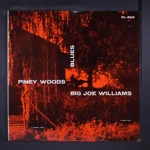
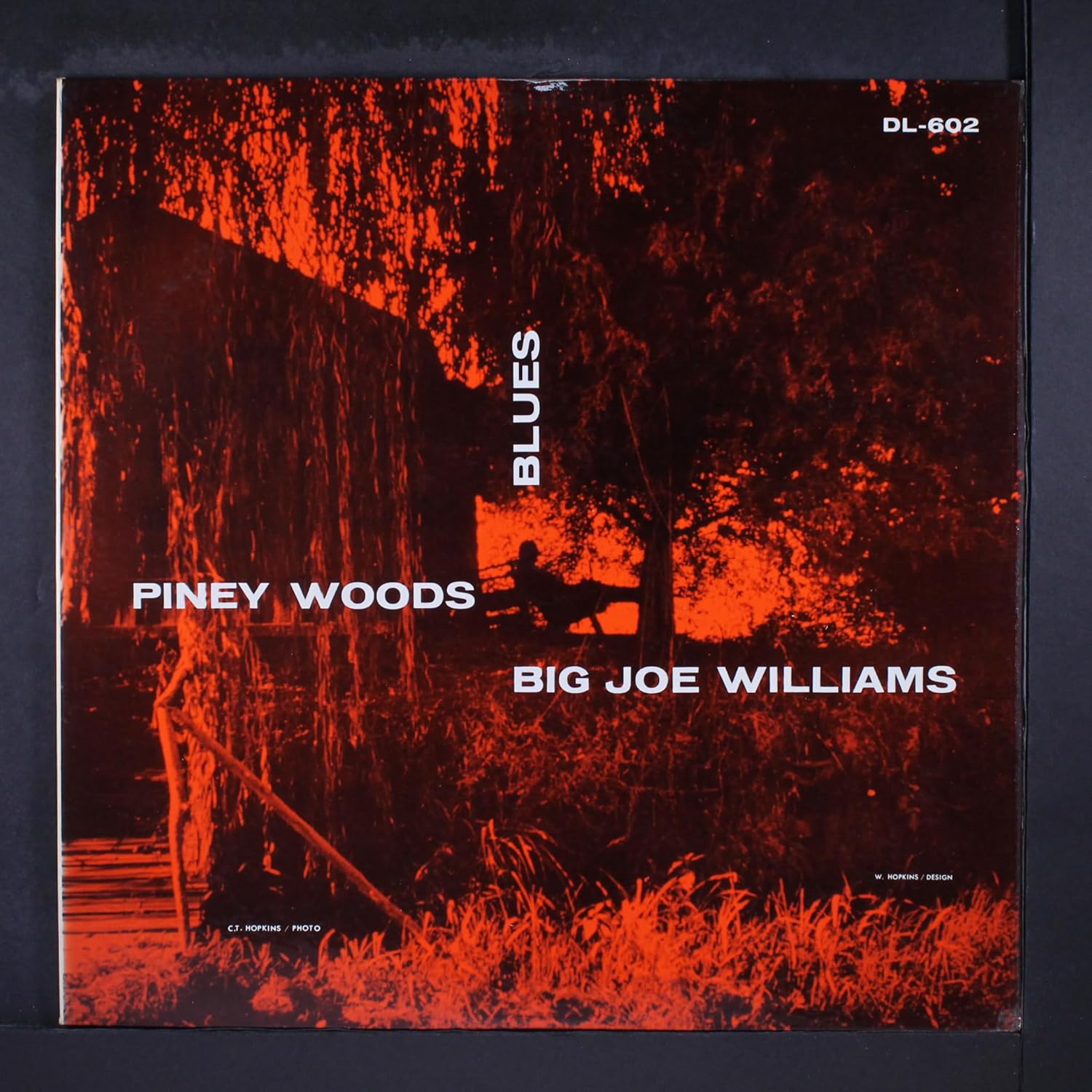
By the mid-1950s, Big Joe Williams (born Joseph Lee Williams, Crawford, Mississippi, 1903) had already been recording since 1935 — his "Baby, Please Don't Go" for Bluebird was a blues standard by then. After years of drifting between Mississippi, Tennessee, and Missouri, he settled for a stretch in St. Louis, where a young record-shop owner named Bob Koester tracked him down. Piney Woods Blues was the result: Williams' first album as a leader, and the debut release on Koester's fledgling label, then spelled "Delmar" (named for St. Louis's Delmar Boulevard) before it became Delmark once Koester relocated to Chicago. It was recorded over three sessions in January–February 1958 and first issued in 1958 on Delmar DL-602 (some later reissue notes give 1960).
The record captures Williams playing his famous homemade 9-string guitar — a battered 6-string with one dead tuning peg, to which he'd bolted an extra flange with four more pegs so he could double up certain courses. That instrument is basically his sonic signature.
The Sessions & Producer
Bob Koester produced and supervised the whole album (and is also credited as an interviewer on the record). Koester would go on to become one of the most important blues/jazz reissue and field producers of the postwar era, running Delmark for over 60 years.
- Session 1 — January 10, 1958, at the St. Louis home of Paul Bridenbach. Williams solo (vocals, spoken word, 9-string guitar). Koester and a young John Hartford (yes, the future "Gentle on My Mind" songwriter) sat in and conducted a recorded interview with Williams during this session — that interview became its own track. 5 songs came from this date.
- Session 2 — February 8, 1958, at the Blue Note Record Shop, St. Louis. Williams joined by J.D. Short on second guitar and harmonica. 4 tracks.
- Session 3 — February 18, 1958, also at the Blue Note Record Shop. Williams solo again. 3 tracks.
Musicians
- Big Joe Williams — vocals, guitar, 9-string guitar, on every track.
- J.D. Short — guitar and harmonica, guesting on 4 tracks. Short was a St. Louis-based songster/multi-instrumentalist (originally from Port Gibson, MS) and longtime friend/associate of Williams; his harmonica in particular colors "No More Whiskey."
Songwriters
Nine of the twelve tracks are credited to Williams himself. The other three are covers/adaptations of blues classics: two Sleepy John Estes numbers ("Drop Down Mama," "Someday Baby") and one Charley Patton-descended tune ("Shetland Pony Blues," a variant of Patton's "Pony Blues"). "Good Morning Little Schoolgirl" is formally credited to Sonny Boy Williamson I on most catalogs even though it's grouped with Williams' originals in reviews — worth flagging since blues songwriting credits from this era are notoriously tangled (labels often registered the current performer as composer regardless of true origin).
Track-by-track
-
Baby, Please Don't Go (3:04) — Williams (comp). Session 3, Feb 18, solo. His own signature tune, first cut in 1935 for Bluebird; this is a stripped-down solo remake on the 9-string, decades before the song became a garage/blues-rock warhorse via Them and AC/DC.
-
Drop Down Mama (2:28) — Sleepy John Estes (comp). Session 2, Feb 8, with J.D. Short on guitar/harmonica. Estes and Hammie Nixon originally cut this in 1935; Williams and Short's version leans on Short's harmonica for atmosphere.
-
Mellow Peaches (3:08) — Williams (comp). Session 1, Jan 10, solo.
-
No More Whiskey (3:12) — Williams (comp). Session 2, Feb 8, with J.D. Short — this is the track most often singled out for Short's harmonica solo work.
-
Tailor Made Babe (3:35) — Williams (comp). Session 1, Jan 10, solo.
-
Big Joe Talking (3:35) — credited as a Williams "composition" but really the recorded interview segment — Koester and John Hartford talking with Williams about his life and travels. Session 1, Jan 10.
-
Someday Baby (2:59) — Sleepy John Estes (comp). Session 3, Feb 18, solo. Estes cut the original in 1935 with Nixon; this is one of the most-covered blues songs of the era (later a Bob Dylan and Muddy Waters staple in variant form).
-
Good Morning Little Schoolgirl (3:12) — Sonny Boy Williamson I (comp, per catalog). Session 3, Feb 18, solo. The 1937 Williamson standard, given a solo Delta treatment here.
-
Peach Orchard Mama (3:42) — Williams (comp, per catalog; the melody/lyric lineage traces back to a Blind Lemon Jefferson 1929 side). Session 1, Jan 10, solo.
-
Juanita (3:24) — Williams (comp). Session 1, Jan 10, solo. Explicitly a nod to Sleepy John Estes' "Vernita" — Williams basically answers Estes' song with his own version of the same conceit ("Juanita, baby, where did you stay last night...").
-
Shetland Pony Blues (3:08) — Charley Patton (comp). Session 2, Feb 8, with J.D. Short. A reworking of Patton's 1929 "Pony Blues" — Williams had come up under Patton's direct influence in the Delta, so this is him paying that debt.
-
Omaha Blues (3:27) — Williams (comp). Session 1, Jan 10, solo. Closes the record.
Legacy
Williams died December 17, 1982, in Macon, Mississippi, and was posthumously inducted into the Blues Hall of Fame in 1992. Piney Woods Blues is generally regarded as one of the cleanest documents of his solo Delta style before he started touring/recording more with full bands in the '60s.