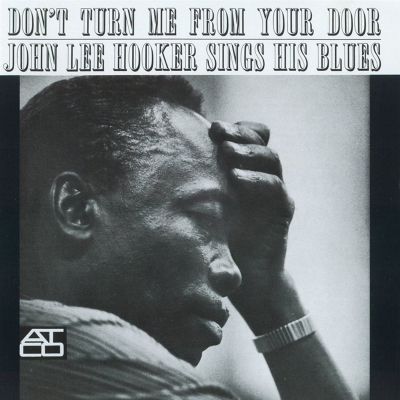
Don't Turn Me from Your Door (subtitled John Lee Hooker Sings His Blues) is a 1963 album by John Lee Hooker, released on Atco Records, the R&B subsidiary of Atlantic. Though marketed as a studio album, it is in fact a compilation drawing from two distinct sessions recorded a decade apart: six tracks cut in July 1953 for DeLuxe Records in Cincinnati, Ohio, and six new recordings made in July 1961 in Miami, Florida.
The result is a remarkably cohesive portrait of Hooker at his most stripped-down and elemental, bridging his raw early-1950s electric Delta sound with the slightly more refined but still primal approach of his early-1960s period.
Background and Sessions
By the early 1950s, John Lee Hooker had already established himself as a singular force in postwar blues. His 1948 debut "Boogie Chillen'" had been a massive hit, and throughout the early 1950s he recorded prolifically for a dizzying array of labels—Modern, Sensation, King, Chess, and DeLuxe among them—often under pseudonyms or through handshake deals that circumvented exclusive contracts.
The 1953 Cincinnati sessions were produced by Henry Stone at the King Records Studio on Brewster Avenue. Stone, who would later become a legendary figure in Miami soul and disco, was working as a talent scout and producer for DeLuxe Records at the time. The sessions yielded a number of singles, several of which featured Hooker's longtime accompanist Eddie Kirkland on second guitar.
The 1961 Miami sessions came at a transitional moment. Hooker had spent much of the late 1950s recording for Vee-Jay in Chicago, where producers increasingly surrounded him with full bands, female vocal groups, and horn sections—arrangements that sometimes cluttered his stark, hypnotic sound.
The Miami recordings, again produced by Henry Stone, represented a return to a leaner, more intimate approach. For these sessions, Hooker was joined by his cousin Earl Hooker, a master slide guitarist whose liquid, melodic lines provided the perfect counterpoint to John Lee's droning, rhythmic attack.
Production and Personnel
Table
| Role | Personnel |
|---|---|
| Artist | John Lee Hooker – vocals, guitar |
| Guitar (Tracks 2, 11) | Eddie Kirkland |
| Guitar (Tracks 5, 9) | Earl Hooker |
| Producer | Henry Stone |
| Label | Atco Records (SD 33-151) |
| Release Date | 1963 |
| Genre | Electric blues, Delta blues |
| Length | ~32:00 |
The album was released in 1963, by which time Hooker was simultaneously pursuing multiple career paths: the black blues club circuit, the white folk-revival college circuit (where his acoustic Riverside recordings had made him a favorite), and the rock audience that was beginning to discover blues through British Invasion bands.
Track-by-Track Breakdown
Side One
1. "Stuttering Blues" — 2:13
-
Songwriter: John Lee Hooker
-
Musician: John Lee Hooker – vocal, guitar
-
Recording: July 1953, Cincinnati, Ohio (DeLuxe session)
-
Notes: The album opens with a solo performance that is quintessential Hooker: a droning E-chord vamp, a stomping foot keeping irregular time, and that deep, half-spoken baritone. The title refers to Hooker's own speech impediment—he stuttered in conversation but never when singing—and the lyric is a sly, seductive monologue ("Can I get your phone number?").It is a masterclass in minimalism; every note matters.
2. "Wobbling Baby" — 2:32
-
Songwriter: John Lee Hooker
-
Musicians: John Lee Hooker – vocal, guitar; Eddie Kirkland – guitar
-
Recording: July 1953, Cincinnati, Ohio
-
Notes: An uptempo shuffle with Kirkland's second guitar adding rhythmic propulsion. The lyric is a comic complaint about an unsteady lover ("She wobblin' me all the time"). Kirkland and Hooker had worked together since the late 1940s, and their interplay here is telepathic.
3. "You Lost a Good Man" — 2:50
-
Songwriter: John Lee Hooker
-
Musician: John Lee Hooker – vocal, guitar
-
Recording: July 7, 1961, Miami, Florida
-
Notes: One of the 1961 Miami recordings, this is a slow, deliberate blues in which Hooker admonishes a lover who has wronged him. The tempo is relentless and mournful, with Hooker's guitar providing stinging, unpredictable accents between vocal lines.
4. "Love My Baby" — 2:35
-
Songwriter: John Lee Hooker
-
Musician: John Lee Hooker – vocal, guitar
-
Recording: July 1953, Cincinnati, Ohio
-
Notes: A classic Hooker paradox: "I love my baby, she been evil all the time." The dynamic interplay between voice and guitar is particularly pronounced here, with Hooker's vocal moans answered by piercing treble-string stabs.
5. "Misbelieving Baby" — 2:30
-
Songwriter: John Lee Hooker
-
Musicians: John Lee Hooker – vocal, guitar; Earl Hooker – guitar
-
Recording: July 7, 1961, Miami, Florida
-
Notes: An instrumental—or nearly so, with wordless vocalizations—that adopts a near-dirge-like feel. Earl Hooker's slide guitar weeps and cries behind John Lee's menacing, resonant rhythm figures. This is one of two tracks on the album featuring Earl, and it demonstrates the unique chemistry between the cousins.
6. "Drifting Blues" — 3:33
-
Songwriters: Charles Brown, Johnny Moore, Eddie Williams
-
Musician: John Lee Hooker – vocal, guitar
-
Recording: July 7, 1961, Miami, Florida
-
Notes: The only non-Hooker composition on the album, this is Hooker's version of the 1945 Charles Brown/Three Blazers standard. Hooker's reading is more raw and desperate than Brown's suave original, with echo-infused guitar tonality and a vocal that sounds truly adrift ("I'm drifting and drifting, like a ship out on the sea").
Side Two
7. "Don't Turn Me from Your Door" — 2:40
-
Songwriter: John Lee Hooker
-
Musician: John Lee Hooker – vocal, guitar
-
Recording: July 7, 1961, Miami, Florida
-
Notes: The title track and album centerpiece. A trademark boogie shuffle with familiar guitar hooks, the lyric is a plea for shelter that carries spiritual overtones ("I'm a pilgrim and a stranger"). The song reflects the eternal blues theme of hard times and plaintive loneliness.
8. "My Baby Don't Love Me" — 2:58
-
Songwriter: John Lee Hooker
-
Musician: John Lee Hooker – vocal, guitar
-
Recording: July 1953, Cincinnati, Ohio
-
Notes: A heart-wrenching lament colored by hostility and resignation. Hooker's guitar serves as an additional voice, with bold riffs punctuating the vocal lines. The emotional rawness is palpable.
9. "I Ain't Got Nobody" — 2:28
-
Songwriter: John Lee Hooker
-
Musicians: John Lee Hooker – vocal, guitar; Earl Hooker – guitar
-
Recording: July 7, 1961, Miami, Florida
-
Notes: The second instrumental (or near-instrumental) featuring Earl Hooker. This showcases Hooker's patented boogie context, surrounded by thumping low-end rhythm guitar and piercing lead accents from Earl. It is a masterclass in mood-setting and demonstrates why Hooker's style would prove so influential to rock musicians.
10. "Real Real Gone" — 2:22
-
Songwriter: John Lee Hooker
-
Musician: John Lee Hooker – vocal, guitar
-
Recording: July 1953, Cincinnati, Ohio
-
Notes: A meditation on betrayal and lost innocence. Hooker muses about a lover who started out with "church and Sunday school" only to end up "runnin' around." The threat to return to his wife adds a layer of domestic realism to the blues narrative.
11. "Guitar Lovin' Man" — 2:38
-
Songwriter: John Lee Hooker
-
Musicians: John Lee Hooker – vocal, guitar; Eddie Kirkland – guitar
-
Recording: July 1953, Cincinnati, Ohio
-
Notes: A scene of blues musical-comedy in which the narrator is shut out by his lady, who has replaced him with another man (played by Kirkland) and even installed a new lock on the door. The two-guitar interplay is playful and conversational, with Kirkland's biting responses answering Hooker's boasts.
12. "Talk About Your Baby" — 2:33
-
Songwriter: John Lee Hooker
-
Musician: John Lee Hooker – vocal, guitar
-
Recording: July 7, 1961, Miami, Florida
-
Notes: The album closer is a breezier jam with an upbeat story about a "long tall woman, built like willow tree." After the darkness of much of what precedes it, this track provides a moment of almost lighthearted release, though Hooker's vocal still carries an undercurrent of sexual menace.
Expanded Reissues
Several reissues of the album have added bonus tracks from the same sessions, bringing the total to sixteen tracks. These additions include:
-
"Pouring Down Rain" (1953, with Eddie Kirkland)
-
"Goin' South" (1953)
-
"Blue Monday" (1953, with Eddie Kirkland)
-
"My Baby Put Me Down" (1953, previously unissued)
Buy The Album
 Buy from Amazon Don't Turn Me from Your Door
Reception and Legacy
Don't Turn Me from Your Door received favorable reviews upon release and has grown in stature over the decades. AllMusic's Steve Leggett praised it as quintessential Hooker: "You really can't go wrong with this guy—he always delivered what he was supposed to deliver with no frills and no fuss, generating a kind of endless boogie that, no matter what embellishments producers added in, was always poised between old country blues and its next-generation urban blues counterpart."
The Penguin Guide to Blues Recordings included the album in its canon of essential blues recordings, and The Encyclopedia of Popular Music likewise noted its importance.
What makes the album historically significant is its demonstration of Hooker's remarkable consistency across a decade of stylistic change. The 1953 tracks are raw, urgent, and almost feral in their intensity; the 1961 tracks are slightly more controlled but no less powerful. Together, they present Hooker as a bluesman who transcended the usual categories—too electric and urban for the folk purists, too rural and idiosyncratic for the Chicago blues mainstream, yet utterly singular and instantly recognizable.
The album also captures two crucial musical partnerships: with Eddie Kirkland, whose rhythmic second guitar helped define Hooker's early electric sound, and with Earl Hooker, whose sophisticated slide work pointed toward the more expansive collaborations Hooker would pursue in later years. As critic Pete Lowry observed in 1972, "Hooker is a small man with a bit of a stammer, but when he begins to sing and play, a change occurs because blues is in his life's blood. The stammer fades, and a subtle intensity takes over as he performs."
In the broader context of Hooker's career, Don't Turn Me from Your Door stands as a bridge between his postwar prime and his later status as a global blues icon. Released the same year he began his Vee-Jay recordings with full band arrangements, it preserved the stripped-down, solo-and-duo format that had made his reputation. For listeners who find Hooker's later work overly polished or his early 78s too sonically primitive, this album hits a perfect middle ground—exquisitely distilled blues by one of the masters.