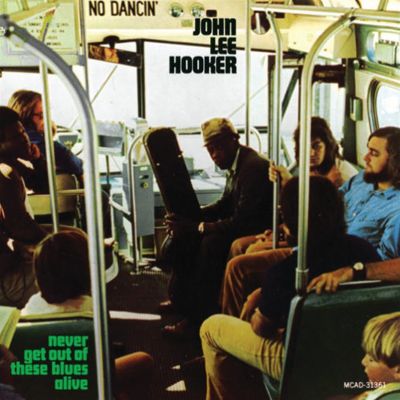
Never Get Out of These Blues Alive is a 1972 studio album by John Lee Hooker, released on ABC Records and recorded over two days in September 1971 at Wally Heider Recording in San Francisco.
Though often overshadowed by Hooker's later star-studded comeback albums, this record was in fact his first major collaboration with younger rock and blues musicians — predating The Healer (1989) and Mr. Lucky (1991) by nearly two decades — and it remains one of the most organic and gritty entries in his vast discography.
Sessions and Production
The album was recorded on September 28–29, 1971 at Wally Heider Recording, San Francisco, and mixed at The Village Recorder in Los Angeles.
| Role | Personnel |
|---|---|
| Artist | John Lee Hooker – vocals, guitar |
| Producer | Ed Michel |
| Engineer | Ken Hopkins |
| Assistant Engineer | Rick Stanley |
| Mixing | Baker Bigsby |
| Cover Design & Photography | Philip Melnick |
| Label | ABC Records |
| Release Date | 1972 |
| Genre | Blues, electric blues |
| Length | 39:53 |
The cover photograph is particularly memorable: a forlorn-looking Hooker seated on a Los Angeles transit bus beneath a sign reading "NO DANCIN'" — an image that is clearly ironic given the album's predominantly driving, upbeat character.
Musicians
The album assembled a remarkable cross-generational cast of blues and rock musicians:
| Musician | Instrument(s) |
|---|---|
| John Lee Hooker | Vocals, guitar |
| Van Morrison | Vocals, guitar |
| Charlie Musselwhite | Harmonica |
| Elvin Bishop | Slide guitar |
| Steve Miller | Organ |
| Earl Hooker | Guitar |
| Luther Tucker | Guitar |
| Mel Brown | Guitar, bass guitar |
| Michael White | Violin |
| Robert Hooker | Organ, electric piano |
| Mark Naftalin | Piano |
| Clifford Coulter | Electric piano |
| Gino Skaggs | Bass guitar, drums |
| John Kahn | Bass guitar |
| Ken Swank | Drums |
| Ron Beck | Drums |
| Chuck Crimelli | Drums |
| Ray MacCarty | Guitar |
| Paul Wood | Guitar |
| Benny Roweh | Slide guitar |
The principal rhythm section for most tracks consisted of Gino Skaggs on Fender bass, Ken Swank on drums, and Hooker's own son Robert Hooker on keyboards — giving the sessions a familial, relaxed atmosphere.
Track-by-Track Breakdown
Side One
1. "Bumblebee, Bumblebee" — 4:12
-
Songwriter: John Lee Hooker
-
Musicians: John Lee Hooker – vocals, guitar; with ensemble backing
-
Notes: The album opens with a buzzing, uptempo blues that showcases Hooker's signature droning guitar style and foot-stomping rhythm. The title references the classic blues trope of the bumblebee as a fickle lover.
2. "Hit the Road" — 2:57
-
Songwriter: John Lee Hooker
-
Musicians: John Lee Hooker – vocals, guitar; Charlie Musselwhite – harmonica; rhythm section
-
Notes: A brisk, two-chord shuffle that clocks in under three minutes. Musselwhite's harmonica provides piercing, bluesy counterpoint to Hooker's vocal.
3. "Country Boy" — 6:59
-
Songwriter: John Lee Hooker
-
Musicians: John Lee Hooker – vocals, guitar; Charlie Musselwhite – harmonica; Elvin Bishop – slide guitar; Steve Miller – organ; rhythm section
-
Notes: The longest track on Side One, this extended blues groove features some of the album's most textured ensemble work. Musselwhite's harp, Bishop's stinging slide, and Miller's organ create a rich, layered backdrop for Hooker's storytelling.
4. "Boogie With the Hook" — 6:32
-
Songwriter: John Lee Hooker
-
Musicians: John Lee Hooker – vocals, guitar; Michael White – violin; rhythm section
-
Notes: An infectious, extended boogie that lets the band stretch out. Jazz violinist Michael White's contributions are particularly notable here, adding a bluesy, swinging texture that elevates the track beyond standard barroom boogie.
Side Two
5. "T.B. Sheets" — 4:58
-
Songwriters: John Lee Hooker, Van Morrison
-
Musicians: John Lee Hooker – vocals, guitar; Van Morrison – vocals, guitar; Michael White – violin; rhythm section
-
Notes: A stunning reinterpretation of Van Morrison's harrowing 1967 song about a lover dying of tuberculosis. Where Morrison's original was a raw, frantic epic, Hooker's version is more restrained and mournful — a shattering requiem that benefits enormously from White's elegiac violin.AllMusic noted that this version is "much more restrained here than on the earlier debut release by Morrison."
6. "Letter to My Baby" — 3:57
-
Songwriter: John Lee Hooker
-
Musicians: John Lee Hooker – vocals, guitar; with ensemble backing
-
Notes: A shorter, more intimate track that serves as a breather before the album's epic closer. Hooker's vocal is conversational and direct, typical of his best mid-tempo blues.
7. "Never Get Out of These Blues Alive" — 10:15
-
Songwriter: John Lee Hooker
-
Musicians: John Lee Hooker – vocals, guitar; Van Morrison – vocals, guitar; Elvin Bishop – slide guitar; rhythm section
-
Notes: The album's centerpiece and title track is a sprawling, ten-minute duet with Van Morrison that ranks among the most celebrated collaborations in either artist's catalog. Bishop's slide guitar is a key element, weaving in and out of the two vocalists' interplay.The song became the foundation of a musical friendship that would culminate 25 years later in the Grammy-winning album Don't Look Back (1997), produced by Morrison.
1987 Reissue Bonus Tracks
The 1987 See For Miles Records reissue added four additional tracks, including two featuring Hooker's cousin Earl Hooker on slide guitar:
| Track | Length |
|---|---|
| "If You'll Take Care of Me, I'll Take Care of You" | 3:42 |
| "(I Got) A Good 'Un" | 3:26 |
| "Baby I Love You" | 3:15 |
| "Lonesome Mood" | 4:51 |
Buy The Album
Reception and Legacy
Never Get Out of These Blues Alive received strong critical notices upon release. Robert Christgau awarded it an A- in his Consumer Guide, praising "an agonizing version of 'TB Sheets,' an apt contribution from Van Morrison, and great studio work from guitarist Luther Tucker, Mel Brown, and Elvin Bishop." He later named it one of his favorite John Lee Hooker albums.
The album peaked at #130 on the Billboard Top Jazz Albums chart.
AllMusic's review situated the record as a crucial bridge in Hooker's career: "Following the legendary bluesman's popular collaboration with Canned Heat [Hooker 'n Heat, 1971], this album continues his work with mostly younger musicians and predates similar projects The Healer and Mr. Lucky by about 20 years."
What distinguishes Never Get Out of These Blues Alive from Hooker's later celebrity-duet albums is its organic, unforced quality. As critic Nick DeRiso observed, "Unlike those later, sometimes prefab duets, however, this early 1970s piece has everything to do with John Lee Hooker, rather than playing to some preconceived notion of selling albums. Never Get Out feels gritty and organic, like a record that Hooker wanted to make with some new friends."
The album also holds a pivotal place in the long and fruitful relationship between Hooker and Van Morrison. Their collaboration on the title track — spanning 25 years before they reunited for Don't Look Back — demonstrated that the aging Delta bluesman and the Belfast soul shouter were kindred spirits, equally committed to music that honored tradition without being imprisoned by it. For Hooker, who would continue recording until shortly before his death in 2001, Never Get Out of These Blues Alive proved that his crawling kingsnake guitar, his pounding foot, and his stoic, doomy rage could not only survive the rock era but thrive within it — provided the setting was right, and the company was good.