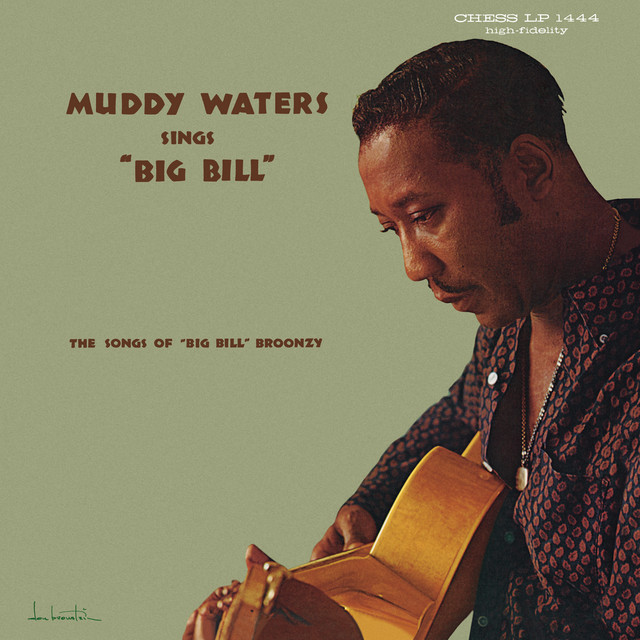
Muddy Waters Sings "Big Bill" is Muddy Waters' first proper studio album — and only his second LP overall following the 1958 compilation The Best of Muddy Waters — released by Chess Records in June 1960.
Recorded at Chess Studio in Chicago between June and August 1959, the album is a full-length tribute to Big Bill Broonzy, the elder blues statesman who had given Waters his start on the Chicago circuit and who had died the previous year in August 1958.
Rather than acoustic folk readings, Waters and his electric Chicago band recast Broonzy's songs in Waters's signature amplified style — making this one of the earliest stereo recordings of the Muddy Waters band and a pivotal release in his crossover to white folk-revival audiences.
Background and Sessions
By 1959, Muddy Waters was already a towering figure in Chicago blues, with a string of R&B hits for Chess including "Hoochie Coochie Man," "Mannish Boy," and "Got My Mojo Working." However, the late-1950s folk-music boom — fueled by college audiences and the success of the 1958 The Best of Muddy Waters LP among white listeners — prompted Chess to position Waters for the burgeoning folk market.
The album was recorded in three distinct phases at Chess Studio, Chicago:
-
June 1959 — initial sessions with the full band
-
July/August 1959 — additional sessions, some with slightly different personnel
The sessions yielded not only the album tracks but also singles that appeared on Chess 1733, 1739, and 1748 between July 1959 and January 1960.
Production and Personnel
Table
| Role | Personnel |
|---|---|
| Artist | Muddy Waters (McKinley Morganfield) – vocals, guitar |
| Harmonica | James Cotton |
| Piano | Otis Spann |
| Second Guitar | Pat Hare |
| Bass | Andrew Stephenson |
| Drums | Francis Clay (with Willie "Big Eyes" Smith on some tracks) |
| Producers | Leonard Chess & Phil Chess |
| Label | Chess Records (LP 1444) |
| Release Date | June 1960 |
| Genre | Chicago blues, electric blues |
| Length | 27:47 |
The core band represented one of Waters's strongest working units of the late 1950s. James Cotton's harmonica work is a particular highlight throughout, adding piercing, bluesy countermelodies to Waters's slashing guitar and gravelly vocals.
Otis Spann's piano and Pat Hare's second guitar filled out the sound, while Andrew Stephenson's bass and Francis Clay's drums provided the relentless Chicago backbeat. Some tracks feature Willie "Big Eyes" Smith on drums instead of Clay.
The album was produced by Leonard and Phil Chess, the label's founders, who had overseen virtually all of Waters's recordings since his 1947 debut.
Studs Terkel contributed the original liner notes.
Track-by-Track Breakdown
Side One
1. "Tell Me Baby" — 2:15
-
Songwriter: Big Bill Broonzy
-
Musicians: Muddy Waters – vocals, guitar; James Cotton – harmonica; Otis Spann – piano; Pat Hare – guitar; Andrew Stephenson – bass; drums (likely Willie Smith based on session documentation)
-
Notes: Recorded during the July/August 1959 sessions.A driving opener that establishes the album's template: Broonzy's acoustic folk-blues material electrified and amplified for the Chicago club circuit. Waters's vocal is urgent and commanding.
2. "Southbound Train" — 2:51
-
Songwriter: Big Bill Broonzy
-
Musicians: Muddy Waters – vocals, guitar; James Cotton – harmonica; Otis Spann – piano; Pat Hare – guitar; Andrew Stephenson – bass; Francis Clay – drums
-
Notes: A train-themed blues that allows the band to stretch out with a propulsive shuffle. Cotton's harmonica mimics the train whistle while Spann's piano rolls underneath Waters's vocal.
3. "When I Get to Thinking" — 3:05
-
Songwriter: Harriett Melka
-
Musicians: Muddy Waters – vocals, guitar; James Cotton – harmonica; Otis Spann – piano; Pat Hare – guitar; Andrew Stephenson – bass; Francis Clay – drums
-
Notes: Recorded in July/August 1959 and released as the B-side of Chess 1748 in January 1960.One of two songs on the album written by Harriett Melka rather than Broonzy. A slow, reflective blues that gives Waters room to emote over Spann's spare piano and Cotton's mournful harp fills.
4. "Just a Dream (On My Mind)" — 2:30
-
Songwriter: Big Bill Broonzy
-
Musicians: Muddy Waters – vocals, guitar; James Cotton – harmonica; Otis Spann – piano; Pat Hare – guitar; Andrew Stephenson – bass; Francis Clay – drums
-
Notes: A mid-tempo number with a classic Chicago blues groove. Waters's guitar work is particularly sharp here, interlocking with Hare's rhythm playing.
5. "Double Trouble" — 2:44
-
Songwriter: Harriett Melka
-
Musicians: Muddy Waters – vocals, guitar; James Cotton – harmonica; Otis Spann – piano; Pat Hare – guitar; Andrew Stephenson – bass; drums (likely Willie Smith based on session documentation)
-
Notes: Recorded in July/August 1959.The second Melka composition on the album, featuring a stinging guitar riff and Waters's world-weary vocal delivery. The title would later become famous as the namesake of the Otis Rush classic, though this is a different song entirely.
6. "I Feel So Good" — 2:53
-
Songwriter: Big Bill Broonzy
-
Musicians: Muddy Waters – vocals, guitar; James Cotton – harmonica; Otis Spann – piano; Pat Hare – guitar; Andrew Stephenson – bass; Francis Clay – drums
-
Notes: Recorded in June 1959 and released as the A-side of Chess 1748 in January 1960.One of Broonzy's most enduring songs, given a raucous, celebratory reading. Waters's vocal is exuberant, and Cotton's harmonica solo is a standout. This track also appears on the landmark live album Muddy Waters at Newport 1960.
Side Two
7. "I Done Got Wise" — 2:56
-
Songwriter: McKinley Morganfield (Muddy Waters)
-
Musicians: Muddy Waters – vocals, guitar; James Cotton – harmonica; Otis Spann – piano; Pat Hare – guitar; Andrew Stephenson – bass; Francis Clay – drums
-
Notes: The only original composition on the album, credited to Waters himself under his birth name. A sly, self-penned blues that fits seamlessly among the Broonzy material while showcasing Waters's own songwriting voice.
8. "Mopper's Blues" — 2:51
-
Songwriter: Big Bill Broonzy
-
Musicians: Muddy Waters – vocals, guitar; James Cotton – harmonica; Otis Spann – piano; Pat Hare – guitar; Andrew Stephenson – bass; Francis Clay – drums
-
Notes: A classic Chicago shuffle with Waters in full command. The interplay between Cotton's harp and Waters's vocal phrasing is particularly effective here.
9. "Lonesome Road Blues" — 3:01
-
Songwriter: Big Bill Broonzy
-
Musicians: Muddy Waters – vocals, guitar; James Cotton – harmonica; Otis Spann – piano; Pat Hare – guitar; Andrew Stephenson – bass; Francis Clay – drums
-
Notes: One of the standout performances on the album. Waters's vocal is steeped in loneliness and resignation, and the band provides a suitably mournful backdrop. DownBeat critic Pete Welding singled out this track and "When I Get to Thinking" as highlights.
10. "Hey, Hey" — 2:41
-
Songwriter: Big Bill Broonzy
-
Musicians: Muddy Waters – vocals, guitar; James Cotton – harmonica; Otis Spann – piano; Pat Hare – guitar; Andrew Stephenson – bass; Francis Clay – drums
-
Notes: The album closer and one of Broonzy's most famous compositions. Waters's version is upbeat and infectious, with a rolling groove that sends the album out on a high note. Cotton's harmonica dances around Waters's vocal, and the band locks into a tight, swinging rhythm.
Buy The Album
Reception and Legacy
Muddy Waters Sings "Big Bill" received strong reviews upon release. AllMusic's Cub Koda later noted that the material "doesn't sound much like Broonzy so much as a virtual recasting of his songs into Muddy's electric Chicago style."
Pete Welding awarded the album four stars in DownBeat, praising how "Muddy works within his accustomed groove in these selections, his voice hoarse and insistent, his guitar driving fiercely below it."
The album was also strategically significant. Chess recognized that the folk revival was opening new markets, and this tribute to Broonzy — who had become something of a folk icon in his final years — helped position Waters for the college and festival circuit. It likely contributed to his booking at the 1960 Newport Jazz Festival, where his electrifying performance was captured on At Newport 1960.
Today, Muddy Waters Sings "Big Bill" stands as a fascinating document of transition: Waters honoring his mentor while firmly stamping the material with his own revolutionary electric sound. It bridges the rural acoustic blues of Broonzy's generation with the urban Chicago blues that Waters himself had pioneered, and it remains an essential entry in both artists' discographies.