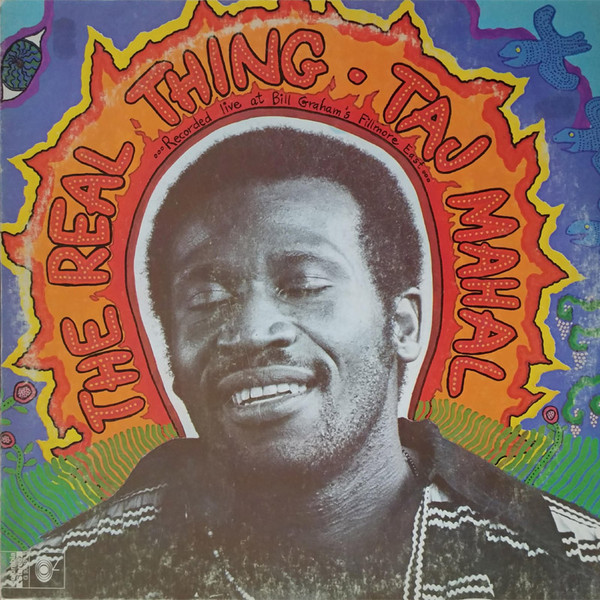
The Real Thing is a double live album by Taj Mahal, released in 1971 on Columbia Records. Recorded on a single night—February 13, 1971—at the legendary Fillmore East in New York City, it stands as one of the most audacious and sonically unique live albums in blues history. What distinguishes it from virtually every other blues live record of the era is its brass section: rather than the customary trumpet-and-saxophone lineup, Taj Mahal performed backed by Howard Johnson's four-tuba band, a configuration that gave the music a deep, resonant, almost orchestral bottom end while retaining the raw energy of a rock concert.
Sessions and Production
The album was recorded in a single concert at Bill Graham's Fillmore East, the premier rock venue of its day. Unlike many live albums that stitch together multiple nights or tour dates, The Real Thing captures one complete performance, giving it a narrative coherence and sustained energy that multi-night compilations often lack.
Table
| Role | Personnel |
|---|---|
| Artist | Taj Mahal (Henry Saint Clair Fredericks) – vocals, blues harp, chromatic harmonica, National steel-bodied guitar, five-string guitar (banjo), fife |
| Producer (Original Recording) | David Rubinson |
| Producer (CD Reissue) | Bob Irwin |
| Engineers | Tim Geelan, Glen Kolotkin, Frank Abbey, Jerry Smith |
| Cover Photography | Irene Harris |
| Cover Artwork/Design | Anna Hornisher |
| Label | Columbia Records |
| Release Date | 1971 |
| Genre | Blues, electric blues, jazz-blues |
| Length | ~66:00 |
The Band: Howard Johnson's Tuba Ensemble
The most striking feature of The Real Thing is its brass section, organized and arranged by jazz tuba virtuoso Howard Johnson. At the time, Johnson was already establishing himself as the preeminent voice on jazz tuba, having worked with Charles Mingus, Gil Evans, and Carla Bley.
Taj Mahal had met Johnson and invited him and his tuba cohorts to tour and record. The resulting album debuted what would become known as Johnson's tuba choir approach—an innovative use of multiple tubas functioning as a horn section rather than merely doubling bass lines.
Table
| Musician | Instruments |
|---|---|
| Taj Mahal | Vocals, blues harp, chromatic harmonica, National steel-bodied guitar, five-string guitar (banjo), fife |
| Howard Johnson | Tuba (BB♭, F), flugelhorn, baritone saxophone, brass arrangements |
| Bob Stewart | Tuba (CC), flugelhorn, trumpet |
| Joseph Daley | Tuba (BB♭), valve trombone |
| Earle McIntyre | Tuba (E♭), bass trombone |
| Bill Rich | Electric bass |
| John Simon | Piano, electric piano |
| John Hall | Electric guitar |
| Greg Thomas | Drums |
| Kwasi "Rocky" DziDzournu | Congas |
This was Taj Mahal's first recording with Howard Johnson's Tuba Band and his first recording with Bill Rich on bass, who would go on to become a cornerstone of the Taj Mahal Trio for decades.
Track-by-Track Breakdown
LP One — Side One
1. "Fishin' Blues" — 2:58
-
Songwriter: Henry Thomas
-
Musicians: Taj Mahal – vocals, National steel-bodied guitar, harmonica; Howard Johnson – tuba, brass arrangements; full ensemble
-
Notes: The album opens with a song Taj Mahal had already recorded on 1969's Giant Step/De Ole Folks at Home. Originally written by Chris Smith in 1911 and first recorded by "Ragtime Texas" Henry Thomas in 1928 on Vocalion, the song had become a folk-revival staple.Taj probably discovered it on Harry Smith's Anthology of American Folk Music.The live version here is relaxed and playful, with the tuba section providing a surprisingly nimble, bouncy foundation.
2. "Ain't Gwine to Whistle Dixie (Any Mo')" — 9:11
-
Songwriters: Chuck Blackwell, Jesse Ed Davis, Gary Gilmore, Taj Mahal
-
Musicians: Taj Mahal – vocals, guitar; full ensemble including tuba section, John Hall (guitar), John Simon (piano), Bill Rich (bass), Greg Thomas (drums), Kwasi DziDzournu (congas)
-
Notes: The first of several extended workouts on the album. Originally from 1969's Giant Step/De Ole Folks at Home, this nine-minute version allows the band to stretch out with Latin-tinged rhythms and extended solo passages. The tuba section's brass arrangements give the groove a weight and momentum that a conventional horn section could not replicate.
LP One — Side Two
3. "Sweet Mama Janisse" — 3:32
-
Songwriter: Taj Mahal
-
Musicians: Taj Mahal – vocals, guitar; full ensemble
-
Notes: A concise, upbeat original that showcases Taj's gift for catchy, folk-inflected songwriting. The tuba section provides melodic counterpoint rather than mere rhythmic support.
4. "Going Up to the Country and Paint My Mailbox Blue" — 3:24
-
Songwriter: Taj Mahal
-
Musicians: Taj Mahal – vocals, guitar, harmonica; full ensemble
-
Notes: One of Taj Mahal's most beloved originals, previously recorded on The Natch'l Blues (1968). The song's whimsical back-to-the-land narrative and singalong chorus made it a staple of his live shows. The tuba section's arrangement adds a carnival-like, New Orleans parade feel.
5. "Big Kneed Gal" — 5:34
-
Songwriter: Taj Mahal
-
Musicians: Taj Mahal – vocals, guitar; full ensemble
-
Notes: A funky, mid-tempo groover with a sly lyric. The track demonstrates how effectively the tuba section could function in a soul-blues context, with the four tubas creating a dense, interlocking rhythmic bed.
6. "You're Going to Need Somebody on Your Bond" — 6:13
-
Songwriter: Blind Willie Johnson
-
Musicians: Taj Mahal – vocals, guitar; full ensemble
-
Notes: A gospel-blues standard by the legendary Texas street singer Blind Willie Johnson. Taj Mahal's version transforms the spiritual into a slow-burning blues meditation, with the tuba section providing a mournful, almost funereal drone beneath his vocal.
LP Two — Side Three
7. "Tom and Sally Drake" — 3:39
-
Songwriter: Taj Mahal
-
Musicians: Taj Mahal – five-string guitar (banjo); Howard Johnson – tuba; possibly reduced ensemble
-
Notes: A charming duet featuring Taj on banjo and Howard Johnson on tuba.This track highlights the album's playful, experimental spirit and the genuine musical rapport between Mahal and Johnson.
8. "Diving Duck Blues" — 3:46
-
Songwriter: Sleepy John Estes
-
Musicians: Taj Mahal – vocals, guitar, harmonica; full ensemble
-
Notes: A Sleepy John Estes classic that Taj had recorded on his 1968 debut album. The song's jaunty rhythm and memorable lyric ("If the river was whiskey, and I was a diving duck") translate perfectly to the expanded ensemble setting.
9. "John, Ain't It Hard" — 5:30
-
Songwriter: Taj Mahal
-
Musicians: Taj Mahal – vocals, guitar; full ensemble
-
Notes: A driving, medium-tempo blues with a call-and-response structure. The track gives the tuba section room to stretch out with arranged passages that demonstrate Johnson's sophisticated brass writing.
LP Two — Side Four
10. "She Caught the Katy (And Left Me a Mule to Ride)" — 4:08
-
Songwriters: Taj Mahal, Yank Rachell
-
Musicians: Taj Mahal – vocals, guitar, harmonica; full ensemble
-
Notes: This track was omitted from the original vinyl issue due to time limitations of the double-LP format and was added to the 2000 CD reissue.The studio version had appeared on The Natch'l Blues (1968). The song would later gain wider recognition when it was featured in the 1980 film The Blues Brothers.
11. "You Ain't No Street Walker Mama, Honey but I Do Love the Way You Strut Your Stuff" — 18:56
-
Songwriter: Taj Mahal
-
Musicians: Taj Mahal – vocals, guitar, harmonica; full ensemble
-
Notes: The album's epic closer occupies an entire LP side. Originally running 19 minutes on vinyl, it was edited to 11:45 on the CD reissue before being restored to its full length on later editions.A sprawling blues jam that moves through multiple sections and moods, it features extended soloing from the tuba section, guitar exchanges between Mahal and Hall, and Taj's charismatic vocal improvisations. The title alone is quintessential Taj Mahal—playful, provocative, and unmistakably his own.
Buy The Album
Critical Reception
Contemporary reviews were generally positive, if somewhat bemused by the unusual instrumentation. Robert Christgau awarded the album a B in his Consumer Guide, noting: "Taj's second straight two-album set is a live one, featuring sidemen from John Simon and John Hall to Kwasi DziDzournu, four count-'em four tubas, and ten count-'em ten titles. Lots of fun, but as you might expect, things get very loose, especially when the tubists lay their burdens down."
Rolling Stone, Entertainment Weekly, The Penguin Guide to Blues Recordings, and AllMusic all reviewed the album favorably, with AllMusic noting its place in Taj's evolving live sound.
Significance and Legacy
The Real Thing occupies a pivotal place in Taj Mahal's career and in the broader history of American roots music. It represents the moment when Mahal fully committed to the expansive, genre-defying approach that would define his subsequent decades of work. Having already established himself as the most credible young African-American voice of the blues revival with his first three studio albums, Mahal used The Real Thing to demonstrate that the blues could accommodate jazz instrumentation, extended improvisation, and large-ensemble arranging without losing its essential grit and soul.
For Howard Johnson, the album was a breakthrough. It introduced his four-tuba concept to a rock and blues audience that might never have encountered it in jazz clubs, and it established the template for his later work with Gravity, the six-tuba-plus-rhythm-section ensemble he would lead for decades.
Johnson himself later recalled the album as a key moment in his crossover from jazz into rock and popular music, leading to his work with The Band, John Lennon, and eventually the original Saturday Night Live house band.
For Bill Rich, the album launched a partnership that would span more than five decades. Rich remains a member of the Taj Mahal Trio to this day, making him one of the longest-tenured sidemen in blues history.
The album also foreshadowed Mahal's later explorations of Caribbean, West African, and Hawaiian music. The use of congas alongside tubas and electric blues guitar pointed toward the pan-diasporic approach that would fully flower on albums like Mo' Roots (1974) and Music Fuh Ya (1976). In hindsight, The Real Thing was not merely a live album but a declaration of artistic freedom: Taj Mahal would follow his curiosity wherever it led, and if that meant backing a Mississippi Delta blues tune with four tubas, so be it.
In 2013, Columbia/Legacy included The Real Thing in The Complete Columbia Albums Collection, a fifteen-CD box set that cemented Mahal's status as one of the most adventurous and enduring figures in American music.
Nearly fifty years after its release, the album still sounds like nothing else in the blues canon—a testament to the vision of two fearless musicians who refused to accept that a tuba had no place in a blues band.