

Introduction: A Song About a Specific Kind of Woman
There is a type of woman in the Texas blues tradition who appears in song after song, album after album, across the entire landscape of Lightnin' Hopkins's extraordinary recorded catalogue. She is the fast-living woman of the juke joints and the roadhouses — the one who drinks too much, stays out too late, runs with too many men, and refuses all the counsel of caution and respectability. She is simultaneously the object of the narrator's desire, the source of his trouble, and the most vivid proof that life, with all its risks and its pleasures, is being lived at full intensity. In various Hopkins songs she is the "fast life woman," the "short haired woman," the "big mama" — and, in one of his most recorded and most celebrated compositions, she is the "barrel house woman."
A barrel house was a specific institution in African American Southern life: a rough drinking establishment, usually in a lumber camp or industrial district, where barrels of beer or whiskey were sold directly to workers. The term carried connotations of roughness, directness, and a certain indifference to the social niceties that governed more respectable establishments. A "barrel house woman" was a woman who frequented such places — tough, independent, accustomed to looking after herself in challenging environments, and emphatically not someone whose behaviour conformed to the domestic ideal. In Hopkins's hands, the barrel house woman was not a figure of moral condemnation but a figure of genuine admiration and rueful desire: here was a woman who was too much of everything, and the narrator's complaint about her was inseparable from his fascination with her.
"Barrel House Woman" exists in multiple recorded versions across Hopkins's career — a testament to the song's commercial durability and to Hopkins's characteristic practice of returning again and again to the same material, finding new angles, new verses, new instrumental approaches, as his circumstances and his audiences changed. Understanding the song requires understanding all of these versions: which sessions produced which recordings, who produced them, who played on them, and how each version differed from its predecessors.
The Man and His Method: Lightnin' Hopkins Before "Barrel House Woman"
Samuel John Hopkins was born on March 15, 1912, in Centerville, Texas — a small community in Leon County — though some sources give his birth year as 1911, the ambiguity itself a reflection of the imprecise record-keeping that characterised African American rural life in the Deep South at the time. His musical education began at a legendary moment: at age eight, he met Blind Lemon Jefferson at a church picnic in Buffalo, Texas, and the encounter imprinted on him the sound of what Texas blues could be. He subsequently learned from his cousin Texas Alexander and from his brother Joel Hopkins, both of them significant figures in the Texas blues world, before developing the individual voice that would make him one of the most extensively recorded blues artists in American history.
The specific qualities that made Hopkins's music immediately identifiable — and that made "Barrel House Woman" the kind of song that audiences repeatedly demanded and that producers repeatedly wanted to record — were both vocal and instrumental. His voice had a conversational directness, a slight roughness in the lower register and a cutting edge in the upper, that made it feel like a communication rather than a performance. He talked as much as he sang, interjecting commentary on his own songs, addressing the listener directly, acknowledging the distance between him and his audience and then collapsing it with a phrase. As the Texas Heritage Songwriters' Association biography notes, "Many of his songs were in the talking blues style, but he was a powerful and confident singer. Lyrically, his songs expressed the problems of life in the segregated South, bad luck in love and other subjects common in the blues idiom."
His guitar playing was equally distinctive: a rhythmically irregular approach that prioritised feeling over metronomic precision, his thumb beating bass notes against the strings with an insistent, slightly unpredictable quality while his fingers picked out treble melodies that ran between and around his vocal phrases. As one producer noted, following Hopkins's rhythm on the drum kit was not a straightforward task — his internal clock was his own, slightly elastic, bending the tempo to serve the emotional moment rather than serving the tempo.
His recording habits were unusual even by the pragmatic standards of the independent blues market of the late 1940s and early 1950s. His recording style was unique: he rarely rehearsed, preferred first takes, and often improvised entire songs in the studio. He also, characteristically, demanded cash payment per song, indifferent to questions of copyright ownership or future royalties. This practice — taking immediate payment and signing away future rights — was both a rational response to the exploitative conditions under which blues musicians worked and a characteristic expression of Hopkins's deep suspicion of the music industry's long-term promises. "Per his usual practice, he demanded payment in cash per song, indifferent to the song's ownership or any future royalties."
The Sittin' In With Label and Bobby Shad
The primary commercial context for the most celebrated "Barrel House Woman" recordings was the Sittin' In With label — an independent record operation run by Robert "Bobby" Shad out of New York City in the early 1950s. Understanding the Sittin' In With context is essential to understanding why the recordings sound the way they do and why they were made at all.
Bobby Shad was a record producer and label owner of considerable commercial instincts and broad musical interests — he would go on to run Mainstream Records in the 1960s and 1970s, producing recordings by jazz and pop artists including Sarah Vaughan. In the early 1950s, his Sittin' In With label was one of the independent operations documenting the Texas blues and R&B world, and his specific approach to recording was shaped by the practical constraints of his operation: he did not have access to a network of established Southern recording studios, so he brought his recording equipment with him wherever his artists happened to be.
As the Bandcamp documentation of the Sittin' In With Lightnin' Hopkins compilation confirms: This collection was recorded by Bob Shad for his "Sittin In" label between the years of 1951 and 1953, while he was traveling the Southern US. Recorded in clubs, churches and even hotels, because there were no recording studios at this time. Using the first mobile recording device, a magnacord, this release features excellent quality recordings from the mid-fifties.
The Magnacord — a portable reel-to-reel tape recorder that was among the earliest practical mobile recording devices — was the technological foundation of the Sittin' In With sessions. Its portability meant that Shad could record Hopkins in Houston without requiring Hopkins to travel to New York, an arrangement that suited Hopkins's preference for staying close to his home territory. The resulting recordings have the particular quality of performances captured in their natural social environment: not the controlled, static atmosphere of a professional recording studio but the warmer, more ambient sound of a hotel room or a club, with all the imperfections and authenticity that such an environment provided.
The Sittin' In With sessions with Hopkins took place in 1951 in both Houston and New York City. As the Texas State University academic account confirms: In 1951, Hopkins began working with producer Bobby Shad, who was based in New York City. In addition to his own Sittin' In With label, Shad also had contacts with Mercury Records and Decca Records. Lightnin' recorded sessions for Shad in both the Big Apple and the Bayou City.
The personnel documentation for the Sittin' In With recordings is confirmed by the Bandcamp release credits: Bass – Donald Cooks; Drums – Connie Kroll (tracks: 16, 17); Guitar – Lightnin' Hopkins; Producer [Original Recordings] – Bob Shad. On most of the Sittin' In With sides — including the "Barrel House Woman" recordings — the ensemble was minimal: Hopkins on guitar and vocal, with Donald Cooks providing bass support and, on some tracks, Connie Kroll on drums. The reissue producers were Lawrence Cohn and Tamara Shad (Bobby Shad's daughter), with remastering by David Mitson.
"Barrel House Woman": The Song's Structure and Character
The song that Hopkins recorded as "Barrel House Woman" for the Sittin' In With label belongs to the category of Texas blues most directly descended from the hokum and double-entendre traditions that had been commercially popular since the late 1920s. The barrel house woman is a specific character type in the broader taxonomy of female figures who populate Hopkins's blues: not the faithful domestic partner, not the faithless lover who has left, but the independent, self-determining woman who exists outside the domestic economy entirely and whose freedom is simultaneously what attracts and what repels the narrator.
The musical structure is the standard 12-bar blues, played in Hopkins's characteristic irregular rhythmic approach — the bass notes falling just slightly behind or ahead of where metronomic precision would place them, the guitar's internal logic perfectly consistent with itself even when it resists external imposition of regularity. This rhythmic quality was not sloppiness but expressiveness: Hopkins placed notes where the music needed them emotionally, not where the clock demanded them technically.
The lyric develops its portrait of the barrel house woman through a series of verses that catalogue her characteristics: her drinking habits, her late hours, her refusal of conventional domestic life, her multiplicity of male companions, her general self-sufficiency. The narrator's attitude toward these characteristics is explicitly ambivalent — he is complaining about her behaviour while simultaneously celebrating it, warning others away from her while being clearly incapable of staying away himself. This ambivalence is not a rhetorical failure but the emotional truth of the song: the barrel house woman is trouble, and trouble is exactly what makes her interesting.
The double entendre that runs through the lyric — the "barrel" of the title suggesting both the barrel of whiskey that is the barrel house's primary commercial offering and various human anatomical references that Hopkins's delivery makes unmistakable — was conventional in the blues tradition he was working within. It was not shocking to his primary audience; it was a known convention, deployed with knowing skill, appreciated for the craft of its deployment as much as for its specific content.
The Sittin' In With Recording: Session Details
The "Barrel House Woman" recording that appeared on the Sittin' In With label (and its subsequent reissues) was made during the 1951 Houston sessions — most likely in a hotel room or a similar informal setting. The documentation confirms that these sessions used Shad's portable Magnacord equipment, giving the recordings their specific sonic character: the slightly ambient quality of a real room rather than the controlled acoustic environment of a professional studio, with the natural reverb of walls and ceiling providing a warmth that studio-processed recordings of the period sometimes lacked.
Hopkins arrived for the session with his electric guitar — the shift from the acoustic instrument he had used on the Aladdin sessions to electric had already taken place by the Gold Star period, and by 1951 the electric guitar was his standard performing and recording instrument. The electric guitar's amplification and sustain gave his playing a different character from the acoustic sessions: more presence, more bite on the high strings, a different relationship between the guitar's voice and his vocal.
Donald Cooks on bass provided the minimal harmonic and rhythmic support that characterised the Sittin' In With recordings. Cooks was not a flashy player; his role was to provide the harmonic foundation that Hopkins's guitar, focused as it was on melody and rhythm, did not always cover. His bass lines were simple, direct, and rhythmically supportive — exactly what the solo Hopkins approach required from an accompanist.
The recording itself — the Magnacord running, Shad operating the equipment, Hopkins playing his guitar and singing — was produced in the manner characteristic of Hopkins's entire commercial career: one or two takes, whatever sounded right, immediate cash payment, and the material was Shad's. The resulting recording had the rough, direct quality of all the best Sittin' In With sides: you can hear the room, you can hear the amplifier, you can hear the specific character of Hopkins's guitar tone on that day with that equipment in that space.
The Gold Star Context: Earlier Houston Recordings
The "Barrel House Woman" recorded for Sittin' In With was not the first time Hopkins had explored similar lyrical territory. His Gold Star recordings from the late 1940s had established a pattern of blues songs about women who didn't behave themselves by conventional standards — "Short Haired Woman" (Gold Star 3131), his initial Gold Star outing and a jukebox favourite, was thematically related, describing a woman whose short hair signalled her independence and self-determination. "Fast Life Woman" explored similar territory through the specific figure of the woman in the whiskey joint.
The Gold Star sessions themselves had been recorded at Bill Quinn's studio on Telephone Road in Houston — a genuine studio, equipped for commercial recording, in the Third Ward area that Hopkins had made his home territory. As the Paste Magazine account confirms: Bill Quinn who, despite racial attitudes in the post-WWII years, opened his studio (then called Gold Star) to all comers. For $75, Hopkins recorded "Short Haired Woman" in his first session for Quinn's Gold Star label and it became a regional hit.
The Gold Star recordings of "barrel house woman" adjacent material gave Shad's Sittin' In With recording a specific genealogical context: this was not a new kind of song for Hopkins but a revisiting and refining of material he had been working with for years, now captured by a different producer in a different context for a different label.
The Reissue History and Commercial Afterlife
The Sittin' In With recordings of "Barrel House Woman" had a complex reissue history that is typical of the Hopkins catalogue generally. As the Wikipedia discography confirms: Last of the Great Blues Singers (Time, 1950-51 [1960]) - collection of Sittin' in With releases. The Time Records compilation was one of several labels that licensed the Sittin' In With masters for reissue as the folk blues revival created new commercial demand for Hopkins material in the early 1960s.
The Time Records reissue — packaged with the "folk blues" marketing language that the revival demanded — introduced Hopkins's early 1950s material to the college-age white audience that was discovering the blues through the folk revival networks. The same material subsequently appeared on Mainstream Records (another Shad-related label), on mainstream compilations of blues material, and eventually on the Sony/Columbia reissue that Lawrence Cohn and Tamara Shad produced as the Sittin' In With Lightnin' Hopkins CD.
The Bandcamp release of this material — with the production credits confirming Lawrence Cohn and Tamara Shad as reissue producers and David Mitson as remastering engineer — represents the most recent commercial form of these recordings, giving them a streaming and download presence that makes them available to a contemporary audience seventy-plus years after they were made in a Houston hotel room with a portable Magnacord.
The Guitar: Hopkins's Technique on the Recording
The guitar playing on the "Barrel House Woman" recording demonstrates the specific qualities that made Hopkins such an immediately identifiable musician and such a difficult one for subsequent players to accurately replicate. The single-string runs that he deploys between vocal phrases have a quality of melodic independence — they are not simply filling the space vacated by the vocal but making their own statements, commenting on the lyric from a slightly different angle, adding information that the words alone do not provide.
His left hand's approach to chord changes — the slight anticipation or delay of harmonic shifts, the preference for partial chord shapes that allowed him to maintain melodic movement while providing harmonic context — gave the guitar work its characteristic feeling of controlled spontaneity. The music sounds improvised because it is improvised, in the sense that each performance was its own creation rather than a fixed reproduction of a predetermined arrangement. But it also sounds controlled because Hopkins's improvisational language was so deeply internalised that the freedom was exercised within a vocabulary of considerable specificity.
The electric guitar's sustain on the recording gives individual notes a presence and a decay quality that acoustic recordings of the same material would not have provided. Hopkins's approach to note choice on the electric guitar — the way he uses string bends, slides, and the guitar's natural sustain to extend individual pitches into something approaching the duration of a vocal note — gave his playing a singing quality that suited the material's emotional register perfectly.
The Broader Context: Hopkins's Recording Proliferacy
Understanding "Barrel House Woman" in the full context of Hopkins's career requires acknowledging the sheer quantity and variety of his recorded output. As the biographical accounts consistently note, it has been estimated that he recorded between eight hundred and a thousand songs in his career, for a remarkable range of labels and producers.
This prolific output was partly economic — Hopkins took cash per song and needed to keep recording to maintain his income — and partly temperamental. He was a musician for whom the act of making music was as natural as breathing, who could and did create songs on the spot in response to whatever situation he found himself in, and whose creative restlessness made the commercial recording session a comfortable rather than a constraining environment.
The variety of recordings he made for different labels through the late 1940s and early 1950s means that any specific song — and "Barrel House Woman" is no exception — may exist in multiple versions across multiple labels. Hopkins would record a song for one label, then record a variant for another, changing a verse here, altering the tempo there, rearranging the structure to suit the specific recording context. The resulting multiplicity of versions is not evidence of commercial cynicism but of a musician who genuinely found new things to say in familiar material every time he returned to it.
Legacy: The Barrel House Woman in Blues Tradition
The "Barrel House Woman" belongs to a tradition of blues portraits of independent women that runs from the earliest commercial recordings through to the present, and Hopkins's contribution to that tradition was substantial. His specific combination of apparent complaint and obvious admiration — the verbal criticisms of the barrel house woman's behaviour alongside the instrumental and vocal enthusiasm of the performance — established a template for how the independent woman figure could be handled in blues: honestly, without sentimentality, with full acknowledgement of her power and her danger.
Subsequent recordings of the song — which appears in various forms in the Hopkins discography across multiple labels and multiple decades — each brought something new to the material while maintaining the essential character that the Sittin' In With recording had established. The song's durability as a Hopkins performance piece reflected its quality as a vehicle: it suited his voice, his guitar style, and his improvisational approach so perfectly that he could return to it in almost any context and find it rewarding.
The specific character of the Sittin' In With recording — the hotel-room ambience, the minimal ensemble, the direct electric guitar sound captured on the Magnacord — gives it a rawness and immediacy that more produced versions of the same material cannot match. Bobby Shad's instinct to record Hopkins in his natural environment rather than transporting him to a professional studio produced, in this and the other Sittin' In With sides, a document of exceptional authenticity: the sound of a great blues musician performing in the conditions under which he had always performed, captured by a producer who had the good sense to set up his tape recorder and stay out of the way.
For more information on Lightnin' Hopkins please see this article Lightnin' Hopkins: The Texas Troubadour and Prolific Blues Poet
Suggested Reading
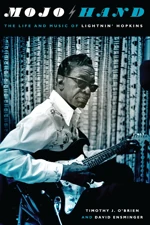
Mojo Hand: The Life and Music of Lightnin' Hopkins
"Barrel House Woman" by Lightnin' Hopkins was recorded in 1951 for the Sittin' In With label (Bobby Shad, producer). Personnel: Sam "Lightnin'" Hopkins (vocal, electric guitar); Donald Cooks (bass). Recorded using portable Magnacord equipment by producer Bobby Shad during sessions in Houston, Texas, 1951. Originally released on Sittin' In With 78 rpm singles; subsequently reissued on Time Records, Mainstream Records, and as part of the CD compilation Sittin' In With Lightnin' Hopkins (Sony Music Entertainment/Columbia, 1991), reissue produced by Lawrence Cohn and Tamara Shad, remastered by David Mitson. The Sittin' In With catalogue is available on streaming services via Bandcamp and Smithsonian Folkways.









