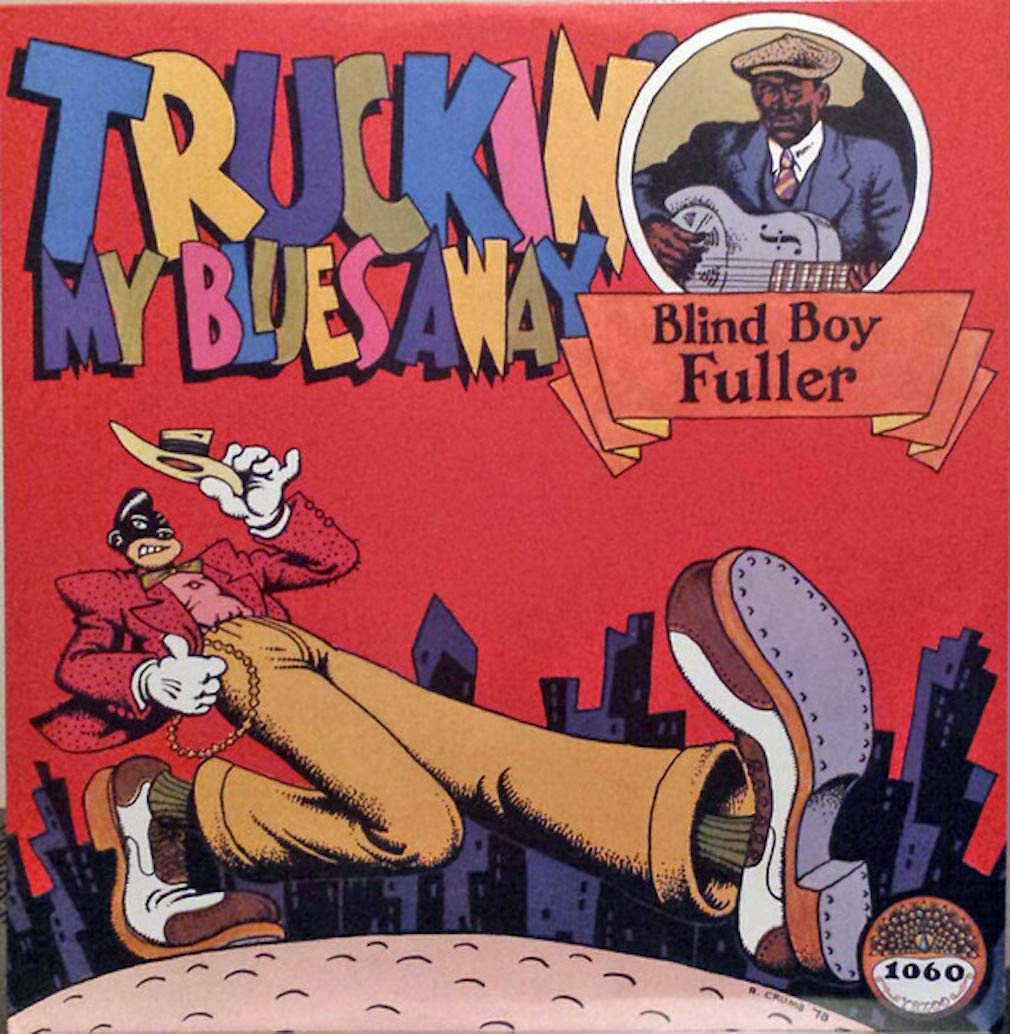
Blind Boy Fuller's "Truckin' My Blues Away" stands as one of the defining recordings of the Piedmont blues tradition—a vibrant, rhythmically infectious piece that captured the energy of East Coast blues at its commercial and artistic peak. Recorded in New York City on April 29, 1936, the song emerged from a period of intense creative output for Fuller, a blind street musician from Durham, North Carolina, who had only recently been discovered by a local talent scout. The recording session that produced "Truckin' My Blues Away" represents a fascinating intersection of regional folk tradition, commercial recording industry practices, and the individual artistry of one of the most influential guitarists in blues history.
The April 1936 Session: Context and Circumstances
The recording session that produced "Truckin' My Blues Away" took place on April 29, 1936, in New York City, likely at one of the studios regularly used by the American Recording Corporation. musicbrainz.org This was Fuller's second visit to New York for recording purposes, following his initial breakthrough session the previous year.
By April 1936, Fuller had already established himself as a commercially viable artist. His first recordings had sold well enough to justify continued investment by ARC, and the label was eager to capture more of his material. The session was supervised by Art Satherley, one of the most important figures in the American recording industry during the 1930s and 1940s.
Art Satherley: The Producer
Arthur Edward Satherley was a British-born recording executive who had emigrated to the United States and risen through the ranks of the recording industry. By the mid-1930s, he was working for ARC as a producer and A&R (Artists and Repertoire) man, responsible for discovering talent, selecting material, and overseeing recording sessions. Satherley would later become legendary for his work with country and western artists, eventually being inducted into the Country Music Hall of Fame, but during the 1930s he was equally active in recording blues, gospel, and other African American musical forms.
Satherley's approach to recording sessions was shaped by the technological and economic constraints of the era. Recording was expensive, studio time was limited, and the 78 RPM format restricted each side to approximately three minutes of music. This meant that sessions were conducted with efficiency as a paramount concern—artists needed to arrive prepared, performances needed to be captured in as few takes as possible, and there was little room for experimentation or post-production manipulation.
For the April 1936 session, Satherley would have worked with Fuller to select material that balanced commercial appeal with artistic merit. "Truckin' My Blues Away" fit perfectly into this calculus—its title referenced the "trucking" dance craze that was sweeping America in the mid-1930s, lending it contemporary relevance, while its musical foundation drew on the traditional Piedmont blues style that Fuller had mastered.
The Musicians: Fuller as Solo Artist
According to the available documentation, "Truckin' My Blues Away" was recorded as a solo performance, with Fuller providing both vocals and guitar accompaniment without additional musicians. musicbrainz.org adp.library.ucsb.edu This was not unusual for Fuller's recordings—while he frequently worked with accompanists, many of his most celebrated sides feature his guitar and voice alone.
The April 1936 session reportedly included ten solo performances from Fuller, along with some recordings featuring guitarist Floyd Council. sundayblues.org However, "Truckin' My Blues Away" itself appears to have been one of the solo tracks.
This solo format placed the full burden of the performance on Fuller's shoulders, requiring him to maintain rhythmic momentum, melodic interest, and vocal expression simultaneously. That he succeeded so memorably is a testament to his extraordinary musicianship. The guitar work on "Truckin' My Blues Away" demonstrates Fuller's mastery of the alternating bass technique that was central to Piedmont blues—the thumb maintaining a steady, driving pulse on the bass strings while the fingers pick out melody and fills on the treble strings. This polyrhythmic approach creates a full, propulsive sound that made single-guitar recordings seem almost orchestral in their completeness.
The Song: "Truckin' My Blues Away"
"Truckin' My Blues Away" exemplifies several key elements of Fuller's artistry and of Piedmont blues more broadly. The title itself reflects the mid-1930s "trucking" craze—a dance style and cultural phenomenon that had originated in Harlem and spread across Black America. "Trucking" involved a particular shuffling, striding walk combined with a wagging index finger, and the term quickly entered the vernacular as a synonym for moving along, traveling, or making one's way through life.
For Fuller, the concept of "trucking my blues away" carried particular resonance. As a blind man dependent on music for his livelihood, he literally trucked—walked, traveled, moved—to earn his living. The song transforms the physical act of mobility into a metaphor for emotional resilience, for the ability to shake off trouble through music and movement.
Musical Characteristics
The recording demonstrates Fuller's command of the up-tempo ragtime-influenced style that made him so popular. The guitar work is propulsive and rhythmically infectious, built around a steady alternating bass that mimics the walking, trucking motion suggested by the lyrics. Fuller's picking is clean and precise, each note ringing clearly despite the rapid tempo.
The vocal performance is equally accomplished. Fuller's voice had a flexible, expressive quality that could convey both joy and melancholy, often within the same phrase. On "Truckin' My Blues Away," he sounds jubilant, almost defiant—a man who has found a way to transform hardship into celebration through the act of making music.
The song follows a standard twelve-bar blues structure, the foundational form that underlies almost all country blues of the era. Within this structure, Fuller incorporates melodic phrases and guitar fills that reference the broader Piedmont repertoire, creating a sense of connection to tradition while asserting his individual voice.
Lyrical Content
The lyrics of "Truckin' My Blues Away" draw on the stock of floating verses and imagery common to blues tradition. The trucking metaphor provides a unifying theme, but individual verses touch on the typical blues subjects: relationships, travel, trouble, and transcendence through music.
This approach to lyrics—combining traditional phrases with original material, personalizing common themes—was characteristic of blues composition in the 1930s. Fuller was not a songwriter in the modern sense of creating entirely original compositions; rather, he was a tradition-bearer and synthesizer, drawing on a shared vocabulary of blues expression while stamping it with his own personality and musical conception.
Technical Aspects of the Recording
The Recording Process
Recording technology in 1936 was primitive by modern standards but had advanced significantly from the acoustic recording methods that had dominated the industry before the mid-1920s. By 1936, electrical recording using microphones and amplifiers had been standard for about a decade, offering improved frequency response and dynamic range compared to the old acoustic horns.
For a session like Fuller's, the setup would have been relatively simple: one or two microphones positioned to capture both voice and guitar, feeding into a cutting lathe that would inscribe the sound directly onto a wax master disc. There was no magnetic tape, no multitrack recording, no overdubbing—what the microphone captured in real time was what ended up on the record.
This technical environment placed a premium on performance quality and consistency. If Fuller made a mistake, the entire take would have to be scrapped and started over. If the balance between voice and guitar was wrong, there was no way to fix it in post-production. The finished record would preserve exactly what happened in the studio at that moment.
The ARC Matrix System
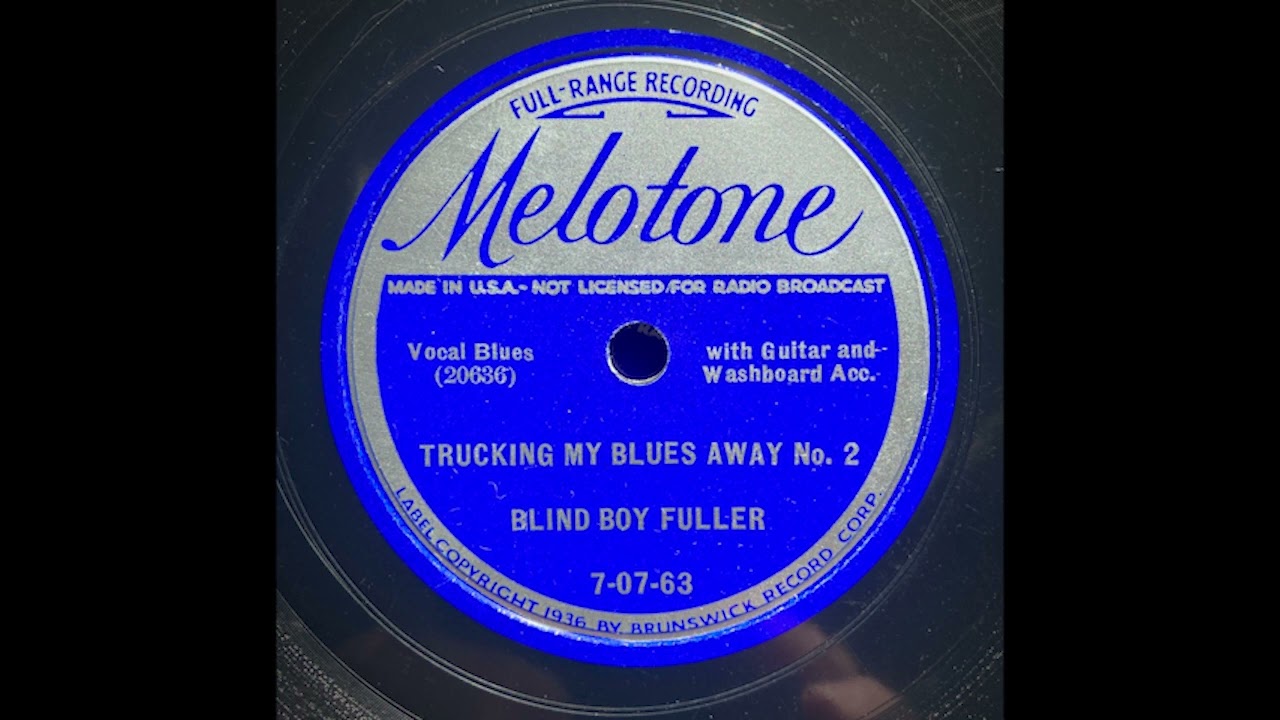
The American Recording Corporation documented its recordings using a matrix numbering system. "Truckin' My Blues Away" was assigned ARC matrix number 19141, indicating its place in the sequential numbering of recordings made by the company. adp.library.ucsb.edu This matrix number served as a permanent identifier for the recording, tracking it through the manufacturing and distribution process.
The recording was pressed as a 10-inch 78 RPM disc, the standard commercial format of the era. The flip side featured another Fuller recording from the same session, "Babe You Got to Do Better"—a typical pairing that offered buyers two songs for their money. musicbrainz.org
Release and Reception
"Truckin' My Blues Away" was released on one of ARC's labels and sold well enough to justify a sequel. In February 1937, less than a year after the original, Fuller returned to the studio to record "Trucking My Blues Away #2," assigned ARC matrix number 20636. adp.library.ucsb.edu The practice of recording sequels to successful numbers was common in the blues industry, allowing artists to capitalize on proven formulas while offering listeners something nominally new.
The song's commercial success was part of a broader pattern that established Fuller as one of the most popular Piedmont blues artists of his era. Unlike blues musicians from the Mississippi Delta, whose darker, more intense style would later be celebrated by rock musicians and blues revivalists, the Piedmont artists like Fuller, Blind Blake, Josh White, and Buddy Moss specialized in a lighter, more technically accomplished sound that appealed to contemporary audiences seeking dance music and entertainment. adp.library.ucsb.edu
Fuller's ability to tap into contemporary trends—the trucking craze being a prime example—while maintaining authentic blues content helped explain his commercial appeal. He was not simply preserving folk tradition; he was participating in popular culture, translating the music of Black Southern communities into a form that could compete in the commercial marketplace.
The Broader Context: Race Records and the Recording Industry
To fully understand the significance of "Truckin' My Blues Away," one must consider the broader context of the "race records" industry in which it was produced. Beginning in the early 1920s, major record labels had discovered that there was a substantial market for recordings by African American artists marketed primarily to African American consumers. These "race records"—the industry's term, later abandoned due to its offensive connotations—encompassed blues, jazz, gospel, and other musical forms.
The race records industry was characterized by several features that shaped the recordings it produced. First, it was segregated—Black artists recorded for separate series and labels that were distributed primarily to Black consumers, with different marketing, pricing, and retail channels than the mainstream pop releases.
Second, it was exploitative. Artists typically received flat fees for their recordings rather than royalties, meaning they did not share in the profits when their records sold well. Managers and talent scouts like J. B. Long took substantial cuts, and the contracts favored the labels in every particular.
Third, it was artistically productive. Despite—or perhaps because of—its commercial orientation, the race records industry documented an enormous amount of African American musical creativity during the 1920s and 1930s. The economic incentive to find and record new artists meant that many musicians who might otherwise have remained local or regional figures were preserved on disc.
Fuller's recordings, including "Truckin' My Blues Away," were products of this system. They were made quickly and cheaply, with minimal rehearsal or multiple takes. They were designed to sell, to appeal to contemporary tastes, to fit within the constraints of the 78 RPM format. Yet within these commercial parameters, Fuller created music of lasting artistic value.
Legacy and Influence
Blind Boy Fuller died on February 13, 1941, in Durham, at the age of thirty-six—although some sources give his age as thirty-three, reflecting ongoing uncertainty about his exact birth date. dncr.nc.gov The cause of death was blood poisoning that resulted in kidney failure, widely attributed to his heavy drinking.
Despite his relatively short career and early death, Fuller's influence on American music was substantial. He was the dominant figure in Durham's blues scene during the late 1930s, attracting and influencing many musicians who would carry the Piedmont tradition forward. dncr.nc.gov
His most direct musical heir was Brownie McGhee, a younger guitarist who had been mentored by Fuller and who initially recorded as "Blind Boy Fuller No. 2" after Fuller's death—an explicit acknowledgment of his debt to the older musician. McGhee went on to form a long-running partnership with Sonny Terry, bringing the Piedmont blues style to folk festival and concert audiences for decades.
Reverend Gary Davis, who had recorded with Fuller and influenced his development, also carried elements of the Piedmont tradition forward, becoming a hero to the folk revival generation of the 1960s. Davis's complex fingerpicking style, which Fuller had studied and adapted, would influence countless guitarists.
"Truckin' My Blues Away" itself has been recognized as one of Fuller's signature recordings. It appears on numerous compilations of his work, including the comprehensive JSP box sets that compile his complete recorded output. sundayblues.org blues-sessions.com The song exemplifies the qualities that made Fuller popular in his own time and that continue to attract listeners: infectious rhythm, accomplished guitar work, expressive vocals, and a spirit of resilience and joy that transcends the troubles it acknowledges.
Critical Assessment
Fuller's reputation has fluctuated over the decades since his death. During the folk and blues revival of the 1960s, critics and audiences often favored the rawer, more emotionally intense style of Delta blues over the lighter, more technically polished Piedmont approach. Fuller's accessibility and commercial orientation were sometimes held against him, as if his popularity in his own time made his music less authentic.
This view has been substantially revised. Contemporary blues scholarship recognizes Fuller as a master of his style, a musician who synthesized influences from multiple sources—recorded artists like Blind Blake, live mentors like Gary Davis, traditional material from the Piedmont region—and forged them into a distinctive personal voice. His ability to fuse elements from different sources into his own performances, far from being derivative, demonstrated his creative intelligence and his responsiveness to the world around him. sundayblues.org
The recordings themselves support this reassessment. Listening to "Truckin' My Blues Away" today, one hears not a musician going through the motions but an artist fully engaged with his material, bringing technical skill, emotional commitment, and personal style to bear on every phrase.
The Recording's Place in Blues History
"Truckin' My Blues Away" occupies a specific moment in the history of recorded blues—the mid-1930s, when the race records industry was at its commercial peak, before the economic disruptions of World War II would transform the business. It captures a style of music, Piedmont blues, that was immensely popular in its time but would later be overshadowed by the Delta tradition in the narrative of blues history.
The recording also represents a moment in the technological history of sound reproduction. Made before the advent of magnetic tape, it preserves a live performance exactly as it happened, with all the spontaneity and imperfection that implies. The slight surface noise of the 78 RPM format, the limited frequency range, the occasional moments of slight imbalance between voice and guitar—these are not defects but documents, evidence of the conditions under which this music was made.
Finally, the recording documents a moment in social history. Fuller's blues, including "Truckin' My Blues Away," reflected the experiences of Black Southerners during the Great Depression—their struggles, their pleasures, their strategies for coping with hardship. Many of his songs addressed the daily challenges of Black tenant farmers and the experiences of those who migrated North in search of better opportunities. dncr.nc.gov
Conclusion
The recording of "Truckin' My Blues Away" on April 29, 1936, brought together a remarkable convergence of talent, circumstance, and historical moment. Blind Boy Fuller, a blind street musician who had been discovered barely a year earlier, entered a New York studio under the supervision of Art Satherley and laid down a performance that would endure for generations.
The session itself was unremarkable by the standards of the time—one of countless race records sessions held in New York studios during the 1930s, cranking out material for an eager market. Fuller performed solo, guitar and voice, capturing the sound he had developed on the streets of Durham and in the tobacco warehouses of the Bull City.
Yet the result transcended its commercial origins. "Truckin' My Blues Away" became one of Fuller's signature songs, a quintessential example of Piedmont blues at its peak. Its infectious rhythm, accomplished guitar work, and spirited vocal delivery have continued to attract listeners across the decades.
The recording stands as a monument to Fuller's artistry—his technical mastery of the guitar, his expressive vocal style, his ability to connect with audiences through music that was simultaneously traditional and contemporary. It also stands as a document of a particular time and place: the world of race records in the 1930s, the blues scene of Durham, North Carolina, the broader experience of Black Southerners during the Depression.
Blind Boy Fuller would record for only five more years before his early death in 1941. In that time, he would produce an extraordinary body of work that established him as one of the most important blues artists of his generation. "Truckin' My Blues Away" remains among the finest examples of what he could do—a three-minute masterpiece of Piedmont blues, captured on wax in a New York studio on a spring day in 1936, and still capable of moving listeners more than eight decades later.
Selected Discography