Introduction: Thirty Songs That Changed Everything
In 1977, a small committee of scientists, musicologists, and cultural ambassadors gathered to answer one of the strangest questions ever put to a selection committee: of all the music humanity had ever created, which recordings best represented the depth and breadth of human experience for an audience that would be, literally, alien? The Voyager Golden Record — the gold-plated copper disk attached to both Voyager space probes before their launch into interstellar space — would carry twenty-seven musical selections, and among the scientists and folklorists tasked with choosing them was Alan Lomax, who had spent his adult life travelling to prisons, churches, and sharecroppers' shacks seeking the most beautiful music America had to offer. Lomax chose "Dark Was the Night, Cold Was the Ground" by Blind Willie Johnson — a three-minute recording made in Dallas, Texas, in December 1927, by a blind street evangelist who had never achieved significant wealth or recognition in his lifetime, and who had died in September 1945 in the ruins of his burned-down home in Beaumont, Texas, after being refused hospital treatment.
Carl Sagan, writing about the purpose of the Golden Records, described "Dark Was the Night, Cold Was the Ground" as one of the recordings most central to the mission's message. Timothy Ferris, the NASA consultant who made the final selection, chose it because of its quality of "cosmic loneliness" — the sense that this music expressed, without words, something fundamental about what it means to be human in an indifferent universe. Ry Cooder, who would base his entire soundtrack to the 1984 film Paris, Texas on Johnson's recording, described it simply as "the most soulful, transcendent piece in all American music." Jack White called it "the greatest example of slide guitar ever recorded."
The man who made this recording had no electricity in his home, no telephone, no automobile. He had been blind since the age of seven. He sang on street corners with a tin cup tied around the neck of his guitar to collect pennies from passers-by. He received $50 per usable recorded side from Columbia Records — a substantial sum for the period, though he forfeited his royalty rights in exchange. He made thirty recordings in total, across five sessions between 1927 and 1930, and then never recorded again. And those thirty recordings constitute one of the most significant artistic legacies in the history of American music.
This is the story of Blind Willie Johnson.
Origins: Pendleton, Marlin, and the Education of a Preacher
Willie Johnson was born on January 25, 1897, in Pendleton, Texas — a small agricultural community near Temple, in central Texas — to a sharecropper named Dock Johnson (also identified in some sources as George Johnson or Willie Johnson Sr.) and his wife Mary Fields. His mother died in 1901, when he was four years old, and his father subsequently remarried. The family moved to Marlin, in Falls County, where Johnson spent most of his childhood. There, the Johnsons attended church — most likely the Marlin Missionary Baptist Church — every Sunday, a practice that had a lasting and formative impact on the boy. The church's music — the spirituals, the hymns, the call-and-response patterns of congregational singing — entered his consciousness at the deepest possible level, providing not just a repertoire but a fundamental musical language that would undergird everything he subsequently made.
When Johnson was five years old, his father gave him his first instrument: a cigar box guitar. He was not born blind. The story of how he lost his sight is one of the most disturbing in any blues biography, reported by his widow Angeline Johnson and accepted by most biographers: when Willie was seven years old, his father violently confronted his stepmother about her infidelity. During the argument, the stepmother splashed lye water at his father; the caustic liquid missed its intended target and struck Willie's face, permanently blinding him. The event was catastrophic in its immediate effects and formative in its long-term ones: the blind boy who had been given a cigar-box guitar now had both the time and the motivation to turn that instrument into the instrument of his calling.
Other theories about the blinding have been advanced — that he wore the wrong spectacles, that he viewed a partial solar eclipse observable over Texas in 1905, or some combination — but the stepmother account, first made by Angeline and accepted by the most careful biographers, has the weight of direct testimony behind it.
At some point in his Texas childhood, Johnson met another blind musician named Madkin Butler — described by the Blues Foundation as a "blind musician who sang his religious message on the streets of Texas cities." Butler's powerful singing and preaching style was, according to the accounts of those who knew Johnson, the primary influence on his vocal delivery. From Butler he appears to have learned the particular intensity and urgency of street-corner religious performance — the need to be heard above the noise of traffic and crowds, the use of the voice as an instrument of spiritual force rather than mere entertainment.
The Reverend Adam Booker, a blind minister interviewed by blues historian Samuel Charters in the 1950s, provided one of the most vivid early descriptions of Johnson's performing life: while visiting his father in Hearne, Johnson would perform religious songs on street corners with a tin cup tied to the neck of his Stella guitar to collect money. He was, from an early age, both musician and preacher — the two roles inseparable in his self-understanding and in his community's understanding of him. The music was not entertainment; it was evangelism. The guitar was not an instrument of secular pleasure; it was the vehicle of a spiritual message. And the street corner was not a performance venue; it was a pulpit without walls.
In Dallas's Deep Ellum district, where the great Blind Lemon Jefferson also performed, Johnson would sometimes play on the same street as Jefferson — the two blind men competing for the change from the crowds who gathered on the corner. The extent of their artistic relationship is unknown, but the geographical proximity was real. When Jefferson's mother used to watch him play on the streets of Dallas, she would have sometimes been watching Johnson too, the two blind evangelists of very different musical traditions occupying the same few blocks of the city's most concentrated musical geography.
By his mid-twenties, Johnson had established his performing territory — moving between Texas cities, playing on street corners and at church gatherings, building the reputation as an evangelist with what blues historian Paul Oliver described as "a remarkable technique and a wide range of songs." He had also, around 1926 or early 1927, begun an unregistered marriage with Willie B. Harris, who occasionally sang on the street with him and accompanied him on piano at church benefits. Harris would later become the female voice on approximately two-thirds of Johnson's Columbia recordings — her precise, restrained vocals providing a counterpoint to the raw intensity of Johnson's own sound.
The Document Records historical account captures perfectly how he lived in the years before his recording career: "For over twenty years, Johnson played in the streets, honing his craft and sharing his genius with the crowds and passers-by that were called by his voice and guitar." Two decades of street performance, of developing the most personal possible relationship with his music — playing it directly to whoever would stop and listen, hearing it respond to different weather conditions, different crowd energies, different times of day — had produced an artist of complete, irreducible originality by the time Frank Walker of Columbia Records came to Dallas in December 1927.
The Guitar: Technique, Sound, and the Knife or Ring
Before proceeding to the recording sessions, it is worth dwelling on what Blind Willie Johnson actually did with his guitar — the technical dimensions of the art that produced the sound that moved Jack White and Ry Cooder and Carl Sagan and countless others.
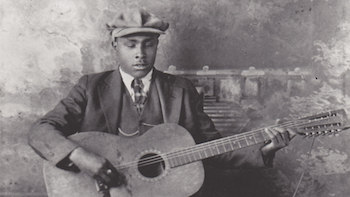
He played a Stella guitar — the cheap but acoustically capable instrument that was common among Southern street musicians in the 1920s. He played it in open tuning, most commonly open D (D-A-D-F#-A-D), which gave the instrument a fundamental major-key resonance and allowed him to play chords by barring across the strings with his slide. The question of what he used as a slide has become one of the small mysteries of blues scholarship: Blind Willie McTell, who knew Johnson personally, remembered him using a brass ring. Willie B. Harris, who was present at the "Dark Was the Night" session, said he used a knife and a thumb pick. Other accounts suggest a pocketknife. The only known photograph of Johnson, angled in such a way as to conceal his slide hand, does not resolve the question.
What is beyond dispute is what the slide produced. Music historian Steve Calt wrote of Johnson's style: "Opposed to other bottleneck artists he varies the speed of his vibrato drastically, often speeding up as he slides into a note. He is also one of the few bottleneck artists with the ability to consistently sound three or four discrete melody notes upon striking a string once, a skill that reflects uncanny left-handed strength, accuracy and agility." This latter quality — the ability to generate multiple distinct melodic pitches from a single string attack — is the most technically remarkable aspect of Johnson's playing, and the one that most confounds imitation. "Anybody who's ever played the bottleneck guitar with some degree of accomplishment is quoting Blind Willie to this day," says Austin slide guitarist Steve James.
His vocal approach was equally distinctive. He sang primarily in a harsh, gravelly bass voice — a voice generated deep in the chest, designed to carry across street noise and crowd movement, powerful enough to stop people in their tracks fifty yards away. The music writer Mark Makin described it as "fierce" and "not unlike the 'Hell and Damnation' of a Baptist preacher such as a fired-up Reverend A. W. Nix." But Johnson also sang, on certain recordings, in his natural tenor — a completely different tonal quality, gentler and more intimate, used for the more devotional and lyrical passages. The combination of these two vocal registers, deployed strategically across the thirty recordings, gave his music an extraordinary emotional range. And there was a third mode: on "Dark Was the Night, Cold Was the Ground," he did not sing words at all, but hummed and moaned — vocalising the emotional content of the music in pure sound, stripped of language.
The PS Audio analysis of Johnson's guitar approach captures what the combination of voice and guitar produced: "In his slide work you can hear how he can get three or four notes out of one hit on the string with incredible expression and accuracy." And this technical precision coexisted with a rhythmic approach the same writer characterises as "stride piano style to his rhythm playing" — a comparison that situates the guitar work in the ragtime and blues piano tradition even as it describes something produced on six strings. He was playing, in other words, as if the guitar were an orchestra.
The Producer: Frank Walker and Columbia Records' Race Division
The person responsible for bringing Blind Willie Johnson's music to commercial recording was Frank Buckley Walker — one of the most important figures in the history of American popular music recording, though his name is not widely known outside specialist circles. Walker had been promoted to head Columbia's "race" division in 1923 — the euphemistically named department responsible for recording music by and for African American audiences. It was Walker who, having heard blues singer Bessie Smith perform in a Selma, Alabama, saloon in 1917, located her and brought her to New York to record, launching one of the most celebrated careers in blues history. His subsequent discoveries, across two decades of talent-scouting, would include Hank Williams, whom he signed to MGM in 1947 — a credential that places him in a unique position as the man responsible for both the "Empress of the Blues" and the defining voice of classic country.
By 1927, Walker was organising field recording expeditions throughout the South — bringing Columbia's electrical recording equipment to Dallas, Memphis, New Orleans, and Atlanta to record local talent. The system was efficient: acts would audition in the morning, rehearse in the afternoon, and record in the evening. The studios were makeshift — storefront complexes, hotel rooms, whatever space was available — but the electrical recording technology that Walker's team used was among the most advanced of the period. The Document Records history places the 1927 Dallas sessions at "the Columbia Records storefront complex, at #2000-#2004 North Lamar St., Dallas" — a three-storefront location that Walker had set up with his engineer, identified in some label notes as "Freiberg," to use the new Viva-Tonal! electrical recording process.
Walker heard something immediately in Johnson that he recognised as exceptional. The Alligator Records annotation captures the moment: "You have to wonder what Columbia's Frank B. Walker, who produced the Dallas sessions, might have been thinking when this fully-formed blind artist came in out of nowhere to lay down that pure, primal sound. Even though Walker had discovered and signed blues superstar Bessie Smith in 1923, he probably wasn't ready for Blind Willie's wails and moans in that voice from the depths."
Walker compensated Johnson with $50 per "usable" side — a substantial amount for the period, described as such in multiple sources — along with a bonus payment in exchange for forfeiting royalty rights from record sales. This was a standard arrangement of the era that benefited the record company enormously when records sold well, and Johnson's did sell remarkably well. The first release, "I Know His Blood Can Make Me Whole" backed with "Jesus Make Up My Dying Bed," pressed 9,400 copies — more than the latest release by Bessie Smith, Columbia's most established African American star — with an additional pressing of 6,000 following. By his final recording session in 1930, Johnson's records were "selling almost twice as many copies as Bessie Smith, and three and four times as many as most of the country blues artists." As a commercial proposition, Blind Willie Johnson was a remarkable success.
The Five Sessions: Dallas, New Orleans, and Atlanta, 1927–1930
The thirty recordings that constitute Johnson's entire commercial output were made across five sessions between December 1927 and April 1930. Each session adds something to the portrait, and together they constitute a remarkably coherent body of work — coherent not in the sense of being repetitive, but in the sense of being governed throughout by a single artistic vision of exceptional clarity.
Session One: Dallas, December 2-6, 1927. The first session produced what would remain Johnson's most celebrated recordings, including "Dark Was the Night, Cold Was the Ground," "If I Had My Way I'd Tear the Building Down," "It's Nobody's Fault but Mine," "Jesus Make Up My Dying Bed," "I Know His Blood Can Make Me Whole," and "Mother's Children Have a Hard Time." Johnson played six selections, thirteen takes in total. Harris accompanied him on the first recording, "I Know His Blood Can Make Me Whole," and on several subsequent sides. Walker and his team captured Johnson in a state of complete artistic readiness — a musician who had been developing these performances on street corners for two decades and knew exactly what he wanted to do with them in the studio.
The commercial instincts of the session are evident: Walker chose "I Know His Blood Can Make Me Whole" backed with "Jesus Make Up My Dying Bed" as the debut release, two gospel pieces with strong melodic hooks and immediately comprehensible religious content. The commercial decision was sound; the debut sold in exceptional numbers. What Walker and the Columbia marketing department perhaps underestimated was the B-side of Johnson's second release — "Dark Was the Night, Cold Was the Ground," paired with "The Sweeter the Juice" — which would prove, in the long view, the most significant recording not just from this session but from Johnson's entire career.
Session Two: Dallas, December 5, 1928. Johnson and Harris returned to Dallas a year after the first session. The 1928 recordings include "Jesus Is Coming Soon," "I'm Gonna Run to the City of Refuge," "Lord I Just Can't Keep From Crying," "Keep Your Lamp Trimmed and Burning," and "God Moves on the Water" — a narrative account of the 1912 sinking of the Titanic that represents one of Johnson's most ambitious compositional achievements. The PS Audio analysis of "Keep Your Lamp Trimmed and Burning" from this session captures what made the second Dallas sessions so compelling: "the two had a unique field holler vocal style trading off lyric lines. But what is most remarkable to me is his melodic slide playing here... listen carefully to what Johnson is doing here, both with the sweet slide soloing and the stride piano style to his rhythm playing."
"God Moves on the Water" deserves particular attention as an example of Johnson's compositional range. A detailed narrative of the Titanic's sinking — still raw in public memory in 1928, only sixteen years after the event — the song demonstrates Johnson's ability to move beyond the devotional and personal into something closer to journalism or historical ballad. The song interprets the disaster through a religious lens (the ship's owners' hubris, the judgment implicit in the disaster), but does so with sufficient factual detail to demonstrate genuine engagement with the historical record.
Session Three: New Orleans, December 11, 1929. Columbia set up a session in Dallas for this third recording date, but Johnson chose to travel to New Orleans instead — a decision that suggests he was, by late 1929, living closer to Beaumont than to Dallas, as his widow Angeline would later confirm. The New Orleans session produced "Let Your Light Shine on Me" — the first song Johnson recorded in standard guitar tuning rather than open D — along with several other tracks. The female vocalist at this session may have been Angeline Johnson rather than Willie B. Harris; the identification is uncertain, as Angeline's voice was reportedly more "insistent and uncontrolled" than Harris's more precise style, and the Document Records analysis notes that the female singer at the December 1929 session "certainly sounds more insistent and complementary to the structure of his singing."
Session Four: Dallas, December 11-12, 1929. A second session from the same period, this one back in Dallas, produced additional material including "You'll Need Somebody on Your Bond," "Bye and Bye I'm Goin' to See the King," and "Take Your Burden to the Lord and Leave It There." The double session dates of December 1929 — with Johnson recording in both New Orleans and Dallas in the same week — reflect Columbia's appetite for his material at this productive mid-career moment.
Session Five: Atlanta, April 20, 1930. Johnson's final recording session took place in Atlanta, Georgia, where he had travelled with Harris to complete ten selections. The Atlanta sessions produced "John the Revelator," "The Soul of a Man," "Everybody Ought to Treat a Stranger Right," "Go with Me to That Land," "Can't Nobody Hide from God," "If It Had Not Been for Jesus," "Church I'm Fully Saved Today," "Trouble Will Soon Be Over," "The Rain Don't Fall on Me," and "Praise God I'm Satisfied." It was at this Atlanta session that Johnson met Blind Willie McTell — who would later recall, in a 1940 interview, "Blind Willie Johnson was a personal pal of mine. He and I played together in many different cities, parts of the states, and different parts of the country. From Maine to the Mobile Bay."
The Great Depression had devastated the market for recorded music by April 1930. Columbia chose "Everybody Ought to Treat a Stranger Right" paired with "Go with Me to That Land" as the first single from the Atlanta sessions, but only 800 copies were pressed — a catastrophic decline from the 15,000 copies that the debut had warranted. Johnson never recorded again after Atlanta. Some of his songs were re-released by Vocalion Records in 1932, but the career as a recording artist was over.
The Key Recordings: An Analysis of the Greatest Songs
Of the thirty recordings Johnson made for Columbia, several demand individual attention as works of particular significance or influence.
"Dark Was the Night, Cold Was the Ground" is the recording that has attracted the most critical attention and achieved the most extraordinary cultural reach. Three minutes and twenty-one seconds of Johnson's slide guitar in open D tuning, accompanied by his melancholy humming, moaning, and vocalising — no words, just sound. The title borrows from a hymn written by English clergyman Thomas Haweis in 1792, "Gethsemane," which begins: "Dark was the night, and cold the ground / Where Jesus prostrate laid." Johnson's version dispenses with the words entirely, performing instead an improvised impression of the emotional content of Christ's suffering in the Garden of Gethsemane — the agony of waiting for crucifixion, the loneliness of divine abandonment, the physical cold of a stone garden at night. Music historian Mark Humphrey describes it as an "impressionistic rendition of 'lining out'" — the call-and-response style of singing hymns common in Southern African American churches — stripped of the words but preserving the emotional architecture.
For the session, Johnson substituted a knife or penknife for the bottleneck, and according to Harris, he played with a thumb pick. The result is the most technically singular of his recordings: the guitar figures have a precision and delicacy that the harder slide technique might not have achieved, while the vocalising — those moans and hums that replace what language cannot adequately express — carry a depth of feeling that has moved every serious listener from Carl Sagan to Jack White. The Alligator Records annotation describes it as "nailed on the first take" — a performance so complete and right that no second attempt was needed or made.
Alan Lomax's selection of this recording for the Voyager Golden Record was the decision of someone who had spent a lifetime listening to music across every tradition the world produced, and who understood that here was something that transcended cultural and linguistic boundaries — music that communicated directly, through pure sonic emotion, without the mediation of language or cultural reference. The Library of Congress documentation of the recording makes the case for this selection: "Johnson's influence on American music was immediate and continues to reverberate. He had the soul and voice of what would become rock 'n' roll, and with him a new era was born."
"Jesus Make Up My Dying Bed" was one of the two songs chosen as Johnson's debut single, and its commercial success established the template for all that followed. The song is a death-bed prayer — the narrator asking Jesus to be present at the moment of death — performed with an intensity that makes the request feel simultaneously universal and acutely personal. Bob Dylan recorded a version of the song for his 1962 debut album, retitling it "In My Time of Dying," and Led Zeppelin included a version on their 1975 album Physical Graffiti — maintaining the title that Dylan had used, crediting it to "Traditional" in both cases.
"It's Nobody's Fault but Mine" presented the narrator in a condition of self-condemnation — the recognition of personal moral failure expressed through the admission that the trouble he finds himself in is entirely of his own making. The song, as it appeared in Johnson's performance, had a ferocity and self-awareness that distinguished it from the more conventional spiritual guilt songs of the tradition. Led Zeppelin's adaptation — retitled "Nobody's Fault but Mine" and appearing on Presence (1976) — maintained the song's basic emotional thrust while transforming its musical setting entirely, credit attributed to Jimmy Page and Robert Plant rather than to Johnson.
"If I Had My Way I'd Tear the Building Down" drew on the biblical story of Samson — the blind giant who pulled down the temple of the Philistines when his strength was restored — in a way that resonated with obvious personal weight for a blind street evangelist. The story of a blind man whose power was denied him and then catastrophically restored was not just a biblical narrative for Johnson; it was a mirror. Blind Gary Davis, who became one of the principal transmitters of Johnson's music to the next generation, recorded the song as "Samson and Delilah," and the Grateful Dead's version of the same song — their recording appearing on Go to Heaven in 1980 — kept the Samson imagery while transforming the musical setting into the rock-gospel hybrid that was the Dead's most characteristic mode.
"John the Revelator" was the call-and-response piece that demonstrated Johnson's compositional intelligence most clearly. The song takes the form of a catechism — the lead voice asking questions ("Who's that writing?") and the response answering ("John the Revelator") — about the author of the Book of Revelation, the most apocalyptically charged text in the Christian Bible. The structure of question and response gives the song an almost hypnotic repetitive quality, and Johnson's delivery of both parts — asking the question in one vocal register, answering in another — creates the impression of a congregation of two. The song was included on Harry Smith's Anthology of American Folk Music in 1952, which introduced it to the folk revival audience that would eventually carry Johnson's music into the rock and folk mainstream.
"The Soul of a Man" represented perhaps the most philosophically searching of Johnson's compositions — a series of questions about the nature of the human soul, its origin, its destination, and what it is in the first place. "I want somebody to tell me / What is the soul of a man?" Johnson asks, and the music's answer is not a verbal proposition but a sonic one: the guitar says what the words cannot. PS Audio's analysis of this track: "'Soul of a Man'. This is an evangelical preacher whose faith in the Lord is solid. But here in the halcyon of the 20s he is asking 'OK, I get it. We have a soul that will transcend this life. But what the heck does that mean?'" The question was not primarily theological but existential — not about doctrine but about experience. And the music, with its unresolved melodic lines and the harmonica-like sustain of the slide guitar, embodied the unresolvable nature of the question.
"God Moves on the Water" — Johnson's account of the Titanic disaster — demonstrates that his compositional abilities extended beyond personal devotion into narrative journalism of a striking kind. The song's account of the disaster is factually grounded and theologically interpreted: the ship's captain ignored warnings, the owners declared the vessel unsinkable, and God's judgment was decisive and irreversible. The apocalyptic quality of the imagery — a great ship descending into the dark ocean — suited Johnson's overall aesthetic perfectly.
"Mother's Children Have a Hard Time" — sometimes rendered as "Motherless Children" or understood as addressing the condition of children without mothers — was one of Johnson's most personal songs. He had lost his own mother at the age of four; the song was not an abstraction. Eric Clapton, who played an acoustic version of the song (titled "Motherless Children") at the Concert for Bangladesh in 1971 and recorded it for his 1974 album 461 Ocean Boulevard, made his connection to Johnson's original explicit in interviews, acknowledging the Johnson recording as the source.
Willie B. Harris: The Other Voice
No account of the Johnson recordings is complete without attention to Willie B. Harris — the woman whose voice appears on approximately twenty of the thirty recordings and whose contribution to the sound of those recordings has been consistently undervalued. Harris and Johnson began their relationship in 1926 or early 1927, when they formed an unregistered partnership that was effectively a marriage. She had been singing with him on the streets and at church benefits before the Columbia sessions, and her vocal style had developed in direct response to his own — adapting to his particular phrasing and timing, learning to provide the harmony and counterpoint that his performances required.
Her contributions fall into two broad categories. On the call-and-response songs — "John the Revelator" being the most striking example — she provides the answering voice, the congregation responding to the preacher's questions. On the devotional pieces, she provides a sustained harmonic context for his lead vocals, a warm, supporting presence that gives his more intense moments a human grounding. Her singing style was, by the Hound Blog's description, notably "restrained and precise" compared to other female singers of the period — more controlled, less theatrical, perfectly calibrated to serve the music rather than perform independently.
The historical confusion about her identity — Charters's 1959 book The Country Blues mistakenly credited Johnson's second wife Angeline as the female vocalist on all the recordings, a mistake he corrected in the liner notes to the 1993 CD reissue — meant that Harris's contribution went unacknowledged for decades. The correction, when it came, restored to the historical record the presence of a musician whose work had always been audible to careful listeners, even when her name was unknown.
The Street Preacher: Johnson's Career Beyond the Studio
While the Columbia recordings are the primary legacy, they represent only five recording sessions across three years of a performing career that lasted more than two decades. From the late 1900s until his death in 1945, Johnson was performing on the streets of Texas — Hearne, Marlin, Temple, Waco, Dallas, Beaumont — and in the churches and revival meetings that his reputation as an evangelist brought him to. The Blues Foundation's biographical note captures this performing life in a sentence: "Playing streetcorners, churches, and revivals with a tin cup tied to his guitar for tips, he befriended other blind street musicians and traveled through Texas and beyond."
The street-corner performance tradition that Johnson inhabited was not a marginal or informal activity but a specific cultural institution in the African American communities of the South — a mode of public religious expression that had its own aesthetic codes, its own social function, and its own relationship to the church as an institution. Johnson was not busking in the modern sense; he was performing street ministry, using music as the vehicle for a genuinely religious message. The tin cup tied to the guitar's neck acknowledged the economic dimension of the activity without making it merely economic; the music was prayer, and the prayer was music, and the money allowed the musician-preacher to continue doing what God, he believed, had called him to do.
A preacher who knew Johnson recalled him once playing on one street corner while Blind Lemon Jefferson was playing on another — the two great blind guitarists of Texas competing for the attention of the same passing crowd. The image is both poignant and vivid: two men whose musical visions were almost entirely different, one playing the blues of secular suffering, the other playing the gospel of religious conviction, each drawing from the same pedestrian pool of potential listeners.
Johnson also, at various points, operated his own churches as Reverend W. J. Johnson. He was not merely a musician who performed religious music; he was, formally, a Baptist minister, with congregations of his own. The city directory entry from 1945 confirms this: "Reverend W. J. Johnson" operated the House of Prayer at 1440 Forrest Street in Beaumont. The music and the ministry were not separate activities but two aspects of a single vocation.
The Final Years: Fire, Illness, and Death
The story of Blind Willie Johnson's death is one of the most damning indictments of American racial injustice in a period full of such indictments. In 1945, a fire destroyed the home he shared with his wife Angeline in Beaumont, Texas. With nowhere else to go, Johnson continued to live in the ruins of the house — sleeping in the charred rubble, exposed to the elements. He contracted malarial fever, and then pneumonia. When Angeline attempted to get him admitted to the Beaumont hospital, he was turned away — refused treatment because he was Black. He died on September 18, 1945, in the ruins of his home.
He was forty-eight years old, though given the uncertainty about his birth year he may have been older. He died in poverty, having received no royalties from the Columbia recordings that had, at their peak, sold better than Bessie Smith's releases. The $50 per side he had received at each session — a total of roughly $1,500 across thirty recordings — was all the music industry had paid him. The millions of copies of his recordings that would eventually be sold in various compilations and reissues, the royalties from dozens of cover versions by artists from Bob Dylan to Led Zeppelin, none of this reached him.
In 1993, his gravestone was erected through the efforts of record collector and researcher Donna Hall, who had located his burial site. The grave marker describes him as "Gospel Blues Singer, Bottleneck Guitarist, Texas Street Evangelist" — an accurate if necessarily compressed description of a life and career of extraordinary richness.
The Revival: Harry Smith, Reverend Gary Davis, and the 1960s Folk Movement
Johnson's music had been commercially dormant since 1932, when the Vocalion reissues of his Columbia recordings had found a small audience. But the folk revival of the 1950s and 1960s created the conditions for a permanent restoration.
Harry Smith's Anthology of American Folk Music, released in 1952 on Folkways Records, was the document that most directly initiated the revival of interest in Johnson's work. The Anthology — a six-LP collection of folk, blues, country, and gospel recordings from the 1920s and 1930s, selected and annotated by the artist and filmmaker Harry Smith — introduced Johnson's "John the Revelator" to an audience of young musicians and enthusiasts who had no prior knowledge of his work. The Anthology's enormous influence on the folk revival of the late 1950s and early 1960s made "John the Revelator" one of the songs that defined the aesthetic of that movement.
Reverend Gary Davis was, in some ways, the most important single carrier of Johnson's musical legacy to the next generation. Davis — himself a remarkable musician, one of the great fingerpicking guitarists of the pre-war tradition — had absorbed Johnson's music deeply and taught it to the young musicians who gathered around him in New York during the 1960s. As he taught Johnson's music to young musicians, groups and acts like the Soul Stirrers, the Staples Singers, Buffy Sainte-Marie, Fairport Convention, and Peter, Paul and Mary covered or reinterpreted his work. Davis's role as transmitter was as important as his role as performer: through him, Johnson's approach to the guitar and his catalogue of songs entered the common vocabulary of the folk revival.
Samuel Charters was the first major blues historian to attempt a serious biographical account of Johnson, beginning with his 1959 book The Country Blues — which, despite some biographical errors that Charters himself corrected in the 1993 Complete compilation liner notes, established Johnson as a figure worthy of sustained scholarly attention. The subsequent research of other blues historians — Mark Humphrey, Ted Drozdowski, and others — has steadily deepened the historical record.
The Influence: From Dylan to Led Zeppelin, from Cooder to the Cosmos
The roll call of artists who have acknowledged Blind Willie Johnson's influence or recorded his music is, as the TIDAL magazine account puts it, "uncountably long." But some connections are particularly direct and particularly significant.
Bob Dylan recorded "In My Time of Dying" (Johnson's "Jesus Make Up My Dying Bed") for his 1962 debut album, and his engagement with Johnson's music was not merely a youthful borrowing but a sustained absorption that ran through his early career. The folk-gospel intensity that characterised Dylan's early recordings owes something specific to the Johnson model — the use of religious imagery as a vehicle for the most personal of emotional statements, the direct and unmediated vocal approach.
Led Zeppelin adapted multiple Johnson compositions. "In My Time of Dying" — recorded by Dylan as an acoustic solo piece — became one of Zeppelin's most ambitious studio recordings on Physical Graffiti (1975), a sprawling eleven-minute electric blues that bore little surface resemblance to the original but acknowledged its debt in its title. "Nobody's Fault but Mine" on Presence (1976) was credited to Page and Plant despite being substantially derived from Johnson's "It's Nobody's Fault but Mine." The band's engagement with Johnson's material was characteristic of their broader approach to pre-war blues — total absorption followed by radical transformation, with attribution practices that were inconsistent and often inadequate.
Ry Cooder made his relationship with Johnson the most explicit and the most creatively consequential of any rock-era artist. Cooder's soundtrack for Paris, Texas (1984) — one of Wim Wenders's greatest films — was built almost entirely on the foundation of "Dark Was the Night, Cold Was the Ground." Cooder describes Johnson's recording as "the most soulful, transcendent piece in all American music," and the film's use of the slide guitar idiom Johnson had developed — applied to the Texas landscapes through which the film's protagonist wanders — demonstrated how completely the music had captured something about a specific geography and a specific condition of American solitude.
Sister Rosetta Tharpe recorded Johnson's "Joshua Fit the Battle of Jericho" and absorbed his intensity into her own gospel-blues performances. Nina Simone recorded "Sinner Man" and engaged with the tradition Johnson represented. Tom Waits, whose raspy voice and approach to the blues as a vehicle for an almost mythological American experience, has consistently cited Johnson as an influence. Captain Beefheart's vocal style — that deep, eccentric bass that made Beefheart one of the most distinctive voices in rock — drew explicitly from Johnson's gravelly chest voice.
Eric Clapton recorded "Motherless Children" for 461 Ocean Boulevard in 1974, acknowledging the Johnson original. His engagement with Johnson's music was part of a broader relationship with the pre-war blues tradition that had defined his approach since the mid-1960s.
The 2016 Alligator Records tribute album God Don't Never Change: The Songs of Blind Willie Johnson brought the tradition full circle: contemporary artists — Lucinda Williams, Tom Jones, Rickie Lee Jones, Bhi Bhiman, Derek Trucks, Maria McKee, and others — recording Johnson's songs with full awareness of their own position as inheritors of a tradition that had been launched by a blind street preacher in central Texas nearly a century earlier.
The Recording Legacy: Compilations and Restoration
All thirty of Johnson's Columbia recordings are commercially available, primarily through two compilation formats. The Complete Blind Willie Johnson (Sony Legacy, 1993), with liner notes by Samuel Charters, gathers all thirty tracks with detailed biographical and historical annotation. American Epic: The Best of Blind Willie Johnson (Sony Legacy, 2017), produced to accompany the award-winning American Epic documentary film series, applied new sound restoration techniques developed specifically for the film — using reverse-engineered versions of the original 1920s electrical recording system, combined with digital restoration by Nicholas Bergh, Peter Henderson, and Joel Tefteller — to reveal "greater fidelity, presence, and clarity than had been heard before." The restoration was sufficiently revelatory to serve as the final chapter of the American Epic documentary series, the filmmakers choosing to close with Johnson's story and the Voyager selection as the culmination of their portrait of 1920s and 1930s American recording.
The Document Records two-volume set (Complete Recorded Works 1927-1930, DOCD-5690 and DOCD-5691) provides the most comprehensively annotated documentation of the recordings, with detailed technical and biographical notes by Mark Makin and others.
The Cosmic Journey: Voyager and the Permanent Archive
In 1977, when NASA launched the two Voyager probes, each carrying a gold-plated copper disk containing humanity's cultural greeting to whatever intelligence might encounter it in the universe, Alan Lomax selected "Dark Was the Night, Cold Was the Ground" as one of twenty-seven musical works to represent human music in all its variety. The selection placed Johnson's recording in permanent company with Bach's Brandenburg Concerto No. 2, Mozart's "Queen of the Night" aria from The Magic Flute, Chuck Berry's "Johnny B. Goode," a Navajo night chant, a Pygmy girls' initiation song, and Beethoven's Fifth Symphony.
As of 2024, Voyager 1 has left the solar system and is travelling in interstellar space — the most distant human-made object in existence. Aboard it, among representations of mathematics and science and the sounds of nature and the greetings of world leaders, is the music of a blind preacher from central Texas who sang on street corners with a tin cup tied to his guitar.
Carl Sagan wrote of Johnson's recording — though not naming him specifically, since Sagan thought of the recordings in terms of their geographic and cultural origins rather than their individual creators — as expressing "cosmic loneliness." The Library of Congress documentation, more specifically, calls "Dark Was the Night" a representation of "what it means to wrestle with the trials of human existence," and describes Johnson himself as "an original, a first among equals — the modern bard who walked the shadows of America's streets, and stood face to face with God."
The man who died in the ruins of his burned house, refused medical care because of his race, whose recordings earned him almost nothing during his lifetime, is now travelling between the stars. There is something almost unbearably poignant about this — and something entirely appropriate. The music he made was, from the beginning, not bound by the circumstances of its creation. It transcended the specific poverty and injustice of a blind Black man's life in Jim Crow Texas and became something that anyone, anywhere, in any era, could recognise as the sound of a human being reaching toward something — toward God, toward meaning, toward other people, toward the stars.
Conclusion: The Body of Work
Thirty songs. Five sessions across three years. One man and his guitar, occasionally joined by one woman's voice. Total compensation somewhere around $1,500 for a life's work of transcendent quality. And then silence, the Depression having closed the recording studios, and the street corners of Texas for fifteen more years, and then the burned house and the hospital that would not let him in.
But the thirty songs survived, and they grew. They grew through Gary Davis's teaching, through Harry Smith's curatorial intelligence, through Bob Dylan's albums and Led Zeppelin's transformations and Ry Cooder's film soundtracks. They grew through every musician who ever picked up a slide guitar and understood, consciously or not, that they were following a trail that led back to Pendleton, Texas, and a cigar-box guitar given to a five-year-old boy by his sharecropper father.
Jack White says "Dark Was the Night, Cold Was the Ground" is the greatest slide guitar recording ever made. Ry Cooder says it is the most soulful, transcendent piece in all American music. Carl Sagan chose it to represent humanity to the universe. Alan Lomax carried a copy of Johnson's record "I Just Can't Keep From Cryin'" as one of his constant companions in the field.
These are not small testimonials. They are the considered judgements of people who knew music deeply, who had heard everything, and who all came independently to the same conclusion: that this blind preacher from Texas, singing for pennies on the street corners of Jim Crow America, had somehow achieved something permanent and universal. Something that, even now, is moving through the darkness between the stars.
Suggested Reading
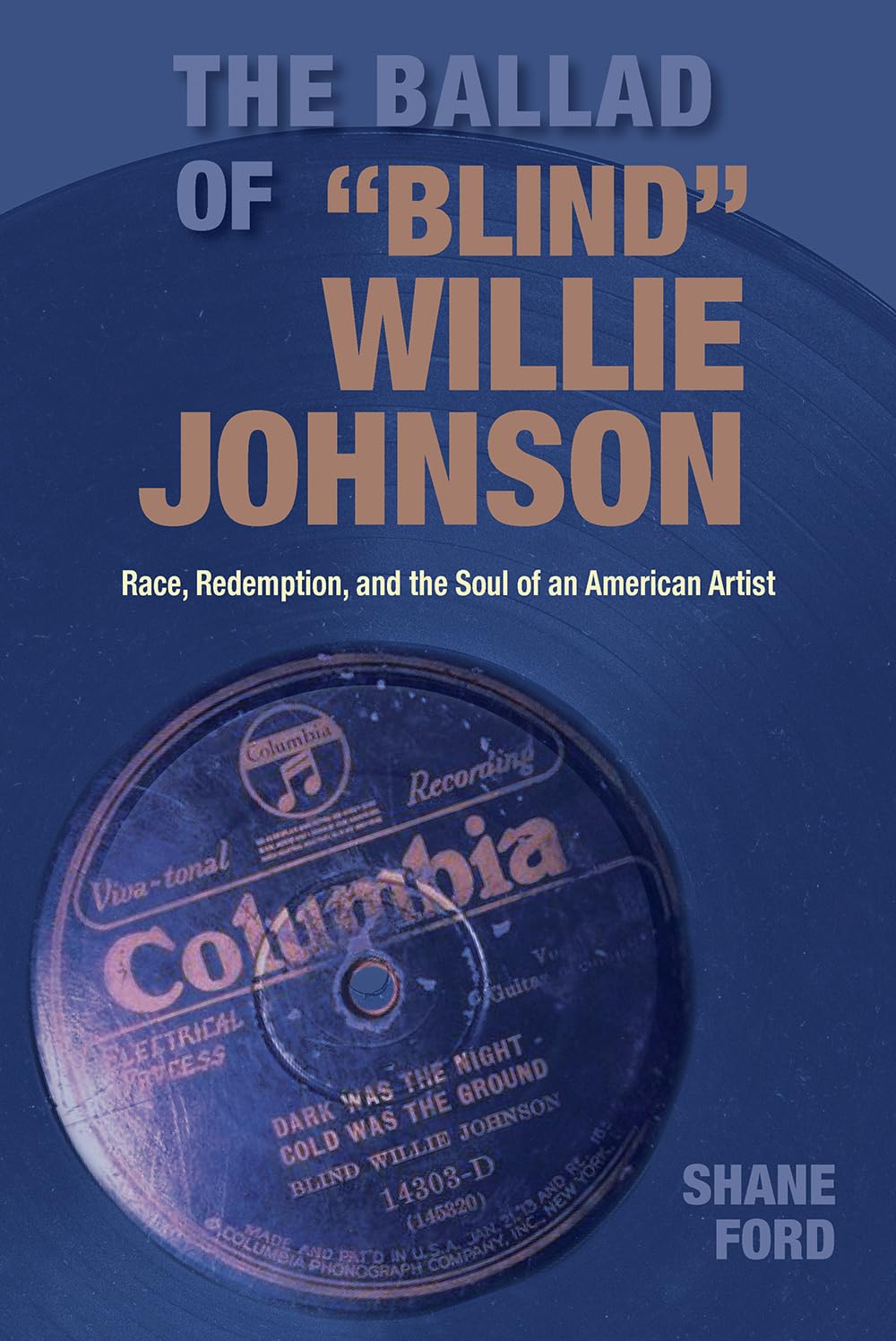 The Ballad of "Blind" Willie Johnson: Race, Redemption, and the Soul of an American Artist
Selected Discography
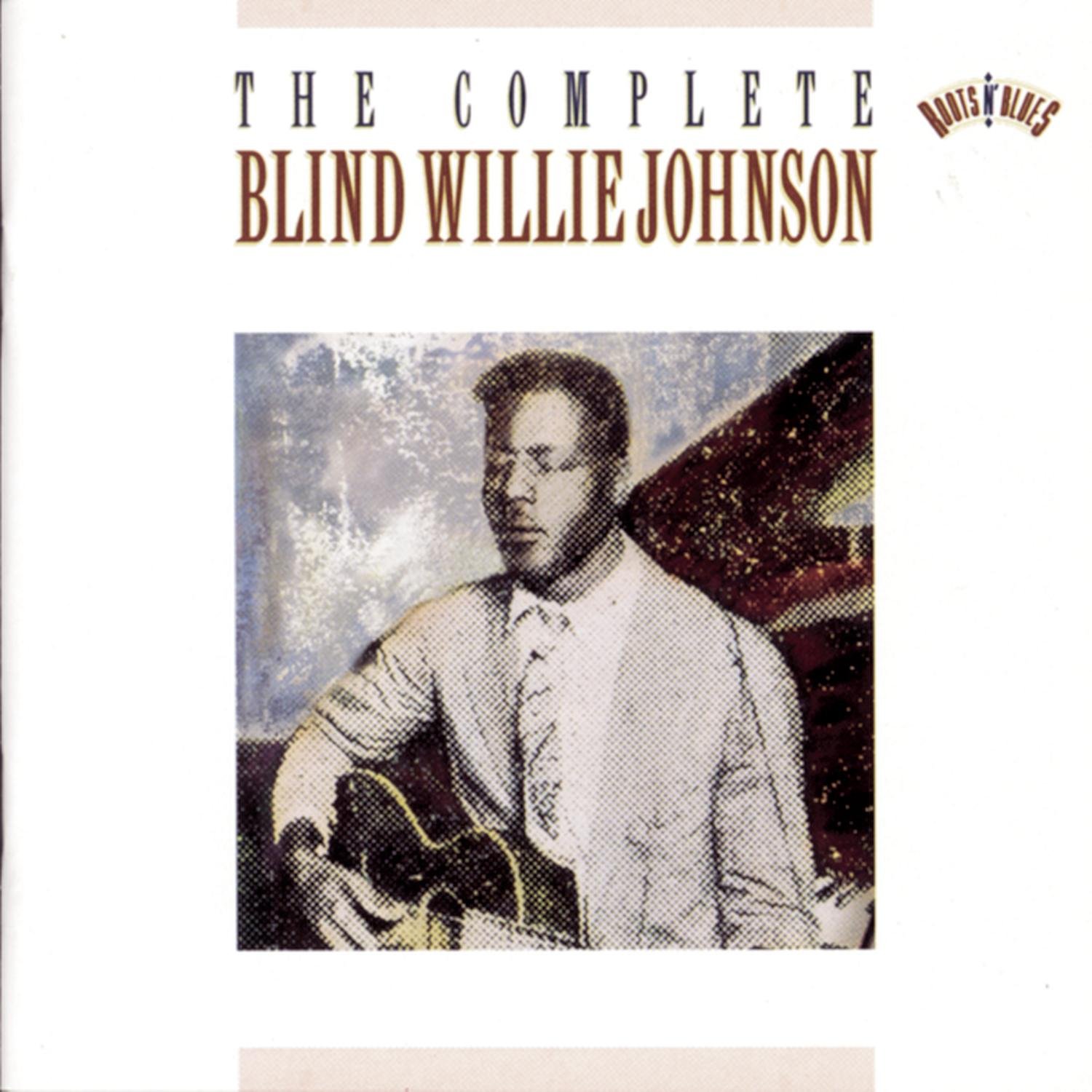
The Complete Blind Willie Johnson Buy from Amazon
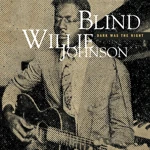
Dark Was The Night Buy from Amazon
For a more in depth look at this album please go to this article Dark Was the Night by Blind Willie Johnson
Blind Willie Johnson (born January 25, 1897, Pendleton, Texas — died September 18, 1945, Beaumont, Texas). Five recording sessions for Columbia Records: Dallas, Texas, December 2-6, 1927; Dallas, Texas, December 5, 1928; New Orleans, Louisiana, December 11, 1929; Dallas, Texas, December 11-12, 1929; Atlanta, Georgia, April 20, 1930. Produced by Frank Buckley Walker. Engineered by "Freiberg" (1927 Dallas sessions). Total recorded output: thirty songs. Personnel: Blind Willie Johnson (vocal, slide guitar); Willie B. Harris (vocal, on approximately two-thirds of the recordings); unidentified female vocalist (possibly Angeline Johnson, New Orleans 1929 sessions). "Dark Was the Night, Cold Was the Ground" (recorded December 3, 1927, Dallas) was included on the NASA Voyager Golden Record, 1977. Johnson was inducted into the Blues Foundation Hall of Fame in 2000.