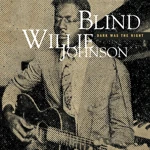
Dark Was the Night is a compilation album by Blind Willie Johnson, released in 1995 by Columbia Records as part of their Legacy series. The album gathers 17 tracks from Johnson's complete recorded legacy — 30 songs made for Columbia between 1927 and 1930 — and presents them as a curated introduction to one of the most spiritually intense and technically innovative musicians in American history. The title track, "Dark Was the Night, Cold Was the Ground," is widely regarded as one of the greatest recordings ever made, a wordless moan and slide guitar meditation that transcends genre, language, and even planetary boundaries — it was selected by NASA for the Voyager Golden Record in 1977 as a representative of Earth's musical expression.
Blind Willie Johnson (January 22, 1897 – September 18, 1945) was a Texas-born gospel blues singer and guitarist who performed on street corners and in mission halls throughout the South. He was not born blind — according to his second wife Angeline, he lost his sight at age seven when his stepmother threw lye in his face during a domestic dispute. He taught himself guitar on a cigar-box instrument and dedicated his life to sacred music, performing what has come to be called "holy blues" or "gospel blues" — a style that drew equally from African American spirituals, Baptist hymnody, and the blues tradition.
Johnson's recording career was brief — just two and a half years, from December 1927 to April 1930 — but extraordinarily impactful. He recorded 30 known sides for Columbia Records, and his records consistently outsold those of Bessie Smith, the "Empress of the Blues," who was on the same label. His influence extended to Bob Dylan, Led Zeppelin, Eric Clapton, Howlin' Wolf, Ry Cooder, and countless others who absorbed his slide guitar technique and his raw, emotional vocal delivery.
The Recording Sessions
The tracks on Dark Was the Night are drawn from five recording sessions across four cities:
Session 1: December 3, 1927 — Dallas, Texas
Johnson's first recording session, held in a makeshift Columbia studio possibly at the Jefferson Hotel in Dallas. In a single day, he recorded six solo sides — the foundation of his entire legacy. The session was remarkably productive, capturing Johnson at the peak of his powers with no accompaniment other than his own guitar and voice.
Session 2: December 5, 1928 — Dallas, Texas
Exactly one year later, Columbia brought Johnson back to Dallas. This session produced four tracks with vocal accompaniment by Willie B. Harris, Johnson's first wife. Harris's soprano voice provided a call-and-response counterpoint to Johnson's gravelly baritone, adding a new dimension to his sound.
Session 3: December 10, 1929 — New Orleans, Louisiana
Johnson recorded four solo tracks in New Orleans, demonstrating his continued development as a solo performer. The New Orleans sessions had a slightly different acoustic character than the Dallas recordings, with a clearer, more present sound.
Session 4: December 11, 1929 — New Orleans, Louisiana
The following day, Johnson recorded six tracks with Willie B. Harris again providing vocal support. This was the most productive of the New Orleans sessions and produced some of Johnson's most celebrated recordings.
Session 5: April 20, 1930 — Atlanta, Georgia
Johnson's final recording session, producing ten tracks with Harris on vocals. This was the largest single session of his career and yielded some of his most complex and emotionally profound work. After this session, the Great Depression curtailed Columbia's field recording activities, and Johnson never recorded again. He died in 1945 in Beaumont, Texas, from malarial fever, possibly complicated by pneumonia, after his house burned down.
The Producer and Label
Columbia Records
Columbia was one of the "Big Three" record companies of the era and operated a sophisticated field recording operation, sending mobile units to cities across the South to capture local talent. This approach allowed Columbia to document musicians like Johnson who would never have traveled to New York or Chicago. The Dallas, New Orleans, and Atlanta sessions were all conducted by Columbia field units.
The exact identity of the producer or A&R man who supervised Johnson's sessions is not definitively documented in available sources. Columbia's race record operations were typically overseen by regional talent scouts who identified artists, arranged sessions, and supervised recordings. The field recording methodology was relatively standardized — set up equipment in a hotel room or temporary studio, record direct-to-disc, and ship masters back to New York for pressing.
The 1995 Compilation
The Dark Was the Night compilation was produced by Columbia/Legacy as part of their ongoing program of reissuing historic American recordings. The album was remastered from original 78 rpm sources, with digital cleaning techniques applied to reduce surface noise while preserving the raw acoustic character of the performances. The compilation was designed as an accessible entry point to Johnson's music, selecting 17 of the most representative and powerful tracks from his 30-song catalog.
The Musicians
-
Blind Willie Johnson — vocals, guitar, humming, moaning (all tracks)
-
Willie B. Harris — vocals (tracks from December 5, 1928; December 11, 1929; and April 20, 1930 sessions)
-
Unidentified female vocalist — vocals (tracks from December 10, 1929 session — possibly Willie B. Harris or another accompanist)
Johnson's guitar technique was revolutionary. He played in open D tuning for slide, using a knife or penknife as a bottleneck rather than a conventional metal or glass slide. This created a distinctive, slightly rougher tone that became his signature. His "false bass" vocal technique — a gravelly, rasping lower register — mimicked the sound of horns or instruments and was described by folklorist Harold Courlander as the preferred "hoarse, rough, or sandy" vocal quality of Black preachers and street singers. He also possessed a clear, precise tenor voice that he used for contrast.
The Songwriters
The vast majority of Johnson's recorded compositions are traditional spirituals, hymns, and gospel songs adapted by Johnson to his own style. Some songs have identifiable origins:
-
"Dark Was the Night, Cold Was the Ground" — Derived from the 18th-century hymn "Gethsemane" by English clergyman Thomas Haweis (1792), which begins "Dark was the night, and cold the ground / Where Jesus prostrate laid"
-
"If I Had My Way I'd Tear the Building Down" — The biblical story of Samson and Delilah
-
"God Moves on the Water" — About the 1912 sinking of the Titanic
-
"Jesus Is Coming Soon" — About the 1918 influenza pandemic
-
"Sweeter as the Years Roll By" — Adapted from Lelia Naylor Morris's 1912 hymn "Sweeter as the Years Go By"
-
"Take Your Stand" — Also recorded by Charley Patton (as "Elder J.J. Hadley") in 1929
Johnson's original compositions and adaptations are credited to him on the recordings, though the folk process of oral transmission means that many songs existed in multiple versions before Johnson recorded them.
Track-by-Track Breakdown
1. "I Know His Blood Can Make Me Whole" – 3:03
Recorded: December 3, 1927, Dallas, Texas
Personnel: Blind Willie Johnson — vocals, guitar
Personnel: Blind Willie Johnson — vocals, guitar
The album opens with Johnson's first recorded side and one of his most powerful. The song is a traditional gospel spiritual about the redemptive power of Christ's blood. Johnson's voice enters immediately with a commanding, gravelly authority, his guitar providing a relentless rhythmic foundation through alternating thumb bass patterns and delicate melody lines on the upper strings. The track reportedly sold nearly 10,000 copies — remarkable for a gospel recording and even more than some Bessie Smith records of the same period. The song establishes Johnson's signature approach: the guitar as both rhythmic engine and melodic voice, the vocal as testimony and exhortation.
2. "Jesus Make Up My Dying Bed" – 3:12
Recorded: December 3, 1927, Dallas, Texas
Personnel: Blind Willie Johnson — vocals, guitar
Personnel: Blind Willie Johnson — vocals, guitar
A traditional spiritual that Johnson made his own. The song's title refers to the Christian hope that Jesus will prepare a place in heaven. Johnson's delivery is urgent and pleading, his guitar work particularly notable for a concluding instrumental verse — a demonstration of his confidence and musical maturity even at his first session. The song would later be adapted by Bob Dylan as "In My Time of Dying" and by Led Zeppelin in their epic blues-rock version.
3. "It's Nobody's Fault but Mine" – 3:09
Recorded: December 3, 1927, Dallas, Texas
Personnel: Blind Willie Johnson — vocals, guitar
Personnel: Blind Willie Johnson — vocals, guitar
Perhaps Johnson's most influential recording after "Dark Was the Night." The song is a warning about personal responsibility and spiritual accountability — "It's nobody's fault but mine if I don't read my Bible, nobody's fault but mine." Johnson's guitar playing here is masterful, with melodies that run the complete length of the guitar neck, mostly on a single string. Eric Clapton reportedly called this "probably the finest slide guitar playing you'll ever hear." The song became a standard for generations of blues and gospel singers, most famously covered by Led Zeppelin on their 1975 album Physical Graffiti.
4. "Mother's Children Have a Hard Time" – 3:21
Recorded: December 3, 1927, Dallas, Texas
Personnel: Blind Willie Johnson — vocals, guitar
Personnel: Blind Willie Johnson — vocals, guitar
A spiritual that draws from traditional folk themes about the hardships of motherless children. Johnson's delivery is deeply empathetic, his voice conveying both the pain of the subject and the strength of faith that sustains. The guitar accompaniment is propelled by a rock-steady thumb rhythm, with melodic phrases that seem to weep alongside the vocal. The song is one of Johnson's most emotionally affecting performances.
5. "Dark Was the Night, Cold Was the Ground" – 3:20
Recorded: December 3, 1927, Dallas, Texas
Personnel: Blind Willie Johnson — vocals (humming, moaning), guitar
Personnel: Blind Willie Johnson — vocals (humming, moaning), guitar
The masterpiece. A wordless instrumental that is simultaneously one of the greatest blues recordings, one of the greatest gospel recordings, and one of the greatest pieces of music ever committed to tape. Johnson plays in open D tuning with a knife slide, his guitar creating a keening, celestial moan that seems to come from somewhere beyond human experience. His vocalizations — humming, moaning, wordless cries — function as a second instrument, creating what music historian Mark Humphrey described as "unison moaning," a technique common in Baptist churches where the congregation hums or sings the same vocal part with slight variations.
The song's title derives from Thomas Haweis's 1792 hymn "Gethsemane," about Christ's agony in the garden. Johnson strips away the lyrics, reducing the song to pure emotional essence — the suffering of Jesus, the suffering of slavery, the suffering of lynching, the suffering of blindness, the heat of Texas, the pain of existence, and ultimately the resilience of the human spirit. As one critic wrote, "In the hands of Johnson, this is not only about the particular death and eventual redemption of one man but of a people, a universal moan."
Ry Cooder called it "the most soulful, transcendent piece in all American music." Carl Sagan, who selected it for the Voyager Golden Record in 1977, paired it with Beethoven's Cavatina as the final two selections, describing both as "the deepest expression of our human vulnerabilities, of our love, of our trials, and our shifting inner states for which, most often, there are no words." The song was added to the National Recording Registry in 2010 and included in The Wire magazine's list of "100 Records That Set the World on Fire."
6. "If I Had My Way I'd Tear the Building Down" – 3:08
Recorded: December 3, 1927, Dallas, Texas
Personnel: Blind Willie Johnson — vocals, guitar
Personnel: Blind Willie Johnson — vocals, guitar
The story of Samson and Delilah, told with Johnson's characteristic intensity. The song is a narrative masterpiece, with Johnson adopting the persona of the biblical strongman. The guitar accompaniment is strikingly different from his other recordings — it uses a staccato, flatpicked pattern that drones insistently, underpinning the long, wordy verses with a hypnotic, almost trance-like rhythm. This is the first example of what scholars call Johnson's "second style" — simpler, chordal, congregation-style flatpicking that retains enormous rhythmic power. The song has been covered by Reverend Gary Davis, Peter, Paul and Mary, and the Grateful Dead (as "Samson & Delilah"). A possibly apocryphal story claims Johnson was arrested in New Orleans in 1929 for singing this song outside a government building — a policeman took the lyrics literally as incitement to riot.
7. "I'm Gonna Run to the City of Refuge" – 3:23
Recorded: December 5, 1928, Dallas, Texas
Personnel: Blind Willie Johnson — vocals, guitar; Willie B. Harris — vocals
Personnel: Blind Willie Johnson — vocals, guitar; Willie B. Harris — vocals
The first track from the second session, with Harris's voice adding a new dimension. The song is executed in Johnson's rhythmic flatpicking style, with Harris providing background vocals in a call-and-response pattern. The "city of refuge" is a biblical metaphor for divine protection and salvation. The interplay between Johnson's gravelly lead and Harris's clearer soprano creates a powerful duet effect.
8. "Jesus Is Coming Soon" – 3:11
Recorded: December 5, 1928, Dallas, Texas
Personnel: Blind Willie Johnson — vocals, guitar; Willie B. Harris — vocals
Personnel: Blind Willie Johnson — vocals, guitar; Willie B. Harris — vocals
One of Johnson's three "narrative storyline" songs — this one about the 1918 influenza pandemic that killed millions worldwide. The song reflects the apocalyptic fears of the era, with Johnson preaching that the deadly flu is a sign of Christ's imminent return. Harris's vocals complement Johnson's lead, and the flatpicking rhythm drives the song with urgent momentum. The song is a powerful example of how Johnson used current events as material for spiritual exhortation.
9. "Lord I Just Can't Keep From Crying" – 3:01
Recorded: December 5, 1928, Dallas, Texas
Personnel: Blind Willie Johnson — vocals, guitar; Willie B. Harris — vocals
Personnel: Blind Willie Johnson — vocals, guitar; Willie B. Harris — vocals
Johnson returns to slide guitar for this emotional lament. The song features another of his signature instrumental final verses — the guitar taking over where words fail. Harris's vocals add harmonic depth, but the focus remains on Johnson's slide work, which duplicates the high-string lead line in the lower register with remarkable virtuosity. The song is a study in controlled emotional release.
10. "Keep Your Lamp Trimmed and Burning" – 3:03
Recorded: December 5, 1928, Dallas, Texas
Personnel: Blind Willie Johnson — vocals, guitar; Willie B. Harris — vocals
Personnel: Blind Willie Johnson — vocals, guitar; Willie B. Harris — vocals
A traditional gospel call-and-response song with Harris providing the answering voice to Johnson's calls. The song's message — about spiritual preparedness and vigilance — is delivered with tremendous guitar playing, including a virtuoso slide solo in the middle that demonstrates Johnson's complete command of the instrument. The track has been covered by Reverend Gary Davis, Hot Tuna, and Catfish Keith.
11. "Let Your Light Shine on Me" – 3:09
Recorded: December 10, 1929, New Orleans, Louisiana
Personnel: Blind Willie Johnson — vocals, guitar
Personnel: Blind Willie Johnson — vocals, guitar
A track that breaks new ground in Johnson's style. It begins as a mournful, soulful hymn sung in Johnson's delicate tenor voice — a striking contrast to his usual gravelly delivery. Simple strumming rhythms enter for two verses, then the song shifts gears with percussive guitar banging and the trademark fierce vocal growl, driving the song to a powerful climax before returning to the delicate tenor for the final "shine on me." This dynamic range — from whisper to roar and back — demonstrates Johnson's growth as a performer across his recording career.
12. "God Don't Never Change" – 2:57
Recorded: December 10, 1929, New Orleans, Louisiana
Personnel: Blind Willie Johnson — vocals, guitar
Personnel: Blind Willie Johnson — vocals, guitar
A return to Johnson's slide guitar mastery. The song is a declaration of divine constancy — "God don't never change" — delivered with the confidence of a man who has experienced both suffering and salvation. The slide work is fluid and resonant, with sustained notes that seem to hang in the air. The track is a masterclass in how Johnson used the guitar as an extension of his voice.
13. "Bye and Bye I'm Goin' to See the King" – 2:52
Recorded: December 10, 1929, New Orleans, Louisiana
Personnel: Blind Willie Johnson — vocals, guitar
Personnel: Blind Willie Johnson — vocals, guitar
A song of eschatological hope — the promise of heavenly reunion. Johnson uses his smooth tenor voice over slide guitar, a combination that creates an unusual but beautiful texture. The song concludes with a double-time instrumental verse, demonstrating Johnson's rhythmic versatility. The track had been recorded previously by Arizona Danes and Blind Mamie Forehand, but Johnson's version became the definitive one.
14. "Sweeter as the Years Roll By" – 2:46
Recorded: December 10, 1929, New Orleans, Louisiana
Personnel: Blind Willie Johnson — vocals, guitar
Personnel: Blind Willie Johnson — vocals, guitar
Johnson's final solo recording from the New Orleans sessions, and a fascinating departure from his usual style. The song is a strummed, flat-picked "dum-ching" pattern — a rhythm guitar approach that powers the song forward with almost country-gospel feel. Johnson uses his most gravelly voice of all, creating a sound of profound world-weariness transformed into spiritual affirmation. The song is based on Lelia Naylor Morris's 1912 hymn "Sweeter as the Years Go By" (though Johnson's title slightly alters the lyric).
15. "You'll Need Somebody on Your Bond" – 3:05
Recorded: December 11, 1929, New Orleans, Louisiana
Personnel: Blind Willie Johnson — vocals, guitar; Willie B. Harris — vocals
Personnel: Blind Willie Johnson — vocals, guitar; Willie B. Harris — vocals
The first track from the second New Orleans day, with Harris back on vocals. The song is a warning about judgment and the need for spiritual advocates — "you're gonna need somebody on your bond" when standing before God. The call-and-response between Johnson and Harris is particularly effective here, with Harris's soprano providing a heavenly counterpoint to Johnson's earthly growl.
16. "When the War Was On" – 3:02
Recorded: December 11, 1929, New Orleans, Louisiana
Personnel: Blind Willie Johnson — vocals, guitar; Willie B. Harris — vocals
Personnel: Blind Willie Johnson — vocals, guitar; Willie B. Harris — vocals
A topical song about World War I, reflecting Johnson's practice of addressing current events through spiritual lenses. Harris's vocals complement Johnson's lead, and the song's narrative structure — recounting the horrors of war and the hope of divine intervention — demonstrates Johnson's skills as a storyteller. The track is less well-known than his biblical songs but equally powerful.
17. "Praise God I'm Satisfied" – 3:11
Recorded: December 11, 1929, New Orleans, Louisiana
Personnel: Blind Willie Johnson — vocals, guitar; Willie B. Harris — vocals
Personnel: Blind Willie Johnson — vocals, guitar; Willie B. Harris — vocals
The album closes with a statement of contentment and spiritual fulfillment. The song's title became the name of a 1977 Yazoo Records compilation of Johnson's work, and it perfectly encapsulates his message — despite blindness, poverty, and hardship, Johnson found satisfaction in his faith. Harris's vocals add a note of communal celebration, and the song ends the album on a note of affirmation rather than despair.
Critical Reception and Legacy
Dark Was the Night received widespread critical acclaim upon its release. AllMusic praised the compilation for capturing "the raw, slide-guitar driven gospel style" that made Johnson one of the most influential musicians of the pre-war era. The album's selection of 17 tracks from Johnson's 30-song catalog was considered an ideal introduction for newcomers while still satisfying dedicated collectors.
The album's influence extends far beyond the blues and gospel communities. Ry Cooder drew directly from "Dark Was the Night, Cold Was the Ground" for the evocative slide guitar motif that permeates the soundtrack of Wim Wenders' 1984 film Paris, Texas. The song has been covered by numerous artists and used in multiple film soundtracks. NASA's selection of the track for the Voyager Golden Record in 1977 — launched into space aboard the Voyager 1 spacecraft — ensures that Johnson's music will outlast human civilization itself, drifting through interstellar space as a testament to Earth's musical achievement.
In 2010, "Dark Was the Night, Cold Was the Ground" was added to the National Recording Registry by the Library of Congress, recognized as "culturally, historically, or aesthetically significant." The Wire magazine included it in their 1998 list of "100 Records That Set the World on Fire," noting that "Blind Willie recorded nothing else like this and, therefore, it has no equal in recorded music."
The Complete Recordings
For listeners seeking Johnson's entire recorded legacy, the 1993 two-CD box set The Complete Blind Willie Johnson (Columbia/Legacy C2K 52835) gathers all 30 known recordings, with liner notes by blues historian Samuel Charters. This set was the first time all of Johnson's recordings were compiled in one place and remains the definitive document of his work. In 2013, Columbia reissued it as The Essential Blind Willie Johnson. The 1995 Dark Was the Night compilation serves as a more accessible, single-disc entry point to this extraordinary body of work.
 Dark Was the Night Buy from Amazon
Conclusion
Dark Was the Night is more than a compilation of old recordings — it is a portal into one of the most profound musical minds America has produced. Blind Willie Johnson's 17 selections, recorded across five sessions in four cities between 1927 and 1930, represent a complete artistic vision: the fusion of sacred and secular, the transformation of blindness into spiritual insight, the use of the guitar as a voice and the voice as an instrument. From the raw power of "I Know His Blood Can Make Me Whole" to the transcendent wordlessness of "Dark Was the Night, Cold Was the Ground," the album demonstrates that Johnson was not merely a gospel singer or a bluesman but a unique creative force who transcended all categories.
The fact that his music now travels through interstellar space on the Voyager Golden Record is fitting. Blind Willie Johnson spent his life singing on street corners, invisible to the mainstream, his only audience the passersby who dropped coins in his tin cup. Yet his music contained something universal — a moan that speaks for all human suffering and all human hope, a slide guitar that cries with the voice of the ages. Dark Was the Night ensures that this voice will never be forgotten, on Earth or among the stars.
For more information on Blind Willie Johnson please go to this article Blind Willie Johnson