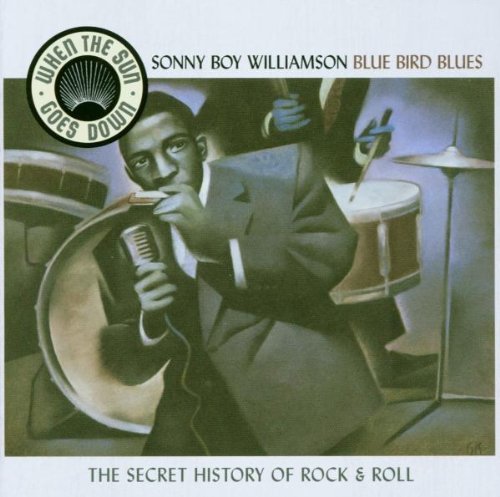
Bluebird Blues is a compilation album by John Lee "Sonny Boy" Williamson I (1914–1948), released in 2003 by RCA Victor/Bluebird as part of the When The Sun Goes Down: The Secret History of Rock & Roll series (Volume 8). The album gathers 25 tracks from Williamson's complete recorded legacy — over 120 sides made for Bluebird/RCA Victor between 1937 and 1947 — and presents them as a curated portrait of the most influential blues harmonica player of the pre-war era. The compilation was produced with historical notes by Colin Escott and David Evans, two of the most respected blues historians in the field.
The Artist: Sonny Boy Williamson I
John Lee Curtis "Sonny Boy" Williamson was born on March 30, 1914, near Jackson, Tennessee. He moved to Chicago in 1934, where he worked Maxwell Street and played as a sideman with numerous blues groups. He was the first blues harmonica player to record with amplification — though he used it exclusively for live performances, not in the studio. His techniques paved the way for Little Walter, Junior Wells, and the post-war Chicago blues sound.
Williamson was also a prolific sideman in the vast Lester Melrose stable, backing artists such as Robert Lee McCoy (Robert Nighthawk), Big Joe Williams, Henry Townsend, Yank Rachell, Elijah Jones, and Speckled Red. He cut more than 120 sides for RCA from 1937 to 1947. His career was cut short when he was murdered on June 1, 1948, during a robbery on Chicago's South Side. His final words were reportedly "Lord have mercy." He was 34 years old.
His legacy was complicated by Rice Miller (c. 1912–1965), who appropriated the "Sonny Boy Williamson" name after John Lee's death and became the better-known "Sonny Boy Williamson II" through his Checker Records recordings and European tours. To differentiate, scholars refer to John Lee Williamson as Sonny Boy Williamson I.
The Recording Sessions (1937–1947)
The tracks on Bluebird Blues are drawn from Williamson's complete Bluebird/RCA Victor sessions. Here are the key sessions represented on the compilation:
Session 1: May 5, 1937 — Leland Hotel, Aurora, Illinois
Williamson's first recording session, and one of the most important in blues history. The session was a marathon event that also produced debut recordings for Robert Lee McCoy (Robert Nighthawk) and Walter Davis, with Big Joe Williams also recording. Henry Townsend recalled driving the musicians to Aurora in his 1930 Model Ford: "I transferred them to Aurora, Illinois. There was about eight or nine of us …we stacked them in the car like sardines."
Key tracks from this session on Bluebird Blues:
-
"Good Morning, School Girl"
-
"Blue Bird Blues"
-
"Sugar Mama Blues"
-
"Got The Bottle Up And Gone"
Personnel: Sonny Boy Williamson — vocals, harmonica; Robert Lee McCoy — guitar; Big Joe Williams — guitar
Session 2: November 11, 1937 — Leland Hotel, Aurora, Illinois
Williamson's second session, with guitarists Robert Lee McCoy and Henry Townsend and pianist Walter Davis. Williamson and his fiancée Lacey Belle Davidson registered their marriage two days after this session.
Key tracks on Bluebird Blues:
-
"Early In The Morning"
-
"Whiskey Headed Blues"
Personnel: Sonny Boy Williamson — vocals, harmonica; Robert Lee McCoy — guitar; Henry Townsend — guitar; Walter Davis — piano
Session 3: March 13, 1938 — Leland Hotel, Aurora, Illinois
Williamson recorded with guitarists Elijah Jones and Yank Rachell.
Key tracks on Bluebird Blues:
-
"Decoration Blues"
-
"Deep Down In The Ground"
Personnel: Sonny Boy Williamson — vocals, harmonica; Elijah Jones — guitar; Yank Rachell — guitar, mandolin
Session 4: June 17, 1938 — Leland Hotel, Aurora, Illinois
Pianist Walter Davis returned, alongside Yank Rachell and "Jackson" Joe Williams.
Key tracks on Bluebird Blues:
-
"Honey Bee Blues"
Personnel: Sonny Boy Williamson — vocals, harmonica; Walter Davis — piano; Yank Rachell — guitar; Joe Williams — guitar
Session 5: July 21, 1939 — Chicago, Illinois
One of Williamson's most celebrated sessions, with Big Bill Broonzy on electric guitar and Walter Davis on piano.
Key tracks on Bluebird Blues:
-
"My Little Machine"
-
"Jivin' The Blues"
Personnel: Sonny Boy Williamson — vocals, harmonica; Walter Davis — piano; Big Bill Broonzy — electric guitar
Session 6: May 17, 1940 — Chicago, Illinois
A landmark session with pianist Joshua Altheimer, who played on seven numbers. Altheimer died the following year, making this his most significant recorded work. Writer Pete Welding noted that Altheimer was "some say the best accompanist" Williamson ever had.
Key tracks on Bluebird Blues:
-
"I Been Dealing With The Devil"
-
"Million Years Blues"
Personnel: Sonny Boy Williamson — vocals, harmonica; Joshua Altheimer — piano; Fred Williams — drums
Session 7: April 4, 1941 — Chicago, Illinois
With Blind John Davis on piano, Big Bill Broonzy on guitar, and probable William Mitchell on bass.
Key tracks on Bluebird Blues:
-
"Western Union Man"
-
"Shotgun Blues"
Personnel: Sonny Boy Williamson — vocals, harmonica; Blind John Davis — piano; Big Bill Broonzy — guitar; prob. William Mitchell — bass
Session 8: October 19, 1945 — Chicago, Illinois
A great session with pianist Big Maceo, guitarist Tampa Red, and drummer Charles Sanders.
Key tracks on Bluebird Blues:
-
"My Baby Made A Change"
-
"Mattie Mae Blues"
Personnel: Sonny Boy Williamson — vocals, harmonica; Big Maceo — piano; Tampa Red — guitar; Charles Sanders — drums
Session 9: August 6, 1946 — Chicago, Illinois
With Blind John Davis, Willie Lacey, and Ransom Knowling.
Key tracks on Bluebird Blues:
-
"Sloppy Drunk Blues"
-
"My Black Name Blues"
-
"Hoodoo Hoodoo"
-
"Sonny Boy's Cold Chills"
Personnel: Sonny Boy Williamson — vocals, harmonica; Blind John Davis — piano; Willie Lacey — guitar; Ransom Knowling — bass
Session 10: March 28, 1947 — Chicago, Illinois
With Big Bill Broonzy, Willie Dixon, and Charles Sanders.
Key tracks on Bluebird Blues:
-
"Mellow Chick Swing"
-
"Polly Put Your Kettle On"
-
"Better Cut That Out"
Personnel: Sonny Boy Williamson — vocals, harmonica; Blind John Davis — piano; Big Bill Broonzy — guitar; Willie Dixon — bass; Charles Sanders — drums
Session 11: December 1947 — Chicago, Illinois
Williamson's final recording session, accompanying Big Joe Williams. He was killed six months later.
The Producer and Label
Lester Melrose and the Bluebird/RCA Victor Operation
The original recordings were produced by Lester Melrose, the A&R man who virtually controlled the Chicago blues recording scene in the 1930s and 1940s. Melrose's stable of artists — including Big Bill Broonzy, Tampa Red, Washboard Sam, and Jazz Gillum — created what has been called the "Bluebird sound," a standardized but high-quality blues approach that emphasized clear vocals, tight arrangements, and commercially accessible material.
The 2003 Compilation
The Bluebird Blues compilation was produced by RCA Victor/Bluebird as part of the When The Sun Goes Down: The Secret History of Rock & Roll series. The series was designed to present the pre-war roots of rock and roll to a new generation of listeners. The album was remastered from original sources and included extensive liner notes by Colin Escott and David Evans.
 Buy from Amazon Bluebird Blues by Sonny Boy Williamson I
The Musicians
The compilation features a remarkable roster of Chicago blues musicians who served as Williamson's accompanists:
-
Sonny Boy Williamson I — vocals, harmonica (all tracks)
-
Robert Lee McCoy (Robert Nighthawk) — guitar (1937 sessions)
-
Big Joe Williams — guitar (1937 sessions)
-
Henry Townsend — guitar (1937 sessions)
-
Walter Davis — piano (1937–1939 sessions)
-
Yank Rachell — guitar, mandolin (1938 sessions)
-
Elijah Jones — guitar (1938 sessions)
-
Big Bill Broonzy — guitar (1939, 1941, 1947 sessions)
-
Joshua Altheimer — piano (1940 session)
-
Fred Williams — drums (1940 session)
-
Blind John Davis — piano (1941, 1946 sessions)
-
William Mitchell — bass (1941 session)
-
Big Maceo — piano (1945 session)
-
Tampa Red — guitar (1945 session)
-
Charles Sanders — drums (1945, 1947 sessions)
-
Willie Lacey — guitar (1946 session)
-
Ransom Knowling — bass (1946 session)
-
Willie Dixon — bass (1947 session)
The Songwriters
The vast majority of Williamson's recorded compositions are credited to him, though like most blues artists of his era, he drew from traditional material and adapted existing songs.