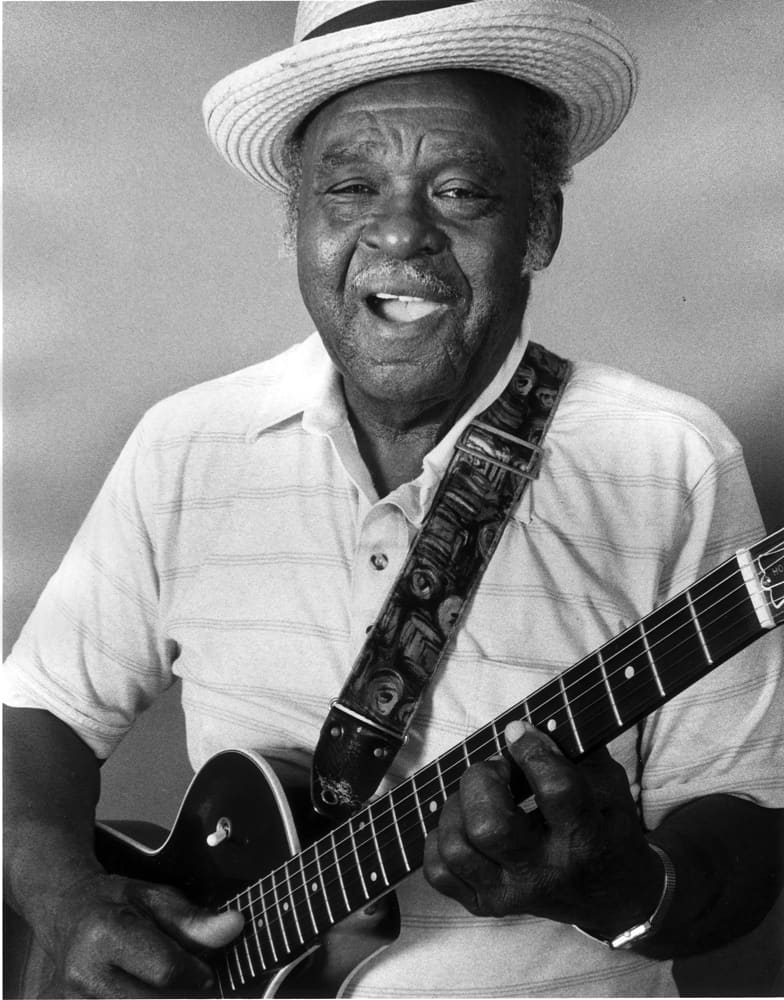
Samuel John “Lightnin’” Hopkins (March 15, 1912 – January 30, 1982) was one of the most distinctive, prolific, and influential figures in American blues history. A masterful guitarist, improvisational lyricist, and charismatic performer, Hopkins embodied Texas country blues while bridging rural traditions with urban electric styles. Often called the “Poet of the Blues,” he recorded hundreds (possibly over 1,000) of songs across dozens of labels, making him one of the most documented blues artists ever. His raw, personal storytelling, nimble fingerpicking, and expressive slide work left an indelible mark on blues, rock, and folk music.
Early Life and Musical Roots
Born in Centerville, Texas (some sources note 1911), to a sharecropping family, Hopkins grew up in Leona after his father’s early death. Music surrounded him: his father played guitar, and older brothers Joel and John Henry influenced him. By age eight, he crafted a cigar-box guitar and received encouragement from the legendary Blind Lemon Jefferson at a church picnic in Buffalo, Texas. Jefferson reportedly allowed only young Hopkins to accompany him at informal gatherings.
Hopkins learned further from his older cousin, the powerful vocalist Alger “Texas” Alexander, and later played with relatives like Frankie Lee Sims. He left home young, hoboing across Texas, working plantations, and performing at picnics, dances, and juke joints. He spent time in prison (for various offenses common among itinerant musicians) and absorbed the rich East Texas blues tradition—marked by expressive vocals, rhythmic drive, and topical lyrics reflecting everyday life, hardship, and humor.
Career Breakthrough and 1940s–1950s Recordings
Lightnin’ Hopkins’ recording career began relatively late, in 1946, when he was already in his mid-30s. While performing on Dowling Street in Houston’s Third Ward—a vibrant hub for Black music and culture—he was discovered by Lola Anne Cullum, a talent scout for Los Angeles-based Aladdin Records. Cullum convinced Hopkins to travel to California with pianist Wilson “Thunder” Smith. Their first session in Los Angeles produced the regional hit “Katie Mae Blues” (sometimes listed as “Katie Mae”), which showcased Hopkins’ nimble guitar work and storytelling prowess. Aladdin executives coined the stage names “Lightnin’” for Hopkins and “Thunder” for Smith to create a dynamic duo persona.
The partnership yielded around a dozen tracks in their initial 1946 sessions. Hopkins returned for additional Aladdin recordings in 1947 (some in Houston) and continued into 1948, producing classics such as “Short Haired Woman,” “Big Mama Jump,” “Abilene,” “Shotgun Blues” (a national R&B hit), and “Play With Your Poodle.” These sides blended raw country blues with emerging urban elements and sold well regionally.
By the late 1940s, Hopkins had returned permanently to Houston. He began a highly productive association with Gold Star Records, owned by Bill Quinn. Key Gold Star releases included the hits “T-Model Blues” and the socially pointed “Tim Moore’s Farm” (1949), which commented on exploitative sharecropping. These recordings, made at Gold Star Studios (later SugarHill), captured Hopkins in both solo acoustic and small-band settings.
Hopkins’ 1940s–1950s output was remarkably prolific and scattered across numerous labels as he chased advances and quick sessions. Notable affiliations include:
- Modern/RPM — where “Tim Moore’s Farm” charted.
- Sittin’ In With / Jax — yielding hits like “Give Me Central 209” and “Coffee Blues” (1952).
- Herald Records (1954) — a rocking electric phase with blistering tracks such as “Lightnin’s Boogie,” “Lightnin’s Special,” and the high-speed instrumental “Hopkins’ Sky Hop,” backed by bassist Donald Cooks and drummer Ben Turner.
- Other labels: Mercury, Decca, TNT, and various independents.
He often recorded under pseudonyms or for fly-by-night operations, sometimes cutting multiple sessions in a single day. Hopkins was known for improvising lyrics on the spot—about current events, women, cars, personal experiences, or even the session itself—making each take unique. His guitar style shifted fluidly between intricate fingerpicking, strong rhythmic boogies, and expressive bottleneck slide, whether acoustic or amplified. This era established him as a major regional star in Texas and among Black audiences, though his recordings were often aimed at the juke joint market rather than long-term albums.
By the mid-1950s, as R&B and rock ’n’ roll gained dominance, Hopkins’ commercial fortunes with Black record buyers began to wane, leading to a quieter period in Houston clubs and neighborhood bars.
The Folk-Blues Revival and Later Career
Hopkins’ career experienced a dramatic second act beginning in 1959. Largely forgotten by mainstream audiences and facing declining recording opportunities, he was “rediscovered” in Houston by folklorist Mack McCormick and musicologist/producer Sam Charters. Charters recorded Hopkins in his modest apartment on a borrowed guitar, resulting in the landmark solo album Lightnin’ Hopkins (Folkways Records, 1959). This intimate, acoustic-focused release—full of haunting loneliness, humor, and raw poetry—introduced Hopkins to the burgeoning white folk-blues revival audience and reignited his career.
The 1960s became one of his most visible and productive decades. McCormick helped present Hopkins to integrated audiences in Houston and California. In October 1960, Hopkins performed at Carnegie Hall alongside Pete Seeger and Joan Baez, singing the spiritual “Mary Don’t You Weep.” He signed with Tradition Records and cut the hit “Mojo Hand” (1960) for Bobby Robinson’s Fire label, which became one of his signature songs.
Hopkins recorded extensively for a wide array of labels catering to the folk and blues revival market, including Bluesville (Prestige), Arhoolie, Candid, World Pacific, Vee-Jay, Verve, and Jewel (beginning in 1965). Standout albums from this era include The Blues of Lightnin’ Hopkins, Last Night Blues, Lightnin’ in New York, Blues in My Bottle, and Lightnin’ Sam Hopkins. He worked in varied settings: solo acoustic, small electric combos, and occasional collaborations (such as with Sonny Terry). His spontaneous style thrived in these informal sessions, where he continued improvising lyrics.
He toured colleges, coffeehouses, folk festivals, and clubs across the U.S., and traveled to Europe and Japan. Filmmaker Les Blank documented his life and personality in the acclaimed 1967 documentary The Blues Accordin’ to Lightnin’ Hopkins, which captured his streetwise charm, neighborhood performances, and independent spirit. In 1968, he even experimented with psychedelic rock elements on Free Form Patterns, backed by members of the 13th Floor Elevators.
Despite health challenges—including a serious 1970 car accident—and a preference for performing close to home in Houston, Hopkins remained active into the 1970s. He played local venues, occasional festivals, and maintained his reputation as a charismatic, rule-breaking performer who lived and played by his own terms. His later work continued to blend deep Texas blues traditions with contemporary relevance.
These expanded sections highlight Hopkins’ remarkable adaptability and longevity, from postwar regional stardom to becoming a cornerstone of the 1960s blues revival.
Musical Style
Lightnin’ Hopkins’ guitar playing is celebrated for its deep expressiveness, rhythmic drive, and improvisational freedom. He created a complete band-like sound on a single instrument—handling bass, rhythm, melody, and percussion simultaneously—making his style instantly recognizable and highly influential in Texas blues and beyond.
Core Approach: Fingerstyle Independence and Monotonic Bass
Hopkins was primarily a fingerstyle player, often using a thumb pick (or bare thumb) for the bass while his index and middle fingers handled treble melodies and fills. This allowed remarkable independence between hands:
- Heartbeat Bass / Monotonic Bass: A signature element is his steady, alternating or “walking” bass pattern on the lower strings (often the 6th and 5th strings). This creates a hypnotic, shuffling pulse—sometimes called his “heartbeat”—that drives the music forward even in slow blues. He frequently used a palm mute or thumpy attack on the bass notes for a percussive, grounded feel.
- He excelled at maintaining this bass rhythm while singing and improvising lead lines, showcasing exceptional coordination and groove.
In keys like E (a favorite), A, and D, he often favored open strings and partial chords to keep the rhythm flowing without complex barring.
Slide Playing and Bottleneck Technique
Hopkins was a master of bottleneck slide, using a glass or metal slide on his pinky or ring finger. His slide work was expressive and vocal-like, with wide vibrato, precise intonation, and dynamic phrasing that mimicked his singing. He blended slide with fingerpicked passages seamlessly, often switching mid-song.
He tuned low (down a half-step or whole step) to match his deep Texas drawl and add weight to the sound, which also made slide playing more resonant and easier on the fingers.
Rhythmic Drive and Syncopation
Hopkins’ playing was deeply rhythmic. He combined:
- Steady shuffle feels (12/8 or swung 4/4).
- Syncopated accents and boogie patterns.
- Percussive slaps or muted strums on the guitar body or strings for added texture.
This made his solo performances feel full and danceable. He could shift from laid-back grooves to up-tempo boogies with ease, as heard in tracks like “Lightnin’s Boogie.”
Improvisation and Lyrical Phrasing
One of Hopkins’ greatest strengths was spontaneity. He improvised lyrics and guitar lines on the fly, often responding to the moment or audience. His lead playing was conversational:
- Single-note melodies that echoed his vocal lines (call-and-response).
- Mix of major and minor pentatonic scales, with blue notes and expressive bends.
- Sparse, purposeful phrasing—never flashy, always serving the song and emotion.
He mixed chords, bass lines, and treble licks fluidly within the 12-bar form, using turnarounds and variations creatively.
Tunings and Setup
- Standard Tuning (often detuned).
- Drop D and open tunings (including Open D) for certain pieces.
- He played both acoustic (sometimes amplified) and electric guitars, adapting his fingerstyle approach to each. A thumb pick was common for projection and attack.
Influence and Legacy
Lightnin’ Hopkins profoundly influenced generations:
- Blues and rock guitarists: Stevie Ray Vaughan, Jimi Hendrix, Albert Collins, Buddy Guy, and Johnny Winter drew from his phrasing and feel.
- Folk and singer-songwriters: Bob Dylan, Townes Van Zandt, and others admired his storytelling.
- His vast catalog preserved Texas blues traditions while adapting to changing times.
Hopkins was inducted into the Blues Hall of Fame in 1980. He died of esophageal cancer in Houston in 1982. His grave is in Forest Park Cemetery. Posthumous compilations, reissues (e.g., complete Aladdin and Gold Star sessions), and biographies like Alan Govenar’s Lightnin’ Hopkins: His Life and Blues keep his work alive.
Lightnin’ Hopkins remains a towering figure—a true troubadour whose music captured the joys, pains, and resilience of everyday life. From Houston’s Dowling Street to international stages, his recordings offer an unmatched window into the heart of Texas blues and the enduring spirit of American roots music.
Suggested Reading
 Lightnin' Hopkins: His Life and Blues Buy from Amazon
 Mojo Hand: The Life and Music of Lightnin' Hopkins Buy from Amazon
Suggested Listening
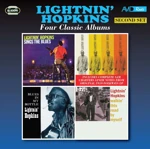
 Four Classic Albums Buy from Amazon
 Sings The Blues, Lightnin' Hop and Others Buy from Amazon