Introduction: The Album That Rescued a Career
On two February evenings in 1959, in a room somewhere in Houston, Texas — the precise location lost to the informality of the enterprise — a folklorist named Mack McCormick set up a single-microphone mono tape recorder and asked Sam "Lightnin'" Hopkins to play some blues. What resulted across those two evenings, fifteen songs' worth of solo guitar and voice with minimal outside intervention, was one of the most historically significant albums of the folk blues revival, one of the finest documents of Lightnin' Hopkins's long career, and — in a biography already crowded with ironies — a commercial recording that succeeded specifically because it refused to sound commercial.
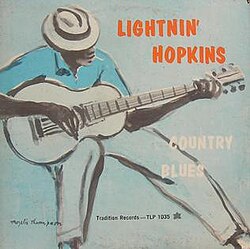
Country Blues, released by Tradition Records in 1959 as TLP 1035, arrived at the exact midpoint of the era when the American folk revival was generating new audiences for pre-war blues and bringing forgotten artists back to public attention. Robert Johnson had already been reissued on Columbia. Skip James, Son House, and Mississippi Fred McDowell would shortly be discovered (or rediscovered) by the researchers and enthusiasts who were systematically excavating the southern blues tradition. Samuel Charters's book The Country Blues — which shared this album's title and in whose wake the album appeared — was reshaping public understanding of where American popular music had come from.
Hopkins was not, strictly speaking, a forgotten artist in 1959. He had been recording commercially since 1946 and had produced dozens of sides for Aladdin, Gold Star, Modern, and other labels through the late 1940s and early 1950s. But the specific phase of his career that had sustained him commercially — the Houston jukebox and club circuit, the regional R&B market — had contracted in the mid-1950s as taste changed and commercial attention shifted toward the Chicago electric blues and the emerging rock and roll. By 1959, Hopkins was playing for small audiences in Houston, the large-scale recording career of his prime years effectively behind him.
What McCormick heard when he sat him down with a microphone was not a diminished artist scrambling for relevance but a fully mature musician with more than thirty years of performing experience, whose specific gifts — the idiosyncratic guitar style, the extemporaneous lyric invention, the conversational vocal approach — were not just intact but deepened by age and circumstance. Country Blues and its companion album Autobiography in Blues (both drawn from the same February 1959 sessions) captured Hopkins at precisely the right moment: experienced enough to have complete command of his art, and in circumstances stripped bare enough to reveal it without commercial mediation.
The Tradition Records liner notes, written by McCormick himself, described the setting with characteristic precision: "Houston's Third Ward is a tiny kingdom. Sam 'Lightnin' Hopkins is its prophet and jester." The formulation — prophet and jester simultaneously — captured the essential duality of Hopkins's performing personality: the man who could sing blues of genuine tragic depth and follow them immediately with something witty and absurd, the street-corner entertainer who was also, at his best, an artist of genuine lyric intelligence.
The Moment: Houston, 1959, and the Context of the Recording
To understand Country Blues, you need to understand what was happening in American music in early 1959 and what was happening specifically in Lightnin' Hopkins's life at that moment.
The folk revival was gathering momentum in ways that were beginning to affect the commercial viability of the acoustic blues. Harry Smith's Anthology of American Folk Music had been released on Folkways in 1952, its six albums of pre-war folk, blues, and country recordings creating the aesthetic foundation on which the folk revival would build. Samuel Charters was completing his book The Country Blues, which would be published later in 1959 and which would introduce a generation of readers to the blues musicians whose names had previously circulated only among specialist collectors. The same month that McCormick was recording Hopkins in Houston, Charters was in a different part of Houston recording Hopkins for the Folkways album (January 16, 1959) — a coincidence that speaks both to the surge of interest in Hopkins specifically and to the broader moment of the blues revival as a cultural phenomenon.
Hopkins himself was in a complicated position. He had not made a commercial recording in several years. The jukeboxes that had once sustained his regional commercial career were playing different music. His primary income came from playing the clubs and bars of Houston's Third Ward and Fifth Ward, the neighbourhoods where his reputation and his music kept him employed. He was, by various accounts, drinking heavily — the "bottle of gin" that Charters had used to persuade Hopkins to record for Folkways three weeks before the McCormick sessions was a detail that spoke to a pattern rather than an isolated incident.
But the drinking and the reduced commercial circumstances had not diminished his art. McCormick's instinct — which he described in the AllMusic account as seeking to capture "rough-edged performances that he felt were lacking from the bluesman's then-recent studio efforts" — was precisely right. The commercial studio recordings that Hopkins had been making through the early 1950s, with their professional backing bands and their commercial-R&B orientations, had given him a commercial platform while constraining the specific qualities of his music: the rhythmic irregularity, the extemporaneous lyric invention, the conversational intimacy that were most fully expressed when he was playing alone. The McCormick sessions removed all the commercial scaffolding and captured what remained.
The two session dates — February 16 and February 26, 1959 — were separated by ten days, giving McCormick two separate opportunities to record Hopkins in what the Wikipedia album entry describes as an "informal setting." The informality was not a technical limitation but a deliberate aesthetic choice: Hopkins had spent the previous few years making formal studio recordings that, in McCormick's assessment, failed to capture the essential quality of his music. By recording him informally, with minimal equipment and no commercial pressure, McCormick was betting that the result would be more rather than less commercially valuable.
He was correct. The fifteen tracks that would comprise Country Blues, drawn from these two sessions, represented Hopkins at his most unguarded and most fully himself — a quality that the folk revival audience was specifically seeking in its rediscovery of older blues artists, and that made the album immediately significant to the people who were paying attention to the direction American roots music was moving.
The Producer: Mack McCormick and His Vision
The figure responsible for Country Blues existing in the form it does — as a solo acoustic document rather than another backed recording, as an informal home capture rather than a formal studio session — was Robert "Mack" McCormick, the Houston-based folklorist whose role in the documentation of Texas blues was as significant as Alan Lomax's in the Delta and Chris Strachwitz's in California.
McCormick's background was in folklore and music research rather than the commercial record business, and his approach to recording Hopkins reflected this orientation. Where a commercial producer would have worried about the marketability of the recordings, about the presence of a backing band to give the music commercial appeal, about the running times and the production values that radio programmers demanded, McCormick was interested in something prior to all of these considerations: the authentic expression of a specific tradition by one of its most capable living practitioners.
The allmusic review of the album quotes McCormick's stated intent directly: "armed with nothing more than a single microphone mono tape recorder, folklorist Mack McCormick recorded Hopkins in an informal setting in hopes of catching some rough-edged performances that he felt were lacking from the bluesman's then-recent studio efforts." The phrase "rough-edged performances" was not a concession but a positive description — the roughness being the quality that commercial studio production had been sanding away, the quality that McCormick specifically wanted to restore.
His characterisation of Hopkins in the original liner notes — "Houston's Third Ward is a tiny kingdom. Sam 'Lightnin' Hopkins is its prophet and jester" — established the album's framing: this was music from a specific place, by a specific person who was deeply embedded in that place, and its meaning was inseparable from those specifics. The "prophet and jester" formulation was acute: it captured Hopkins's ability to move between the tragic and the comic, to deliver genuine emotional depth and then subvert it with wit, to maintain the dignity of the bluesman while refusing the earnestness that dignity sometimes demanded.
McCormick's other characterisation of Hopkins — preserved in the quote cited by musicologist Robert "Mack" McCormick himself in Hear My Black Dog Bark: "Hopkins is 'the embodiment of the jazz-and-poetry spirit, representing its ancient form in the single creator whose words and music are one act'" — situated him in the broadest possible tradition of the improvising artist, the troubadour for whom composition and performance were not separable activities but a single continuous act of making. This was the McCormick framing that gave Country Blues its significance beyond the commercial horizon of its 1959 release: not just another R&B artist captured on tape but a specific exemplar of a deep artistic tradition.
The technical equipment McCormick used — the single-microphone mono tape recorder that the allmusic description identifies — was primitive by professional standards but entirely adequate for its purpose. Mono recording captured everything in a single plane rather than separating the sonic elements across a stereo field, giving the recordings a focused, unified quality that suited the solo acoustic format. Hopkins's guitar and voice were simultaneously captured by the single microphone, the acoustic balance between the two determined by his own natural performing relationships rather than by any engineering decision. The result was a recording in which guitar and voice had the acoustic balance of a live performance, heard from the position of someone sitting in the same room.
The Musicians: Sam Hopkins, Alone and with a Friend
Country Blues was, in its essential form, a solo record. Sam "Lightnin'" Hopkins — vocal and guitar — was the entirety of the musical content on thirteen of the album's fifteen tracks. On two tracks, Luke "Long Gone" Miles provided vocal assistance, his voice joining Hopkins's in a manner that documented a spontaneous social performance rather than a planned musical collaboration.
Sam "Lightnin'" Hopkins was, by February 1959, one of the most completely individual guitar stylists in American music. His guitar technique — developed across thirty years of playing, from his early encounters with Blind Lemon Jefferson and Texas Alexander through his decades on the Houston club circuit — was immediately recognisable and essentially inimitable. His left hand, fretting the chords and single notes, operated with a deliberate, slightly unhurried quality that belied the rhythmic sophistication of what he was doing; his right hand, picking the strings with a thumb-and-fingers approach, produced bass notes and treble melodies in a configuration that suggested a more complete ensemble than a single acoustic guitar could logically provide.
The acoustic guitar on these sessions — its specific make and model not documented in the available record — was Hopkins in his most natural performing instrument context. His commercial recordings of the late 1940s and early 1950s had frequently used an electric guitar, and the amplification had given those recordings their specific commercial character. The acoustic guitar of the McCormick sessions placed him back in a tradition that ran to his earliest musical influences: Blind Lemon Jefferson playing for tips, Texas Alexander accompanying himself, the street-corner blues tradition of which Hopkins had been a part since childhood. The acoustic instrument's natural dynamics — louder and softer depending on how hard he struck the strings, responding directly to his physical touch without the electronic mediation of amplification — gave the recordings their specific expressive quality, the guitar's volume and tone changing as his mood and the music's demands changed.
His guitar tuning on these recordings was the standard tuning that he had always used, and his approach to the instrument was the combination of single-string runs, chord strums, and bass-note patterns that characterised his style at every stage of his career. The specific quality of his timing — the rhythmic irregularity that was either a personal idiosyncrasy or a sophisticated expressive tool depending on your perspective — was fully present on the acoustic recordings, the guitar's time floating around the underlying pulse in ways that followed the emotional contour of the lyric rather than the mechanical demands of a steady beat.
Luke "Long Gone" Miles is the only other musician credited on Country Blues, his "vocal assistance" on tracks 3 ("Baby!") and 5 ("Prison Blues Come Down on Me") documented in the original liner notes with the qualifier that places him firmly in the informal social context of the sessions rather than as a professional participant. Miles was a Houston blues singer and musician who was part of the same Third Ward musical world that Hopkins inhabited; his presence at the sessions reflected the social nature of those evenings rather than any commercial calculation. His voice on the two tracks where he participates adds a second human presence to what would otherwise be entirely solo performances, the two voices finding each other's harmonies with the casual ease of musicians who have played together many times.
Track-by-Track Analysis
Track 1: "Long Time" (Sam Hopkins)
Recorded: February 16 or 26, 1959 Duration: 1:36 Personnel: Lightnin' Hopkins (vocal, guitar)
The album's opener is also its shortest track — one minute and thirty-six seconds that function as an introduction and a statement of purpose rather than a fully developed blues performance. The brevity is itself characteristic of Hopkins's improvisational approach: when the song has said what it needs to say, it ends, regardless of what convention or commercial considerations might suggest about running time.
"Long Time" establishes the acoustic guitar and unaccompanied voice format that will define the album immediately and without apology. Hopkins's guitar enters with the rolling bass-note figure that characterises his accompaniment style, the thumb providing the rhythmic foundation while the fingers work the treble strings for melody. The lyric addresses the "long time" quality of some situation — separation, difficulty, waiting — with the compression that Hopkins consistently brought to his more meditative blues material.
The song's 1:36 running time would be commercially non-viable in any professional recording context; McCormick's willingness to include it reflects the documentary rather than commercial orientation of his project. On the album, it functions as a statement of the informality that defines what follows: these are performances shaped by musical logic rather than commercial calculation.
Track 2: "Rainy Day Blues" (Sam Hopkins)
Recorded: February 16 or 26, 1959 Duration: 3:06 Personnel: Lightnin' Hopkins (vocal, guitar)
The second track establishes the album's deeper emotional register. "Rainy Day Blues" is a slow, meditative performance in which Hopkins inhabits the specific depressive quality of a rainy day with the specificity that his best blues compositions consistently achieved. The rain is literal — a specific atmospheric condition producing a specific emotional response — and metaphorical simultaneously, as it has always been in the blues tradition.
The guitar here demonstrates the full range of Hopkins's acoustic approach: the bass lines walking steadily under the vocal, the treble notes picking out melodic comments between the lyric's phrases. The "rough-edged performance" quality that McCormick was specifically seeking is fully present: the recording has the texture of a real event rather than a professional production, the acoustic environment present in the sound in ways that give the guitar a physical warmth that studio processing would have filtered away.
McCormick's liner notes note that Hopkins "dwells on a momentary state of mind (Rainy Day Blues)" — a description that captures the specificity of his approach to the blues subject. This is not a general meditation on sadness but a specific report on a specific moment's feeling, and the specificity gives it its power.
Track 3: "Baby!" (Sam Hopkins)
Recorded: February 16 or 26, 1959 Duration: 3:05 Personnel: Lightnin' Hopkins (vocal, guitar); Luke "Long Gone" Miles (vocal assistance)
The first of the two tracks featuring Luke "Long Gone" Miles, "Baby!" shifts the album's emotional register from the meditative solitude of the opening tracks to something more socially animated. Miles's presence — unplanned, informal, the participation of a friend who happened to be present rather than a professionally arranged collaboration — gives the track the quality of a real social performance, the kind of singing-together that happened spontaneously in the Third Ward world Hopkins inhabited.
Miles's vocal assistance does not compete with Hopkins's lead but supplements it, the two voices finding their natural relationship in the way that musicians who know each other's approach can do without rehearsal. The "Baby!" of the title is a conventional blues address — the narrator speaking directly to a beloved, the exclamation point suggesting urgency or surprise — and Hopkins deploys it with the casual confidence of someone who has addressed this specific situation in song many times before.
Track 4: "Long Gone Like a Turkey Through the Corn (Long John)" (Sam Hopkins)
Recorded: February 16 or 26, 1959 Duration: 3:41 Personnel: Lightnin' Hopkins (vocal, guitar)
One of the album's most rhythmically assertive tracks, "Long Gone Like a Turkey Through the Corn" has the driving quality of the older narrative blues tradition — a song about movement, escape, and the freedom of someone who has left everything behind. "Long John" was a folk and blues character type: the man who runs when he should stay, who disappears when he's needed, whose disappearance is both a failure and a kind of freedom.
The guitar on this track has a more propulsive quality than the meditative pieces that precede it, Hopkins's right hand driving the rhythm with the kind of urgency that the song's subject demands. The running-away narrative — the lyric tracing the movements of someone trying to escape — finds its musical expression in the forward momentum of the guitar pattern, the song refusing to settle into the slower, more contemplative pace of the rainy day blues.
McCormick's liner notes observe that Hopkins "stages a capsule drama (Gonna Pull A Party)" — the reference to drama-making applies equally to this track, in which the narrative of flight is compressed into a few minutes of music with the efficiency of a storyteller who knows exactly how much detail a song requires.
Track 5: "Prison Blues Come Down on Me" (Sam Hopkins)
Recorded: February 16 or 26, 1959 Duration: 3:24 Personnel: Lightnin' Hopkins (vocal, guitar); Luke "Long Gone" Miles (vocal assistance)
The second Luke Miles appearance, and the album's most directly social document — two men sharing a blues about imprisonment, the subject drawn from the larger blues tradition of the prison farm and the chain gang but given Hopkins's specific, Texas-rooted treatment.
Prison blues were a constant theme in the Texas blues tradition, rooted in the specific reality of the Texas state prison farms — agricultural operations that used inmate labour in conditions that the blues had been documenting since the early twentieth century. The "prison blues come down on me" of the title describes a psychological condition as much as a literal circumstance: the feeling of confinement, of being subject to forces outside your control, that the prison farm image crystallised. Hopkins had personal experience of imprisonment — his mid-1940s incarceration at the Brazos Bottom prison farm had given him the material for several blues songs, and the emotional authenticity he brought to prison-themed material reflected this direct experience.
Miles's voice on this track has a slightly more prominent role than on "Baby!" — the two voices responding to each other in a manner that suggests a longer acquaintance with this specific song, as if they have sung it together before. The informal setting in which the song was recorded gives the dual vocal an appropriately unguarded quality, the two men singing for themselves and for each other rather than performing for an imagined audience.
Track 6: "Backwater Blues (That Mean Old Twister)" (Traditional, attributed to Bessie Smith/James Cox)
Recorded: February 16 or 26, 1959 Duration: 2:45 Personnel: Lightnin' Hopkins (vocal, guitar)
The album's only explicit engagement with the pre-war classic blues tradition, "Backwater Blues" was associated most closely with Bessie Smith's definitive 1927 recording — a performance that had become one of the canonical documents of the blues tradition's confrontation with natural disaster and its metaphorical resonances. Hopkins's version is not a cover in the conventional sense but an appropriation — he takes the song's essential subject matter (flooding, displacement, homelessness) and reframes it in his own musical and lyrical vocabulary.
The alternate title "That Mean Old Twister" suggests Hopkins's specific Texan relationship to natural disaster: where Smith's recording connected to the Mississippi River floods of 1927, Hopkins's version connects to the tornado and flood traditions of the Texas Gulf Coast, where severe weather was a recurring feature of life and a constant subject of concern in the communities he came from.
His guitar on this track has a spare, slightly ominous quality that suits the subject matter — the bass notes lower and more deliberate than on the more playful tracks, the melody in the treble strings carrying a weight that reflects the song's subject.
Track 7: "Gonna Pull a Party" (Sam Hopkins)
Recorded: February 16 or 26, 1959 Duration: 3:38 Personnel: Lightnin' Hopkins (vocal, guitar)
One of the album's more explicitly narrative tracks, "Gonna Pull a Party" is the "capsule drama" that McCormick identifies in his liner notes — a song that sets up a social situation and plays it out with the efficiency of a skilled storyteller. The party that Hopkins is planning is both a real social event and a symbolic assertion: I am going to have a good time, I am going to gather people around me, I am going to make music and joy despite whatever circumstances surround the decision to do so.
The track demonstrates Hopkins's gift for the dramatic scene-setting that distinguished his narrative blues from the more meditative or complaint-focused material elsewhere on the album. He moves through the preparation, the invitation, the anticipation, and the implied event itself with the compressed dramatic economy of someone who has told this kind of story many times and knows exactly what to include and what to leave out.
The guitar here has a lighter, more celebratory quality than on the blues of difficulty and pain — the picking style brighter and more forward-moving, reflecting the social energy of the song's subject.
Track 8: "Bluebird, Bluebird" (Sam Hopkins)
Recorded: February 16 or 26, 1959 Duration: 1:29 Personnel: Lightnin' Hopkins (vocal, guitar)
The album's second-shortest track at one minute and twenty-nine seconds, "Bluebird, Bluebird" is a fragment rather than a fully developed song — an impression, a brief lyrical statement addressed to the bluebird of the American folk and blues tradition. The bluebird as a messenger — carrying news from a distant person, or serving as a symbol of hope and possibility — was a recurring figure in the blues and folk traditions, and Hopkins's brief address to it has the quality of an improvised verse rather than a composed song.
The extreme brevity of the track is itself expressive — Hopkins says what needs to be said about the bluebird and moves on, the song's incompleteness part of its meaning. McCormick's willingness to include such brief fragments alongside the more fully developed pieces gave the album its quality of documentary completeness: this is a portrait of a musician playing, not a selection of his best commercial material.
Track 9: "See See Rider" (Ma Rainey)
Recorded: February 16 or 26, 1959 Duration: 3:10 Personnel: Lightnin' Hopkins (vocal, guitar)
The album's single track credited to a composer other than Hopkins, "See See Rider" was one of the canonical pieces of the classic blues tradition — associated most strongly with Ma Rainey, whose 1924 recording had established the song as a standard, and subsequently recorded by Leadbelly, Big Bill Broonzy, Louis Armstrong, and dozens of other artists. Hopkins's version placed him squarely within the tradition that the song represented: here was an artist who had absorbed the full history of the blues from its earliest commercial documentation, who could move between his own original compositions and the tradition's shared stock with equal facility.
His guitar approach on "See See Rider" is characteristically individualistic — this is Hopkins's version rather than a cover in any conventional sense, the song filtered through his specific rhythmic and harmonic sensibility until it sounds as much like him as anything original he might have written. The lyric's request to know the whereabouts of a departed lover — the "C.C. Rider" as a specific addressee or a metaphorical figure — is delivered with the conversational directness that Hopkins brought to all his material.
Track 10: "Worrying My Mind" (Sam Hopkins)
Recorded: February 16 or 26, 1959 Duration: 3:27 Personnel: Lightnin' Hopkins (vocal, guitar)
A slow blues in the meditative tradition of "Rainy Day Blues," "Worrying My Mind" explores the specific quality of obsessive, circular thought — the mind that cannot rest, that returns again and again to the same troubling subject. The "worrying" of the title is not general anxiety but specific emotional preoccupation, the mental equivalent of the physical nagging that the word's other sense describes.
Hopkins's guitar on this track has the deliberate, slightly hesitant quality that suited his slow blues best — notes placed where the music required them emotionally rather than where rhythmic regularity would demand them. The slight asymmetries in his timing are most audible on tracks like this one, where the slow tempo exposes the individual quality of each note's placement.
Track 11: "Till the Gin Gets Here" (Sam Hopkins)
Recorded: February 16 or 26, 1959 Duration: 1:02 Personnel: Lightnin' Hopkins (vocal, guitar)
At barely over a minute, "Till the Gin Gets Here" is the album's shortest track and one of its most characteristically Hopkins-esque performances — an improvised verse about waiting for alcohol, the casual relationship between drinking and music-making acknowledged with complete matter-of-factness. The "gin" of the title was not a metaphor but a literal fact: Hopkins's drinking was part of his performing world, the improvised verse acknowledging it with the humour and the casual self-awareness that distinguished his best comic blues material.
The track's brevity and its subject matter demonstrate the documentary quality of the McCormick sessions: Hopkins was playing for himself and for whoever was in the room, and what he played included fragments and improvisations as well as fully developed songs. "Till the Gin Gets Here" would not appear on a professionally prepared album by an artist managed for commercial success; its presence here is exactly the quality that McCormick was pursuing when he set up his single microphone and asked Hopkins to play.
Track 12: "Bunion Stew" (Sam Hopkins)
Recorded: February 16 or 26, 1959 Duration: 1:55 Personnel: Lightnin' Hopkins (vocal, guitar)
McCormick's liner notes identify "Bunion Stew" as a track in which Hopkins "reminisces of his family" — a biographical reading that gives the song's title (a vernacular term for a specific kind of stew that appears in the family cooking tradition) its specific personal resonance. The song has the quality of a recalled domestic detail rather than a blues complaint or a narrative construction — a fragment of family memory, preserved in two minutes of music.
The informality of the subject matter — the family kitchen, the specific dish, the memory of a domestic circumstance — connects this track to the tradition of blues as autobiography. Hopkins's best songs were consistently rooted in specific personal experience, and "Bunion Stew" is an especially specific example: a song about a dish, about a family, about a particular way of life that the singer is documenting through music.
Track 13: "You Got to Work to Get Your Pay" (Sam Hopkins)
Recorded: February 16 or 26, 1959 Duration: 2:30 Personnel: Lightnin' Hopkins (vocal, guitar)
McCormick's liner notes observe that "the recording process itself becomes the subject of veiled comment in You Got To Work To Get Your Pay" — a typically acute observation that points to the self-reflexive quality of Hopkins's improvised blues. The "work" of getting paid was the work of making music; the "pay" was whatever compensation the performance generated; and the statement that you had to work for it acknowledged both the commercial reality of the musician's life and the effort that genuine blues performance required.
The track demonstrates Hopkins's characteristic gift for the simultaneously literal and metaphorical statement — a sentence that means exactly what it says and also means something beyond what it says, the layer of additional meaning creating a resonance that simple literalism could not achieve.
Track 14: "Go Down Old Hannah" (Traditional)
Recorded: February 16 or 26, 1959 Duration: 3:30 Personnel: Lightnin' Hopkins (vocal, guitar)
The album's engagement with the Texas work song and prison song tradition reaches its deepest and most explicit point in "Go Down Old Hannah" — the traditional song about the Texas sun (Hannah) whose blinding heat tormented chain gang workers and farm labourers across the Gulf Coast and the Delta. The "old Hannah" — a folkloric term for the sun derived from some process of personification no longer fully traceable — was the presence that workers addressed when they had nothing else to address: the relentless, impersonal source of the heat that made their labour even more brutal.
McCormick's liner notes note that Hopkins "talks to the sun in a work song of the Texas river bottoms (Go Down Old Hannah)" — a description that situates the song precisely in its geographic and historical context. The Texas river bottoms — the farm land along the Brazos and Trinity and Colorado rivers, where prison farm work and sharecropping work had shaped the African American experience for generations — were the specific environment from which this song came.
Hopkins's guitar on "Go Down Old Hannah" has an almost hymn-like quality — slower and more deliberate than the driving rhythmic tracks, the notes given space to sustain, the overall texture more sparse and more weighted. It is the album's most directly historical performance, the one most clearly rooted in a tradition that preceded Hopkins's own lifetime.
Track 15: "Hear My Black Dog Bark" (Sam Hopkins)
Recorded: February 16 or 26, 1959 Duration: 3:49 Personnel: Lightnin' Hopkins (vocal, guitar)
The album's longest track and its closer, "Hear My Black Dog Bark" is both the most personally specific and the most lyrically accomplished performance on the album. McCormick's liner notes identify it as a song in which Hopkins "sees himself as a cuckold" — a reading supported by the song's lyrical content, in which the black dog's barking announces the presence of a stranger and the narrator's response to that announcement exposes both his jealousy and his helplessness.
The "black dog" as a blues symbol carried multiple resonances: the literal animal that served as a warning system, the supernatural association of black dogs with bad luck and death in folk tradition, and the specific emotional state that the dog's barking announced. Hopkins's treatment of the image combined these resonances without separating them — the song worked simultaneously as a literal narrative (someone is in my yard, my dog is barking, I know what this means) and as an emotional metaphor (jealousy is my black dog, and it is always barking).
At 3:49, the track gave Hopkins the room to develop the narrative fully, his guitar establishing and sustaining the slow, slightly ominous groove that suited the lyric's subject, his vocal moving between the direct narrative of the verses and the more reflective quality of the chorus. The album ends on this note of ambiguous emotional resolution — the situation remains unresolved, the black dog continues to bark, and the blues of it are precisely the blues of situations that cannot be fixed by direct action.
The Album's Place in Hopkins's Career and in Blues History
Country Blues occupies a specific and irreplaceable position in both Hopkins's discography and in the broader history of the blues revival. The allmusic review by Cub Koda captured the essential quality: "here is Lightnin' truly in his element, playing for his friends and his own enjoyment, minus the commercial overlay of the times or the imposed 'folk blues' posturing of his later acoustic recordings."
The distinction between this recording's naturalness and the "imposed 'folk blues' posturing" of subsequent recordings is a significant one. As the folk revival created demand for acoustic blues recordings, many artists found themselves performing in a stylised "folk blues" mode that acknowledged their audience's expectations rather than their own natural performing inclinations. Country Blues predates the full development of this market pressure, and its recordings caught Hopkins before the folk revival's specific demands had time to shape his performing approach. The result was something more direct, more personal, and more musically honest than many of the acoustic blues recordings that followed it in his catalogue.
The Amazon description of the album captures the commercial and critical consensus with characteristic concision: "Lightnin's first two albums for Tradition (AUTOBIOGRAPHY IN BLUES and COUNTRY BLUES) were just that -- down and dirty, out and out blues, honest and true -- perfect documents of Lightnin's style, songs...Country Blues showcases Hopkins in his element, vividly coloring in the standards and originals with emotion, energy, longing, and wiry wit."
The "wiry wit" is perhaps the most important quality the Amazon description identifies — the quality that distinguished Hopkins from the earnest, tragic blues archetype that the folk revival sometimes expected its rediscovered artists to embody. Hopkins was simultaneously capable of the deepest emotional engagement and the most deflating comic perspective, and the combination gave his music a humanity that pure tragedy could not have achieved. The "prophet and jester" of McCormick's liner notes was a more complete description than "prophet" alone would have been, and Country Blues documented both dimensions with equal authenticity.
For more information on Lightnin' Hopkins please see this article Lightnin' Hopkins: The Texas Troubadour and Prolific Blues Poet
Selected Discography
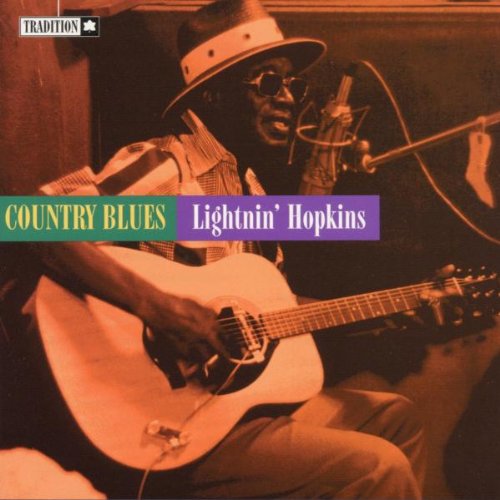
Country Blues (Tradition TLP 1035) was released in 1959 by Tradition Records. Produced, recorded and edited by Mack McCormick. Recorded February 16 and 26, 1959, in Houston, Texas. Personnel: Sam "Lightnin'" Hopkins (guitar, vocals); Luke "Long Gone" Miles (vocal assistance on tracks 3 and 5). All compositions by Sam "Lightnin'" Hopkins except "See See Rider" (Ma Rainey) and "Go Down Old Hannah" (Traditional). Cover design by Mozelle Thompson. Running time: 42:07. The sessions also produced the companion album Autobiography in Blues (Tradition TLP 1040, 1960). The Penguin Guide to Blues Recordings awarded Country Blues three stars. AllMusic gave the album a positive review.