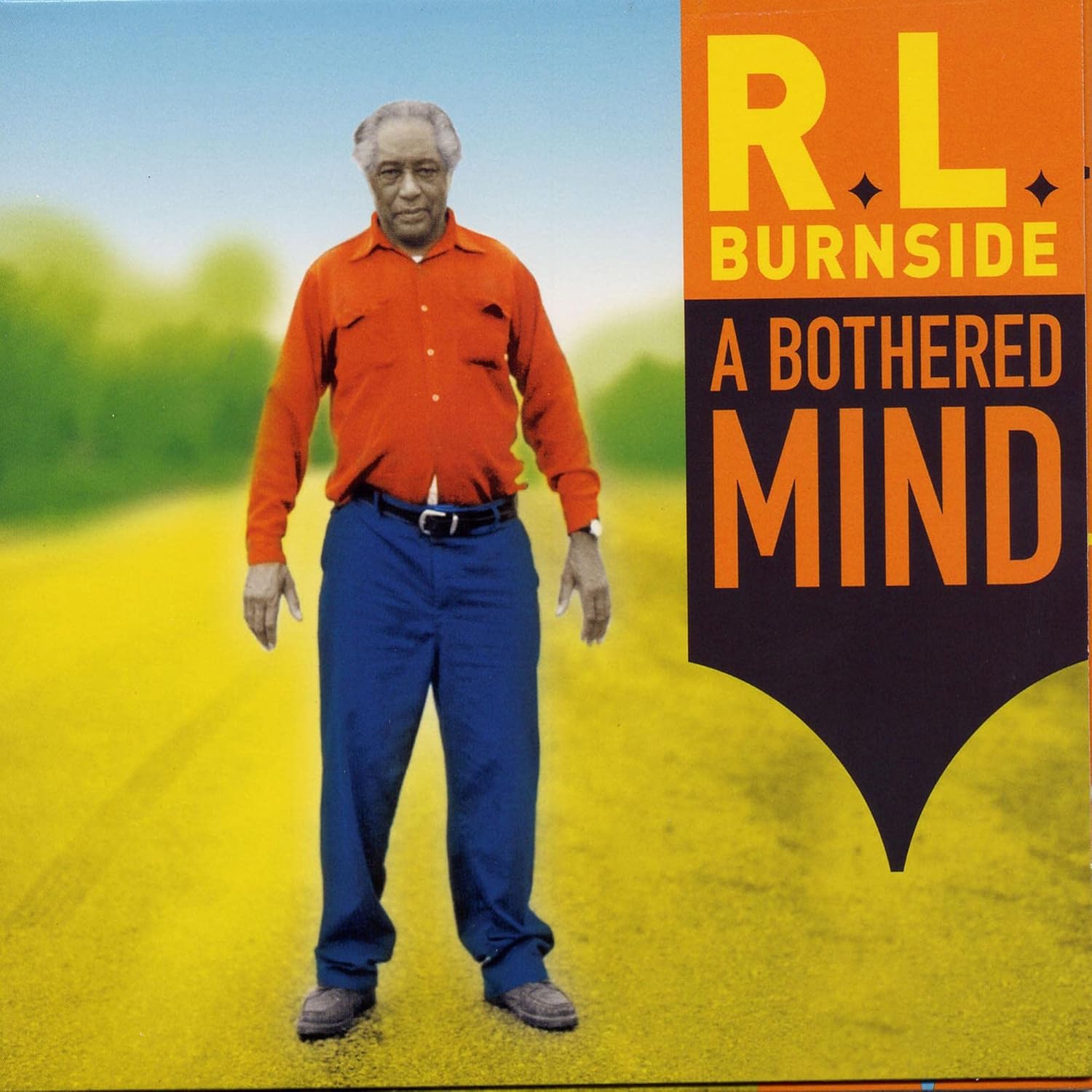
1. Album Overview
| Detail | Information |
|---|---|
| Artist | R.L. Burnside |
| Album Title | A Bothered Mind |
| Label | Fat Possum Records |
| Catalog Number | FP 80362-2 |
| Release Date | 2004 |
| Recorded | 2003–2004 |
| Genre | Blues, Electric Blues, Experimental Blues, Hip-Hop Blues |
| Producer | Tom Rothrock |
| Engineer | Dennis Herring (tracking); Tom Rothrock (mixing) |
2. Background & Context
A Bothered Mind was released in 2004 on Fat Possum Records and stands as one of the final studio albums recorded by R.L. Burnside (November 23, 1926 – September 1, 2005) before his death. By the time of its recording in 2003–2004, Burnside was in his late seventies and in declining health, having suffered a heart attack in 2001. Despite his physical frailty, his artistic voice remained formidable, and the album captures a late-career statement that is simultaneously raw, reflective, and experimental.
The album continues the trajectory that Fat Possum had been building with Burnside since the early 1990s — fusing his North Mississippi Hill Country blues tradition with modern production sensibilities. Where the 2000 collaboration with Jon Spencer (A Ass Pocket of Whiskey, 1996) had leaned into garage-rock energy, A Bothered Mind takes a more measured, atmospheric approach, layering Burnside's guitar and vocals over hip-hop-influenced beats, loops, and sparse electronic textures courtesy of producer Tom Rothrock.
Burnside was born in Harmontown, Mississippi, and spent most of his life in the Hill Country region around Holly Springs, Marshall County. His style — rooted in the hypnotic, trance-like drone of the North Mississippi tradition — differed markedly from the Delta blues of Robert Johnson or the Chicago electric blues of Muddy Waters. He learned guitar from Fred McDowell and was deeply influenced by John Lee Hooker. His music is characterized by a relentless one-chord or two-chord vamp, minimal chord changes, and a propulsive, rhythmically driving feel that proved remarkably compatible with hip-hop production aesthetics.
By 2003, Burnside had achieved a level of late-career recognition unusual for an elderly Mississippi bluesman, with his Fat Possum recordings finding audiences among indie rock and alternative music fans far beyond the traditional blues market. A Bothered Mind was recorded with this expanded audience in mind while remaining true to Burnside's voice and style.
3. Production & Sessions
The album was recorded in 2003 and early 2004, with sessions taking place primarily in Memphis, Tennessee, and at Rothrock's Los Angeles-area studio. The recording process was shaped significantly by Burnside's health situation — sessions were kept relatively short to accommodate his energy levels, and the production approach was designed to build around Burnside's core guitar and vocal performances rather than demanding extensive overdub work from him.
Tom Rothrock's production method involved recording Burnside's guitar and vocals as the foundational bed, then constructing rhythmic and atmospheric layers around those performances. This approach — building beats and textures beneath a live blues performance — had been pioneered on earlier Fat Possum releases and reached a refined form on A Bothered Mind. The result is a record that feels intimate and live despite its electronic embellishments.
The sessions were relatively lean in terms of personnel. Burnside's grandson, Cedric Burnside, who had long served as his drummer in live performances, contributed to the sessions, maintaining the family musical lineage that had always been central to Burnside's world. Burnside's son-in-law Calvin Jackson and other members of the extended musical family circle also participated in some capacity.
Fat Possum founder Matthew Johnson was involved in the project's oversight, continuing his long relationship with Burnside that had begun when Johnson essentially rediscovered Burnside for a wider audience in the early 1990s. Johnson's philosophy at Fat Possum had always been to document these Mississippi bluesmen authentically rather than polish them for mainstream consumption, and A Bothered Mind reflects that ethos even within its more produced framework.
The mixing was handled by Rothrock, who balanced the organic blues elements against the programmed and electronic components. The mastering gave the album a warm but present sound that suits both the intimacy of Burnside's voice and the punch of the rhythmic tracks.
4. The Producer
Tom Rothrock is a Los Angeles-based record producer and musician whose career spans alternative rock, folk, and blues. He is perhaps best known for producing Beck's landmark debut album Mellow Gold (1994) and for his long association with Elliott Smith, producing Either/Or (1997) and XO (1998). Rothrock co-founded Bong Load Custom Records with Rob Schnapf, and the two frequently collaborated as a production team throughout the 1990s.
Rothrock's involvement with R.L. Burnside and Fat Possum represented a notable intersection of his indie-rock world and the raw Mississippi blues tradition. His approach to producing Burnside was sympathetic and minimalist — he understood that Burnside's power lay in the hypnotic repetition and raw vocal delivery, and that the production's job was to frame and enhance rather than transform. On A Bothered Mind, Rothrock employed programmed beats, loops, and atmospheric textures in a way that recalls hip-hop production aesthetics while never overwhelming Burnside's guitar and voice.
Rothrock had previously worked with Burnside on Wish I Was in Heaven Sitting Down (2000), which gave him a strong understanding of how to navigate the creative territory between Burnside's traditional approach and contemporary production. By A Bothered Mind, the working relationship was well-established, and Rothrock was able to work efficiently within the constraints imposed by Burnside's health.
His production philosophy — rooted in capturing authentic performances and building sympathetic sonic environments around them — made him an ideal collaborator for a musician like Burnside, whose power resided entirely in the organic truth of his playing and singing rather than in technical virtuosity or studio craft.
5. The Musicians
R.L. Burnside — Guitar, Vocals
Rueben Lee Burnside (November 23, 1926 – September 1, 2005) was the central creative force on the album. Born in Harmontown, Mississippi, Burnside spent most of his life in the Hill Country region around Holly Springs. He learned guitar primarily from Fred McDowell and developed a style rooted in the North Mississippi Hill Country tradition — hypnotic, repetitive, drone-based, and rhythmically relentless. His guitar work on A Bothered Mind is characteristically spare and powerful, built on open tunings and a driving, percussive right-hand attack. His voice, weathered by age and hard living, carries an authority and emotional weight that no amount of production can manufacture.
Burnside's guitar style on this album reflects the Hill Country approach: minimal chord movement, heavy emphasis on rhythm and groove, and a trance-inducing repetition that aligns naturally with the loop-based production Rothrock employs. He plays primarily electric guitar throughout, with a tone that is simultaneously raw and resonant.
Cedric Burnside — Drums, Percussion
Cedric Burnside (born 1978) is R.L. Burnside's grandson and one of the most important figures in the continuation of the North Mississippi Hill Country blues tradition. He began playing drums in his grandfather's band as a teenager and became his primary live drummer for many years. On A Bothered Mind, Cedric's drumming provides the human rhythmic anchor that grounds the electronic and programmed elements. His style is loose, swinging, and deeply rooted in the Hill Country feel — less metronomic than a session drummer, more conversational, responding to his grandfather's guitar in real time. Cedric has since become a celebrated artist in his own right, winning multiple Grammy Awards and continuing to perform and record extensively.
Additional Session Contributors
The album's production involved additional musicians and programming contributors working under Rothrock's direction. These included bass contributions and additional rhythmic and atmospheric elements provided by session players and programming. The lean personnel roster reflects both the intimacy of the project and the practical constraints of recording with an elderly musician in declining health. Fat Possum's house network of Memphis and Mississippi musicians provided a pool of potential contributors, though Burnside's own family remained the core live musical presence.
6. The Songwriters
The songwriting credits on A Bothered Mind reflect the traditional and semi-traditional nature of the Hill Country blues repertoire, with most compositions attributed to R.L. Burnside himself, either as sole author or in collaboration.
R.L. Burnside
Burnside's songwriting — if it can be called that in a conventional sense — operates in the tradition of blues composition where melody, lyric, and structure are often inherited from the broader folk-blues tradition and then personalized through repeated performance. Many of his "compositions" are variants of traditional themes, reworked through his own experience and vocal personality. Songs about hard luck, hard women, hard drinking, and the grinding difficulties of Mississippi life recur throughout his catalog. On A Bothered Mind, the lyrics carry the weight of a man reflecting on a long and difficult life, and several tracks have an elegiac quality that may reflect Burnside's awareness of his own declining health.
Traditional Sources
Several tracks on the album draw on traditional blues themes and structures that predate Burnside's own recordings. In the Hill Country tradition, the line between composition and traditional material is often deliberately blurred, with performers treating the entire tradition as a shared resource to be drawn upon, adapted, and personalized. Burnside was deeply versed in this tradition and brought it to bear throughout the album.
Tom Rothrock (Production Compositions)
On tracks where the programmed beats and loops form a significant structural component, Rothrock's contribution to the composition is acknowledged. The interplay between Burnside's traditional material and Rothrock's contemporary production framework creates a kind of co-authorship that reflects the hybrid nature of the album.
7. Track-by-Track Breakdown
A Bothered Mind contains ten tracks that span Burnside's characteristic thematic territory — hard luck, desire, defiance, and mortality — filtered through Rothrock's contemporary production lens. Below is a detailed breakdown of each track.
Track 1: "A Bothered Mind"
Writer: R.L. Burnside Duration: approx. 4:00
The title track opens the album with one of Burnside's most direct and personal statements. Built on his characteristic hypnotic guitar vamp, the track establishes the album's central mood: a weary, reflective quality that suggests a man taking stock of his life. The production is relatively spare here, with Rothrock allowing Burnside's guitar and voice to dominate while adding subtle low-end reinforcement and atmospheric texture. Cedric Burnside's drumming is present but restrained, providing pulse without overwhelming the intimate feel. The lyric dwells on worry, unease, and the weight of accumulated experience — "a bothered mind" as both literal state and metaphor for a life lived hard. The track sets the tone for an album that is simultaneously a late-career artistic statement and, in retrospect, a valediction.
Track 2: "It's Bad You Know"
Writer: R.L. Burnside Duration: approx. 3:30
One of the more groove-driven tracks on the album, "It's Bad You Know" features a stronger rhythmic presence, with Rothrock's production bringing the beat forward. The guitar work is characteristically circular and hypnotic. The lyric operates in the classic blues mode of understatement — "it's bad you know" as a catch-all acknowledgment of life's difficulties. The track has a slightly harder edge than the opener, and the interplay between the programmed rhythmic elements and Cedric Burnside's live drumming is particularly effective here, creating a layered rhythmic texture that feels both contemporary and rooted.
Track 3: "Shuck Dub"
Writer: R.L. Burnside / Traditional Duration: approx. 3:45
"Shuck Dub" draws on the deeper well of Hill Country traditional material, with a title and feel that evokes the agricultural world of the Mississippi Hill Country. The guitar pattern here is particularly drone-like, built on a repeated figure that barely varies over the course of the track — a pure expression of the Hill Country trance aesthetic. Rothrock's production adds a subtle low rumble and atmospheric reverb that deepens the hypnotic effect. The lyric references work, land, and the rhythms of rural Mississippi life. This is one of the album's most purely traditional-feeling tracks, and one of its most effective.
Track 4: "Skinny Woman"
Writer: R.L. Burnside Duration: approx. 3:20
A more playful entry in the classic blues tradition of songs about women. "Skinny Woman" has a lighter touch than many of the album's tracks, with a guitar figure that is almost jaunty in its delivery. The lyric is in the tradition of the blues compliment/complaint — describing a woman's physical attributes with a mixture of admiration and exasperation. The production here is relatively unadorned, letting Burnside's personality come through clearly. It provides an effective tonal contrast to the heavier, more brooding tracks around it.
Track 5: "I Want You By Me"
Writer: R.L. Burnside Duration: approx. 4:10
One of the album's more emotionally direct tracks, "I Want You By Me" is a straightforward expression of desire and longing. The guitar work is slightly more melodic than on some other tracks, and Burnside's vocal delivery has a tenderness that is moving in the context of his age and health. Rothrock's production adds a warm, enveloping quality — the beat is present but soft, and the overall sonic texture is more intimate than on the harder-driving tracks. In the context of the album as a whole, the track reads as a late-life love song, and its emotional simplicity is one of its greatest strengths.
Track 6: "Rollin' and Tumblin'"
Writer: Traditional (attributed variously to Muddy Waters, Hambone Willie Newbern, and others) Duration: approx. 4:30
Burnside's take on one of the most recorded songs in the blues canon. "Rollin' and Tumblin'" has been performed by virtually every major blues artist from Muddy Waters (who recorded a definitive version in 1950) to Cream (on Fresh Cream, 1966) to Bob Dylan (on Modern Times, 2006). Burnside's version is firmly in the Hill Country tradition — the chord structure is simplified almost to a single-chord drone, and the emphasis is entirely on rhythm and feel rather than melodic development. Rothrock's production gives this track a particularly heavy bottom end, and the result is one of the album's most powerful moments. Cedric Burnside's drumming is at its most forceful here. The track demonstrates how the Hill Country approach can strip a song down to its rhythmic and emotional essence.
Track 7: "Goin' Down South"
Writer: R.L. Burnside Duration: approx. 3:50
A road song and a departure song, "Goin' Down South" taps into the deep blues tradition of movement and migration. The lyric references leaving, traveling, and the pull of the South as both home and burden. The guitar work is driving and propulsive, with a forward momentum that suits the lyric's theme of movement. Rothrock's production adds a subtle rhythmic underpinning that enhances the sense of motion. The track is one of the album's most straightforwardly bluesy moments, with less electronic embellishment than some others, and it benefits from that directness.
Track 8: "Someday Baby"
Writer: Traditional / R.L. Burnside Duration: approx. 3:40
Another track rooted in traditional blues material, "Someday Baby" (also known in various forms as "Worried Life Blues" and associated with Big Maceo Merriweather's 1941 recording) is given the full Hill Country treatment. Burnside strips away the conventional chord changes and rebuilds the song around his characteristic drone approach. The lyric — about a faithless lover and the hope that circumstances will eventually change — is delivered with a world-weary resignation that suits Burnside's voice perfectly at this stage of his life. The production is measured and effective.
Track 9: "Let My Baby Ride"
Writer: R.L. Burnside Duration: approx. 4:00
A track with a slightly more assertive, even aggressive energy, "Let My Baby Ride" features some of Burnside's most forceful guitar work on the album. The title and lyric play with the double entendre tradition that runs through the blues, but the overall feel is more about raw power than humor. Rothrock's production brings the rhythm up here, and the track has a harder, more contemporary edge. Cedric Burnside's drumming is particularly propulsive, and the combination of live drums and programmed elements is at its most seamlessly integrated.
Track 10: "Lovin' Blues"
Writer: R.L. Burnside Duration: approx. 4:20
The album closes with one of its most meditative and affecting tracks. "Lovin' Blues" is slow, spacious, and deeply felt — a closing statement that brings the album full circle to the reflective mood of the title track. Burnside's guitar playing here is at its most stripped-down, and his vocal performance is one of the most emotionally resonant on the record. Rothrock's production is appropriately restrained, with the atmospheric elements providing a gentle sonic bed rather than a rhythmic drive. As a closing track, it functions almost as an elegy — for lost love, for a life lived, for the blues tradition itself. In retrospect, knowing that Burnside would die in September 2005 just over a year after the album's release, the track carries an additional weight that is impossible to ignore.
Buy This Album on Amazon
 A Bothered Mind by R L Burnside
8. Legacy & Influence
A Bothered Mind occupies a distinctive place in the Fat Possum catalog and in the broader story of late-twentieth and early-twenty-first century blues. It represents the final chapter of a remarkable late-career renaissance that Fat Possum engineered for Burnside beginning with Bad Luck City (1991) and continuing through Too Bad Jim (1994), A Ass Pocket of Whiskey (with Jon Spencer, 1996), Mr. Wizard (1997), Come On In (1998), and Wish I Was in Heaven Sitting Down (2000).
The Fat Possum Story
Fat Possum Records, founded by Matthew Johnson in Oxford, Mississippi in 1991, built its early catalog almost entirely on the North Mississippi Hill Country blues tradition. Johnson's approach was to document these musicians — many of them elderly, many of them largely unknown outside their local communities — with minimal interference, capturing them in their natural environment and releasing the results to an audience that was largely outside the traditional blues market. The label's roster included R.L. Burnside, Junior Kimbrough, T-Model Ford, Cedric Burnside, and others, and its influence on the rediscovery of this tradition cannot be overstated.
Burnside was Fat Possum's most commercially successful artist, and his collaborations with Jon Spencer and the subsequent work with Rothrock brought him to the attention of audiences who might never have encountered traditional Mississippi blues. A Bothered Mind was the culmination of this trajectory.
Influence on Contemporary Blues and Beyond
The album's fusion of Hill Country blues with hip-hop production aesthetics anticipated and influenced a broader trend toward genre-blending in blues and roots music. Artists such as Gary Clark Jr., Cedric Burnside (in his solo work), and various hip-hop producers who have sampled blues recordings all reflect, in different ways, the creative possibilities that Burnside and Rothrock explored on this album.
Critical Reception
A Bothered Mind was well received by critics, who recognized it as a worthy late-career statement from one of the most important figures in the Hill Country blues tradition. Reviewers noted the effectiveness of Rothrock's production approach and the remarkable endurance of Burnside's artistic voice despite his physical decline. The album was understood, even at the time of its release, as likely being one of Burnside's final recordings.
Burnside's Death and Posthumous Recognition
R.L. Burnside died on September 1, 2005, in Memphis, Tennessee, approximately eighteen months after A Bothered Mind was released. He was 78 years old. His death was mourned widely in the blues community and beyond, and his Fat Possum recordings — with A Bothered Mind among the most significant — have continued to grow in stature. He is now recognized as one of the essential figures in American roots music, and the North Mississippi Hill Country blues tradition he embodied has been carried forward most directly by his grandson Cedric Burnside and by the broader community of musicians he influenced.
The Hill Country Tradition
A Bothered Mind is, among other things, a document of the North Mississippi Hill Country blues tradition at a particular moment in its history — filtered through contemporary production but rooted in an approach to music-making that stretches back to the early twentieth century and beyond. The tradition's emphasis on hypnotic repetition, minimal harmonic movement, and raw emotional directness proved remarkably durable and adaptable, and the album demonstrates why: there is a universality to Burnside's music that transcends era, genre, and geography. It speaks directly to something fundamental in human experience, and no amount of time or production can diminish that power.
Sources: Fat Possum Records discography; liner notes, A Bothered Mind (2004); blues scholarship including Robert Gordon's "It Came from Memphis" (1995); Living Blues magazine; and discographic research by David Evans and Jim O'Neal.