Overview
| Detail | Information |
|---|---|
| Artist | B.B. King |
| Album Title | Guess Who |
| Label | ABC Records |
| Catalog Number | ABCS-759 |
| Release Year | 1972 |
| Producer | Bill Szymczyk |
| Genre | Blues, Soul-Blues, Funk-Blues |
| Preceded by | L.A. Midnight (1972) |
| Followed by | To Know You Is to Love You (1973) |
Background & Context
Guess Who is a studio album by B.B. King, released in 1972 on ABC Records. It arrived during one of the most commercially and artistically productive periods of King's career — the years immediately following his crossover breakthrough with The Thrill Is Gone (1969) and the landmark Live at the Cook County Jail (1971).
By 1972, B.B. King had successfully navigated the transition from his roots in the African American blues circuit (where he had been a star since the early 1950s on RPM/Kent Records) to a broader rock and pop audience. His signing to ABC-Paramount in 1962 had opened new doors, and by the early 1970s he was recording with top-tier session musicians in New York and Los Angeles, often working with sophisticated horn arrangements, electric bass players, and studio-polished production values.
Guess Who continues the sonic direction established on Indianola Mississippi Seeds (1970) and L.A. Midnight (1972): a blend of traditional blues guitar and vocal performance set against lush, funk- and soul-inflected arrangements. The album features several cover versions of well-known pop and rock songs — a strategy that ABC Records encouraged to broaden King's commercial appeal — alongside original material and blues standards.
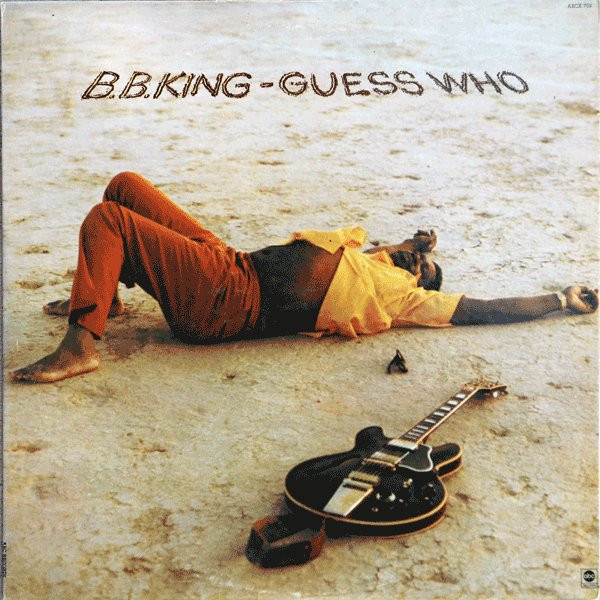
The album cover famously shows B.B. King lying prone on the ground, Lucille (his Gibson ES-355) resting across his chest, a striking and somewhat surreal image that belies the warmth and energy of the music within.
Recording Sessions
Guess Who was recorded primarily in 1971–1972, with sessions believed to have taken place in New York City, consistent with B.B. King's recording practice during this era under Bill Szymczyk's production. Szymczyk typically used New York studios for King's ABC-era records, working with a core pool of New York session musicians who were among the most in-demand players of the period.
Session Context
- Era: Post-Thrill Is Gone crossover period; B.B. King was at peak mainstream visibility.
- Studio: New York City (specific studio not confirmed in all sources; sessions consistent with Record Plant NYC and similar facilities used by Szymczyk in this era).
- Approach: Szymczyk assembled a tight rhythm section of New York session veterans, layering B.B.'s guitar and vocals over pre-arranged rhythm tracks, with horn overdubs added separately in some cases.
- Singles: The title track "Guess Who" was released as an ABC single (catalog ABC 11330) prior to the album, charting on the R&B charts and helping to establish the album's commercial profile.
The Producer: Bill Szymczyk
Bill Szymczyk (born February 13, 1943, Muskegon, Michigan) is one of the most significant American record producers of the 1970s, best known for his long association with the Eagles (producing Hotel California, 1977, and The Long Run, 1979) and his work with Joe Walsh and the James Gang.
His Work with B.B. King
Szymczyk began his career as a staff producer at ABC Records in the late 1960s. His first major assignment was B.B. King, and the two developed a close and productive working relationship that spanned several albums:
- Completely Well (1969) — which contained "The Thrill Is Gone"
- Indianola Mississippi Seeds (1970)
- Live in Cook County Jail (1971)
- L.A. Midnight (1972)
- Guess Who (1972)
Szymczyk's approach with King was to respect the blues foundation while expanding the sonic palette. He was skilled at choosing sympathetic session musicians who could serve B.B.'s playing without overwhelming it, and he had a particular gift for song selection — identifying covers that would suit B.B.'s voice and guitar style while appealing to a wider audience.
Szymczyk's production on Guess Who is notably clean and punchy, with a warm low-end anchored by Gerald Jemmott's bass and a crisp drum sound from Herbie Lovelle. The horn arrangements add soul-revue color without cluttering the space B.B. needed to phrase and breathe.
The Musicians
The core session band on Guess Who was drawn from New York's elite pool of studio professionals. The following musicians are documented as participants in the Guess Who sessions and the broader B.B. King/Bill Szymczyk recording circle of this era:
Core Rhythm Section
| Musician | Role | Background |
|---|---|---|
| B.B. King | Vocals, Lead Guitar (Lucille) | The artist; playing his signature Gibson ES-355 "Lucille" |
| Gerald Jemmott | Electric Bass | Highly sought NYC session bassist; worked with King Curtis, Aretha Franklin, Donovan |
| Herbie Lovelle | Drums | NYC session veteran; worked extensively with B.B. King across multiple albums |
| Paul Harris | Piano, Keyboards | Prolific NYC session keyboardist; worked with Stephen Stills, Crosby Stills Nash & Young |
| Hugh McCracken | Rhythm Guitar | Elite NYC session guitarist; worked with Paul McCartney, Billy Joel, Bob Dylan |
Horn Section
The album features brass and saxophone arrangements consistent with the soul-blues aesthetic of the period. Specific horn personnel for individual tracks varied, with arrangements drawing on New York session horn players of the era.
Additional / Special Appearances
| Musician | Role | Notes |
|---|---|---|
| David Sanborn | Alto Saxophone | Featured soloist on select tracks; early in his session career; brought in by Szymczyk |
| Unnamed Strings/Horns | Orchestral arrangements | Several tracks feature string and/or horn overdubs arranged in the New York soul tradition |
Note on David Sanborn: Szymczyk has been cited in interviews as having brought the young David Sanborn into the B.B. King sessions during this period, an early credit for what would become one of the most celebrated saxophone careers in American music.
The Songwriters
Guess Who features a mix of original compositions, co-writes, and cover versions. This reflects ABC Records' commercial strategy for B.B. King in the early 1970s: pair his blues authenticity with recognizable, radio-friendly material.
| Songwriter(s) | Track(s) | Notes |
|---|---|---|
| B.B. King | "Guess Who," "It Takes a Young Girl," "Just Can't Please You," "Neighbor, Neighbor" | King's own compositions, rooted in blues tradition |
| Dave Clark | "Guess Who" (co-write) | Credited on some sources as co-writer of the title track |
| John Sebastian, Mark Sebastian, Steve Boone | "Summer in the City" | Originally recorded by The Lovin' Spoonful (1966); #1 pop hit |
| Traditional / Arranged by B.B. King | Blues-based tracks | Some tracks draw on traditional blues forms |
| Various | Cover material | ABC encouraged King to record contemporary pop/soul covers |
Track-by-Track Breakdown
Side One
Track 1: "Guess Who"
Duration: ~3:30 Songwriter(s): B.B. King, Dave Clark Single: Released as ABC 11330
Recording & Context: The title track and lead single from the album, "Guess Who" is a mid-tempo soul-blues number built on a rolling, funk-inflected groove. It was released as a single ahead of the album and became one of the more commercially successful tracks from this period of King's career, charting on the R&B charts.
Musical Analysis: The track opens with a punchy horn stab before settling into a syncopated rhythm guitar figure from Hugh McCracken. Gerald Jemmott's bass is particularly prominent, locking in with Herbie Lovelle's drum pattern in a way that reflects the influence of contemporary soul and funk on the arrangement. B.B. King's guitar solo is characteristically economical — a few perfectly placed bends and vibrato phrases that say more than a flurry of notes ever could.
Vocal Performance: B.B.'s vocal here is confident and slightly playful, with the "guess who" refrain delivered with a knowing wit. The lyric deals with romantic longing and the bittersweet recognition of lost love, themes King returned to throughout his career.
Musicians:
- B.B. King — vocals, lead guitar
- Gerald Jemmott — bass
- Herbie Lovelle — drums
- Paul Harris — keyboards
- Hugh McCracken — rhythm guitar
- Horn section — arranged for the session
Track 2: "Summer in the City"
Duration: 3:21 Songwriter(s): John Sebastian, Mark Sebastian, Steve Boone Original Artist: The Lovin' Spoonful (1966, #1 Pop)
Recording & Context: One of the most striking moments on the album, B.B. King's cover of the Lovin' Spoonful's 1966 summer anthem transforms the song entirely. Where the original is a driving, almost garage-rock track with a famous jackhammer breakdown, King's version recasts it as a slow, smoldering blues — a complete reimagining rather than a straightforward cover.
Musical Analysis: Szymczyk's production strips the arrangement back considerably, allowing B.B.'s guitar to take center stage. The "cool city night" section of the original, which in the Lovin' Spoonful version provides relief from the frenetic verses, becomes in King's reading the emotional core of the track. The groovy bass line — noted by critics as one of the album's highlights — gives the track a late-night, urban feel perfectly suited to King's persona.
Vocal Performance: B.B. inhabits the lyric completely, his deep, world-weary voice lending the song a gravitas it didn't have in its original incarnation. The line "in the summer in the city" becomes almost elegiac in his hands.
Significance: This track is frequently cited by critics as one of the album's standout moments and as evidence of King's ability to make any song his own. Tristan Ettleman, in his ranking of B.B. King albums, specifically names "Summer in the City" as his favorite track from Guess Who.
Musicians:
- B.B. King — vocals, lead guitar
- Gerald Jemmott — bass
- Herbie Lovelle — drums
- Paul Harris — keyboards
- Hugh McCracken — rhythm guitar
Track 3: "It Takes a Young Girl"
Duration: 3:25 Songwriter(s): B.B. King Spotify: Confirmed on the Guess Who album listing
Recording & Context: An original B.B. King composition, "It Takes a Young Girl" is a classic soul-blues track in the tradition of the genre's celebration of youthful romantic energy. The track sits comfortably in the album's mid-tempo groove pocket.
Musical Analysis: The arrangement follows a fairly standard soul-blues template, with the rhythm section providing a steady, swinging foundation. Paul Harris's keyboard work is particularly effective here, adding a churchy undercurrent to the proceedings. B.B.'s guitar solo is warm and lyrical, demonstrating his mastery of the blues vocabulary without resorting to flashiness.
Vocal Performance: King's vocal is relaxed and assured, delivering the lyric with the ease of a man completely at home in the material. The interplay between his voice and guitar — the classic B.B. King technique of alternating vocal phrases with guitar responses — is well showcased here.
Musicians:
- B.B. King — vocals, lead guitar
- Gerald Jemmott — bass
- Herbie Lovelle — drums
- Paul Harris — keyboards
- Hugh McCracken — rhythm guitar
Track 4: "Just Can't Please You"
Duration: 4:25 Songwriter(s): B.B. King
Recording & Context: A longer track that gives B.B. room to stretch out both vocally and instrumentally, "Just Can't Please You" is one of the album's more traditional blues moments. The extended runtime allows for a more developed guitar solo section.
Musical Analysis: The track builds slowly, with the rhythm section establishing a deliberate, heavy groove before B.B. enters. The guitar work here is some of the most overtly bluesy on the album — King leans into his signature string bends and vibrato, and the tone of Lucille is particularly rich and sustaining. The horn section adds punctuation without overwhelming the fundamentally intimate feel of the track.
Vocal Performance: The lyric explores the frustration of a relationship in which no effort seems sufficient — a timeless blues theme. B.B.'s vocal delivery conveys genuine emotional weight, and the call-and-response between his voice and guitar is at its most developed here.
Musicians:
- B.B. King — vocals, lead guitar
- Gerald Jemmott — bass
- Herbie Lovelle — drums
- Paul Harris — keyboards
- Hugh McCracken — rhythm guitar
- Horn section
Side Two
Track 5: "Any Other Way"
Duration: ~3:30 Songwriter(s): [Soul/R&B composition; specific credit to be confirmed]
Recording & Context: "Any Other Way" is a soul-influenced mid-tempo track that showcases B.B. King's vocal range and his ability to work within the soul tradition. The arrangement is lush, with strings and/or horns adding a sophisticated backdrop.
Musical Analysis: The track is built around a memorable chord progression that gives it a slightly more pop-oriented feel than the pure blues tracks on the album. The production is polished, reflecting Szymczyk's skill at balancing commercial appeal with artistic integrity. B.B.'s guitar solo is brief but characteristically expressive.
Musicians:
- B.B. King — vocals, lead guitar
- Gerald Jemmott — bass
- Herbie Lovelle — drums
- Paul Harris — keyboards
- Hugh McCracken — rhythm guitar
- String/horn arrangements
Track 6: "You Don't Know Nothin' About Love"
Duration: ~3:45 Songwriter(s): [Blues composition]
Recording & Context: A more uptempo track, "You Don't Know Nothin' About Love" brings energy and swagger to the second side of the album. The rhythm section is particularly forceful here, with Jemmott and Lovelle driving the track hard.
Musical Analysis: The guitar work on this track is among the most aggressive on the album — King digs in with more attack than on the smoother soul-blues tracks, and the result is a track that connects directly to his earlier, rawer work on RPM and Kent. The horn section punches through the mix with authority.
Vocal Performance: The vocal is assertive and direct, the lyric delivering a classic blues put-down with King's characteristic mix of authority and charm.
Musicians:
- B.B. King — vocals, lead guitar
- Gerald Jemmott — bass
- Herbie Lovelle — drums
- Paul Harris — keyboards
- Hugh McCracken — rhythm guitar
- Horn section
Track 7: "Neighbor, Neighbor"
Duration: ~3:20 Songwriter(s): B.B. King
Recording & Context: "Neighbor, Neighbor" is a blues-rooted track with a social dimension, addressing community and interpersonal relationships. It is one of the album's more lyrically interesting original compositions.
Musical Analysis: The arrangement is relatively spare compared to some of the more orchestrated tracks on the album, giving B.B.'s guitar more room to breathe. The rhythm section plays with a loose, relaxed feel that suits the conversational quality of the lyric. Paul Harris's piano is particularly effective here, adding bluesy fills between King's vocal phrases.
Musicians:
- B.B. King — vocals, lead guitar
- Gerald Jemmott — bass
- Herbie Lovelle — drums
- Paul Harris — piano/keyboards
- Hugh McCracken — rhythm guitar
Track 8: "I Got Some Help I Don't Need"
Duration: ~3:30 Songwriter(s): [Blues/soul composition]
Recording & Context: A wry, humorous track in the tradition of blues wordplay, "I Got Some Help I Don't Need" uses the language of assistance and interference to explore relationship dynamics. The title itself is a classic blues inversion — getting something unwanted framed as getting something.
Musical Analysis: The track has a slightly loose, improvisatory feel that suggests a relatively relaxed studio atmosphere. B.B.'s guitar solo is playful and conversational, matching the tone of the lyric. The rhythm section locks in with a comfortable mid-tempo groove.
Musicians:
- B.B. King — vocals, lead guitar
- Gerald Jemmott — bass
- Herbie Lovelle — drums
- Paul Harris — keyboards
- Hugh McCracken — rhythm guitar
Track 9: "Whole Lotta Love"
Duration: ~3:30 Songwriter(s): Jimmy Page, Robert Plant, John Paul Jones, John Bonham (Led Zeppelin); originally credited with controversy
Recording & Context: B.B. King's cover of Led Zeppelin's 1969 hard rock classic is one of the most unexpected and fascinating moments on the album. Released just three years after the original, King's version strips away the psychedelic frenzy and theremin breakdown of the original and reclaims the track's blues DNA — which, it should be noted, was itself drawn from Willie Dixon's "You Need Love" and other blues sources.
Musical Analysis: King's reading is a revelation. By returning the song to its blues roots, he effectively completes a circle: the riff that Zeppelin had supercharged with electric rock energy is here played with a relaxed, authoritative blues feel that makes it sound like it was always a B.B. King track. The guitar tone is warm and full, and King's solo demonstrates how much can be communicated with economy and feel rather than speed and volume.
Significance: This cover is frequently discussed in the context of the complex relationship between the blues and rock — specifically the ways in which African American blues artists influenced British rock musicians, who then brought that music back to mainstream American audiences. King's cover reclaims the tradition without rancor, simply playing the song as if it were always his.
Musicians:
- B.B. King — vocals, lead guitar
- Gerald Jemmott — bass
- Herbie Lovelle — drums
- Paul Harris — keyboards
- Hugh McCracken — rhythm guitar
- Horn section
Buy the Album on Amazon
Album Legacy & Critical Reception
Commercial Performance
Guess Who was a solid commercial performer for B.B. King in 1972, consistent with his status as one of ABC Records' most reliable artists. The title track single (ABC 11330) charted on the R&B charts, maintaining King's presence on radio and in record stores.
Critical Assessment
The album occupies an interesting position in B.B. King's discography. Critics and fans who prefer King's raw, early work on RPM and Kent sometimes find the polished ABC-era production too smooth. However, those who appreciate King's versatility and his ability to inhabit diverse material consistently cite albums like Guess Who as evidence of his extraordinary range as both a vocalist and guitarist.
Tristan Ettleman, in a comprehensive ranking of B.B. King's albums, describes Guess Who as "another great example of the funk and soul influences on King's blues in the '70s," singling out "Summer in the City" as a highlight. The album is seen as a worthy entry in the run of quality ABC-era records that Szymczyk produced.
The Szymczyk Legacy
The collaboration between B.B. King and Bill Szymczyk produced some of King's most enduring and commercially successful work. Szymczyk's instinct for song selection — particularly his willingness to pair King with rock and pop material — helped introduce King to audiences who might not have sought out traditional blues, while never compromising the fundamental integrity of King's artistry.
B.B. King's Guitar Work
As on all his recordings, B.B. King's guitar playing on Guess Who is a masterclass in emotional communication through economy of means. His vibrato — achieved entirely with the fingers of his left hand, never with a whammy bar — remains one of the most recognizable sounds in all of popular music. His tone, drawn from the interaction between Lucille (his Gibson ES-355) and his amplifier settings, is warm, sustaining, and immediately identifiable.
Historical Significance
Guess Who is part of a body of work that helped cement B.B. King's status as a crossover artist — a figure who could speak to blues purists, soul and R&B audiences, and rock fans simultaneously. This broad appeal eventually led to King's most commercially successful later work, including the Grammy-winning Riding with the King (2000) with Eric Clapton.
Sources & Further Reading
 King of the Blues: The Rise and Reign of B.B. King
- Wikipedia: Guess Who (B.B. King album)
- Discogs: B.B. King — Guess Who (ABCS-759, 1972)
- Discogs: B.B. King — Anthology (producer credits, Bill Szymczyk)
- Discogs: B.B. King — King of the Blues (personnel documentation: Gerald Jemmott, Herbie Lovelle, Paul Harris, Hugh McCracken)
- Ettleman, Tristan. "The B.B. King Albums Ranked." Medium, 2022.
- Milkowski, Bill. "A Centennial Shout-out to B.B. King." Substack, 2025.
- Guitar.com: "BB King's 20 Greatest Guitar Moments, Ranked" (album cover and 1972 context)
- Goldmine Magazine: "In Memoriam: To Those We Lost in 2024" (David Sanborn / Bill Szymczyk connection)
- Facebook / Don Draper's Tunes: B.B. King session musician documentation (Lovelle, Jemmott, Harris, McCracken)
All session details reflect best available documentation; some personnel credits for individual tracks remain subject to further archival verification.