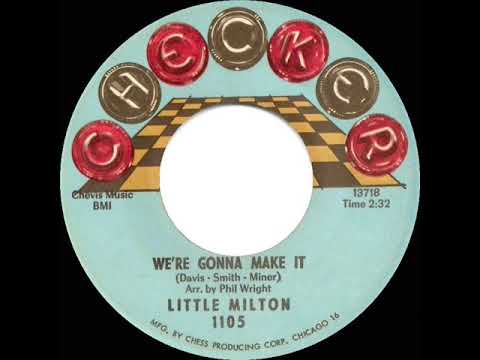
"We're Gonna Make It" is a landmark 1965 R&B/soul-blues hit by Little Milton (James Milton Campbell Jr., 1934–2005), marking a commercial peak and stylistic evolution for the Mississippi-born singer-guitarist on the Chess/Checker label. The uplifting anthem resonated during the Civil Rights era as a song of resilience and hope.
Recording Session
The track was recorded in Chicago around early-to-mid 1965 at Chess Studios (or associated facilities) for the Checker subsidiary. It was part of sessions that blended blues with emerging soul elements, helping Little Milton move beyond straight blues toward a broader audience. The album We're Gonna Make It (Checker, 1965) compiled these sides.
Producer: Billy Davis (also known as a songwriter/arranger) played a central role, collaborating closely with Milton to craft the blues-soul fusion. Leonard and Phil Chess provided overall label oversight, typical of Chess productions. Arranger Phil Wright contributed to the horn-heavy, polished sound.
The sessions reflected Chess's efficient approach: tight, live-feeling recordings with professional session players, emphasizing groove and emotional delivery. Milton's stinging guitar and soulful baritone were front and center.
Songwriters
The song was written by Gene Barge, Billy Davis, Raynard Miner, and Carl William Smith. This team specialized in soulful, anthemic material for Chess artists. The lyrics speak of overcoming hardship ("We may not have a cent to pay the rent... But we're gonna make it"), turning personal and societal struggles into a message of perseverance—perfectly timed for the mid-1960s.
Musicians (Personnel)
Exact full credits for the session are typical of the era (not always fully documented), but the sound features:
- Little Milton – vocals, guitar (his signature stinging, B.B. King-influenced leads)
- Horn section (arranged for punchy, soulful brass)
- Rhythm section with bass, drums, and likely piano/organ for the groove
- Background vocals for the gospel-tinged uplift
The production had a professional, big-city soul polish while retaining blues grit—horns, tight rhythm, and Milton's emotive delivery.
"We're Gonna Make It" masterfully fuses Chicago blues grit with 1960s Southern soul elegance, creating a hybrid sound that was both commercially accessible and emotionally authentic. At its core, the song is a mid-tempo soul ballad (roughly 110–120 BPM) built on a warm, rolling groove that emphasizes resilience and communal uplift rather than raw Delta lament.
The track opens with a inviting, gospel-tinged introduction—subtle piano or organ chords and a steady rhythm section—before Milton's rich, resonant baritone enters with conversational verses detailing everyday struggles ("We may not have a cent to pay the rent / But we're gonna make it..."). The chorus explodes into an anthemic declaration, layered with background vocals that add church-like call-and-response energy, reinforcing the song's message of perseverance.
Milton's vocal and guitar performance is central: his voice—deep, soulful, and slightly husky—conveys weary optimism, drawing from blues shouters and gospel traditions while anticipating Southern soul stylists like Otis Redding or Bobby Bland. His stinging, hollow-body guitar (often a Gibson ES-series) delivers sharp, expressive fills and single-note lines with B.B. King-inspired bends, vibrato, and phrasing. These guitar interjections act as "responses" to the vocal lines, adding tension and release without overpowering the arrangement.
Arrangement and production: Producer Billy Davis and arranger Phil Wright crafted a polished yet funky backdrop. Key elements include:
- Rhythm section: Tight, swinging bass and drums provide a danceable pulse with subtle shuffle undertones rooted in blues.
- Horns: Punchy brass (trumpets and saxes) deliver stabs and swells for dramatic emphasis, a hallmark of mid-60s soul.
- Key and structure: Likely in a major key (around A or B♭), the harmony uses straightforward I-IV-V progressions with soulful extensions, avoiding complex jazz changes. The modal feel in transitions and the building dynamics create a sense of journey from hardship to hope.
- Production polish: Chess/Checker engineering captured natural warmth with good separation—horns bright and cutting, rhythm fat, and Milton's voice upfront. The overall sound is professional and radio-ready while retaining blues authenticity.
Lyrically and musically, it functions as a secular gospel anthem: personal struggles (rent, hardship) become metaphors for broader societal challenges during the Civil Rights Movement. The repetitive, sing-along chorus makes it participatory and empowering. Its length (around 2:40–3:00) is tight for singles, with dynamic builds that reward repeated listens. This blues-soul fusion influenced later artists and helped define Little Milton's trademark style for decades.
Chart Performance and Success
"We're Gonna Make It" was a major breakthrough. Released in spring 1965, it topped the Billboard Hot R&B Singles chart for multiple weeks (including May 1–21) and crossed over to the Billboard Hot 100, peaking at #25. This made it Little Milton's biggest hit and one of Chess Records' most successful R&B releases of the era (their first R&B #1 since Chuck Berry's "Sweet Little Sixteen" in 1958).
The single's success propelled the album We're Gonna Make It (Checker, 1965), which reached #3 on the R&B album chart and #101 on the Pop albums chart. Follow-up "Who's Cheating Who?" also hit the R&B Top 5, cementing Milton's momentum. Its crossover appeal—reaching pop audiences during a time when Black artists faced barriers—highlighted the growing mainstream acceptance of soul music. The song's optimistic message resonated amid civil rights advancements, boosting its cultural impact and airplay on both R&B and pop stations.
This commercial triumph validated Milton's shift toward soul-blues and sustained his career through subsequent labels like Stax and Malaco. It remains a staple in blues and soul compilations, symbolizing hope and resilience.
Other Versions and Covers
- Millie Jackson covered it on her 1982 album Hard Times.
- Reggae artist Max Romeo recorded a version with The Aggrovators.
- It appears on various compilations and has been reissued (e.g., Acoustic Sounds vinyl series). Milton himself revisited soul-blues territory throughout his career, but this remains his signature hit.
Legacy
"We're Gonna Make It" was Little Milton's biggest hit, topping the R&B charts for weeks in 1965 and giving Chess its first R&B #1 in years. It solidified his shift to a blues-soul hybrid and crossed over to pop audiences. The song became an anthem of hope amid civil rights struggles and economic hardship, resonating with Black audiences.
Milton continued with hits like "Who's Cheating Who?" and later Stax/Malaco work, but this track defined his commercial peak and influence on Southern soul-blues. It endures on playlists, reissues, and as a testament to Chess Records' role in bridging blues and soul. Little Milton's legacy as a versatile vocalist-guitarist owes much to this era-defining recording.
Suggested Listening
 Buy from Amazon We're Gonna Make It