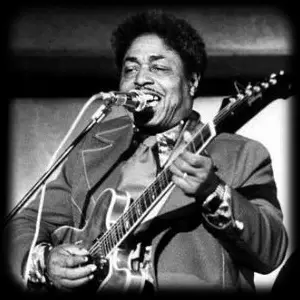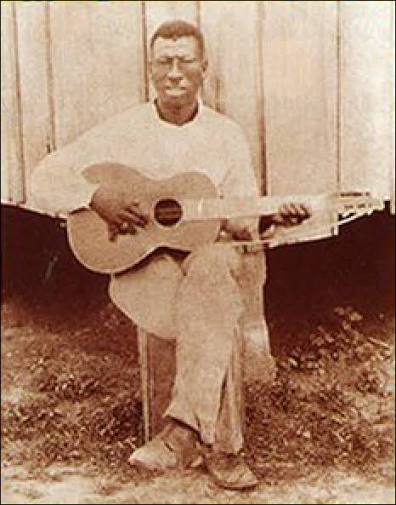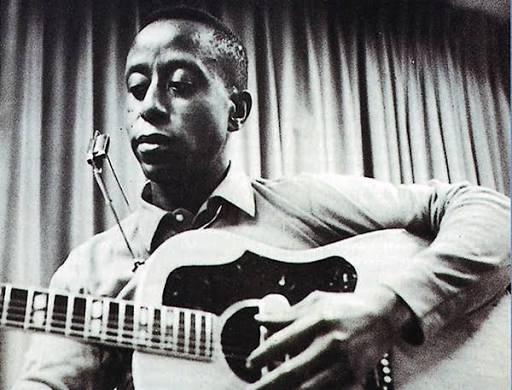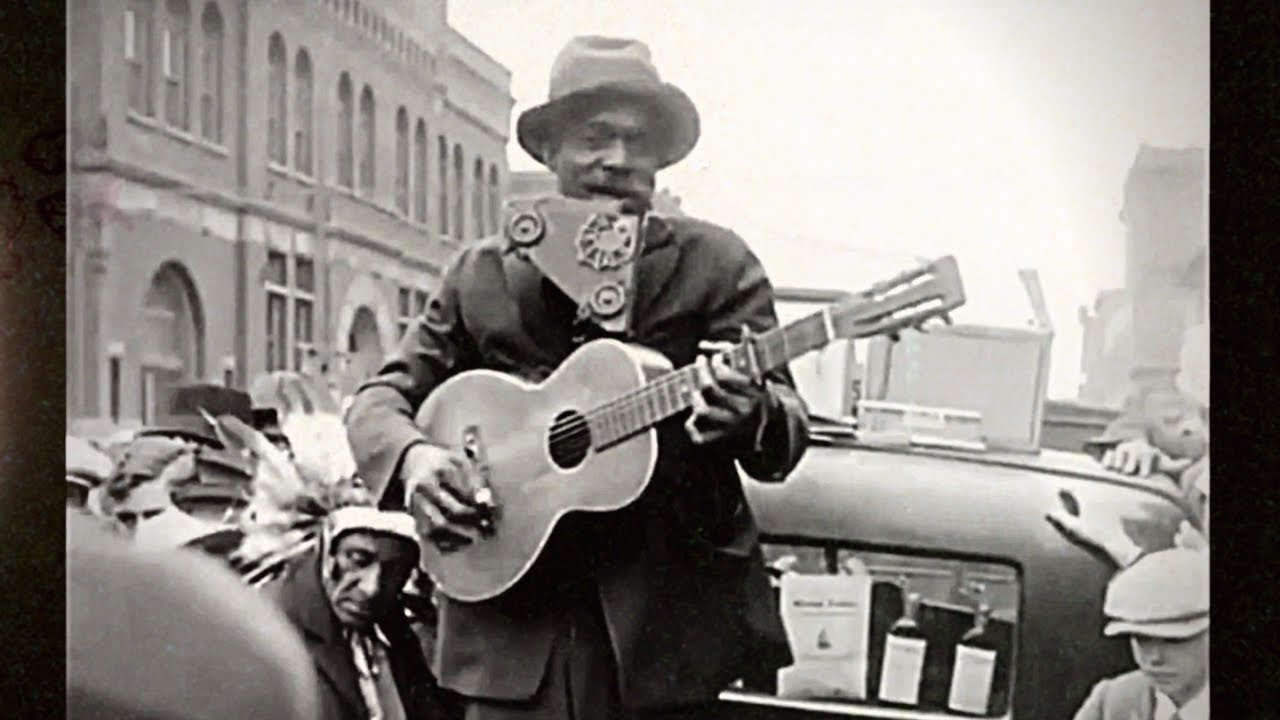
He broke the rules on purpose.
Most bluesmen build songs like houses — twelve bars, three chords, a story that lands on the turnaround right where you expect it. John Lee Hooker tore that blueprint up. He dragged time behind him like a heavy suitcase. He talked more than he sang. He stomped a wooden board so hard the microphone mistook his foot for a drummer, and he built entire records out of one chord that refused to sit still. For more than fifty years that sound traveled — from the cotton fields around Vance and Tutwiler, Mississippi, through the nightclubs on Hastings Street in Detroit, into folk-revival coffeehouses, onto British stages that would go on to invent a new kind of rock, and finally into a late-life coronation in California, where the same voice once leased out under fake names sat beside Carlos Santana, Bonnie Raitt, and Van Morrison like it had always belonged there.
Writing about Hooker for people who already love the blues isn't introducing a stranger. It's sitting with a musician who stays just out of reach, no matter how many anthologies and tribute albums pile up. He's everywhere and nowhere at once. "Boogie Chillen'" is a founding document of postwar electric blues, and no two versions of it agree with each other. "Boom Boom" is a standard that younger bands still treat as a sure thing, yet the original is full of small, stubborn choices that cover bands sand smooth without noticing. He recorded under so many names, for so many companies that cheated him as standard practice, that a complete discography isn't really a list. It's a weather system.
So here's an attempt to walk through that weather: the life, the records, the style, the shadow he left behind.
A Birth Date That Would Not Stay Put
Hooker gave August 22, 1917 as his birthday, and most reference books still print it. Census sheets and Social Security papers disagree. Some researchers push the date earlier, closer to 1912. Some put the birth in Tutwiler, Tallahatchie County; others say Clarksdale, in Coahoma County; still others say Glendora.
He was the youngest of a large family — eleven children, by the most common count — born to William Hooker, a sharecropper and Baptist preacher, and Minnie Ramsey. In that house, the blues counted as trespassing. Spirituals were fine. The devil's music was not.
That rule didn't hold. His parents split while he was still small. Minnie later married Will Moore, a local guitarist whose playing Hooker would spend the rest of his life pointing to as the root of everything he did. Moore wasn't famous. He played a strain of country blues built on the one-chord drone — closer to North Mississippi hill country than to the three-chord Delta style of Charley Patton and Son House. Hooker insisted, and never once backed off it, that his own style was "identical" to Moore's. Whether that's literally true matters less than what it reveals: Hooker never framed his sound as an invention. He framed it as an inheritance.
There were other teachers, too. Tony Hollins, who was courting one of Hooker's sisters, handed the boy his first real guitar and left behind songs Hooker would later remake as his own — "When My First Wife Left Me" traces straight back to a Hollins record. Charley Patton reportedly visited the house to see Moore play. Whether the child picked up Patton's stomp firsthand or just absorbed the rumor of it, the air in that house was already thick with guitar. Hooker also built the instrument every poor kid of that era built: inner-tube rubber nailed to a barn wall, one string pulled tight enough to speak.
Then he left. The story — told with the same loose chronology as the birth date — is that he ran off at fourteen and never saw his mother or stepfather again. Memphis came first: Beale Street, ushering at the New Daisy Theatre, house parties, a city already overloaded with guitarists competing for the same corners. A teenager with a borrowed style and zero reputation could vanish there, and commercially, he did. Cincinnati came next — factory work by day, gospel groups by night, the Fairfield Four and a group called the Big Six among them, plus juke joints and rent parties that paid in coins and whiskey. Biographers tend to skip the gospel years. That's a mistake. The pacing in a Hooker vocal — the way a line gets worried until the room finally answers — owes as much to the church he wasn't supposed to leave as to the jukes he wasn't supposed to enter.
The Great Migration wasn't an abstraction here. It was bus tickets and factory gates. In 1943 he landed in Detroit and found work at the Ford Motor Company. The war plants needed hands. Hastings Street needed a guitar player loud enough to cut through the noise. He rarely spoke of Mississippi with much sentiment — the historical marker in Vance, in fact, is more nostalgic about the Delta than he usually was. He'd taken what he needed from home: Moore's drone, Hollins's songs, a clear sense of what a day's labor actually cost. He left the rest behind.
Hastings Street and the Invention of a City Sound
Detroit in the 1940s wasn't Chicago. No Chess Records yet, no South Side club circuit turning into a brand. What it had was auto money, a Black entertainment strip along Hastings, and a reputation as a piano town — guitarists were scarce. Hooker, still playing acoustic, bought an electric just to be heard over the room, and that single decision rewired everything he'd carried up from Mississippi. The drone got heavier. The foot stomp — later miked on a plywood board — turned into a second instrument. The voice, already low and half-spoken, found a new grain against the amplifier.
He was working as a janitor and gigging clubs when record-store owner Elmer Barbee took an interest and pointed him toward Bernard Besman at Sensation Records. Besman had an ear for atmosphere. He leased sides to the Bihari brothers at Modern Records in Los Angeles, and in 1948 Modern put out a record that rearranged Hooker's life. One side was "Sally Mae." The other was "Boogie Chillen'."
"Boogie Chillen'" is autobiographical the way a dream is autobiographical. A boy tells his mother he's going to boogie-woogie whether she likes it or not. He walks down Hastings Street. He hears a guitar ringing out. There's barely a form to speak of — one chord, a walking bass line that's more suggestion than structure, a vocal sliding between talk and moan, and that stomp, steady as a factory press. It hit number one on the R&B chart and became one of the best-selling Black records of 1949. The hit let Hooker quit the mill for good. T-Bone Walker, the elegant Texas modernist, reportedly gave him an electric guitar as a gift. The country boy from Vance was now a professional whose entire job was finding new ways to say the same true thing.
What came next was a flood. "Hobo Blues" and "Hoogie Boogie" both charted. "Crawlin' King Snake" — a song with deep folk roots that Big Joe Williams and others had already worked over — became a Hooker signature, and later a landmark for the Doors and generations of bar bands after them. In 1951, "I'm in the Mood" hit number one R&B, crossed onto the pop chart, and sold in the millions. It's a study in controlled heat: whispered vocal, hovering guitar, a sexual tension that never quite breaks. Miles away from "Boogie Chillen'" in every respect — and proof that Hooker wasn't just a stomper. He could make a room lean in and hold its breath.
The Pseudonym Years
The 1950s music business paid Black blues singers as little as it could get away with, and it got away with plenty. Hooker fought back the only way he fully controlled: volume of output. Under contract to one label, he'd walk into a competitor's studio the same week and cut sides under names that fooled nobody who was actually listening — and everybody who was signing checks. Texas Slim. John Lee Booker. John Lee Cooker. Birmingham Sam. Johnny Williams. Delta John. The Boogie Man. Little Pork Chops. The aliases read like a census of a man trying to eat. He cut sides for Modern, Sensation, Chess, Fortune, King, Deluxe, Regent, Staff, Acorn, Gone, and others. He was probably the busiest blues artist recording in the early 1950s, full stop.
These weren't the tidy three-hour union sessions later decades got used to. Hooker was illiterate in the ordinary sense and fluent in the studio sense — he made up lyrics on the spot, stretched or crushed a bar line to match his breath, his mood, whatever the moment demanded. Backup musicians expecting a downbeat where a downbeat usually lives often got marooned instead. That's why so much of the early catalog is basically solo work: guitar, voice, foot. When a second guitar or harmonica shows up, you can sometimes hear that player hunting for the one.
Collectors have spent lifetimes untangling this period. The Ace and Classics reissue programs. The various "Complete" box sets that are never quite complete. The 1949 Detroit house recordings that Gene Deitch captured on a home machine and that didn't surface for half a century. All of it points to one simple fact: Hooker treated a recording studio the way a country preacher treats a tent. You show up. You open your mouth. You don't wait for permission. The Deitch tapes — acoustic, close-miked — are especially valuable because they catch the pre-electric grammar underneath the Detroit roar. Moore's drone is right there. So is proof of how little Hooker actually needed to sound like himself.
Vee-Jay, "Dimples," and the Making of a Standard
By the mid-1950s the wild-west era of tiny independent labels was giving way to slightly more organized companies, and Hooker found a more stable — if still imperfect — home at Vee-Jay in Chicago. Vee-Jay already had Jimmy Reed, whose lazy shuffle was the other great one-chord religion of the era, and the label knew how to build a small band around a singer without smothering him. Most listeners meet Hooker through his Vee-Jay sides first, because those are the ones radio and later CD compilers could actually track down.
"Dimples," cut in 1956, is a masterclass in economy. The guitar figure works as a pop hook and a blues trance at once. The lyric is just a glance across a room. When Britain reissued the record in 1964, it hit the Top 40 there — proof a Detroit nightclub song could wait eight years and still arrive right on time. "I Need Some Money," from around the same period, walks a line Barrett Strong's "Money (That's What I Want)" would later make famous; whether the borrowing was direct or just atmospheric, the kinship is audible. "No Shoes," from 1960, states poverty flat, no self-pity attached: a man who can't afford footwear and won't dress the fact up. "It Serves Me Right to Suffer" sits at the other pole — guilt and hunger braided into a slow burn that Van Morrison never quite got over.
Then came "Boom Boom." Recorded for Vee-Jay in 1961, released in 1962. It's Hooker's most widely traveled song, and, in a way, his most conventional. There's a real band. A riff a bar guitarist could learn on a Thursday and play for the rest of his life. A lyric built on swagger rather than confession. It reached the R&B chart, nicked the pop chart, and eventually became something close to national property in Britain. The Animals covered it. Later generations covered the Animals' cover. In 1992, a remake with Jimmie Vaughan — tied to a new album and to a very television-friendly image of Hooker in dark glasses and a sharp hat — climbed to number sixteen on the UK singles chart, higher than the original ever went at home. It's an easy song to underrate because it's easy to play. Go back and listen to the Vee-Jay vocal, though. The timing is still Hooker's timing. The band is visiting his country. Not the reverse.
Folk Rooms, Newport, and the First British Invasion of the Blues
While Vee-Jay was putting a band behind him, a different audience was discovering the unamplified version of the man. The folk revival of the late '50s and early '60s wanted authenticity the way earlier record buyers had wanted a dance beat. Hooker — rural as a porch, urban as a mill whistle, depending on the night — fit the bill once he turned the volume down. He played coffeehouses and campuses. He hit the Newport Folk Festival in 1960. Riverside, Vee-Jay, Vanguard and others put out albums framing him as a country bluesman with an acoustic guitar, even as he kept plugging in whenever a room called for it.
The acoustic records from this stretch — The Country Blues of John Lee Hooker, The Folk Lore of John Lee Hooker, the Newport sets — aren't a betrayal of the Detroit material. They're a translation. "Tupelo," his account of the 1927 flood, is the closest he came to a historical ballad, and he sings it like the water's still in the yard. "Hobo Blues" comes back around with new weight once there's no drummer pushing it along. White college kids who'd have been nervous walking into a Hastings Street bar could sit still for this and tell themselves they were hearing the source. They were. And they weren't. What they were actually hearing was a professional who knew exactly how much dirt to leave on the lens.
In 1962 he crossed the Atlantic with the American Folk Blues Festival — a German-promoted package that delivered live blues to European rooms that had only ever known the music through imported 78s. British musicians about to become famous themselves sat in those halls taking notes. The Rolling Stones, the Animals, the Yardbirds, the Mayall circle that would produce Eric Clapton, and later the heavier children of that scene — Led Zeppelin, the ground ZZ Top would till — all drank from the same cup. Hooker wasn't the only American on those bills. He was one of the most transferable. You didn't need to master a Chicago turnaround to play Hooker. You needed a riff, a stare, and the nerve to stay on one chord until the floorboards started to argue.
He stayed characteristically unsentimental about the whole British love affair. He hadn't planned on English boys singing his songs. He also didn't turn down the work. Through the '60s he drifted among labels — Chess again, Verve-Folkways, BluesWay, ABC — as the original R&B market thinned and the white album market grew. "House of the Blues," a Chess compilation of earlier sides, became, decades later, the accidental namesake of a restaurant chain. The Big Soul of John Lee Hooker tucked away "No One Told Me," a track whose phrasing Rod Argent later credited as a seed for the Zombies' "She's Not There." Influence, in Hooker's case, usually comes down to a single line overheard and misremembered into a new song. That's a more honest kind of influence than a footnote ever gets you.
Canned Heat, Guest Stars, and the Long Middle
By the end of the 1960s, the first wave of the revival had receded. Hooker was a legend who still had to book the next gig himself. The collaboration that reset his commercial life was Hooker 'n Heat, recorded in 1970 with Canned Heat — a California band whose entire aesthetic amounted to a scholarly obsession with his boogie. The album reached the Billboard 200, his first as an LP artist. You can hear the mutual relief on those tapes. Canned Heat spoke the language; Hooker didn't have to translate anything. "Whiskey and Wimmen," "Let's Make It," the side-long boogies that never bother apologizing — this isn't a cameo. It's a conversation between people who'd been waiting years to have it.
Endless Boogie (1971) and Never Get Out of These Blues Alive (1972) kept the door open. Steve Miller, Elvin Bishop, Van Morrison — the names on those jackets mapped out exactly how deep Hooker's feel had sunk into rock's bloodstream. Morrison in particular became a recurring partner rather than a passing tourist. Their duets over the following twenty-five years — "Never Get Out of These Blues Alive," later "The Healing Game," "I Cover the Waterfront," the live meetings preserved on Morrison's A Night in San Francisco — work because Morrison, like Hooker, treats time as optional. Two men wandering past the bar line together can sound like a wreck. Or it can sound like church. With these two, it was usually church.
The rest of the '70s and early '80s were uneven, the way long blues careers tend to be. Good nights, indifferent records, European tours that paid and American club dates that didn't. A cameo in The Blues Brothers in 1980 put "Boom Boom" in front of a multiplex audience and handed Jake and Elwood a pair of sunglasses and a soul patch they'd really already borrowed from a dozen older men. Hooker also flickered through The Color Purple in 1985. Film liked his face. The camera understands a man who doesn't blink first.
By then he'd moved west. California became home — Redwood City, Long Beach, eventually Los Altos. He opened the Boom Boom Room in San Francisco, turning his most famous riff into a mailing address. He owned several houses. The sharecropper's son had become a man of property, a fact he discussed with the same mix of pride and suspicion running through "I Need Some Money." He married and divorced repeatedly, fathering a large family — the public record cares less about the domestic weather than the album catalog, but the albums are packed with women leaving, women arriving, and a bill that comes due either way.
The Healer and the Last Great Act
In 1989, well past the age when the industry usually files a bluesman under "catalog," Hooker released The Healer. The title wasn't subtle, and it didn't need to be. Carlos Santana, Bonnie Raitt, Los Lobos, George Thorogood, Robert Cray, Canned Heat again — a guest list that could easily have turned into a parade of famous names standing on a grave. It didn't, mostly because producer Roy Rogers (the slide guitarist, not the cowboy) understood one thing clearly: Hooker's voice and guitar had to stay the weather, not the special guest. The title track with Santana is incense and slow lightning. The remake of "I'm in the Mood" with Raitt won a Grammy for Best Traditional Blues Recording, and earned it — Raitt doesn't decorate Hooker here. She answers him.
The record sold in numbers that surprised anyone who assumed the blues had already become a museum piece. It set a template the '90s would repeat, sometimes with diminishing returns, often with real heat. Mr. Lucky (1991) brought in Keith Richards, Albert Collins, Van Morrison, Johnny Winter. Boom Boom (1992) recut the title song for a new decade. Chill Out (1995) reunited him with Santana and won a second Grammy. Don't Look Back (1997), produced with Morrison's ear for space, won two more — Best Traditional Blues Album, and Best Pop Collaboration with Vocals for the title duet. The Best of Friends (1998) played like a victory lap. A final studio project, Face to Face, arrived after his death.
The '90s also turned him into a face recognizable well beyond blues fans. Advertising and film had already borrowed his silhouette; now the man himself sat for interviews, speaking slowly, smiling rarely, letting silence do work his guitar used to handle. Younger players who visited the house in Los Altos describe a host who was courtly, watchful, and not especially interested in being explained back to himself. He'd outlived most of the men who cut records in 1948. He'd outlived several entire versions of the music business. He never treated any of that as a tragedy.
There's a lazy critical habit of writing off these late albums as advertisements with guitar solos attached. It doesn't hold up. What they actually document is a style so completely formed it can absorb almost any company without dissolving. Hooker in his seventies sings less, talks more, leaves wider silences between phrases. The famous guests, when they're paying attention, learn to wait for him. When they aren't paying attention, you can still hear them waiting — because there's nothing else to do in that room. It's still his house.
Awards piled up in a stack that would've struck the man who cut "Boogie Chillen'" for a flat fee as pretty funny. Blues Hall of Fame, 1980. Rock and Roll Hall of Fame, 1991. A star on the Hollywood Walk of Fame, and another in Clarksdale. The Rhythm & Blues Foundation Pioneer Award. A Grammy Lifetime Achievement Award in 2000. "Boogie Chillen'" and "Boom Boom" both landed on the Rock Hall's list of songs that shaped rock and roll; "Boogie Chillen'" also made the Recording Industry Association of America's Songs of the Century. He'd gone official. And almost to the end, he treated officialdom like a nice hotel — somewhere he didn't actually have to live.
How the Music Actually Works
Time to slow down on the mechanics. Hooker's influence gets described in adjectives — raw, hypnotic, primitive — that flatter the listener more than they explain the records.
Start with the right hand. Hooker was never a flashy lead player. He was a pulse player. The thumb, or the pick, sets up a bass figure that might be a dead-thumb drone, a boogie walk, or a single note worried into becoming a drum. Above it, his fingers snap out double-stops and small clusters closer to piano boogie-woogie than to the single-string poetry of B.B. King. He tuned the guitar to whatever the night demanded — not a theorist of open tunings, just a man who liked the instrument to ring. He often played it like a drum with strings attached, which is exactly why drummers trying to "lock in" with him sometimes sound like they're chasing a bus.
Then the foot. On the Besman sides, the stomp isn't decoration. It's the kick drum, the click track, and the congregation, all at once. Later bands replaced it with a rhythm section, and something always went missing: the sense that one human body was generating the entire grid by itself.
Then the voice. Hooker's a baritone who can drop into a growl or climb into a thin, pleading head tone that's almost a woman's cry. He slurs. He repeats himself. He'll abandon a lyric mid-thought the second a better thought shows up. He's one of the great talkers in American music — part of a lineage that runs through blues shouters, field hollers, Holiness preachers, and the talking blues Bob Dylan would later thin out for Greenwich Village. His sense of the bar line is famously loose. Musicians who worked with him learned fast to watch his shoulders, not count beats. Count "one-two-three-four" like a metronome and you'd lose him inside eight bars.
Gear collectors, who love a serial number, don't have much to chew on with Hooker — not the way they do with Albert King or Stevie Ray Vaughan. In later years he was associated with Epiphone Sheratons, those elegant semi-hollow bodies that photographed beautifully under a fedora. But the sound people mean when they say "Hooker" was never really about wood and pickups. It was attack and space. A cheap guitar in his hands still sounded like a verdict. An expensive one still sounded like a man talking.
Formally, he's a master of the one-chord vamp and a tourist in twelve-bar country. Plenty of his songs pass through a twelve-bar neighborhood. Few of them stick around to pay rent. The drama isn't in the IV and V chords showing up on schedule. It's in the vocal entering a bar early, or late, or not at all, and the guitar answering with a figure that may or may not match what you heard last chorus. That's why he's genuinely inimitable. You can copy the riff of "Boogie Chillen'." You can't copy the feeling that the riff might fall apart at any second — and that Hooker would've been perfectly fine if it did.
Lyrically, he's both traditional and deeply private. He recycles floating verses because floating verses are the common law of the blues. He also thinks out loud about money, buses, floodwater, a woman's dimples, a judge, a bottle, the North, the South, and the particular loneliness of a room with a guitar in it. He's less a poet of images than a poet of insistence. The line worth remembering is usually the one he says three times until it becomes true.
Influence Without Imitation
Hooker's influence is easy to claim and hard to trace cleanly, because so many people took one piece of it and left the rest behind.
Within the blues itself, he stands slightly apart from the Chicago school that Muddy Waters, Howlin' Wolf, and Little Walter turned into a national style. People often pair him with Muddy as a co-founder of modern electric blues, and that's fair if you mean "Southern feeling turned loud in a Northern city." It's less fair if you mean a shared band language. Muddy's groups swing — they have parts. Hooker's greatest records are the sound of one man refusing parts altogether. Buddy Guy, Otis Rush, and the younger Chicago players pulled more from B.B. King and the South Side's 44s than from Hooker's drone. The players who really absorbed him were the ones already drawn to trance in the first place: hill-country descendants, juke-joint minimalists, the ones who understood that repetition isn't a limitation as long as the pulse stays alive.
In rock, the debt gets loud fast. British R&B bands treated his songbook like a public park. The Animals' "Boom Boom" pushed him onto American pop radio through a side door. The Yardbirds and the Stones absorbed the stance — the sexual confidence, the riff-as-threat — more than the exact meter. ZZ Top's "La Grange" is Hooker boogie fitted with Texas chrome; Billy Gibbons has never once been shy about the parentage. Canned Heat built a whole career on it. George Thorogood turned "One Bourbon, One Scotch, One Beer" — a 1966 Hooker recasting of an Amos Milburn idea — into a beer-commercial anthem that's both a reduction of the original and a genuine tribute to it. The Doors took "Crawling King Snake" into a darker room. Aerosmith, Hendrix, and countless bar bands used Hooker the way they used Chuck Berry: as a starter kit for American electricity.
There are stranger inheritances, too. The Zombies story is one. Another is the entire ritual of the "blues dad" guest appearance — a tradition The Healer didn't invent but definitely perfected. Every time a rock star spends a verse standing next to an older Black man with a hollow-body guitar, part of the ghost at that session is Hooker's. That ritual can be generous, or it can be extraction. Hooker, who'd been extracted from since 1948, seemed to treat the late-life version as the more honest contract. He got paid. He got billed above the guests. He never had to pretend to be surprised.
He also changed how the music looked. The fedora, the dark glasses, the suit, the face that never moved — Hollywood and advertising have been renting that silhouette for decades. Some of it is generic blues iconography. Some of it is specifically him: a man who could stand still and turn stillness itself into a plot.
The Problem of Too Many Records
Here's the honest version: no one needs all of John Lee Hooker, and no one alive has actually heard all of him. The early 78s, the Vee-Jay singles, the folk albums, the BluesWay dates, the guest-star CDs of the '90s, the live tapes from European festivals, the bootlegs, the compilations reshuffling the same twenty songs under new titles — it's a catalog that defeats completionism outright. It also rewards browsing in a way tidier careers never do.
Want the shock of the new, even though it's now very old? Start with the Besman and Modern sides: "Boogie Chillen'," "Hobo Blues," "Crawlin' King Snake," "I'm in the Mood," "House Rent Boogie." Want the songwriter fronting a band? The Vee-Jay years won't let you down. Want the folk-circuit philosopher? Find the Newport and Riverside recordings and sit with "Tupelo." Want to understand why rock musicians knelt? Play Hooker 'n Heat loud. Want the late emperor? The Healer and Don't Look Back are the dignified picks.
After that, get lost on purpose. Even a mediocre Hooker album has two minutes where he leans on a single note and the century leans right along with him.
The reissue industry has tried to impose order — complete Chess, complete Vee-Jay, the "Alternative Boogie" vault sets — and those projects are genuine acts of respect. They're also a little absurd, because order was never the point. Hooker would recut the same song under a new title whenever a different A&R man had cash in his pocket. The repetition isn't a flaw in the catalog. It's the catalog's actual subject. The boogie doesn't end. It just changes shirts.
Death, and the Refusal to Be Gone
On June 16, 2001, he played a show in Santa Rosa, California. Five days later, on June 21, he died in his sleep at home in Los Altos. Eighty-three by the calendar he preferred to use, older by some of the paperwork. He'd still been planning more studio work. "Natural causes" is the phrase the obituaries settled on — a bureaucratic way of saying a long life reached its last bar and didn't ask for an encore.
The tributes came in from everywhere, and for once they weren't overblown. He was one of the last musicians who could stand on a stage and represent, no costume department required, the whole line from the Delta plantation to the electric city to the rock festival. B.B. King was still alive then; a handful of others remained too. But Hooker's specific combination — primitive and modern, rural and industrial, uncountable and unforgettable — wasn't something the culture could just restock.
He'd already written his own epitaph, more than once. In 1996 he told an interviewer that when he was gone, he wouldn't really be gone — not in person, but in the hearts and minds of the people who'd loved the music. That's the kind of thing famous men say for the cameras. In his case it also happens to be true. You can't walk through a blues club, a jam night, a guitar shop, or a streaming playlist called "Delta to Detroit" without running into him somewhere. You can't understand how a one-chord groove can feel like an entire world until you've spent real time inside his.
What Remains for Listeners Who Already Know
Blues fans don't need reminding that John Lee Hooker matters. They might need reminding that "important" is the least interesting thing about him. What's actually interesting is how stubborn the feel is. In an art form usually taught as a set of chord changes, he's the great argument for pulse over progression. In a business built to reward the new single, he's the great argument for saying the old thing until it turns new again. In a culture that likes its elders either tragic or saintly, he offered something more useful: a working professional who got paid late, then got paid well, and never once stopped sounding like a man who might still have to catch a bus.
He's also proof that "authenticity" is a critic's word, not a musician's method. The same man cut raw solo 78s and Grammy-winning duets with pop stars. The same man played folk festivals as a sharecropper's oracle and Detroit bars as a local celebrity with an electric guitar. None of those versions cancels out the others. They're all just Hooker adjusting the volume on a voice that, at bottom, never really adjusted at all.
If there's one image worth holding onto, it isn't the late-period photo in the expensive hat, and it isn't the mythic child with a string nailed to a barn wall. It's the middle distance: a man in a Detroit studio in 1948, a board under his foot, an amplifier warming up, inventing a song about walking down a street that still exists only inside the record. He tells his mother he's going to boogie whether she likes it or not.
Then he does. For fifty-three years. The rest of us are still standing on that same street, listening for the guitar he said he heard — and finding, every single time, that it was his.
Suggested Reading
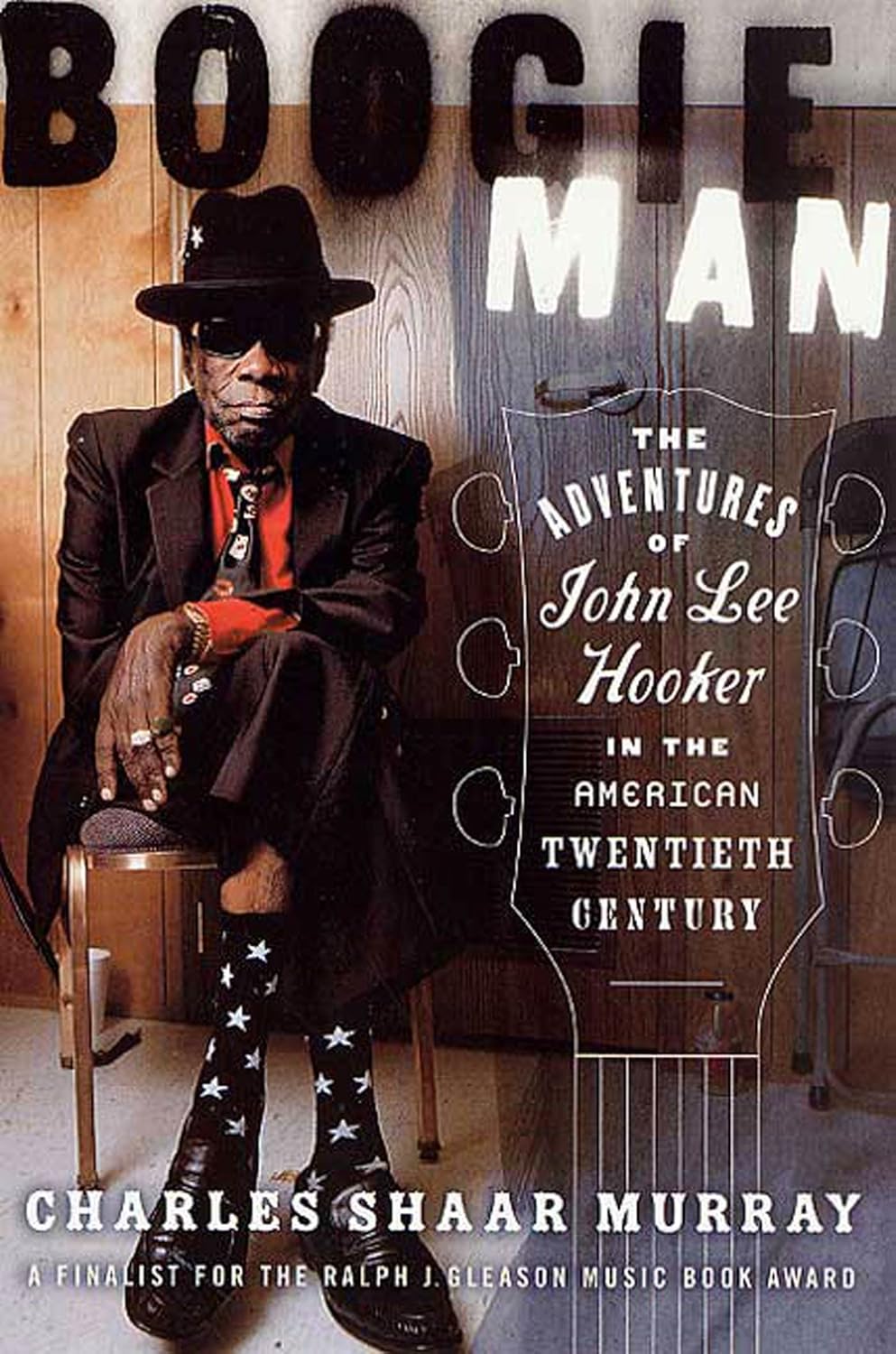 Buy from Amazon Boogie Man: The Adventures of John Lee Hooker in the American Twentieth Century
Suggested Listening
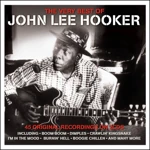 Buy from Amazon The Very Best Of John Lee Hooker
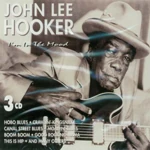 Buy from Amazon I'm In The Mood 3CD Box Set
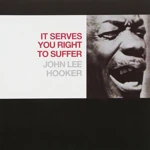 Buy from Amazon It Serves You Right To Suffer
John Lee Hooker (August 22, 1917–June 21, 2001) recorded hundreds of sides, shaped the grammar of electric blues and rock, and left behind a body of work that's less a museum than a working jukebox. The boogie, as he warned us, doesn't chill. It just changes rooms.