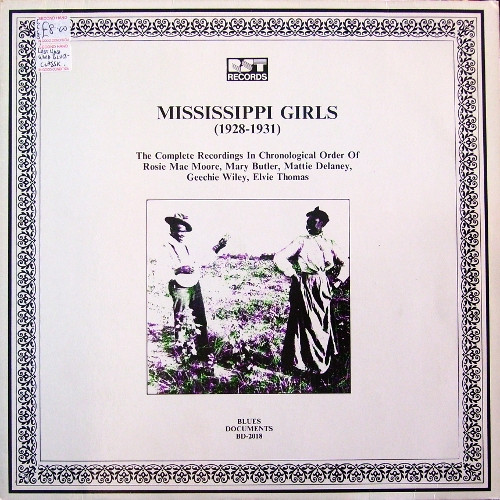
Mississippi Girls (1928–1931) is a compilation album issued by the Austrian reissue label Document Records (catalog DOCD-5315) during the 1990s, gathering together the complete known recorded output of several obscure female blues singers from Mississippi who committed their music to shellac during the narrow window between 1928 and 1931. The artists featured on the collection include Mattie Delaney, Geeshie Wiley, Elvie Thomas, Louise Johnson, and Rosie Moore, among others—women whose entire recorded legacies amount to a handful of fragile 78-rpm sides, and about whose lives almost nothing is known beyond what can be inferred from the grooves of those discs.
The album is not a "studio album" in any conventional sense. It is an act of archaeological recovery, assembling recordings originally made for Paramount Records, Vocalion Records, and OKeh Records during the final years of the pre-Depression blues boom, and presenting them in a single, coherent package for the first time. As such, the "producer" of the album operates on two distinct historical levels: the original A&R men and recording engineers who captured these performances in the late 1920s and early 1930s, and the modern compilation team at Document Records who rescued the recordings from obscurity nearly seven decades later.
Background and Context
Document Records and the Mission of Complete Reissue
Document Records was founded in Vienna, Austria, by Johnny Parth, a dedicated collector and scholar of pre-war African American music. Beginning in the late 1980s and accelerating through the 1990s, Parth undertook one of the most ambitious projects in the history of recorded sound: the systematic reissue, on compact disc, of the complete recorded output of virtually every blues, jazz, gospel, and jug band artist who had recorded commercially before the Second World War. The label's catalog eventually swelled to hundreds of releases, organized by artist, region, and genre, and it became an indispensable resource for scholars, musicians, and serious listeners.
The philosophy behind Document Records was one of completeness rather than curation. Where other reissue labels might select a dozen highlights from an artist's career and package them with glossy liner notes, Document aimed to present every known side, including alternate takes, fragmentary recordings, and tracks of dubious audio quality, in chronological order. The result was a catalog of extraordinary scholarly value but sometimes challenging listenability—the recordings were transferred from the best available 78-rpm sources, but the source material was often severely degraded by decades of neglect, poor original pressing quality, and the inherent limitations of acoustic and early electrical recording technology.
Mississippi Girls (1928–1931) fits squarely within this mission. The women featured on the compilation were not famous even in their own time. They recorded a small number of sides for budget labels, sold modestly (if at all), and then vanished from the historical record. Without Document Records' intervention, their music might have remained accessible only to a handful of 78 collectors willing to pay extraordinary sums for original pressings.
The Historical Moment: Female Blues Singers in the Late 1920s
The period from 1928 to 1931 represents a pivotal and ultimately tragic chapter in the history of American recording. The late 1920s were the tail end of the first great blues recording boom, which had begun in 1920 with Mamie Smith's "Crazy Blues" and had expanded rapidly through the decade as labels like Paramount, OKeh, Columbia, and Vocalion discovered a lucrative market for "race records"—recordings by and for African American consumers.
The early years of this boom had been dominated by the so-called "classic" or "vaudeville" blues singers—urban, professionally trained women like Bessie Smith, Ma Rainey, Ida Cox, and Victoria Spivey, who performed with jazz accompaniment and whose recordings were polished, theatrical, and commercially successful. By the late 1920s, however, the market was shifting. Record companies began sending mobile recording units into the rural South to capture the rawer, more regionally specific styles of country blues artists—both male and female—whose music was closer to the folk traditions of the plantation and the juke joint than to the professional stage.
It was during this second wave of field recording that the women on Mississippi Girls were captured. They were not vaudeville professionals but local musicians, women who sang and played in their communities, at house parties, in juke joints, and on street corners. Their recordings were made quickly, often in makeshift studios set up in hotel rooms or rented halls during recording expeditions to cities like Memphis, Jackson, Grafton, Wisconsin (Paramount's headquarters), and Dallas. The Depression, which began with the stock market crash of October 1929, devastated the race records market almost overnight, and by 1931 the window of opportunity for these artists had effectively closed. Most of them never recorded again.
The Gender Dynamics of Country Blues Recording
The relative scarcity of female country blues recordings from this era is itself a subject of historical significance. While women had dominated the early commercial blues market through the vaudeville tradition, the country blues recording boom of the late 1920s was overwhelmingly male. Artists like Charley Patton, Son House, Tommy Johnson, Skip James, and Blind Lemon Jefferson were extensively documented, while their female contemporaries were largely overlooked by A&R men who associated rural blues with masculine performance.
The women who did manage to record during this period faced a double marginalization—overlooked both as rural artists and as women operating outside the established vaudeville framework. Their recordings were often pressed in smaller quantities, distributed more narrowly, and promoted less aggressively than those of their male counterparts. The result is that the surviving recorded output of female country blues singers from Mississippi is extraordinarily small, making compilations like Mississippi Girls all the more valuable as historical documents.
The Original Recording Sessions
Paramount Records Sessions (Grafton, Wisconsin, and Field Locations)
Paramount Records, based in Grafton, Wisconsin, was the most important label for country blues recording in the late 1920s and early 1930s. Founded as a subsidiary of the Wisconsin Chair Company, Paramount had entered the race records market in the early 1920s and quickly established itself as the premier outlet for raw, unpolished blues from the rural South. The label's recording practices were notoriously haphazard—sessions were often poorly documented, pressings were made from inferior shellac compounds, and master recordings were frequently lost or destroyed.
Geeshie Wiley and Elvie Thomas recorded their sides for Paramount, most likely at the label's studio in Grafton, Wisconsin, around March 1930 and possibly again in 1931. The exact circumstances of these sessions remain one of the great mysteries of blues discography. Wiley and Thomas appear to have traveled together to the recording session, possibly from the Natchez, Mississippi area, and their six surviving sides represent the entirety of their known recorded output. The Paramount sessions were overseen by the label's recording director, Arthur Laibly, though the degree of creative input from A&R personnel on these particular recordings is unclear. Given Paramount's well-documented tendency to let artists record whatever material they chose, it is likely that Wiley and Thomas selected their own repertoire with minimal interference.
Louise Johnson also recorded for Paramount, at a session in Grafton, Wisconsin, around May or June 1930, that is believed to have overlapped with sessions by Charley Patton and Son House. According to blues lore, Johnson was Patton's girlfriend at the time and accompanied him to the recording session, where she was given the opportunity to record four sides of her own. The session was likely overseen by Laibly, with Patton possibly present in the studio. Johnson's recordings have a raw, unpolished quality that suggests she was not a seasoned studio performer but a local musician given a rare chance to record.
Vocalion Records Sessions
Mattie Delaney recorded her two known sides for Vocalion Records, a subsidiary of the Brunswick-Balke-Collender Company, in 1930. The exact location and date of the session are not definitively established, though it is believed to have taken place during a Vocalion field recording trip to the South, possibly in Jackson, Mississippi or Memphis, Tennessee. Vocalion's race records division was active in scouting and recording rural blues artists during this period, and Delaney's session was likely arranged by one of the label's regional talent scouts.
The Vocalion recordings have a slightly better technical quality than the Paramount sides, reflecting the superior recording equipment and pressing facilities available to the Brunswick organization. However, the performances themselves are no less raw and personal than those captured by Paramount.
OKeh Records and Other Sessions
Some of the other artists on the compilation may have recorded for OKeh Records or other labels during field trips to the South. OKeh, under the direction of Ralph Peer and later H.C. Speir (a Jackson, Mississippi furniture dealer who served as a talent scout for multiple labels), was active in recording Mississippi blues artists throughout the late 1920s. The specific session details for the lesser-known artists on the compilation are often lost to history.
The Compilation Production
For the Document Records reissue, Johnny Parth served as compilation producer, overseeing the selection, sequencing, and audio transfer of the original 78-rpm recordings. The transfers were made from the best available copies of the original discs, sourced from private collections and institutional archives. Given the extreme rarity of many of these 78s—some of the Paramount sides are known to exist in only one or two copies worldwide—the audio quality varies considerably from track to track, with surface noise, distortion, and frequency loss being unavoidable features of the listening experience.
The liner notes for the Document Records release were typically written by blues scholars and discographers, providing what biographical and historical context could be assembled from the fragmentary surviving record. For many of the artists on Mississippi Girls, the liner notes amount to little more than educated guesses and acknowledgments of ignorance—a testament to how thoroughly the lives of these women have been erased from the historical record.
The Musicians and Songwriters
The question of songwriting on Mississippi Girls is complex and resists simple answers. In the tradition of pre-war country blues, the distinction between "composition" and "arrangement of traditional material" is often blurred. Many of the songs performed by these artists draw on shared pools of lyrical and melodic material that circulated orally throughout the Mississippi Delta and the broader South. Verses, melodic phrases, and guitar figures were freely borrowed, adapted, and recombined, making it difficult to attribute authorship in the modern sense.
That said, the recordings on this compilation are generally credited to the performers themselves, reflecting the convention that the specific arrangement and performance of a traditional blues song constitutes a form of authorship. The primary musicians are as follows.
Geeshie Wiley (vocals, guitar) is the most celebrated artist on the compilation and one of the most enigmatic figures in all of blues history. Her real name is believed to have been Lillie Mae Wiley (or possibly "Geechie" Wiley, with "Geechie" being a term associated with the Gullah-Geechee people of the South Carolina and Georgia coast, suggesting possible coastal origins). She may have been from the Natchez, Mississippi area, and she is thought to have been a traveling musician who performed at house parties and juke joints in the lower Mississippi Valley. Her guitar style is highly distinctive—complex, contrapuntal, and harmonically adventurous, with a rhythmic sophistication that sets her apart from most of her contemporaries, male or female. Her vocal delivery is equally remarkable: deep, mournful, and emotionally intense, with a quality of haunted resignation that has captivated listeners since her rediscovery by collectors in the 1960s.
Elvie Thomas (vocals, guitar) was Wiley's musical partner and accompanist. Almost nothing is known about her life. She recorded two solo sides and accompanied Wiley on several others, providing a second guitar part that interlocks with Wiley's playing in a manner that suggests long familiarity and close musical collaboration. Thomas's guitar work is more straightforward than Wiley's, serving as a rhythmic and harmonic foundation over which Wiley's more elaborate lines can unfold.
Mattie Delaney (vocals, guitar) is another figure about whom virtually nothing is known. Her two surviving recordings reveal a powerful, confident performer with a strong rhythmic sense and a voice capable of considerable emotional range. Her guitar playing is driving and percussive, rooted in the Delta tradition, and her songs deal with the classic blues themes of travel, loss, and the natural landscape of Mississippi.
Louise Johnson (vocals, piano) is the only artist on the compilation who performs on piano rather than guitar. Her connection to Charley Patton places her within the orbit of the most important Delta blues musician of the era, and her recordings have a raucous, uninhibited energy that suggests a performer accustomed to entertaining rowdy juke joint audiences. Her vocal style is rough and declamatory, more shouted than sung, and her piano playing is percussive and rhythmically driving.
Rosie Moore (vocals, guitar) is the least documented of the major artists on the compilation. Her surviving recordings are few and poorly preserved, but they reveal a competent performer working within the standard country blues idiom.
Track-by-Track Breakdown
The following analysis addresses the key recordings on the compilation, drawing on the most widely documented versions of the track listing.
Mattie Delaney – "Down the Big Road Blues" (Vocalion, 1930)
This is one of the two surviving recordings by Mattie Delaney and one of the most powerful tracks on the compilation. The song is a slow, driving Delta blues built on a repetitive, hypnotic guitar figure that Delaney plays with remarkable force and precision. The "big road" of the title refers to the highway—a symbol of escape, migration, and the restless mobility that characterized African American life in the Jim Crow South. The lyrics describe the narrator's experience of traveling down this road, encountering hardship and loneliness along the way.
Delaney's vocal performance is striking for its authority and emotional directness. She sings with a deep, resonant tone that conveys both strength and vulnerability, and her phrasing is rhythmically assured, locking in tightly with her guitar accompaniment. The guitar work features a steady alternating bass pattern with melodic fills that comment on and extend the vocal lines, demonstrating a level of technical proficiency that places Delaney among the most accomplished female country blues guitarists of her era. The recording quality, while degraded by time, preserves enough of the original performance to convey its power and immediacy.
Mattie Delaney – "Tallahatchie River Blues" (Vocalion, 1930)
The companion piece to "Down the Big Road Blues," this recording is named for the Tallahatchie River, a major waterway in the Mississippi Delta that flows through Tallahatchie County and into the Yazoo River. The river serves as both a geographical reference and a metaphorical presence in the song, evoking the landscape of the Delta and the cycles of flooding, planting, and harvest that shaped the lives of the region's inhabitants.
The performance is slightly more uptempo than "Down the Big Road Blues," with a driving rhythmic feel that suggests the movement of water. Delaney's guitar work is again impressive, featuring a complex interplay between bass and treble voices that creates the impression of multiple instruments. The vocal delivery is urgent and impassioned, with Delaney pushing her voice to its upper register at moments of emotional intensity. The song's connection to a specific Mississippi landmark gives it a sense of place that is characteristic of the most powerful Delta blues recordings.
Geeshie Wiley – "Last Kind Words Blues" (Paramount, 1930)
This is the most famous and critically celebrated recording on the entire compilation, and one of the most revered performances in the entire canon of pre-war blues. "Last Kind Words Blues" is a slow, haunting meditation on death, abandonment, and the afterlife, delivered with an emotional intensity that has lost none of its power in the nearly century since it was recorded.
The song opens with Wiley's guitar, playing a complex, arpeggiated figure that immediately establishes a mood of profound melancholy. The guitar part is harmonically unusual for country blues, featuring chord voicings and melodic movements that suggest a sophisticated musical intelligence operating well beyond the standard blues vocabulary. Wiley's vocal enters with the line "The last kind words I heard my daddy say," and the song unfolds as a series of stark, imagistic verses that move between the personal and the cosmic with disorienting fluidity.
The lyrics are among the most striking in the blues tradition. Wiley sings about death, about the river Jordan, about the experience of being abandoned by a lover, and about the strange landscape of the afterlife, all in language that is simultaneously plain and deeply mysterious. Lines like "If I get killed, please don't bury my soul / I cry, just leave me out, let the buzzards eat me whole" carry a raw, unflinching confrontation with mortality that is startling even by the standards of the blues.
The recording quality is poor, as is typical of Paramount pressings from this era, with heavy surface noise and significant frequency loss. However, the power of the performance transcends the technical limitations of the medium. Wiley's voice cuts through the hiss and crackle with an almost supernatural clarity, and the guitar work, even in its degraded state, reveals a level of harmonic and rhythmic complexity that continues to astonish musicians and scholars.
Geeshie Wiley – "Skinny Leg Blues" (Paramount, 1930)
This track presents a striking contrast to "Last Kind Words Blues," showcasing Wiley's ability to work in a lighter, more playful register. "Skinny Leg Blues" is a humorous, sexually suggestive number in the hokum tradition, with Wiley delivering double-entendre lyrics about a lover's physical attributes with evident relish. The guitar work is bouncy and rhythmic, with a syncopated feel that suggests the influence of ragtime and early jazz.
The performance demonstrates the breadth of Wiley's repertoire and her command of multiple blues styles. Where "Last Kind Words Blues" is solemn and visionary, "Skinny Leg Blues" is earthy and comic, revealing a performer who was equally at home with the sacred and the profane dimensions of the blues tradition. The interplay between Wiley's vocal and guitar is particularly effective on this track, with the guitar providing a lively, conversational accompaniment that mirrors the playful tone of the lyrics.
Geeshie Wiley – "Eagles on a Half" (Paramount, 1930)
Another of Wiley's Paramount sides, "Eagles on a Half" is a medium-tempo blues that deals with themes of gambling and risk-taking. The "eagles" of the title likely refer to coins or currency (the eagle was a ten-dollar gold coin in American currency), and the "half" may refer to a half-dollar or a fifty-dollar stake. The song places Wiley within the world of the juke joint and the gambling house, social spaces that were central to the blues culture of the Delta.
The guitar work on this track is again notable for its complexity, with Wiley employing a fingerpicking style that weaves together bass, melody, and rhythmic accents in a manner that anticipates later developments in acoustic guitar technique. The vocal delivery is confident and assertive, with Wiley projecting the persona of a woman who is fully at home in the rough-and-tumble social world described in the lyrics.
Elvie Thomas – "Motherless Child Blues" (Paramount, 1930)
Elvie Thomas's solo recording of "Motherless Child Blues" is one of the most emotionally affecting tracks on the compilation. The song draws on the ancient spiritual "Sometimes I Feel Like a Motherless Child," transforming the sacred material into a secular blues that retains the spiritual's profound sense of loss and dislocation. Thomas's vocal delivery is plaintive and vulnerable, with a trembling, keening quality that conveys deep personal sorrow.
The guitar accompaniment is simpler than Wiley's, providing a steady, supportive foundation that allows the vocal to take center stage. The recording quality is particularly poor, even by Paramount standards, and Thomas's voice is partially obscured by surface noise. However, the emotional content of the performance is unmistakable, and the song stands as a powerful testament to the connection between the sacred and secular traditions in African American music.
Elvie Thomas – "Over to My House" (Paramount, 1930)
This track features Thomas in a more upbeat, inviting mode, singing about welcoming a lover to her home. The song has a warm, domestic quality that is relatively unusual in the blues repertoire, which more commonly focuses on loss, travel, and conflict. Thomas's guitar work is rhythmic and propulsive, with a bouncy feel that suggests the influence of ragtime and dance music. The vocal delivery is relaxed and good-humored, providing a welcome contrast to the darker material elsewhere on the compilation.
Louise Johnson – "On the Wall" (Paramount, 1930)
"On the Wall" is the most famous of Louise Johnson's four recorded sides and one of the most energetic performances on the compilation. The song is a raucous, uptempo number built on Johnson's driving piano accompaniment and her shouted, declamatory vocal delivery. The lyrics are sexually explicit and celebratory, with Johnson describing a dance or party scene with vivid, kinetic energy.
The recording is notable for its connection to Charley Patton, who is believed to have been present at the session and may have contributed vocal interjections (though this is debated among scholars). The piano playing is percussive and rhythmically insistent, with Johnson hammering out bass figures with her left hand while her right hand plays melodic and rhythmic accents in the upper register. The overall effect is one of barely controlled chaos, capturing the energy and excitement of a juke joint at full tilt.
Louise Johnson – "All Night Long Blues" (Paramount, 1930)
This companion piece to "On the Wall" continues in the same high-energy vein, with Johnson delivering a marathon celebration of nocturnal revelry. The piano playing is again the driving force, with Johnson maintaining a relentless rhythmic momentum throughout the performance. The vocal delivery is raw and uninhibited, with Johnson shouting, moaning, and laughing her way through the lyrics with an abandon that is both exhilarating and slightly unnerving.
The recording quality is characteristically rough, with the piano's lower frequencies overwhelming the microphone and creating a distorted, muddy sound. However, this technical limitation paradoxically enhances the track's power, giving it a visceral, overwhelming quality that mirrors the physical intensity of the performance.
Louise Johnson – "Long Way from Home" (Paramount, 1930)
This track shifts to a slower, more reflective mood, with Johnson exploring the theme of displacement and longing that is central to the blues tradition. The piano accompaniment is more restrained than on the uptempo numbers, allowing Johnson's vocal to carry the emotional weight of the performance. The lyrics describe the experience of being far from home, a theme that resonated deeply with the African American experience of migration and dislocation in the early twentieth century.
Louise Johnson – "Bye and Bye Blues" (Paramount, 1930)
The final track attributed to Johnson on the compilation is a medium-tempo blues that combines elements of the raucous energy of "On the Wall" with the reflective quality of "Long Way from Home." The piano playing is steady and propulsive, and the vocal delivery is confident and assertive. The song serves as a fitting conclusion to Johnson's recorded legacy, capturing the full range of her musical personality in a single performance.
Rosie Moore – Recorded Sides (c. 1928–1931)
Rosie Moore's contributions to the compilation are among the most fragmentary and poorly preserved. Her surviving recordings reveal a competent performer working within the standard country blues idiom, with a guitar style that draws on the same Delta and Piedmont influences that shaped the work of her more celebrated contemporaries. The audio quality of Moore's recordings is particularly challenging, with severe surface noise and distortion making it difficult to discern the details of her playing and singing. Nevertheless, the inclusion of her work on the compilation is historically important, as it ensures that even the most obscure and marginalized voices of the pre-war blues tradition are preserved and made accessible.
Significance and Legacy
The Recovery of Lost Voices
The primary significance of Mississippi Girls (1928–1931) lies in its act of historical recovery. The women featured on this compilation were, for decades, almost entirely absent from the narrative of American music. The standard histories of the blues, written largely by male scholars and focused overwhelmingly on male performers, had little to say about Mattie Delaney, Geeshie Wiley, Elvie Thomas, Louise Johnson, or Rosie Moore. Their recordings were known only to a small circle of 78 collectors, and their biographies were almost entirely blank.
Document Records' decision to compile and reissue these recordings on CD represented a significant intervention in the historiography of the blues. By gathering these scattered, obscure sides into a single, accessible package, the label made it possible for a new generation of listeners and scholars to encounter these artists and to begin the process of integrating their contributions into the broader narrative of American music.
Geeshie Wiley and the Canon of American Music
Of all the artists on the compilation, Geeshie Wiley has experienced the most dramatic posthumous elevation in status. "Last Kind Words Blues," in particular, has come to be regarded as one of the greatest recordings in the entire blues tradition, and Wiley herself has been the subject of increasing scholarly and popular attention. The critic Greil Marcus devoted extensive attention to Wiley in his writings, and the guitarist and scholar John Jeremiah Sullivan published a celebrated essay in the New York Times Magazine in 2014 attempting to trace Wiley's biography, an effort that underscored how little is known about her despite the extraordinary power of her music.
Wiley's guitar style, with its harmonic sophistication and contrapuntal complexity, has been cited as a precursor to later developments in American guitar music, including the "American Primitive" style of John Fahey and the experimental folk traditions of the late twentieth century. Her vocal delivery, with its deep emotional intensity and its refusal of conventional blues phrasing, has been compared to the work of artists as diverse as Skip James, Nina Simone, and Patti Smith. The fact that only six recordings by this extraordinary artist are known to survive is one of the great tragedies of American cultural history.
The Broader Question of Female Agency in the Blues
Mississippi Girls also contributes to the ongoing scholarly reassessment of women's roles in the creation and development of the blues. For much of the twentieth century, the country blues was narrated as an almost exclusively male tradition, with women appearing primarily as subjects of male blues lyrics rather than as creators and performers in their own right. The recordings on this compilation challenge that narrative by demonstrating that women were active participants in the country blues tradition, performing with a level of technical skill and emotional depth that matches or exceeds that of their better-known male contemporaries.
The fact that so few female country blues recordings survive is not evidence that women were absent from the tradition but rather a reflection of the gender biases of the recording industry, which systematically underrepresented female rural performers. Compilations like Mississippi Girls help to correct this historical imbalance, even if the correction is necessarily partial and incomplete.
Influence on Contemporary Musicians
The recordings on Mississippi Girls have influenced a growing number of contemporary musicians, particularly within the folk, experimental, and indie music communities. Geeshie Wiley's "Last Kind Words Blues" has been covered and referenced by artists including Rory Block, Cassandra Wilson, and The Black Keys (whose Dan Auerbach has spoken about Wiley's influence). The raw, unpolished quality of the recordings has also resonated with the lo-fi and DIY aesthetics of contemporary independent music, connecting the women of the 1920s and 1930s to a new generation of artists who value emotional authenticity over technical polish.
The Document Records Legacy
More broadly, Mississippi Girls (1928–1931) is part of the extraordinary legacy of Document Records as a whole. Johnny Parth's label performed an invaluable service to the cause of musical preservation, ensuring that the recorded output of hundreds of obscure and forgotten artists was transferred to a durable digital format before the original 78-rpm discs deteriorated beyond recovery. While the audio quality of Document's transfers has sometimes been criticized by audiophiles who prefer the more carefully restored versions produced by labels like Yazoo Records and JSP Records, the sheer comprehensiveness of the Document catalog makes it an irreplaceable resource for anyone interested in the history of American vernacular music.
The Fragility of Cultural Memory
Ultimately, Mississippi Girls (1928–1931) is a meditation on the fragility of cultural memory. The women whose music is preserved on this compilation lived lives of extraordinary difficulty and obscurity, performing in a society that afforded them little recognition or respect. Their recordings were made hastily, pressed cheaply, and distributed narrowly, and most of them disappeared from public consciousness within a few years of their release. The fact that their music survives at all is due to the efforts of a small number of dedicated collectors and scholars who recognized the value of these recordings when the rest of the world did not.
Listening to Mississippi Girls is an act of communion with the past—a reminder that the history of American music is not only the story of famous artists and celebrated recordings but also the story of countless unnamed and unremembered performers whose contributions have been lost to time. The compilation invites us to hear these voices, however faintly and imperfectly, and to recognize the extraordinary artistry that flourished in the most unlikely and inhospitable circumstances.
Buy The Album
Album Details Summary:
- Title: Mississippi Girls (1928–1931)
- Label: Document Records (DOCD-5315)
- Released: 1990s (exact date varies by pressing)
- Compilation Producer: Johnny Parth
- Original Recording Labels: Paramount Records, Vocalion Records, OKeh Records
- Original Recording Period: 1928–1931
- Primary Artists: Mattie Delaney, Geeshie Wiley, Elvie Thomas, Louise Johnson, Rosie Moore
- Format: Compact disc compilation of 78-rpm transfers
- Genre: Pre-war country blues, Delta blues, female blues