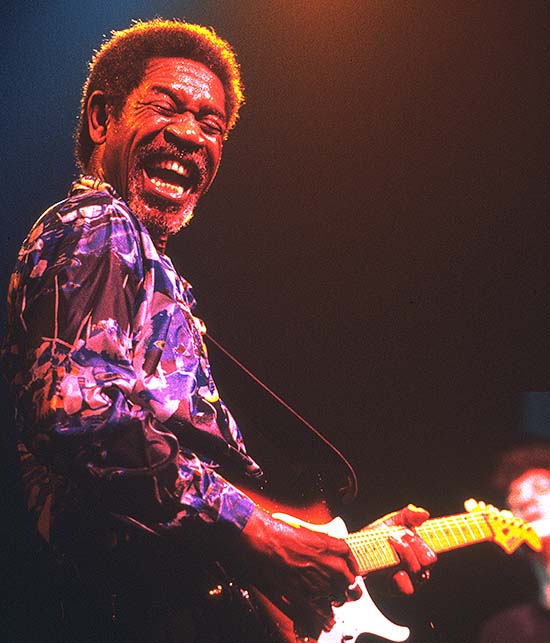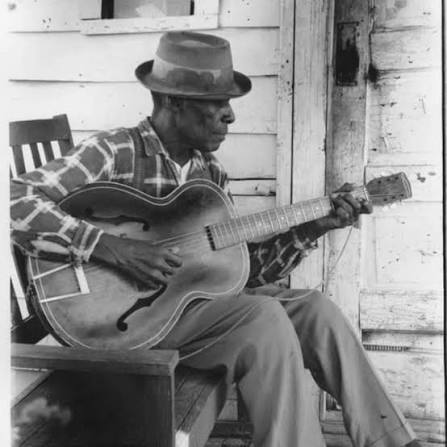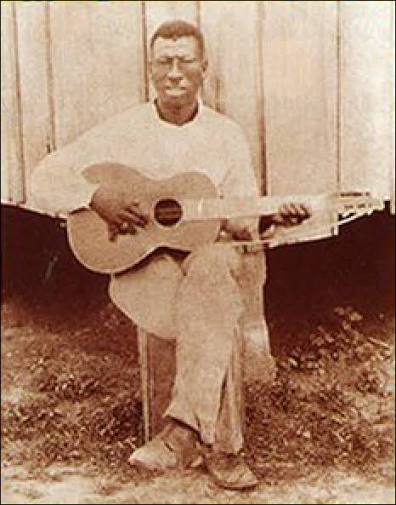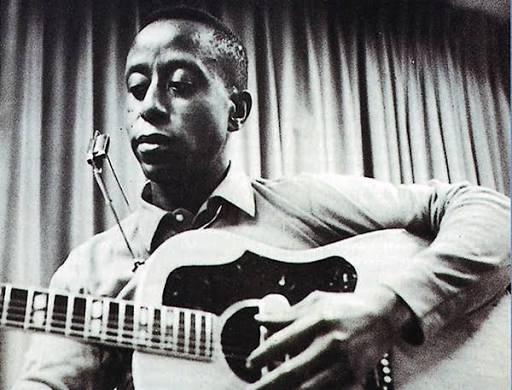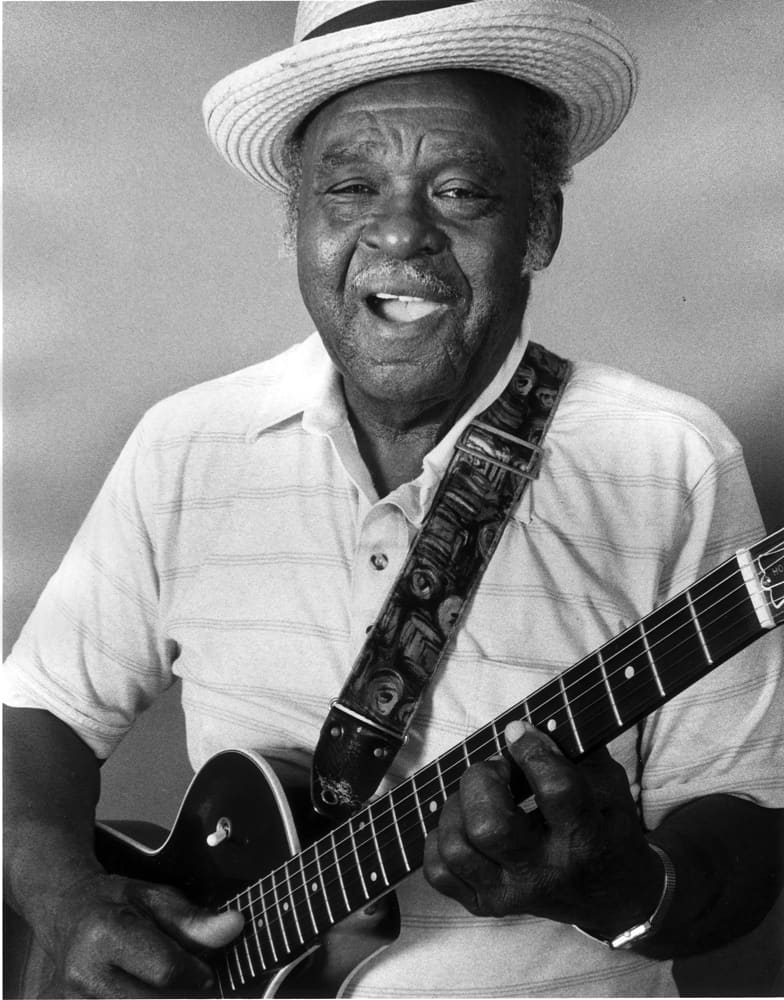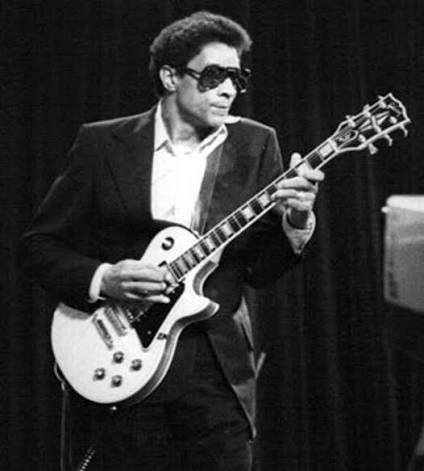
From a boy peering into an Arkansas juke joint to the defining guitar voice in Howlin’ Wolf’s Chicago band, Hubert Sumlin made tension, silence and a few sharply placed notes feel as forceful as a shout.
On Howlin’ Wolf’s “Smokestack Lightning,” the guitar does not simply keep time; it keeps watch. A clipped figure circles the singer’s groaning melody, then slips sideways, leaving a gap where expectation hangs. Hubert Sumlin never had to fill every bar to command attention. That restraint is the source of a paradox at the centre of his career: he became one of the most recognisable guitarists in postwar blues while spending most of his best-known years in another man’s band. The records tell a fuller story than the job title. They reveal a musician who listened with unusual acuity, whose guitar could sharpen a singer’s authority without competing with it, and whose individual sound remained unmistakable even when he played in the background. 1 2 3
The association with Wolf is so strong that it can eclipse the rest of Sumlin’s story. Yet the guitarist’s life ran from a teenage partnership with James Cotton to the Chicago studios, European tours and a long career after Wolf’s death. He moved among the roles of sideman, arranger, singer and bandleader without losing the individual voice that made his guitar immediately recognisable. 1 2 3
A boy on the edge of the music
Hubert Charles Sumlin was born on November 16, 1931, on the Pillow plantation near Greenwood, Mississippi. His family moved to Hughes, Arkansas, while he was still young. Those places put him within the Delta’s cultural orbit, though the border between Mississippi and Arkansas mattered less to his musical formation than the close-knit world of church, family, local dances and juke joints. His mother was a churchgoing woman who objected to the blues as “the devil’s music.” Sumlin first played in church, but the secular sounds that drew him outward were already close at hand. 1 2
Before he had a six-string guitar, Sumlin experimented with a length of wire stretched along a wall. The homemade instrument belonged to a broader rural tradition: a single vibrating string could carry rhythm and pitch without a manufactured guitar. His mother eventually bought him a guitar. He began to work out songs by listening, not by reading notation, and later recalled that he was drawn to the instrument before he had any clear idea of a career. The early lessons were practical ones—how a note bent, how a string responded to touch, how a repeated figure could hold a listener. 3 4 5
His musical imagination was not limited to the blues. Sumlin later said that, as a boy, he wanted to play jazz like Charlie Christian; records by Charley Patton and Robert Johnson also helped shape his early ear. He absorbed different kinds of phrasing and sound, then tested what they could do in the music around him. His blues remained rooted in the Delta, but his ambitions were wider than any single tradition. 6 7
The most colourful story from his childhood begins with a window. Sumlin later told interviewers that he was too young to enter a local club where Howlin’ Wolf was performing. He stacked Coca-Cola crates beneath a window to see inside; the makeshift platform shifted, and he tumbled through the opening onto the stage. In Sumlin’s often-repeated account, he landed on Wolf’s head. Wolf allowed him to stay for the performance and later drove him home, asking his mother not to punish him. Sumlin remembered the moment as the beginning of a lifelong attachment: “I followed him ever since.” 2 4
The anecdote has the shape of a blues legend, but it preserves a plain truth: Sumlin pursued Wolf’s music before he had the means to become a professional. He learned not just the tunes but what a player could do inside them—a habit of attention that later became the basis of their musical partnership. 2 5
In his teens, Sumlin joined forces with another young musician who would become a major blues figure: harmonica player James Cotton. The two played local functions and eventually worked around West Memphis, where the club circuit brought musicians into contact with one another. They formed a band with other players, including guitarist Pat Hare, and sometimes performed on radio. Cotton was not simply a fellow beginner; he became a friend and musical companion whose career would repeatedly cross Sumlin’s. The young musicians were learning the repertoire by playing it, earning little and taking opportunities where they found them. Sumlin later recalled the pay as “sometimes 50 cents, sometimes a dollar” for a Saturday night’s work. 1 3 5
They also shared airtime on West Memphis radio. In Sumlin’s later recollection, Wolf had a half-hour radio programme and sometimes gave the younger band a fifteen-minute slot. That arrangement captures the relationship before the Chicago years: Wolf was already an established performer, but he made room for musicians who were still building an audience and a repertoire. The younger players were not yet his regular Chicago band, but they were learning in public, on the same local circuit that had brought them into his orbit. 5
The group’s early life was close to Howlin’ Wolf’s orbit. Sumlin and Cotton played in a region where Wolf was already a commanding performer, and their radio and stage appearances put them in the same musical community. Their working relationship began not as a polished contract but as a local exchange of performance, example and opportunity. When Wolf decided to build a band in Chicago, Cotton encouraged Sumlin to go. Cotton stayed behind for a time; Sumlin moved north to join the singer whose music had first drawn him to the window. 1 2 5
First records, then Chicago
The dates are easy to compress but mark separate moments. Sumlin first recorded with Wolf in 1953, before he made the permanent move to Chicago. The University of California, Santa Barbara’s Discography of American Historical Recordings lists him on early Wolf sides including “All Night Boogie” and “I Love My Baby.” In 1954, Wolf invited him to join the Chicago band. He was on record before the move, but Chicago gave him the long apprenticeship and studio platform that would define his career. 8 9
In Chicago, Sumlin entered a scene that was already moving quickly. Wolf had relocated from Memphis and was building a harder, louder electric ensemble around his deep voice and imposing stage presence. Sumlin was initially one of the guitarists rather than the sole lead, and he had to learn how to occupy a place in a band whose dynamics were set by Wolf. Players such as Jody Williams and Willie Johnson were part of the wider guitar story around the group. As personnel shifted, Sumlin moved from supporting rhythm parts toward the more exposed lead role that listeners would come to identify with Wolf’s records. By the middle of the decade, his phrasing was becoming one of the band’s signatures. 2 3
The change was gradual rather than ceremonial. Sumlin had to hear how Wolf’s existing guitarists left room for the singer, then discover what his own part could add. When Jody Williams departed, Sumlin became the band’s principal guitar voice, but his early training in the group had already taught him that prominence did not mean constant soloing. The guitar could shape a track through rhythm, a one-bar reply or a sudden break as effectively as through a long lead. 2 3
Chess Records made that musical evolution permanent. Its sessions compressed Wolf’s band into a few minutes. Each side had to establish its character quickly: Wolf’s voice out front, Dixon’s songwriting and, on many sides, his bass, the rhythm section, piano or harmonica, and Sumlin’s guitar. The recording process did not give Sumlin the space of a long club performance. It demanded that he make an entrance, a reply or a rhythmic turn count. In that compressed form, his economy was not a limitation but an advantage. A clipped chord could be more vivid than a cascade of notes if it landed at the right moment. 3 8
Wolf and Sumlin’s relationship gave that discipline a rough edge. Wolf was a demanding bandleader, a mentor and, in Sumlin’s later description, something close to a father figure. He also fired the guitarist repeatedly, sometimes for a few minutes, sometimes for longer, then brought him back when the band needed him. Sumlin himself described the cycle with wry understatement: Wolf would “keep on firing me … and hiring me.” Behind the anecdote was a hard lesson about the job: Wolf did not want a guitarist who merely demonstrated facility; he wanted a player who could make the song bigger without taking the singer’s place. 1 5
Accounts differ on how Sumlin moved away from a pick. Wolf may have objected to his volume or to the way he played over the vocal; Sumlin also recalled that, after years with a plectrum, he woke one morning and began working with his fingers. The details need not be forced into a single origin story. Fingerstyle playing became central to his voice because it gave him fine control over attack and dynamics: he could move from a quiet fill to a stinging phrase without shifting the song’s centre of gravity. 4 6 7
Wolf’s investment in Sumlin extended beyond discipline. Sumlin later recalled that Wolf arranged about six months of lessons with a classical guitar teacher in Chicago, a musician connected to the city’s symphonic world. The instruction did not turn him into a conservatory stylist or erase the roughness of his blues. It widened the materials available to him: knowledge of scales and the fretboard could sit behind an instinctive phrase without making it sound academic. 6 7
The tension between mentor and student was productive precisely because it was not smooth. There were fights, departures and returns, and Sumlin spent a short period playing with Muddy Waters, whose band paid better. That move briefly brought three major figures in Chicago blues into close orbit: Wolf, Waters and the young guitarist whose work could sharpen either singer’s sound. Sumlin eventually returned to Wolf and stayed for most of the remaining years of the singer’s life. 2 4 10
The sound inside the songs
Sumlin’s importance is easiest to hear by resisting the idea that a blues guitarist’s primary task is to solo. His greatest work with Wolf often happens in the margins of the vocal. Wolf’s voice was a physical event: low, growling, then opening into a bark or a cry. A guitarist who crowded that voice would weaken its force. Sumlin’s achievement was to frame it. He could answer the end of a line, underline a word with a short chord, or hold a note long enough for its rough edge to become part of the atmosphere. He created motion without making every beat busy. 2 3 10
“Smokestack Lightning” is a clear lesson in this kind of listening. Built on a hypnotic, repeating figure, the performance does not depend on the arrival of a conventional chorus or a sequence of elaborate chord changes. The song moves because its repeated pattern seems to shift under the voice. Sumlin’s guitar catches the pulse and then worries it: a small bend, a short accent, a fragment that sits just to one side of the beat. Those interventions keep the vamp from becoming static. Wolf can stretch a syllable across the bar, and Sumlin’s guitar makes the gap around it feel deliberate. The performance is not a contest between singer and guitarist; it is a single piece of pressure applied from two directions. 1 2 8
The songwriting credits matter. Willie Dixon wrote “Spoonful,” “Back Door Man,” “Wang Dang Doodle,” “The Red Rooster,” “Hidden Charms” and “Three Hundred Pounds of Joy”; Wolf wrote or adapted other staples, including “Smokestack Lightning,” “Killing Floor” and “Shake for Me.” Sumlin did not write most of these best-known titles. His contribution is audible in the way they are played: in the distinctive shape of a response, the timing of an accent, the slightly crooked line that stays in a listener’s memory. He made an arrangement feel authored without claiming the composition. 1 2 3
On “Spoonful,” Sumlin’s guitar helps turn a compact blues into a lesson in restraint. Dixon’s title image is blunt and memorable; Wolf delivers it with the weight of a warning. Sumlin does not bury that vocal under a continuous lead line. He leaves spaces, then steps in with phrases that feel like answers, not decorations. The guitar’s movement is rough-edged but controlled, and its relationship to the vocal gives the song a conversational structure. The listener hears a band thinking together, not a singer with a guitarist waiting for his solo. 2 3
“Back Door Man” and “Wang Dang Doodle” show a different side of the partnership. The first has a lurching, ominous drive that lets Wolf’s low voice dominate while Sumlin’s guitar adds a sharp, almost taunting edge. The second is more celebratory and communal, with a groove designed to carry a crowded room. The guitarist can make a riff feel like a warning in one setting and a dance cue in another. His work is not a fixed collection of licks laid over a shuffle; it changes its function according to the song’s character. That adaptability is one reason his playing is hard to reduce to a single signature phrase. 1 2 3
“Hidden Charms” shows how fleet and playful he could be. Its arrangement gives him room to dart into the foreground, and his lines seem to turn corners unexpectedly, stopping short or bending away just as a more conventional blues solo might settle into a familiar pattern. “Killing Floor,” by contrast, is built around a more driving figure. Sumlin’s guitar brings a biting, unsettled energy to the track, but the force is not simply volume. It comes from the balance between the riff’s insistence and the brief spaces that keep it from becoming blunt. In both songs, the guitar feels vocal—not because it imitates a human voice note for note, but because it has a sense of breath, interruption and reply. 2 3 8
“Shake for Me” makes clear that Sumlin’s control of space was not confined to slow or ominous blues. The song moves with a compact, propulsive groove, and his clipped responses keep it springing forward without crowding Wolf’s vocal. He can raise the pressure with a short phrase, then withdraw before the next line begins. That ability to make a faster track feel both tight and open is a different kind of virtuosity from the extended solo: it is not about how much he can play, but how much energy he can release with a few notes. 2 3
That vocal quality is one reason Sumlin’s style cannot be reduced to speed or a single signature riff. His lines can be angular, with intervals that feel slightly askew. He bends notes into their target rather than arriving there cleanly, and he can let a note tremble or slide down at the end of a phrase. Sometimes he places a short run where a listener expects a full bar of soloing; sometimes he lets the silence speak. The effect is not neatness but intention. His phrases seem to come from inside the song’s tension rather than from a preplanned vocabulary of “blues licks.” 3 5
His right hand contributed to that sound. Playing without a pick, he could use the fingers to shape the attack of individual notes and the weight of a chord. It is tempting to reduce this to a technical signature, but the technique mattered because it served his role in the band. With Wolf’s voice in front of him, Sumlin needed to vary his level of force. A lighter touch could make room for the vocal; a harder attack could restore the song’s momentum. The technique enabled those shifts. It also made his tone recognisable even when he changed guitars or played in a new ensemble. 4 5
Sumlin’s rhythmic freedom was equally essential. His lines can seem to hesitate at the point where a steadier player would resolve them, or make a fill land just after the beat instead of squarely on it. Wolf’s songs could then feel heavier, stranger or more impatient without the rhythm section losing its footing. The pocket remained there, but the guitar made it feel unstable around the edges. 3 11
The work was collaborative in a deeper sense than “backing.” Sumlin had to keep track of Wolf’s mood, the dynamic of each verse and the choices of the band. Later, he described how he helped shape parts and arrangements in the studio. On “300 Pounds of Joy,” he recalled working out the horn figures on the spot when the scheduled players failed to show for rehearsals. The detail complicates the conventional picture of Sumlin as a sideman who supplied a few memorable fills. He was often listening for how the whole arrangement could move, deciding where a guitar line should sit and how the song might be carried by the ensemble. 5
Chess, Europe and the long afterlife of the Wolf records
Sumlin’s guitar can be heard across a broad stretch of Wolf’s Chess catalogue, from early sides to the celebrated studio recordings of the 1960s. The songs were sometimes issued as singles, sometimes gathered onto albums such as Moanin’ in the Moonlight and Howlin’ Wolf. The formats have changed over time, and a listener may first encounter the music through a compilation, a reissue or an individual track. What remains constant is the ensemble’s balance: Wolf’s voice as the centre of gravity, Dixon’s compositions and bass lines, the band’s rhythmic engine, and Sumlin’s guitar supplying an edge that could be threatening, witty or unexpectedly tender. 3 8
His work was not confined to Wolf’s catalogue. The same guitarist appeared on records by Muddy Waters, Chuck Berry, Jimmy Reed, Willie Dixon, Sonny Boy Williamson, Eddie Taylor and James Cotton, among others. That session work placed him inside the broader Chicago blues community, where musicians moved between bandstands and recording dates. It also helps explain why his phrasing could be so flexible: he was not just learning one singer’s cues, but adapting his sound to different voices, song forms and bandleaders. 1 3
The records travelled farther than the musicians. The American Folk Blues Festival brought Sumlin and Wolf to Europe in 1964, and a reissue of “Smokestack Lightning” reached the British Top 50 that year, helping bring Wolf’s sound to a wider rock audience. Bands such as the Yardbirds and Manfred Mann took up Wolf material; later, Cream recast “Spoonful,” and Jimi Hendrix recorded “Killing Floor.” These versions introduced the songs to new listeners, but the guitar language in the originals was no incidental detail. Young players heard Sumlin’s tense, slashing phrases and found a way of making electric guitar sound less polished and more alive. 2 4
Sumlin’s own name did not always travel as widely as the music. Wolf stood at the front of the stage and on the album covers; the bandleader’s voice and persona commanded attention. Sumlin’s contribution, while immediately audible to musicians, was more easily missed by listeners who treated the guitar as part of the background. This imbalance is one reason his later recognition matters. His work helped define a sound that moved across genre boundaries, even while his own public identity remained tied to the role of Wolf’s guitarist. 2 11
The 1964 European tour also gave Sumlin an unusual chance to record under his own name. During the festival’s stop in East Berlin, producer Horst Lippmann organised a session with pianist Sunnyland Slim, bassist Willie Dixon and drummer Clifton James. The tracks later appeared under titles including American Folk Blues and Blues Anytime!; this was not a conventional solo album, and other musicians shared the programme, but it captured Sumlin in a more exposed setting. Some of the pieces let him play acoustic guitar and sing, offering a contrast to the electric tension he created behind Wolf. His only 45 rpm single, “Across the Board,” was released by Blue Horizon in 1965, after being recorded in England during the same tour. 1 3 4
The British single had its own improbable setting: in November 1964, label founder Mike Vernon recorded Sumlin at the Vernon family home in England. Issued as Blue Horizon’s first release the following year, “Across the Board” condensed the touring guitarist’s individuality into a brief instrumental. The modest session contrasts with the full Chicago ensemble, but it also made Sumlin’s name a label’s first statement rather than only a credit beneath Wolf’s. 12 13
A few years later, the 1970 London sessions for The London Howlin’ Wolf Sessions brought Sumlin back alongside Wolf and a line-up that included Eric Clapton, Steve Winwood, Bill Wyman and Charlie Watts. Released in 1971, the album is remembered for the meeting between Wolf and musicians who had absorbed his records. Sumlin was the person on the bandstand who already knew how Wolf’s music breathed. He anchored the ensemble as its familiar guitar voice, not an expendable addition to the guest list. The sessions made visible what the Chess sides had established: a blues master and his rock admirers could meet without losing the band that had formed the music. 2 14
Later accounts report that Clapton insisted on Sumlin’s presence when Chess hesitated over the cost of flying him to London. The anecdote underlines the session’s balance: for the guests, Wolf’s records were a source of inspiration; for Sumlin, they were the working music he had helped create. He was not a historical prop, but a musician still shaping the band’s sound. 14
The London album was not the only route through which the music crossed generations. Clapton, Richards, Jimmy Page, Jeff Beck, Jimi Hendrix, Robbie Robertson and Stevie Ray Vaughan are among the players connected to Sumlin’s influence or admiration. The exact line differs from guitarist to guitarist, but many heard his phrasing and sense of risk. His playing suggested a way of arranging sound: make a phrase crooked enough to be memorable, place it against the singer rather than over him, and do not confuse constant motion with force. 1 2 5 11
After Wolf: stepping out of the sideman’s role
Howlin’ Wolf died in 1976. Sumlin had spent more than two decades playing beside him, with interruptions, and the loss was both personal and professional. The older musician had treated him almost as a son; at Wolf’s funeral, Sumlin was listed among the family. After a period away from music, he returned to touring and recording alongside former Wolf musicians, carrying the repertoire forward while the band adjusted to its absent leader. He later moved to Texas, where he left an impression on the brothers Jimmie and Stevie Ray Vaughan. The transition was not simply from one band to another. Sumlin had to decide what kind of career could follow the end of the partnership that had shaped his musical identity. 2 3 15
He did not become a conventional frontman overnight. Sumlin’s own singing was more conversational and understated than Wolf’s dramatic growl, so his records often made the guitar their centre or invited other vocalists into the material. His albums do not all aim for the same effect: some expand his repertoire, while others document the pleasure of playing with old friends and younger musicians. 2 3
That solo identity was already emerging while Wolf was alive. My Guitar & Me, recorded in Paris in December 1975, a year before Wolf’s death, gives a useful early portrait of Sumlin outside the singer’s band. With pianist Willie Mabon, guitarist Lonnie Brooks and other veteran Chicago players around him, Sumlin sings and takes more room for his own material. The record is not a guitar demonstration; without Wolf’s voice to answer, Sumlin’s guitar has to carry more of the narrative itself, whether in a compact vocal number or an extended passage of lead playing. 3 16
The next phase brought Sumlin together with musicians who knew the Chicago blues world from the inside. Hubert Sumlin’s Blues Party (1987) put him in a more overtly bandleading role, while Heart & Soul (1989) paired him with James Cotton and Little Mike & the Tornadoes. Cotton’s harmonica reconnects the record to the partnership of their youth, but the music is not a nostalgic re-creation of their teenage band. It is a later conversation between two musicians who had followed separate careers and still shared a deep repertory. The understated backing gives Sumlin’s conversational singing room to breathe, while his guitar remains the most forceful storyteller. 3 17
Healing Feeling (1990) and Blues Guitar Boss (1994) continued that work, with Sumlin moving between covers, originals and collaborators. The titles can sound like declarations of mastery, but the music is less about virtuoso display than about holding the centre of an ensemble. His guitar is not a continuous stream of lead; it shifts from a few sharp strokes to a longer solo, then recedes. He had spent much of his life making someone else’s song sound fully inhabited. The same skill remained valuable in his own sessions, where he could give a familiar tune a character without needing to remake it from the ground up. 3
In the 1990s, Sumlin’s recording career gained renewed visibility. Wake Up Call, recorded in New York in 1997 and released the next year, puts his guitar into a larger, more contemporary blues setting while retaining the unsettled phrasing that had marked the Wolf records. Its title track and songs such as “Hubert Runs the Hoodoo Down” suggest a musician comfortable with the role of bandleader, willing to let the guitar speak in a modern studio without sanding away its odd angles. The record’s energy is not a return to the past so much as evidence that the old language remained usable. Sumlin could still make a groove feel alert, as if the next beat might change direction. 3 18
The collaborative album Legends (1998), made with pianist Pinetop Perkins, showed another side of his later career. The two musicians were different kinds of elder statesmen: Perkins’s piano was a central source of rhythmic lift, while Sumlin’s guitar tended to puncture and redirect the groove. Their meeting did not need to be framed as a duel between virtuosos. Its appeal was in the contrast and mutual patience, the way two older musicians could turn an apparently familiar blues into a space for wit and interaction. The album brought Sumlin one of his four Grammy nominations, and it placed him in a company of musicians whose authority came from decades of playing rather than from any single hit. 5 15
A return to the Muddy Waters songbook gave his late-career work a particularly resonant focus. Sumlin had briefly played in Waters’s band and learned from the Chicago scene around both men. On About Them Shoes, he revisited Waters repertoire alongside songs associated with Willie Dixon, with guests including Eric Clapton, Keith Richards, Levon Helm, David Johansen and James Cotton. Although recorded earlier, the album appeared in the mid-2000s and feels less like a timely comeback than a gathering of musicians from across Sumlin’s life. 2 3 19
The guest list could have turned the project into a parade of famous admirers, but the arrangement keeps Sumlin’s guitar at the centre. Clapton joins as a fellow student of Chicago blues; Richards brings a grainy, conversational vocal to “Still a Fool”; Levon Helm gives the rhythm section a deep, unforced pulse; Cotton’s harmonica renews a friendship that began in Arkansas. On Willie Dixon’s “I’m Ready,” Clapton sings and plays lead, but the ensemble remains grounded in Sumlin’s guitar. Much of the repertory is associated with Waters and Dixon: songs from Sumlin’s working life, returned to the hands of musicians who helped shape the Chicago sound. 3 19 20
The closing “Little Girl, This Is the End,” one of Sumlin’s own songs, is a small but revealing shift. After an album built largely from other people’s material, it gives him a final chance to sing in his own unforced style and to place his writing alongside the Waters and Dixon repertory. Richards’s guitar joins the exchange, but the track’s modest scale keeps Sumlin’s voice and authorship in focus. 19
The record also gives more weight to the guitar than to sustained vocal display, a perceptive choice for a voice that had grown rougher with age. Sumlin’s playing carries the continuity: sharp attacks, surprising turns and the ability to make familiar material feel unsettled again. The album earned a Grammy nomination and brought his work to listeners who might have known the guests before they knew the guitarist whose sound had helped shape their own. 2 5 15
Treblemaker, issued in 2007, extended the late-career sequence. It was not a planned farewell—Sumlin continued to perform and record afterward—but it shows that he remained active after About Them Shoes. His bandleading years drew on the same habits of listening and shaping that had made the Wolf recordings distinctive. 3 5
A working musician to the end
Recognition came in forms that reflected different parts of his career. Sumlin was inducted into the Blues Foundation’s Blues Hall of Fame in 2008, a distinction that formally acknowledged the body of work he had built over decades. He received four Grammy nominations, including nominations for A Tribute to Howlin’ Wolf, Legends with Pinetop Perkins, About Them Shoes and the Kenny Wayne Shepherd Band’s Live! In Chicago, which included him as a guest. He did not win a Grammy, but the nominations trace the range of his professional life: tribute, collaboration, solo work and a later-generation band acknowledging its debt to the blues tradition. 1 15
Rolling Stone placed Sumlin at No. 43 on its list of the 100 Greatest Guitarists. A ranking cannot explain his sound, but the number signals how far his reputation had travelled beyond blues circles. His playing was also recognised by musicians who had heard it before it was canonised. Clapton, Richards and Page spoke of their admiration; Hendrix and Stevie Ray Vaughan were among the guitarists named as admirers in blues histories. Such testimony is meaningful, but it can also obscure the musicianship at its source if Sumlin is described only as an influence on rock stars. He mattered first because his guitar worked so precisely inside the blues band he helped build. 1 2 11
His later years brought serious health problems. Sumlin had a lung removed in 2004 and faced respiratory difficulties, at times using oxygen while performing. He kept working. Guitarist and producer Elliott Sharp, who recorded and toured with him, recalled Sumlin in a Manhattan studio in September 2011, frail but alert, trying different guitars and shaping another phrase. The detail matters not as a heroic fable but as a record of the ordinary persistence of a working musician: show up, listen, try another pass. 2 5
Hubert Sumlin died of heart failure in Wayne, New Jersey, on December 4, 2011. He was 80. The news was reported as the death of Howlin’ Wolf’s guitarist, and that description was accurate, but incomplete. Sumlin had played with Wolf for more than two decades, recorded with him before moving north, and carried the memory of the band into his own later work. He had also been a musician in his own right long before obituary language made him a legend: a player who made records, led bands, sang, toured, collaborated and kept searching for a sound he could call his own. 2 10
A guitar that keeps answering
Hubert Sumlin’s legacy is not simply that he helped make Howlin’ Wolf sound like Howlin’ Wolf. It is that he showed how a guitarist can create a second voice without competing with the first. His best-known work demonstrates that the guitar’s power does not depend on taking over the song. It can come from timing, space, the pressure of a bend, the scrape of a chord or a phrase that arrives just late enough to change the feeling of a bar. In a music built around repeated forms, Sumlin made repetition feel dangerous again. 2 3 21
The most useful measure of his influence is the music itself. In the Wolf sides, the guitar stays close to the vocal yet remains alert and independent. On My Guitar & Me and Wake Up Call, the same instincts take on a different role when Sumlin is the leader; on About Them Shoes, he returns to the Chicago repertory as one of the musicians who helped give it shape. Across those settings, the instrument sounds like a person thinking in real time. 2 3 19 18
Sumlin once advised younger guitarists to “define yourself, find yourself.” His career gives the words weight. He studied, listened, answered other musicians, got fired, came back and kept playing until the guitar’s grammar became his own. The result was not a style apart from the people around him, but a way of making a band speak. 5
Suggested Further Reading
 Buy from Amazon Incurable Blues: The Troubles & Triumph of Blues Legend Hubert Sumlin
Sources
Footnotes
-
Mississippi Blues Commission, “Hubert Sumlin – Greenwood”, Mississippi Blues Trail. ↩ ↩2 ↩3 ↩4 ↩5 ↩6 ↩7 ↩8 ↩9 ↩10 ↩11 ↩12 ↩13 ↩14
-
Robin Denselow, “Hubert Sumlin obituary”, The Guardian, December 5, 2011. ↩ ↩2 ↩3 ↩4 ↩5 ↩6 ↩7 ↩8 ↩9 ↩10 ↩11 ↩12 ↩13 ↩14 ↩15 ↩16 ↩17 ↩18 ↩19 ↩20 ↩21 ↩22 ↩23 ↩24 ↩25 ↩26 ↩27 ↩28 ↩29
-
Bill Dahl, “Hubert Sumlin”, AllMusic. ↩ ↩2 ↩3 ↩4 ↩5 ↩6 ↩7 ↩8 ↩9 ↩10 ↩11 ↩12 ↩13 ↩14 ↩15 ↩16 ↩17 ↩18 ↩19 ↩20 ↩21 ↩22 ↩23 ↩24 ↩25 ↩26 ↩27 ↩28 ↩29
-
Spencer Leigh, “Hubert Sumlin: Guitarist and Howlin’ Wolf’s right-hand man”, The Independent, December 11, 2011. ↩ ↩2 ↩3 ↩4 ↩5 ↩6 ↩7
-
Elliott Sharp, “Hubert Sumlin: Howlin’ Wolf’s Secret Weapon”, Please Kill Me, March 25, 2021; includes an interview conducted with Sumlin in 1996. ↩ ↩2 ↩3 ↩4 ↩5 ↩6 ↩7 ↩8 ↩9 ↩10 ↩11 ↩12 ↩13 ↩14 ↩15
-
“The Life and Times of Hubert Sumlin, Blues Guitar Great”, Guitar World, originally published March 1992. ↩ ↩2 ↩3
-
Julian Piper, “He Showed Me Some Things That Charlie Patton and Robert Johnson Had Taught Him”, MusicRadar, interview originally published in Guitarist, 2006. ↩ ↩2 ↩3
-
University of California, Santa Barbara Library, “Sumlin, Hubert”, Discography of American Historical Recordings. ↩ ↩2 ↩3 ↩4 ↩5
-
Jon Pareles, “Hubert Sumlin, Master of Blues Guitar, Dies at 80”, The New York Times, December 5, 2011. ↩
-
Michell Eloy, “Howlin’ Wolf guitarist Hubert Sumlin dies”, WBEZ Chicago, December 6, 2011. ↩ ↩2 ↩3
-
“Hubert Sumlin Dead at 80”, Rolling Stone, December 5, 2011; reports Sumlin’s No. 43 ranking on the magazine’s 100 Greatest Guitarists list. ↩ ↩2 ↩3 ↩4
-
“The Blue Horizon Story”, Blue Horizon Records. ↩
-
Stefan Wirz, “Illustrated Hubert Sumlin Discography”, for the recording date of “Across the Board.” ↩
-
The London Howlin’ Wolf Sessions, AllMusic album entry; see also “Howlin’ Wolf’s London Sessions”, uDiscover Music. ↩ ↩2
-
Recording Academy, “Hubert Sumlin: Awards and Nominations”. ↩ ↩2 ↩3 ↩4
-
My Guitar & Me, AllMusic album entry. ↩
-
Heart & Soul, AllMusic album entry and review. ↩
-
Wake Up Call, AllMusic album entry. ↩ ↩2
-
About Them Shoes, AllMusic album entry and review. ↩ ↩2 ↩3 ↩4
-
“Review of Hubert Sumlin – About Them Shoes”, BBC Music. ↩
-
“Hubert Sumlin”, Chicago Reader. ↩