Introduction: The Name, the Song, and the Inheritance
Joe Willie Perkins was not born Pinetop. He earned the name — took it, really, from the dead man who had made the song famous in 1929 and then died three months later at the age of twenty-four, shot by a stray bullet at a rent party in Chicago. Clarence "Pinetop" Smith was buried in an unmarked grave, having recorded only three sessions in his short life, having given the word "boogie woogie" its commercial birth certificate and its definitive musical form. And then Joe Willie Perkins, growing up on a plantation in Honey Island, Mississippi, heard the record on someone's phonograph and began to learn it — slowly, carefully, playing it over and over until his fingers could do what Pinetop Smith's had done. "They used to call me 'Pinetop,'" he later recalled, "because I played that song."
This is the story of how that song — or rather, how the various recordings of that song associated with Joe Willie "Pinetop" Perkins — came to be made. It is, properly speaking, three stories: the story of the 1928 original that started everything; the story of the 1953 Sun Studio recording that gave Perkins his name; and the story of the 1992 Antone's Records album Pinetop's Boogie Woogie that stands as the fullest and most authoritative documentation of Perkins's relationship with the piece that defined him. These three recording moments span sixty-four years of American blues history, three different cities, and the entire arc of the boogie-woogie tradition from its first commercial documentation to its late-century celebration by a pianist who had been playing longer than most of his contemporaries had been alive.
Clarence "Pinetop" Smith and the Original, 1928
Before Pinetop Perkins there was Pinetop Smith, and no account of the former's relationship with the song can proceed without understanding the latter's creation of it. Clarence "Pinetop" Smith was born on June 11, 1904, in Pike County, Alabama — in the small town of Orion, according to the Encyclopedia of Alabama, though some sources give Troy, Alabama, as his birthplace. He received his nickname as a child from his liking for climbing trees, a detail of biographical inconsequence that would eventually give American popular music one of its most recognisable genre terms.
By the mid-1920s, Smith had made his way to the urban North — first to Pittsburgh, then to Chicago, where he settled in the tight community of barrelhouse and boogie-woogie pianists who played the rent parties, dance halls, and small clubs of the city's South Side. The rent party was the social institution that sustained working-class African American communities in Chicago during this period: an apartment cleared of furniture, a piano hauled in, admission charged at the door, the proceeds going toward the month's rent. The pianists who worked these events — Smith, Albert Ammons, Pete Johnson, Meade "Lux" Lewis, and their contemporaries — developed the boogie-woogie style that was characterised by rolling, rhythmic bass patterns in the left hand driving the melody and improvisation in the right: rhythmically propulsive, physically irresistible, designed to keep people dancing.
The Vocalion Records session of December 29, 1928, at which Smith recorded "Pinetop's Boogie Woogie," produced what the Wikipedia article on the song confirms is "the first known recording of a song with 'Boogie' in the title." This historical significance was not appreciated at the time of recording; Vocalion was simply documenting a popular South Side piano entertainer. But the recording that Smith made that day in Chicago was, as the Wikipedia analysis notes, "strikingly similar" to Meade Lux Lewis's "Honky Tonk Train Blues" of the previous year — possibly not a coincidence, since at the time Lewis and Smith were living in the same boarding house.
What made "Pinetop's Boogie Woogie" distinctive within the boogie-woogie tradition was its lyrics: vocal instructions to the dancers in the audience, a tradition of interactive performance that gave the record a social function as well as a musical one. "Now when I say 'Hold yourself!', everybody stop, I want everybody that ain't got no boogie-woogie to leave the floor." The instructions are simultaneously comedic and practical, giving the dancers direction while establishing the performer as the commanding presence in the room.
Smith died on March 15, 1929 — shot by a stray bullet while attending a dance party, a random act of violence that killed one of the most genuinely original musical minds of his generation at the age of twenty-four. He was buried in an unmarked grave; not until 2014 did the Killer Blues Headstone Project place a marker on his grave at Restvale Cemetery in Alsip, Illinois.
The posthumous fame of "Pinetop's Boogie Woogie" was, in some ways, more extraordinary than anything Smith experienced in his short life. Tommy Dorsey's big band arrangement, recorded in 1938, became Dorsey's best-selling record with over five million copies sold. Lionel Hampton, Bing Crosby, Count Basie, and dozens of other artists recorded versions. Ray Charles adapted it for "Mess Around" in the early 1950s. The song outlasted its creator, its name, and its genre's commercial moment to become one of the permanent fixtures of American popular music.
Joe Willie Perkins: From Honey Island to Sun Studio
Joseph William Perkins was born on July 7, 1913, in Belzoni, Mississippi, the seat of Humphreys County in the heart of the Delta. He grew up on a plantation in Honey Island, Mississippi — in the agricultural heartland where the boogie-woogie piano style that would define his career was being developed simultaneously by the same community that produced the Delta blues. His early musical life was shaped by the particular cultural environment of this region: church music, work songs, the secular entertainment of the dance hall and the juke joint, all of it filtered through the specific experiences of an African American child growing up in one of the most economically and racially constrained environments in the United States.
He began his musical career as a guitarist, not a pianist — a fact that his subsequent fame as one of the greatest blues pianists of the twentieth century tends to obscure. The transition from guitar to piano was the result of one of those biographical accidents that reshape entire careers: a fight with a chorus girl in Helena, Arkansas, in which he received a knife wound that severed tendons in his left arm and permanently compromised his ability to play guitar. Unable to manage the complex left-hand movements that guitar playing required, Perkins turned to the piano — where the roles of the two hands are somewhat more separable, and where the strength and reach of the right hand are at least as important as the left.
The musical environment in Helena, Arkansas, where Perkins was working in the late 1940s, was a remarkably rich one. Helena was the base of operations for the King Biscuit Time radio programme on KFFA — the daily noon-hour blues broadcast that had been making Sonny Boy Williamson II and Robert Lockwood Jr. famous throughout the Delta since 1941. Robert Nighthawk, one of the most significant slide guitarists of the post-war era, was using KFFA for his own radio programme, and Perkins became his pianist. The 1950 recording of "Jackson Town Gal" — on which Perkins accompanied Nighthawk — was one of his first commercial recording appearances, demonstrating the piano style that had been developing since his injury.
Through the early 1950s, Perkins joined the touring band of Earl Hooker — the Chicago-based guitarist who was one of the most technically adventurous slide players of the post-war era. It was during this association with Hooker that Perkins made the recording that would give him his permanent professional name.
The Sun Studio recording of "Pinetop's Boogie Woogie" took place in Memphis, Tennessee, at the studio of Sam Phillips — the man who would, within a year, record Elvis Presley, and who had already established his recording facility at 706 Union Avenue as the most important blues recording location in the mid-South. The Wikipedia sources confirm the recording date as "some sources claim August 10, 1953," placing it in the same period when Phillips was recording an extraordinary range of material, from Howlin' Wolf and B.B. King to the early rock and roll sessions that would transform popular music.
Perkins's 1953 recording of Smith's composition was not a stylistic departure but a direct homage — an attempt to capture on tape the piece that had been his signature performance for years. The Sun recording demonstrates Perkins at an early professional stage: the boogie-woogie left hand already powerful and rhythmically authoritative, the right hand's improvisations drawing from the vocabulary of Smith's original while adding Perkins's own melodic ideas. The recording circulated in the mid-South blues market and gave Perkins sufficient local recognition to establish "Pinetop" as his working name.
The consequences of this association with the song were permanent. For the remainder of his life — nearly sixty more years — Perkins would play "Pinetop's Boogie Woogie" at virtually every performance he gave. The song was not merely part of his repertoire; it was his identity, his most direct connection to the historical tradition he inhabited, and his most reliable means of demonstrating to any audience what he could do.
Antone's Records and the Austin Blues Scene
The fuller story of the Pinetop's Boogie Woogie album — the 1992 Antone's Records release that serves as the definitive document of Perkins's relationship with the song and its broader repertoire — requires understanding the Austin blues scene that produced it.
Antone's Records was the recording arm of Antone's nightclub, the Austin institution that Clifford Antone had opened in July 1975 specifically as a venue for the Chicago blues tradition. Antone's had become, over the intervening seventeen years, one of the most important blues venues in America — not just a nightclub but a community, a gathering place for both the older generation of Chicago blues masters and the younger musicians who revered and studied their work. By the early 1990s, the club had attracted a remarkable network of musicians from both generations to Austin, creating the conditions for recordings of unusual historical depth.
The relationship between Perkins and Antone's was natural and deep. He had been a regular presence in Austin since the late 1970s, when the post-Muddy Waters phase of his career was beginning to bring him the solo recognition that his work as a sideman had long merited. The Austin blues scene's particular combination of Chicago tradition and Texas musicianship — the combination that had produced Stevie Ray Vaughan and the Double Trouble band alongside the ongoing engagement with the older Chicago players — gave Perkins a platform that suited his expansive approach to blues piano perfectly.
The album that became Pinetop's Boogie Woogie was, as the Bear Family Records description confirms, "a re-release of the Antone's classic from the 1980s" — material that had been recorded across multiple sessions in Austin before being compiled and released in 1992. The recording locations were: Arlyn Studio, Studio D, Lone Star Audio, and Reel Sound — all Austin recording facilities. The use of multiple studios reflects the accumulation of material across different sessions, each with its own specific personnel configuration.
The Producer: The Austin Session Approach
The production credit on the Pinetop's Boogie Woogie album falls to the collective Antone's Records operation, with mixing handled by Stuart Sullivan, Derek O'Brien, and a credit listed as "Arkadelphia" — the latter being an apparent reference to a specific engineer or production entity. This reflects the somewhat informal, collective production approach that characterised Antone's Records sessions generally: rather than a single overseeing producer in the manner of a Chess or Atlantic session, the Austin blues recordings tended to be shaped by the collective musical intelligence of the participants, with the studio engineers serving a more facilitating than directing function.
Derek O'Brien — who appears on the album as both a guitarist and a mixing credit — was one of the central figures in the Austin blues scene, his double role as performer and production participant giving the sessions a quality of insider musical knowledge that more distanced production arrangements could not have achieved. Stuart Sullivan was the primary recording engineer across most of the Austin sessions, his experience with the specific acoustic requirements of blues recording in the Austin context giving the album its consistent sonic character.
The production philosophy that governed the sessions was, fundamentally, one of documentation: capture the best musicians available playing these songs as well as they can play them, and get out of the way. This approach — rooted in the same "laissez-faire" philosophy that had characterised the best Prestige Records sessions of the 1950s — was particularly appropriate for a musician of Perkins's stature and experience. He did not need to be directed; he needed to be recorded.
The Musicians: A Gathering of Blues Royalty
The most immediately striking thing about the Pinetop's Boogie Woogie sessions is the extraordinary quality of the supporting musicians. The Discogs entry for the album documents the full personnel with track-by-track precision, and the result is a roster that reads less like a studio session's cast list and more like a Hall of Fame induction ceremony.
Pinetop Perkins himself (piano and vocals) was seventy-eight years old at the time of the primary sessions — a biographical detail that puts the album's remarkable energy into perspective. He had been playing blues piano for more than sixty years, had spent a decade as Muddy Waters's pianist, and had earned the assessment of Bruce Iglauer, founder of Alligator Records, that he was "absolutely the premier blues piano player." His piano work on the album has the quality of absolute mastery — not the careful precision of someone working to demonstrate technique, but the relaxed authority of someone for whom technique is entirely subordinated to expression.
James Cotton (harmonica, tracks 4 and 9) was one of the supreme harmonica players in blues history. Born in Tunica, Mississippi, in 1935, Cotton had learned harmonica directly from Sonny Boy Williamson II (the KFFA radio star) — the same Sonny Boy that Perkins had shared the Helena radio environment with in the late 1940s. Cotton had subsequently replaced Little Walter in Muddy Waters's band in 1955, becoming one of the most influential blues harmonica stylists of his generation. His presence on "Pinetop's Boogie Woogie" (track 4) and "How Long" (track 9) gave those performances the deep historical resonance of a collaboration between two veterans of the Muddy Waters world.
Kim Wilson (harmonica, tracks 1-3, 5-8, 10-11) was, in 1992, both the most commercially active and the most stylistically accomplished white harmonica player in blues. As the vocalist and harmonica player for the Fabulous Thunderbirds — the Austin blues band that had built an international following through the 1980s — Wilson had combined a comprehensive technical mastery of pre-war and post-war harmonica styles with a vocal approach that owed equal debts to Howling Wolf and Louis Jordan. His presence across nine of the album's eleven tracks gave it a consistent harmonica voice of the highest quality, and his familiarity with Austin blues culture made him a natural collaborator for the Perkins sessions.
Jimmy Rogers (guitar, tracks 3 and 7) was a historical connection of the most direct kind. Rogers had been one of Muddy Waters's original guitarists — his presence in the Waters band alongside Little Walter and Perkins himself on "Hard Again" (1977) represented a reunion of some of the key figures in Chicago blues history. His guitar work has the measured, deliberate quality of a musician who has been playing blues for fifty years and knows exactly what each note is for. His appearance on "Ida B." and "Sunny Road Blues" brought the deep Chicago tradition directly into the Austin sessions.
Hubert Sumlin (guitar, track 7 — "Sunny Road Blues") was Howling Wolf's guitarist — the man who had been responsible for the electric guitar work on "Smokestack Lightning," "Back Door Man," and "Killing Floor," and who occupied a position in electric blues guitar history that went well beyond merely technical excellence. Like Rogers, Sumlin's presence on track 7 alongside Rogers himself created a moment of historical convergence: two musicians whose work had defined the Chicago electric blues style of the 1950s and 1960s, playing alongside a pianist who had been working in the same tradition since before either of them were recording.
Matt Murphy (guitar, tracks 4 and 9) brought yet another deep blues credential to the sessions. Murphy had been Memphis Slim's guitarist for years before achieving wider fame as "Matt Guitar Murphy" in the Blues Brothers films, and his guitar style — fluid, melodically sophisticated, rooted in the West Side Chicago tradition — was perfectly suited to the slow blues material he accompanied on this album. His work on "Pinetop's Boogie Woogie" (track 4) and "How Long" (track 9), alongside James Cotton's harmonica, gave those tracks the quality of a recorded conversation between three different dimensions of the same tradition.
Duke Robillard (guitar, tracks 1, 2, 5, 8, 11) was the most technically versatile guitarist on the album — a Rhode Island-born musician whose stylistic range encompassed jump blues, swing jazz, Texas blues, and the deep Chicago tradition with equal fluency. As the co-founder of Roomful of Blues and a longtime associate of the New England and Austin blues scenes, Robillard brought a different kind of knowledge to the sessions: not the direct Chicago tradition of Rogers and Sumlin, but the enthusiast's comprehensive understanding of the genre's complete history. His work across five tracks gave those performances a clean, swinging quality that suited Perkins's often swing-inflected piano style.
Derek O'Brien (guitar, tracks 1-3, 5, 8, 11) was the Austin connection — a Texas-born guitarist who had been a central figure in the local scene since the 1970s and whose multiple roles in the album (guitarist, mixer) reflected his comprehensive involvement in Austin blues culture.
Luther Tucker (guitar, track 4) brought yet another connection to the Chicago tradition — Tucker had worked with both Little Walter and Muddy Waters, and his guitar work on "Pinetop's Boogie Woogie" (track 4) alongside James Cotton's harmonica created a performance that drew directly from the world of the post-war Chicago South Side blues band.
The rhythm sections across the album were equally distinguished. Preston Hubbard, Calvin Jones, and Bob Stroger shared the bass duties. Jones — the longtime bassist for Muddy Waters — was another direct connection to the Chicago tradition that ran through Perkins's musical life. Fran Christina (Fabulous Thunderbirds), Ted Harvey, George Rains, and Willie "Big Eyes" Smith shared the drum duties. Smith's presence was particularly significant: Perkins's former Muddy Waters colleague and co-founder of the Legendary Blues Band, Smith would later record the Grammy-winning Joined at the Hip album with Perkins in 2010.
The Sessions: Three Studios, One City
The album was recorded at three Austin facilities — Arlyn Studio, Studio D, Lone Star Audio, and Reel Sound — across multiple sessions, with different personnel configurations for different tracks. This multi-studio, multi-session approach reflected the practical realities of assembling an ensemble of this calibre: musicians of the stature of Jimmy Rogers, Hubert Sumlin, James Cotton, and Matt Murphy had their own schedules and their own touring commitments, and they could not all be in Austin simultaneously. The album was built, piece by piece, around Perkins's piano and vocal performances, with the supporting musicians coming in as their schedules allowed.
The track-by-track personnel breakdown documented by Discogs reveals the specific configurations:
Track 4 — "Pinetop's Boogie Woogie" — the title track — featured the most historically resonant lineup: Perkins on piano and vocals, James Cotton on harmonica, Matt Murphy on guitar, Luther Tucker on guitar. This configuration — four musicians all deeply connected to the Chicago blues world, three of them veterans of the Muddy Waters orbit — gave the definitive recording of the song its particular weight. Here were musicians who had collectively spent more than a century in the blues tradition, playing the song that had started everything, in a studio in Austin, Texas, recording it for an audience that had been waiting for exactly this document.
The mix of the title track, handled by the production team of O'Brien, Sullivan, and Arkadelphia, gives Perkins's piano the dominant position in the sonic picture — the boogie-woogie left hand audible with full force, the right-hand improvisations given the presence they deserve. Cotton's harmonica sits alongside the piano in the mid-range, his bluesy fills responding to Perkins's vocal lines in the call-and-response manner that had characterised his playing since his days learning from Sonny Boy Williamson II. Murphy's and Tucker's guitars provide the rhythmic foundation that frees Perkins's piano from that function, allowing it to pursue the melodic and improvisational dimensions of the piece without the constant tether of strict rhythmic responsibility.
The overall album sound that Sullivan and his colleagues achieved across the various recording locations has a warmth and directness consistent with the Antone's Records aesthetic. These were not studio productions in the contemporary sense — not built from separate instrumental tracks assembled in post-production — but essentially live ensemble recordings, the musicians playing together in the room and captured with the minimum necessary processing. The decision to record multiple sessions at multiple studios gives the album a slightly varied acoustic character from track to track, but the consistency of Perkins's piano and the quality of the musicians around him unify the collection.
The Song Itself: What Perkins Made of It
The 1992 recording of "Pinetop's Boogie Woogie" runs four minutes and forty-one seconds — substantially longer than the Smith original of 1928, reflecting Perkins's incorporation of extended solo passages and multiple improvisational choruses that give the piece a more complete display of his piano range than the original had allowed. The recording demonstrates what Perkins had developed across sixty-odd years of playing the song: a complete command of the boogie-woogie vocabulary, extended with harmonic ideas drawn from the broader blues and jazz traditions he had inhabited through his decades with Muddy Waters and the Legendary Blues Band.
The rolling left-hand bass pattern — the "walking" or "rolling" bass that is the technical foundation of the boogie-woogie style — is as powerful as ever, the rhythmic drive it generates giving the track its essential physical momentum. Perkins's right hand improvises above this foundation with a freedom and ease that comes only from decades of playing: melodic phrases that reference Smith's original theme while developing it in directions that Smith could not have anticipated, harmonic implications that acknowledge the jazz tradition without departing from the blues foundation.
The dance-floor instructions that had given the original its social character are present in Perkins's version but transformed by the passage of time into something with a historical as well as an immediate dimension: this is no longer literally a set of commands to an audience at a rent party but a reference to that tradition, an acknowledgement of where the song came from and what it was for.
Legacy: The Name and the Song
"Pinetop's Boogie Woogie" occupies a unique position in Pinetop Perkins's biography — simultaneously a piece of cultural property he adopted rather than created, a performance vehicle he made so completely his own that it was inseparable from his identity, and a historical connection to one of the most significant single moments in the history of American popular music. The first known use of the word "boogie woogie" on a commercial recording; the song that gave Joe Willie Perkins his professional name; the performance that, across nearly sixty years of his career, announced at every concert who he was and where he came from.
The Antone's Records album that bears the song's name as its title is the most complete single document of Perkins's relationship with this tradition. The surrounding pieces — "Kidney Stew Blues," "Caldonia," "How Long," "Going Down Slow," and the other blues standards — situate the title track within the full repertoire of a pianist who absorbed the complete history of the blues piano tradition and could demonstrate that absorption across two hours of performance without repeating himself. But it is the title track that defines the album, as it defined the man: four minutes and forty-one seconds in an Austin studio, with James Cotton's harmonica and Matt Murphy's and Luther Tucker's guitars and a rhythm section connecting the boogie-woogie tradition of 1928 Chicago to the blues revival world of 1992 Austin, and in between it all, a seventy-eight-year-old man from Honey Island, Mississippi, playing the song they named him after.
Selected Discography
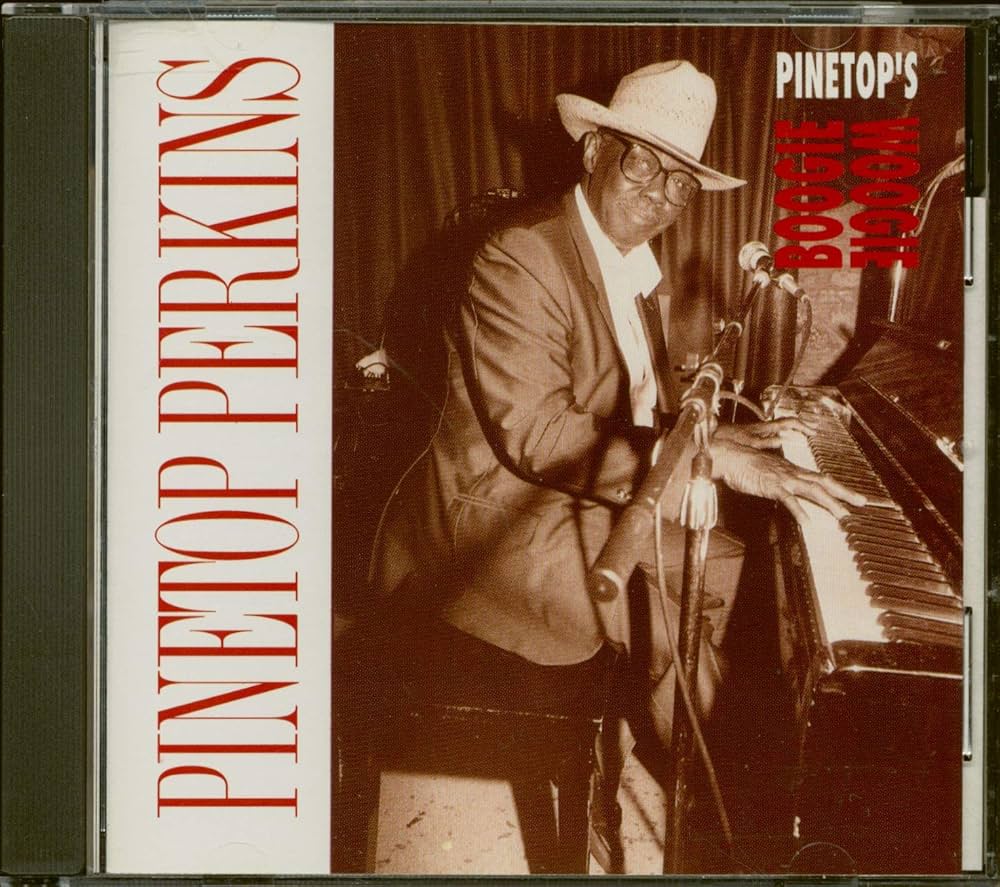
"Pinetop's Boogie Woogie" was written by Clarence "Pinetop" Smith and first recorded December 29, 1928, in Chicago, Illinois, for Vocalion Records. Pinetop Perkins recorded it at Sam Phillips's Sun Studio, Memphis, Tennessee, approximately August 10, 1953. The Antone's Records album Pinetop's Boogie Woogie (Antone's Records, 1992) was recorded at Arlyn Studio, Studio D, Lone Star Audio, and Reel Sound, Austin, Texas. Mixed by Stuart Sullivan, Derek O'Brien, and Arkadelphia. Track 4 ("Pinetop's Boogie Woogie") personnel: Pinetop Perkins (vocals, piano); Luther Tucker (guitar); Matt Murphy (guitar); James Cotton (harmonica). Full album personnel: Pinetop Perkins (vocals, piano); Duke Robillard, Jimmy Rogers, Hubert Sumlin, Matt Murphy, Derek O'Brien, Luther Tucker (guitar); James Cotton, Kim Wilson (harmonica); Preston Hubbard, Calvin Jones, Bob Stroger (bass); Fran Christina, Ted Harvey, George Rains, Willie "Big Eyes" Smith (drums). The album was reissued on New West Records (2015) and on vinyl by Texas Music Group (2022).