Introduction: A Single That Changed Everything
In the spring of 1957, in a modest studio in Crowley, Louisiana, a soft-spoken harmonica player from Baton Rouge walked up to a microphone and, guided by the instructions of a canny local producer, sang through his nose. The result was one of the most enduring debut singles in blues history: a two-sided marvel that captured the very essence of what would come to be known as swamp blues. "I'm a King Bee" and "I Got Love If You Want It" — pressed together on Excello Records catalogue number 2113 — were more than just two songs by an unknown musician. They were the opening statement of an artist who, though never fully appreciated in his own lifetime, would go on to influence the Rolling Stones, the Kinks, the Yardbirds, the Grateful Dead, and generations of blues and rock musicians on both sides of the Atlantic.
The story of these recordings is a story of place, circumstance, collaboration, and a singular producer's vision. It is also the story of a man who had been working in the shadows of better-known blues acts, quietly learning his craft, waiting for his moment. When that moment came, he didn't waste it. The first session that James Isaac Moore — soon to be rechristened Slim Harpo — ever led as a frontman resulted in two timeless classics that, nearly seven decades later, remain the definitive recordings of his career and monuments of American roots music.
The Man Behind the Harp: James Isaac Moore Before Slim Harpo
To understand the significance of the March 1957 session, you first need to understand the long road that brought James Moore to the studio. Born on February 11, 1924 — though some sources say January 11 — in Lobdell, Louisiana, near Baton Rouge, Moore grew up in poverty. His parents died while he was still a child, leaving him the eldest of a young family. He dropped out of school early and, through the late 1930s and early 1940s, supported himself doing hard manual labour in New Orleans — working as a longshoreman, a construction worker, whatever kept food on the table.
Music was never far away. Moore was self-taught on both guitar and harmonica, gravitating toward the latter with increasing dedication. He was drawn to the styles of Chicago blues artists, particularly Jimmy Reed, whose loose, rolling sound and relaxed vocal approach left a clear mark on Moore's own aesthetic. By the mid-1950s, Moore had settled in Baton Rouge and was performing regularly in the local bars and juke joints that made up the city's lively after-dark circuit, billing himself as Harmonica Slim.
The crucial connection came through his relationship with Otis Hicks, known professionally as Lightnin' Slim, who happened to be his brother-in-law. Hicks was already recording for producer J.D. Miller in Crowley and was one of Miller's most valued acts. Moore first appeared in a professional recording context as a sideman on Lightnin' Slim's "Lightnin' Blues," recorded in Crowley as far back as autumn 1955. For the next couple of years, Moore worked in Lightnin' Slim's shadow — an essential but uncredited presence, learning the studio environment, absorbing Miller's production approach, watching how records were made.
It was Lightnin' Slim who eventually advocated for Moore to have his own shot at the microphone, though even that came about in a roundabout way. Miller later recalled that Moore had Lightnin' act as an intermediary, asking the producer if he'd be willing to record his harmonica player. Miller was skeptical. "He was Lightnin's harmonica blower," Miller said. "I had no idea that he wanted to make records. He had Lightnin' come and ask me if I'd record him. Well, I hadn't heard him sing, so I told Lightnin', 'I'll listen after we get through the session.' I did, and it sounded pretty bad. So I told Lightnin', 'I don't believe I can use him. He's not too good a singer.' He said, 'Mr. Miller, I sure wish you would, because he might quit me if you don't.' So I said, 'Well, we'll give him another try.'"
That second try would produce something extraordinary.
The Producer: J.D. "Jay" Miller and His Crowley Studio
No account of the March 1957 session can proceed without an extended portrait of Joseph Denton "Jay" Miller, the man who shaped the sound of that day and, indeed, of swamp blues as a whole. Born on May 5, 1922, in Iota, Louisiana, Miller grew up steeped in the music of his region, learning guitar as a teenager and playing with various Cajun and country groups. A multi-talented operator, he moved through music as a performer, songwriter, and eventually — most consequentially — as a record producer and studio owner.
By 1947, Miller had set up a rudimentary recording facility at his home in Crowley, a small agricultural city in Acadia Parish, in the heart of the flat Louisiana prairie. He had initially worked out of Cosimo Matassa's studio in New Orleans, but the home studio allowed him to work on his own terms. Throughout the late 1940s and early 1950s, Miller focused primarily on Cajun and country music, building a roster that included Jimmy C. Newman and the accordion-driven French-language artists of the southwest Louisiana prairie. He also proved himself as a songwriter, most dramatically with "It Wasn't God Who Made Honky Tonk Angels," which became a landmark country number one for Kitty Wells in 1952.
But the music that would define Miller's legacy — and his place in American cultural history — came later, when he turned his ear toward rhythm and blues, swamp blues, and the African American musical communities of Baton Rouge. His deal with Ernie Young, owner of the Nashville-based Excello Records, gave Miller a crucial distribution outlet. Under the arrangement, Miller would record artists in his Crowley studio and license the masters to Excello for pressing and national distribution. It was an arrangement that would yield some of the most distinctive and beloved recordings in the blues canon.
Miller's studio aesthetic was minimalist, almost to a fault, but brilliantly so. He favoured sparse arrangements — small ensembles, no more than four or five musicians — and a recording approach that prioritised the naturalness of the performance over technical polish. The echo and reverb that characterise his Excello productions are not the lush artificial ambience of a Chicago studio; they are the sound of a small room in a Louisiana town, captured on tape with a directness that made everything feel simultaneously intimate and a little otherworldly. The harmonica has room to breathe. The guitar lines hang in the air. The drums feel like they're being played in the room next to you. It is an accidental perfection, a sonic signature that would come to define "the Excello sound" even though, as various commentators have noted, people often assumed these Louisiana records were made in Nashville.
As a talent-spotter, Miller had an unerring instinct for the particular qualities of the musicians who came through his door. He gave many of his artists their famous stage names — Lightnin' Slim, Lonesome Sundown, Lazy Lester — with a flair for branding that was well ahead of its time. And while his handling of royalties and publishing credits left much to be desired (a pattern shared by many small independent producers of the era), his ear for a performance was impeccable. His recordings of Lightnin' Slim, Lazy Lester, and Silas Hogan are among the great documents of the post-war Southern blues.
Miller's studio also had a distinctive stable of musicians — a house band of sorts, drawn from the talented pool of Louisiana players who orbited his operation. Chief among them, by the time of the Slim Harpo session, was a young guitarist named Gabriel Perrodin and his tight ensemble.
The Musicians: Guitar Gable and the Musical Kings
The musicians who accompanied Moore at the March 1957 session were not strangers to the Miller studio. They were, in fact, the heart of Miller's preferred rhythm section at the time: Gabriel "Guitar Gable" Perrodin on guitar, his brother Clinton "Fats" Perrodin on bass guitar, and Clarence "Jockey" Etienne on drums.
Guitar Gable — born Gabriel Perrodin on August 17, 1937, in Bellevue, Bossier Parish, Louisiana — was, at the time of the Slim Harpo session, barely nineteen years old, yet he was already a seasoned presence in Miller's studio. Self-taught on guitar, he had been influenced by the flamboyant, stinging style of Guitar Slim (Eddie Jones), and that influence can be heard in the controlled but urgent guitar tone he brought to his sessions. Gable had formed a group called the Swing Masters before connecting with vocalist King Karl (Bernard Jolivette) to form the Musical Kings, a group that also included his brother Clinton "Fats" Perrodin on bass and Clarence "Jockey" Etienne on drums. The Musical Kings had already cut their own debut single for Excello in 1956 — the instrumental "Congo Mombo" backed with "Life Problem" — before becoming, as Wikipedia describes them, "the heart of Miller's preferred studio musical ensemble."
The Perrodin brothers' surnames point to a Creole heritage — their father was Creole — and there is something in the music they made that sits at the intersection of multiple Louisiana traditions. Gable's guitar work has a Caribbean lightness to it on some recordings, a touch of what might be heard in the rhumba-influenced feel of "I Got Love If You Want It." He was versatile, capable of the stinging, tremolo-drenched lines that swamp blues demanded, but equally at home in the more rhythmically buoyant pop territory that the Musical Kings explored on their own records.
Fats Perrodin's bass playing is worth special attention in the context of these recordings. The bass lines on "I'm a King Bee" are deceptively simple but perfectly crafted — walking patterns that lock in with Jockey Etienne's minimal drum work to create the rolling, loping groove that is the song's backbone. There is no wasted motion. Every note serves the hypnotic momentum of the track. Swamp blues, as a genre, owes much of its distinctive character to this kind of playing: blues bass lines filtered through Louisiana rhythmic sensibilities, slower and looser than Chicago, earthier and more repetitive, suggestive of something vast and slow-moving, like a river.
Clarence "Jockey" Etienne's drumming on the session deserves equal credit. Miller's recording approach tended to place the drums back in the mix rather than forward, giving them a muffled, atmospheric quality. Etienne's playing is understated but essential — the snare hit with just enough snap, the hi-hat open and brushed rather than tightly clenched. It is playing designed to support rather than dominate, and in that restraint lies its power.
Importantly, while James Moore played harmonica at the session — the amplified harp work that would become so closely identified with his stage persona of Slim Harpo — he did not play lead guitar on the recording. Guitar Gable handled that role. This was a pattern that would continue throughout much of Harpo's recording career: while he played guitar in live performances, in the studio he typically relied on other guitarists, freeing himself to focus on his harp work and vocals.
The Session: March 1957, Crowley, Louisiana
The initial recording session at Miller's studio in March 1957 yielded three completed masters — three original songs: "I'm A King Bee," "Got Love If You Want It," and "This Ain't No Place For Me." The efficiency of this speaks to both the preparedness of the musicians and the directness of Miller's production method. There was no protracted multi-day process, no elaborate overdubs, no second-guessing. You walked in, you played, and if it sounded right, you moved on.
Before Moore could perform, however, there was the matter of his voice — and the remarkable creative intervention that Miller made to solve what he saw as a problem. Miller found Moore's natural singing voice unconvincing, too rough and unformed to carry a record on its own. But rather than sending him away, Miller hit upon an unusual solution. As he later recalled: "I instructed him to sing nasal. I'd never thought of that before. I asked him to sing nasal, and he didn't know what that meant. So I got in the studio, 'Sing through your nose, partially.' And that was really unique."
Moore apparently took to the instruction immediately, and the result was the distinctive vocal quality that defines every Slim Harpo recording: a drawling, nasal delivery that sounds lazy and relaxed on the surface but carries an undeniable authority. It is a voice that never shouts, never strains, never reaches — and yet commands complete attention. Peter Guralnick described Harpo's vocal style memorably as resembling what you'd get "if a Black country and western singer or a white rhythm and blues singer were attempting to impersonate a member of the opposite genre." There is something in that observation that captures the particular appeal of Harpo's singing: it belongs to multiple traditions at once without belonging fully to any of them.
There was also the matter of the name. Moore had been performing as Harmonica Slim, but as Miller pointed out, a West Coast performer already carried that name, and a duplication would create confusion in the marketplace. Accounts differ as to who invented the new name — Miller himself claimed some credit, while others attribute it to Moore's wife, Lovelle. What is generally agreed is that "Slim Harpo" was a clever reworking of "slim harp," a colloquial term for the harmonica, with the "-o" suffix turning it into something that sounded like a person's name while winking at the instrument he played. It was, in retrospect, the perfect blues name — evocative, slightly comical, instantly memorable.
"I'm a King Bee": The Song, the Sound, the Legend
"I'm a King Bee" is, at its most basic, a 12-bar blues — or rather, something close to a 12-bar blues, since blues historian Gerard Herzhaft has noted the song's structure is somewhat irregular, departing from the standard 12-bar format in ways that give it a slightly unpredictable, hypnotic quality. The irregularity is not felt as a flaw; if anything, it adds to the song's unsettling, dreamlike momentum.
The lyrical content draws on a long tradition of blues double entendre. The narrator describes himself as a king bee — the dominant insect, buzzing around the hive, capable of making honey if only he is allowed to come inside. The sexual metaphor is unmistakable, and in the context of 1957 American popular culture, it was provocative enough to limit radio play and restrict the record largely to regional markets and jukeboxes. The imagery itself, as Herzhaft has documented, draws from earlier blues traditions, incorporating elements from songs by Memphis Minnie, Bo Carter, and Muddy Waters, while the underlying rhythm figure derives from "Rockin' and Rollin'" by Lil' Son Jackson. In other words, Moore was not working in a vacuum; he was a skilled practitioner of a living tradition, recombining established elements into something new.
The opening harmonica figure is immediately arresting — a looping, circular phrase that sets the tone before Moore has sung a word. It does not announce itself with the drama of a Chicago blues introduction; instead, it simply arrives, matter-of-fact and unhurried, as if the song has already been playing in another room and you have just stepped closer to hear it. Gable's guitar enters with a simple, stinging lick that will recur throughout the song, a brief melodic comment between vocal phrases. The rhythm section settles into its groove and barely moves from it. Nothing changes dramatically. The song inhabits its atmosphere and stays there.
This static quality — the refusal to build dramatically toward a climax — is one of the defining characteristics of swamp blues and one of the things that mystified listeners accustomed to the architecturally more complex Chicago or Delta styles. But it is also the secret of the genre's hypnotic power. "I'm a King Bee" doesn't go anywhere because it doesn't need to. The groove is the destination.
Moore's amplified harmonica — the instrument for which he would become most famous — is handled with a restraint that is almost counterintuitive. He does not show off. He does not play rapid runs or complex improvisations. Instead, he uses the harp sparingly, as a kind of punctuation to his vocal lines, occasionally sustaining a note into a wavering, almost vocal sound that reinforces the song's languid, humid atmosphere. The amplification gives the harp a slightly buzzing, distorted quality that suits the "king bee" imagery perfectly — this is what a bee might sound like if it could play a harmonica.
Although it was released as the B-side to "I Got Love If You Want It," "I'm a King Bee" quickly established itself as the stronger track and Excello eventually swapped the sides, recognising that this was the record that was making noise on jukeboxes and in bars across the South. It didn't make the national R&B charts, but it became a significant regional hit — enough to establish Slim Harpo as a name worth watching on the Louisiana blues scene.
In 2008, more than half a century after its recording, "I'm a King Bee" received a Grammy Hall of Fame Award, an honour granted to recordings of "lasting qualitative or historical significance." Few awards have been more deserved.
"I Got Love If You Want It": The B-Side That Conquered Britain
While "I'm a King Bee" became the standard-bearer, the flip side has a claim to equal historical importance — not necessarily in terms of the quality of the original recording, but in terms of its subsequent impact on rock and roll history.
"I Got Love If You Want It" is a different kind of song from its A-side companion. Where "King Bee" is hypnotic and slow-building, "Got Love If You Want It" moves with more urgency, a rhumba-inflected bounce that is closer to the jump blues and New Orleans R&B styles that also circulated in Louisiana at the time. The rhythm is more syncopated, the feel more dance-oriented. It is a song built for a Saturday night, for a dance floor rather than a darkened juke joint corner.
The lyrics are in the same suggestive vein as "King Bee" — a narrator offering his services as a lover to a woman who is apparently teasing him or playing hard to get — but the tone is more forthright, less atmospheric. "Got love if you want it, babe," Moore sings, in his nasal drawl. "Quit teasin' me, baby, wit' yo' fine bone frame. If you let me love you, baby, I'll be yo' lovin' man." It is direct, unpretentious, and built on a groove that almost anyone could feel.
Gable's guitar work here has a lighter touch than on "King Bee," more rhythmically playful. Fats Perrodin's bass walks with an almost rhumba-like bounce, and Etienne's drumming has a looser, more open quality. The whole thing swings in a way that is different from the deeper hypnosis of the A-side — a slightly more extroverted personality.
The first significant recognition of the track's potential came quickly and from an unexpected direction. Sun Records rockabilly artist Warren Smith recorded a cover version of "I Got Love If You Want It" in February 1958, a "vicious rockabilly rendition," as one contemporary description puts it, that showed how naturally the song translated into other idioms. The underlying groove and the simple but effective hook were robust enough to survive translation.
But the song's most consequential impact came via the British Isles. As American rhythm and blues records began circulating among young British musicians in the early 1960s, Slim Harpo's 1957 single — both sides — attracted intense interest. The Kinks included "Got Love If You Want It" on their 1964 debut album, and the Yardbirds offered a live version that appeared on their debut album "Five Live Yardbirds" the same year. The Rolling Stones, meanwhile, took the A-side: "I'm a King Bee" appeared on the Stones' own 1964 debut, with Mick Jagger on vocals and harmonica, Brian Jones on slide guitar, Keith Richards on acoustic guitar, Bill Wyman on bass, and Charlie Watts on drums. Mick Jagger's famous remark on the subject — "What's the point in listening to us doing 'I'm a King Bee' when you can hear Slim Harpo do it?" — is both an act of admirable honesty and a tribute to the irreducible greatness of the original.
The Rolling Stones also took the title of Harpo's 1966 concert album "Got Live If You Want It!" directly from Slim Harpo's song title — a tribute, however uncredited, to the influence of the Baton Rouge bluesman. Later, the Stones would cover Harpo's "Shake Your Hips" on their 1972 masterpiece "Exile on Main Street," and ZZ Top would borrow its riff for their own early classic "La Grange." The debt rock and roll owes to Slim Harpo is incalculable.
Excello Records and the Release
After Miller recorded the tracks in Crowley, he followed his standard business practice of licensing them to Ernie Young's Excello Records in Nashville for release and distribution. Excello, founded in 1952, was a small independent label that had developed a strong identity in the R&B and gospel markets. Young had the distribution network and industry connections that Miller lacked; Miller had the recording facilities and the access to Louisiana talent that Young needed. The arrangement was mutually beneficial, even if it was not without its tensions.
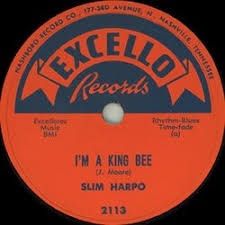
The single was pressed as Excello 2113, with "I Got Love If You Want It" as the A-side and "I'm a King Bee" as the B-side. The writing credit was listed as J. Moore (James Moore, Moore's legal name), with the BMI rights society indicated on the label. In retrospect, there is some complexity in the publishing arrangements — as was common in the era, the exact apportionment of songwriting credit and royalties was not always straightforward, and Moore later believed he was not receiving the royalties due to him, a dispute that would eventually cause a temporary break from both Miller and Excello. His wife Lovelle, who contributed substantially to the songwriting of many of his later songs, never received formal credit on the label during this period.
The initial release did not make the national R&B charts — a fact that, in retrospect, says more about the limitations of Excello's promotion and distribution than about the quality of the music. But the record circulated widely in the South, finding enthusiastic audiences in Louisiana, Mississippi, and neighbouring states through jukebox play and word of mouth. It established Slim Harpo's name in his home territory and provided the foundation on which he would build a career.
The decision to eventually flip the sides — recognising "I'm a King Bee" as the more powerful track — was a common one in the era, when the commercial potential of a given side was often only understood after the record had been in circulation for some time.
The Wider Context: Swamp Blues and the Excello Sound
The March 1957 session did not take place in a vacuum. It was part of a broader creative moment in Baton Rouge and the surrounding parishes, a moment in which J.D. Miller's studio in Crowley was functioning as a kind of unofficial creative hub for a generation of Louisiana blues musicians. Lightnin' Slim had been recording there since 1954. Lazy Lester (Leslie Johnson) would begin recording with Miller the following year, in 1958. Lonesome Sundown (Cornelius Green) and Silas Hogan were also in Miller's orbit. Together, these musicians — most of them based in or around Baton Rouge — created the body of recordings that would come to define swamp blues.
What united them was not a single sound so much as a set of shared aesthetic values: a preference for spare arrangements, a slower and more hypnotic tempo than Chicago blues, a sensibility shaped by the particular landscape and culture of south Louisiana. The production values of Miller's studio — the natural reverb of the small room, the muffled drums, the tremolo guitar effect that became a hallmark — gave these recordings their distinctive quality, a sound that was simultaneously rural and modern, deeply rooted and strangely timeless.
As Katie Webster, who played piano on many of Miller's sessions, observed, the producer demanded high standards from those who entered his studio: "When you go into J.D. Miller's studio you have to cut perfect records." The efficiency of the March 1957 session — three completed masters in a single day — reflects not just the talent of the musicians involved but the rigorous preparedness that Miller's operation required.
The connection between swamp blues and the broader Louisiana musical ecosystem is important. Miller was simultaneously recording Cajun music, zydeco, swamp pop, and early rock and roll in his Crowley facility, and the cross-pollination between these genres was real. The rhumba feel of "I Got Love If You Want It" owes something to the Caribbean rhythms that had long been part of south Louisiana's musical DNA. The nasal, almost country quality of Harpo's singing connects to the Hank Williams-inflected country sounds that Miller had been producing for years. Swamp blues, in this context, is not an isolated tradition but a confluence of multiple streams.
Legacy and Afterlife
The years following the March 1957 session were not immediately filled with commercial success for Slim Harpo. He continued recording for Excello — and occasional tensions with Miller notwithstanding, he stayed with the label until his death — but it wasn't until "Rainin' in My Heart" in 1961 that he achieved his first national chart hit, reaching number 17 on Billboard's R&B chart and number 34 on the Hot 100. His biggest success came in 1966 with "Baby Scratch My Back," which hit number one on the R&B chart and crossed over to number 16 on the broader pop charts, an extraordinary achievement for a deeply Southern, rural blues record in an era dominated by the Beatles and the Beach Boys.
Throughout this period, Harpo never became a full-time musician. He owned a trucking business during the 1960s, and he remained based in Baton Rouge, living modestly and playing the Southern club circuit. It was not until the British Invasion — particularly the Rolling Stones' adoption of his music — that he began to gain a wider audience, eventually performing at venues like the Fillmore East in New York and the Whisky a Go Go in Los Angeles in the late 1960s.
He was on the verge of his first European tour, with recording sessions in London already planned, when he died suddenly of a heart attack in Baton Rouge on January 31, 1970. He was 46 years old. His death, as one writer put it, was "unexplainable" — he had never been plagued with serious health problems. He was buried at Mulatto Bend Cemetery in Port Allen, Louisiana.
Guitar Gable, the guitarist who had played on that first, definitive session, continued working in Louisiana music for decades. He left Miller and Excello after a dispute over the royalties from "This Should Go On Forever" — a song Gable had recorded in 1958 that became a hit in a cover version by Rod Bernard — and his own career, while locally celebrated, never achieved the national breakthrough that his talent deserved. He died in hospital at Opelousas, Louisiana, on January 28, 2017, at the age of 79.
J.D. Miller continued producing music until the late 1960s, when he took a job with the town of Crowley and passed the studio on to his sons. He died on March 23, 1996, from complications following bypass surgery. His legacy is genuinely complicated: he was a visionary producer of Black music who simultaneously embraced segregationist ideology, producing and releasing explicitly racist recordings on his own Reb Rebel label in the 1960s. This contradiction — the man who shaped the sounds of Lightnin' Slim, Lazy Lester, and Slim Harpo, and also released recordings celebrating white supremacy — has come to be seen by music historians as one of the more painful paradoxes of the Jim Crow South's musical history.
The Grammy Hall of Fame Award that "I'm a King Bee" received in 2008 was a belated but fitting recognition of the recording's significance. The citation honours recordings of "lasting qualitative or historical significance," and on both counts, the song qualifies emphatically. Its influence stretches from the British Invasion to the Rolling Stones' peak creative period, from the Grateful Dead's early improvisations to the broad river of rock and blues that flows through popular music to this day.
Conclusion: The Room in Crowley
What happened in J.D. Miller's studio in Crowley, Louisiana, in March 1957 was, on one level, entirely unremarkable: a handful of musicians gathered to record a few songs for a small independent label with limited distribution. No one in the room could have anticipated that one of those recordings would eventually receive a Grammy Hall of Fame Award, that it would be covered by the Rolling Stones on their debut album, that it would be performed hundreds of times by the Grateful Dead, that it would be cited by generation after generation of blues and rock musicians as a foundational influence.
What makes these recordings extraordinary is the precision with which they captured something that is very difficult to capture: a mood, an atmosphere, a feeling of a particular place and time. "I'm a King Bee" sounds like a Louisiana summer evening — humid, languid, dark with potential energy, alive with the buzzing of things unseen. It is simultaneously simple and complex, immediately accessible and mysteriously deep. The same can be said of "I Got Love If You Want It," with its infectious rhumba groove and its no-nonsense lyrical proposition.
The musicians who made them — Moore's nasal, unhurried vocal and amplified harp; Gable's stinging, minimalist guitar work; Fats Perrodin's rolling bass lines; Jockey Etienne's sparse, atmospheric drumming — were all doing something that looked, on the surface, like the simplest thing in the world. But simplicity of this kind is an achievement, not a default. Miller's production framework, the particular chemistry of the assembled musicians, Moore's willingness to follow an unusual vocal instruction and trust that it would yield something unique: all of these things had to come together simultaneously to produce what they produced.
In the decades since, no one has successfully duplicated the sound of Slim Harpo's original Excello recordings, despite countless attempts. The languid soulfulness, the perfect balance between restraint and expression, the ineffable quality that makes you feel the Louisiana heat even through a pair of headphones — these things belong to a specific moment, a specific room, a specific group of people, and a specific set of circumstances that can never be precisely recreated. That is what makes records like "I'm a King Bee" and "I Got Love If You Want It" irreplaceable: they are not just songs, but time capsules, sealed in March 1957 and capable of transporting anyone who listens back to that room in Crowley, where a man who didn't know what "singing nasal" meant took a producer's strange instruction and turned it into one of the most distinctive voices in American music.
The original single "I'm a King Bee" / "I Got Love If You Want It" was released on Excello Records, catalogue number 2113, in 1957. Personnel: Slim Harpo (vocals, harmonica); Guitar Gable / Gabriel Perrodin (guitar); John "Fats" Perrodin (bass); Clarence "Jockey" Etienne (drums). Produced by J.D. Miller. Recorded at J.D. Miller's Studio, Crowley, Louisiana, March 1957.
Suggested Reading
Slim Harpo: Blues King Bee of Baton Rouge by Martin Hawkins
Selected Discography
I'm A King Bee 1957-1961 ORIGINAL RECORDINGS REMASTERED