
Introduction: The Crossover That Changed Everything
In the spring of 1961, a record began appearing on radio playlists and jukebox set lists throughout the American South that seemed to defy easy classification. It was too plaintive to be straight blues, too rooted in swamp and earth to be straightforward country, and too saturated in the atmosphere of the Louisiana bayous to be conventional rhythm and blues. The voice singing it was nasal, unhurried, and somehow both emotionally direct and oddly detached — like a man delivering the news of his heartbreak with a kind of exhausted acceptance rather than burning grief. The record was "Rainin' in My Heart" by Slim Harpo, and by the summer of 1961 it had climbed to number 17 on Billboard's R&B chart and crossed over to number 34 on the broader pop chart — a remarkable achievement for a record made in a small studio in a small Louisiana town, by a man who drove trucks for a living and had been recording without major commercial success for four years.
"Rainin' in My Heart" was not Slim Harpo's artistic reinvention. It was, in many ways, a logical extension and refinement of everything he and his producer J.D. Miller had been working toward since their first session together in March 1957. But it was also something genuinely new in his catalogue: a slow, melancholy ballad that replaced the suggestive swagger of "I'm a King Bee" with something more vulnerable, more openly emotional, and in doing so, something that spoke to a far wider audience. It became a standard that would be covered by country artists, Cajun musicians, blues bands, and rock and rollers on both sides of the Atlantic. It earned Harpo an appearance on American Bandstand. And it triggered, in its wake, a bitter dispute over royalties that would sour his relationship with Miller and result in nearly two years of creative silence at precisely the moment when Harpo's momentum should have been carrying him forward.
The story of "Rainin' in My Heart" is thus not just the story of one exceptional recording. It is the story of a breakthrough and its complicated aftermath — of artistic triumph tangled with commercial conflict, of a musician whose genius was evident to everyone except the people in a position to properly reward it.
The Road from "King Bee" to "Rainin'": Four Years in the Making
Between his debut session in March 1957 and the recording of "Rainin' in My Heart" around 1959 or early 1960, Slim Harpo had continued working steadily with J.D. Miller in Crowley, releasing a succession of singles on Excello that built his reputation without breaking through to the national charts. Those four years were not idle ones, either creatively or professionally. Harpo was performing constantly, playing the Southern club circuit, working the juke joints and dance halls of Louisiana, Mississippi, Alabama, and Texas, building the kind of regional following that sustained a working musician's life even without chart success. He was also, during this period, running other businesses — working construction, hauling sugar cane, eventually establishing the trucking operation that would remain a parallel career throughout his musical life.
The singles from those years have their own considerable merit. "Wondering and Worryin'" (1958), "Strange Love" (1958), "You'll Be Sorry One Day" (1959), and "One More Day" (1959) all showcase the distinctive swamp blues formula that Miller and Harpo had developed on the debut: spare instrumentation, nasal vocal delivery, rolling harmonica figures, and the hypnotic loping groove that came from the interplay between guitar, bass, and drums. "Blues Hang-Over" (1960) has a particularly atmospheric quality, and "Buzz Me Babe" (1960) — which recycled the telephone imagery of the day into a suitably buzzing title — showed Harpo and Miller working with variations on the King Bee template that had established them initially.
Between 1957 and 1961, Miller recorded Slim Harpo across approximately six sessions in Crowley, producing a body of material that ranged from driving up-tempo R&B to the slower, more introspective blues that would eventually yield "Rainin' in My Heart." What is notable about this period is the gradual evolution of the ensemble around Harpo. By the time of the sessions that produced "Rainin' in My Heart," the musician lineup had shifted from the Guitar Gable–led Musical Kings who had appeared on the debut to a newer, more settled combination that would become Harpo's most enduring studio and live ensemble.
The Songwriting: Slim Harpo, Lovelle Moore, and the Mystery of "Jerry West"
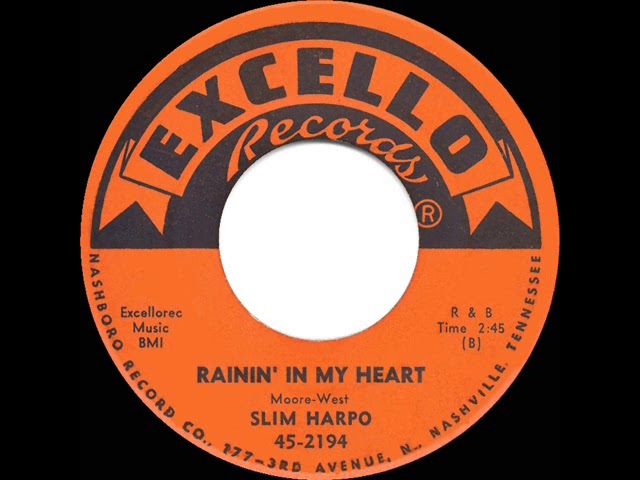
The songwriting credit on "Rainin' in My Heart" as it appeared on Excello Records reads "Moore-West" — a pairing that encodes an important and somewhat complicated story about how songs got written and credited in Slim Harpo's world.
"James Moore" is unambiguously Slim Harpo himself — his legal name, and the name under which his songwriting credits were registered. "Jerry West," however, is an alias used by producer J.D. Miller, who apparently took a co-writing credit on the song. This was not unusual in the world of independent record production in the 1950s and 1960s, where producers frequently attached their names to songs as a way of collecting additional income through publishing royalties. Whether Miller's contribution to the composition was substantive or merely a business arrangement is difficult to determine from the historical record.
But the Moore-West credit obscures a third creative presence: Slim Harpo's wife, Lovelle Moore. In a 1961 interview, Harpo himself explicitly credited his wife with the song, recalling: "Around '59 or '60, I did a song my wife wrote called 'Rainin' in My Heart.'" This is consistent with what is widely documented about the creative partnership between the two: many of Harpo's most successful songs were co-written with Lovelle, who contributed to his songwriting throughout his career, though she never received a formal credit on any Excello release. The invisibility of Lovelle Moore's contribution to her husband's catalogue is one of the more troubling aspects of Harpo's legacy, a reminder that the business practices of the era were particularly harsh on those who lacked the power to insist on fair treatment.
Lovelle Moore's contribution to her husband's art was not just a matter of supplying occasional lyrics. By all accounts she was an active collaborator who helped shape the emotional content and lyrical quality of the songs that bore his name. Her instinct for melody and sentiment — evident in "Rainin' in My Heart" — represents a sensibility somewhat different from the earthier, more suggestive material of the "King Bee" era, and it is this broader emotional range that would make Harpo's catalogue so durable and so accessible to artists in multiple genres. When Hank Williams Jr. recorded "Rainin' in My Heart" in 1971 and took it to number three on the country charts, or when Jo-El Sonnier took it to number 35 on the country chart in 1989, they were in part acknowledging the song's country feeling — a quality that Lovelle's contribution had helped put there.
The Producer and His Methods: J.D. Miller in 1960
By the time the sessions that produced "Rainin' in My Heart" were recorded — most likely in late 1959 or 1960, with the single released in early 1961 — J.D. Miller was operating his studio in Crowley at the height of his swamp blues productivity. His deal with Excello Records, in place since 1955, had given him a reliable distribution channel for his Louisiana recordings, and the stable of artists he was recording in Crowley at this period represented a genuinely remarkable concentration of blues and R&B talent: Lightnin' Slim, Lazy Lester, Lonesome Sundown, Silas Hogan, and Slim Harpo all recorded with Miller during this era, each bringing a distinctive voice to the shared sonic environment of the Crowley studio.
Miller's recording approach had not changed dramatically from the first Harpo sessions of 1957, but it had been refined. The spare, echo-drenched sound of the Excello productions was by now a fully formed aesthetic rather than an accidental by-product of limited resources. Miller understood that the particular atmospheric quality of his recordings — the sense of space and air in the mix, the way sounds seemed to float rather than press forward — was an asset that distinguished his work from the denser, more urban sounds coming out of Chicago or Memphis. He resisted the temptation to add production elements that might have been fashionable but would have dissolved the particular identity of what his studio was producing.
For "Rainin' in My Heart," Miller was working with a song that required a somewhat different approach than the up-tempo blues and mid-tempo R&B that had characterised Harpo's earlier singles. This was a slow ballad — closer in feeling to country weeping songs or to the tender side of New Orleans R&B than to the driving swamp blues of "I'm a King Bee." The challenge for Miller was to give the song an appropriate emotional weight without abandoning the distinctive Excello atmosphere. The solution he arrived at — a gently rolling rhythm, subdued ensemble playing, Harpo's voice and harmonica at the centre of a spare but carefully balanced arrangement — was one of his finest achievements as a producer.
Miller's use of echo and reverb, always a characteristic of his productions, is particularly effective on "Rainin' in My Heart." The slight reverb applied to Harpo's voice gives it a haunted, atmospheric quality that suits the song's mood perfectly. The echo suggests depth and space — an aural equivalent, perhaps, of rain falling in an open, lonely landscape. It is production as emotional storytelling, and it is far from accidental.
There is also the question of the writing credit "Jerry West" — Miller's alias on this and other blues and R&B compositions. That Miller used a pseudonym to disguise his race when writing blues songs reflects the complex social dynamics of the Jim Crow South, where a white man publishing blues music under his own name might have encountered commercial or social friction. The alias also allowed Miller to accumulate publishing income from songs recorded by Black artists without that income appearing in his own name — a practice that, whatever its commercial logic, reflects the asymmetry of power that characterised the relationship between many small-label producers and the artists they recorded.
The Musicians: The King Bees — James Johnson and Rudolph Richard
By the time of the sessions that produced "Rainin' in My Heart," the ensemble around Slim Harpo in the studio had evolved significantly from the Guitar Gable–led Musical Kings who had appeared on the debut single. The group now cohered around two guitarists who would become Harpo's most enduring musical partners: James Johnson and Rudolph "Rudy" Richard, both of whom are credited on the single's companion piece "Don't Start Cryin' Now" and who contributed to the Rainin' in My Heart recording sessions.
Johnson's later recollection of the sessions provides an invaluable human perspective on the moment. "Yeah, we didn't know exactly which one was going to make it," he said of his recording work with Harpo. "But Slim hit the right spot at the right time. We were just an old blues band, and I didn't never think something like that would go that far." The modesty in that recollection is characteristic — Johnson was a man who did music because he loved it, maintaining a day job as a mechanic at Louisiana State University throughout his musical career, never seeking the spotlight even as the records he played on became famous worldwide.
The backstory of how Johnson joined Harpo's outfit is telling. He had originally been brought into the musical orbit of Lightnin' Slim — Harpo's brother-in-law and the man who had originally advocated for Harpo to get his own recording opportunity with Miller. When Lightnin' Slim found religion and temporarily stepped back from performing, Johnson was steered toward Harpo. "Slim said, 'Well, I can use a guitar player.' I ran a few licks for him. He said, 'Yeah, it sound pretty good.' So, I start playing bass with him, and Rudolph [Richard] was lead guitar." The arrangement — Johnson sometimes on bass, sometimes on guitar; Richard on lead guitar — gave the King Bees a flexible two-guitar core that could serve both the rhythmic and melodic needs of different songs.
Rudolph Richard, who died in 2014, was the other constant in Harpo's studio ensemble from the late 1950s onwards. Rudolph Richard had been with Slim on and off since 1958, and his guitar work on tracks like "Don't Start Cryin' Now" and the later "Baby Scratch My Back" — with its distinctive "chicken pickin'" tremolo style — became as much a part of the Slim Harpo sonic identity as the nasal vocal or the amplified harmonica. Richard's playing on "Rainin' in My Heart" is restrained and supportive, never overreaching, always serving the emotional tone that the song demands. This is the mark of a great accompanist: the ability to pull back when the song requires space.
The album Slim Harpo Sings "Raining in My Heart" (Excello LPS-8003) provides detailed personnel notes that document the ensemble around this period. Session records indicate that the core lineup for the key sessions included James Johnson and Rudolph Richard on guitars, T.J. Kitchen on bass, and Sammy K. Brown on drums, with additional sessions featuring piano from either Katie Webster or Sonny Martin. The piano parts — where they appear on the album — are restrained and supportive, adding harmonic depth without overwhelming the spare instrumental palette.
Katie Webster, who appeared on several Miller sessions of this period, was herself a formidable talent. A Cajun-inflected blues and R&B pianist from the Lafayette area, Webster became one of the most distinctive keyboard voices in south Louisiana music, later building an international career as a solo artist. Her presence on Miller sessions — and her famous observation that in Miller's studio "you have to cut perfect records" — underscores the level of musicianship that surrounded Harpo during this creative period.
The rhythm section's contribution to "Rainin' in My Heart" deserves particular emphasis. The song's success as a ballad depends entirely on the quality of its groove — on the rhythm section's ability to generate forward momentum while maintaining an emotional stillness that suits the song's mood. This is a more subtle technical challenge than simply driving a fast blues, and the musicians here meet it beautifully. The drum work is measured and unhurried, the bass walks quietly but purposefully, and the overall effect is of something gently but inexorably moving forward — like the rain itself, which doesn't rush but keeps coming.
Willie "Tomcat" Parker, who played tenor saxophone on the companion piece "Don't Start Cryin' Now," added a horn presence that brought a different tonal colour to that recording — more assertive, more R&B in feel — highlighting how versatile the musical environment around Slim Harpo had become by this point.
The Session: Recording "Rainin' in My Heart" at the Crowley Studio
The specific date of the "Rainin' in My Heart" session is not pinpointed in public records with the same clarity as the March 1957 debut, but available documentation points to a recording date in late 1959 or during 1960, consistent with its release as a single in early 1961. The session appears to have taken place as part of a broader set of recordings from which Miller would draw to populate both the single and the subsequent album.
The Slim Harpo Sings "Raining in My Heart" album, released by Excello in 1961 as catalogue number LPS-8003, drew on material from multiple sessions. The album's session documentation indicates that the bulk of the album material was recorded in December 1959 at the Jay Miller Studio in Crowley. The sessions were recorded in Miller's characteristic way: a live ensemble in a small room, minimal setup, direct recording to tape with Miller shaping the sound through the mix and the application of his distinctive production touches.
What distinguished the "Rainin' in My Heart" session from earlier Harpo work was the song itself — a slow twelve-bar ballad that demanded a completely different emotional register from the artist. Where the earlier swamp blues singles had been built on groove and atmosphere, on the hypnotic repetition of rhythmic figures, "Rainin' in My Heart" asked Harpo to inhabit a specific emotional state and communicate it directly to the listener. The lyrical content — a narrator whose lover has left him, leaving him with the blues in a literal and figurative rainfall — is simple but effective, drawing on the long blues tradition of using weather as an emotional correlative.
Harpo's vocal performance on the track is one of the most revealing in his catalogue. The nasal delivery that Miller had coached him into at the 1957 debut session is present, but here it serves a different purpose: rather than giving the voice a slightly detached, almost ironic quality, the nasality here sounds genuinely mournful, as if emotion is being held in check by sheer force of habit rather than indifference. There is a quality to Harpo's singing on this record that Peter Guralnick's famous description — "if a Black country and western singer or a white rhythm and blues singer were attempting to impersonate a member of the opposite genre" — captures very well. The song sits right at the intersection of multiple American musical traditions, and Harpo's vocal sits there with it, belonging to all of them and none of them entirely.
The harmonica work on "Rainin' in My Heart" is notably restrained, more atmospheric than demonstrative. Where the harp on "I'm a King Bee" had been a constantly active presence, buzzing and circling around the vocal, here it appears in concentrated moments — brief interjections between vocal phrases, a sustained moan at particular emotional peaks — that serve the song's mood rather than showcase the player's technique. This restraint was characteristic of Harpo's harp playing throughout his career: he used the instrument to serve the song, not to display virtuosity. As one observer noted, his "less-is-more style made suspenseful and effective use of silent space between notes."
The recording of the companion piece "Don't Start Cryin' Now" — which was originally pressed as the A-side to "Rainin' in My Heart" on Excello 2194 — offers an instructive contrast. Where the ballad is quiet and inward, "Don't Start Cryin' Now" is fast, riffing, and extroverted, with James Johnson and Rudolph Richard driving a tight, urgent groove over which Willie "Tomcat" Parker's saxophone cuts through with real force. The two sides of the single represent the full range of Slim Harpo's musical personality: the contemplative weeper and the sharp-edged dance floor rocker, all produced in the same room with the same people.
The Flip That Became the Hit: How "Rainin' in My Heart" Found Its Audience
The initial configuration of Excello 2194 placed "Don't Start Cryin' Now" as the A-side and "Rainin' in My Heart" as the B-side — an arrangement that suggests Miller and perhaps Ernie Young at Excello initially favoured the faster, more commercially conventional dance track as the stronger commercial proposition. This was a common enough error in an era when the B-side frequently turned out to be the side that mattered.
What changed the equation was radio. DJs in the South began playing the B-side — "Rainin' in My Heart" — in preference to the A-side, and listener response was immediate and enthusiastic. The record had a quality that spoke to people across demographic lines: it worked as blues, it worked as country, it worked as a tearjerker in the broad pop sense. Once radio embraced it, Excello swapped the sides, and what had been the B-side became the focus of the label's promotional efforts.
The Cash Box trade magazine — one of the key industry publications of the era — captured the early enthusiasm for the record: describing it as "slow moaning, earthy blues" that "proves the artist's meat as he takes the tune for a tuneful ride. A real weeper." The mesmerizing quality of the performance, combined with its cross-genre appeal, drove the record steadily up the charts through the spring and early summer of 1961. "Rainin' in My Heart" hit the R&B top 20 in June while developing more slowly on the pop charts, eventually reaching number 34 on the Billboard Hot 100 in the summer. For a deeply Southern, regionalized blues record on a small independent label, these were remarkable numbers.
The pop crossover success was significant enough to earn Harpo something almost unprecedented for a Louisiana swamp blues artist: an appearance on American Bandstand, the nationally televised dance show hosted by Dick Clark that had become the primary vehicle for introducing new pop music to the American teenage market. Harpo's appearance was a lip-sync performance — the show rarely featured live music — but the fact of it represents a moment of genuine mainstream recognition for an artist whose music had previously circulated largely through regional channels. Frustratingly, no video documentation of this appearance survives: Harpo appeared on American Bandstand in July 1961, but all the kinescopes for that year have been lost.
The album that followed — Slim Harpo Sings "Raining in My Heart" — was Harpo's first full LP, released on Excello as LPS-8003 later in 1961. Drawing on material from the 1959 and subsequent sessions, it presented a full portrait of the artist at a creative peak, including the instrumental "Moody Blues" (a track that, according to some accounts, may have given the British progressive rock band their name when they discovered Harpo's music in the mid-1960s) and "Snoopin' Around," alongside various slower blues and R&B pieces that showcased the full range of the King Bees ensemble. The album was, by any measure, a fully realised artistic statement — not the hastily assembled cash-in that might have been the response to a surprise hit, but a genuine representation of what Slim Harpo and J.D. Miller were capable of together.
The Aftermath: Royalties, Rupture, and the Lost Years
The success of "Rainin' in My Heart" should have been the beginning of a sustained commercial breakthrough for Slim Harpo. Instead, it became the trigger for a damaging rupture between Harpo and his producer that effectively silenced him for the better part of two years at the worst possible moment.
The dispute was about money — specifically about royalties. Under the arrangement Miller had with Excello, Miller received a relatively small royalty from Ernie Young's Nashville-based company, from which he in turn paid Harpo his share. From Harpo's perspective, the share he was receiving did not match the commercial success the record had achieved, and the dispute became increasingly acrimonious. The situation illustrates a pattern that was depressingly common in the small-label blues and R&B world of the era: the producer and the label owner were insulated from the artist by layers of contractual complexity that made it very difficult for the recording musician to verify what was actually owed or to claim it effectively.
Harpo's response was to try to jump ship. He recorded four tracks for Imperial Records, a Los Angeles-based label owned by Lew Chudd that had a significantly stronger distribution network than Excello. However, Miller had locked Harpo into a contract that gave him legal control over the artist's recordings, and when Miller's lawyers learned of the Imperial session, they moved to block the release of the tracks. Harpo was effectively trapped: bound by contract to Miller and Excello, unable to release new material elsewhere, the momentum of his breakthrough dissipating with every month of inaction.
"He laid down a few sides for Imperial Records, but those were never released because of Miller's iron-clad contract," as one account puts it. "Ernie Young could have put out singles of earlier recordings but opted not to, effectively squelching any chances of getting a follow-up to the hit. Slim spent the next two years on the road, performing mainly in the south and southwestern U.S.; at least he was able to take advantage of the fame his hit had given him, while Miller and Young were unable to cash in beyond the money they'd made on 'Rainin' in My Heart.'"
This was the bitterest consequence of the success: both artist and industry lost. Harpo lost the commercial momentum that a timely follow-up could have secured, while Miller and Excello lost the income that further successful singles from their biggest pop-crossover act could have generated. It was an impasse that served no one.
Eventually, after more than two years of near-silence on record, Harpo and Miller negotiated a new contract — one that gave Harpo full songwriting royalties under his own name, James Moore, even though Lovelle Moore continued to contribute substantially to the songs. A new single, "I Love the Life I'm Living," appeared on Excello in the fall of 1963. But by that point, as one commentator observed, "more than 18 months between releases and record buyers' memories had no doubt faded." The moment had passed, and it would take another five years — and the very different kind of record that "Baby Scratch My Back" represented — before Harpo would chart nationally again.
The Song Across Genres: A Standard That Crossed All Lines
One measure of the depth and durability of "Rainin' in My Heart" as a composition is the breadth of the artists who subsequently recorded it, and the variety of musical contexts in which it succeeded. Country, Cajun, swamp pop, rock and roll, zydeco — the song moved through all of these traditions as naturally as rain moves through different kinds of landscape.
The most commercially successful cover came from Hank Williams Jr., who recorded "Rainin' in My Heart" in 1971 featuring the Mike Curb Congregation, and took it to number three on the U.S. country chart and number two in Canada. That a song rooted in the swamp blues of Louisiana could sit comfortably at the top of the country chart is testament to the song's structural quality and to the quality of Lovelle Moore's songwriting instinct. The song's emotional core — loss, loneliness, the feeling of persistent melancholy that won't lift — is universal, and its musical framework was flexible enough to absorb the arrangements of very different genres without losing its essence.
Jo-El Sonnier, the Louisiana-born Cajun and country musician, took the song to number 35 on the U.S. country chart in 1989, demonstrating that the record's appeal was not merely a matter of period taste but something durable. Warren Storm, the swamp pop drummer and singer who was himself a regular at Miller's Crowley studio, also recorded the song, adding it to a swamp pop repertoire that made natural use of its blend of blues feeling and country sentiment.
The song also became a fixture in the repertoires of British blues bands who discovered Slim Harpo's music in the early 1960s. The Moody Blues — who may have named themselves after Harpo's instrumental "Moody Blues" — were among the British acts who absorbed his influence, as were various other acts in the early British R&B boom. The accessibility of "Rainin' in My Heart" made it easier for British musicians to approach than the more assertively bluesy material in Harpo's catalogue, and this accessibility was itself a consequence of the song's cross-genre quality.
Neil Young has also been cited as having covered "Rainin' in My Heart" — a connection documented in J.D. Miller's Wikipedia entry, which notes that Miller "produced Harpo's 'I'm a King Bee' and 'Rainin' in My Heart', significant swamp blues recordings later covered, respectively, by the Rolling Stones and by Neil Young." Young's association with the song reflects the broader rock world's ongoing engagement with Harpo's material.
Legacy: The Hit That Defined a Career
"Rainin' in My Heart" occupies a pivotal position in the Slim Harpo story. It was, chronologically, the midpoint of his recording career — the first of his three genuine pop crossover successes (the others being "Baby Scratch My Back" in 1966 and, to a lesser degree, "Tip On In" in 1967) — and the one that established him as something more than a regional favourite. Before "Rainin' in My Heart," Slim Harpo was known along the Southern club circuit and among the cognoscenti of American blues. After it, he was a name that registered on the national consciousness, however briefly.
The song's success also, paradoxically, revealed the fragility of his position within the music industry. The royalties dispute that followed the hit demonstrated with painful clarity that commercial success, in the small-label blues world of 1961, did not automatically translate into financial security for the artist. Harpo was not wealthy. He kept his trucking business running throughout the early 1960s because he had to — because the music business, even at its most rewarding, did not offer the reliability that a working man with a family needed.
The recording itself has worn remarkably well. Listening to it today, "Rainin' in My Heart" sounds simultaneously of its time and timeless — unmistakably a product of J.D. Miller's Crowley studio and of the swamp blues aesthetic, yet carrying an emotional directness that transcends its origins. Harpo's vocal is unhurried and unforced, the guitar work from James Johnson and Rudolph Richard is perfectly calibrated to the song's mood, and the production — Miller's echo, the careful balance of the ensemble, the way the harmonica enters and withdraws like something breathing — creates an atmosphere that is, in its own quiet way, irreducible.
John Broven, the musicologist and author of South to Louisiana, captured the record's significance concisely, noting that "Rainin' in My Heart" changed everything for Slim. "After climbing the R&B charts the record crossed over to the popular ratings and reached No. 34 on the Billboard 100 in the summer of 1961." For a record made in a small Louisiana studio on the kind of modest budget that Miller's Crowley operation worked with, that chart position represented an extraordinary achievement — one that confirmed not just the talent of the musician, but the rightness of the aesthetic philosophy that Miller had been developing across years of recording Louisiana artists.
Slim Harpo would never return to that chart altitude with "Rainin' in My Heart" again, though "Baby Scratch My Back" would surpass it five years later. He would continue recording and performing until his death from a heart attack on January 31, 1970 — at 46, on the eve of a first European tour, with recording sessions in London already planned. The song he had made in a small studio in Crowley, drawing on his wife's songwriting gift and his own irreplaceable vocal identity, would outlast him, finding its way into the catalogues of country stars, Cajun revivalists, and blues collectors worldwide.
Conclusion: Rain as a State of Mind
What "Rainin' in My Heart" ultimately represents — beyond its chart success, beyond its catalogue of covers, beyond its role in the Slim Harpo biography — is a perfect meeting of song and performance. It is a record in which everything that needed to be right was right: the melody, the lyric, the vocal, the arrangement, the production. Such moments are rarer than the volume of recorded music in the world might suggest, and they are impossible to engineer deliberately. They happen when the right artist, the right song, the right producer, and the right musicians come together at the right moment — and something clicks.
For James Moore — the man who had grown up in poverty in Lobdell, Louisiana, who had worked the docks in New Orleans and hauled sugar cane and driven trucks, who had spent years performing in the bars and juke joints of the South before finding his way to J.D. Miller's studio — that click came in a small room in Crowley, sometime in 1959 or early 1960, when a song his wife had written took shape in the hands of a group of musicians who understood instinctively what it needed. The rain in the song is a state of mind as much as a weather condition — persistent, pervasive, the kind of melancholy that doesn't announce itself dramatically but simply keeps on falling.
It was the perfect metaphor for a man like Slim Harpo, whose genius was never loud or assertive, who didn't shout his feelings but let them seep through the cracks of his nasal drawl, whose harmonica didn't wail but breathed, whose music accumulated its effects slowly and deeply, the way rain accumulates in the ground. The record took four years to arrive after his debut and cost him two years of his career in the dispute that followed. But it announced to the world what those who knew him had always understood: that this quiet, deliberate man from the Louisiana bayous was, in his own understated way, one of the finest blues musicians of his generation.
"Rainin' in My Heart" was released as Excello 2194 in early 1961, with "Don't Start Cryin' Now" as the original A-side. Written by James Moore (Slim Harpo) and Jerry West (J.D. Miller's alias). Produced by J.D. Miller. Recorded at J.D. Miller's Studio, Crowley, Louisiana, approximately December 1959. Personnel: Slim Harpo (vocals, harmonica); James Johnson (guitar/bass); Rudolph Richard (guitar); T.J. Kitchen (bass); Sammy K. Brown (drums); with additional sessions featuring Katie Webster or Sonny Martin (piano). It reached number 17 on the U.S. R&B chart and number 34 on the pop chart in 1961. Featured on the album Slim Harpo Sings "Raining in My Heart" (Excello LPS-8003, 1961).
Suggested Reading
Slim Harpo: Blues King Bee of Baton Rouge by Martin Hawkins









