Lightnin' Slim and the Excello Sound
Lightnin' Slim — born Otis Verries Hicks (1913–1974) — was the founding star of producer J.D. "Jay" Miller's Louisiana blues stable, and the artist most responsible for establishing what came to be known internationally as the "Excello sound" or "swamp blues." Raised partly in St. Francisville and Baton Rouge, Louisiana, Hicks learned guitar from his father and older brother and worked the local juke-joint circuit through the 1940s before being brought to Miller's attention by Baton Rouge disc jockey Ray "Diggy Do" Meaders. His first session for Miller's Feature label, in spring 1954, yielded "Bad Luck Blues," and over the next dozen years he became the most prolific and influential artist on Miller's roster, which the producer leased to the Nashville-based Excello label for national distribution.
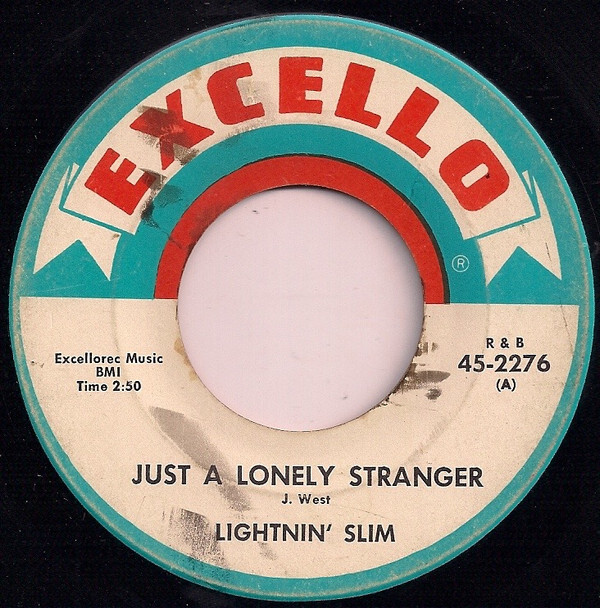
By the mid-1960s, when "Just a Lonely Stranger" was recorded and issued, Lightnin' Slim's long Excello run was approaching its end — Excello 2276 (1966) sits very near the close of his original singles sequence for the label, not far from his final Crowley sessions. The mid-1960s records found Miller occasionally experimenting with the formula that had defined Lightnin's sound for a decade, even as the bedrock elements — Slim's raw, unhurried baritone, his rudimentary but utterly distinctive guitar figures, and a stripped-down rhythm section — remained intact.
The Sessions
"Just a Lonely Stranger" was recorded, like virtually all of Lightnin' Slim's classic output, at J.D. Miller's studio in Crowley, Louisiana — the small Acadiana recording complex Miller had built up since the late 1940s, first for Cajun music and increasingly through the 1950s for the blues and R&B artists who would define "the Excello sound." The record was issued on Excello 2276 in 1966, backed with "Goin' Away Blues." As with the bulk of the Crowley sessions, the recording is characterized by close, direct miking, minimal overdubbing, and the tape-echo "swamp" ambience Miller favored, giving even a small ensemble a deep, reverberant presence on record.
The Producer
Jay Miller produced the session, as he did virtually every Lightnin' Slim recording made between 1954 and the artist's departure from Excello in the mid-1960s. Miller — a Cajun-music veteran who had built his own studio and a string of small regional labels (Feature, Fais-Do-Do, Zynn, and others) before striking a long licensing deal with Excello — was the architect of the swampy, tape-echoed, minimalist production style that became Lightnin' Slim's signature, and indeed the signature of the wider Crowley blues stable that also included Slim Harpo, Lazy Lester, Lonesome Sundown, and Silas Hogan. Miller's method was famously economical: small combos, live takes, heavy use of slapback echo, and a hands-on role not just as engineer and producer but frequently as credited songwriter on the records he released.
The Songwriter
The label credit on "Just a Lonely Stranger" reads "J. West." "J. West" was not, by most accounts, a working musician but a publishing pseudonym used on numerous Excello/Crowley-stable releases — most researchers and collectors who have examined Miller's business practices believe the name was a vehicle for routing songwriting royalties to Jay Miller himself (or to his publishing interests) rather than to Hicks, a common practice of the era among small, regional R&B labels, where producers frequently took outright or partial composer credit on songs largely shaped, if not entirely written, by the performing artist. The same "J. West" credit appears on a long run of other Lightnin' Slim sides from the same period, including "Death Valley Blues," "Nothin' but the Devil," "Feelin' Awful Blue," "Greyhound Blues," and "My Starter Won't Work," underlining how routinely the pseudonym was applied across Miller's Lightnin' Slim catalogue. Whatever the precise authorship, the lyric content and loose, conversational narrative style are entirely consistent with Lightnin' Slim's own first-person blues idiom: a wandering man, alone in an unfamiliar town, missing a woman back home.
The Musicians
Lightnin' Slim's Crowley sessions in this era were typically stripped to guitar, harmonica, and drums, occasionally with light additional support, in keeping with Miller's lean production approach. On "Just a Lonely Stranger":
- Lightnin' Slim (Otis Hicks) — lead vocal and electric guitar.
- Lazy Lester (Leslie Johnson) — harmonica. Lester was Miller's house harmonica player throughout this period and the most frequent musical foil on Lightnin' Slim's Excello sides; on this track he also contributes a brief spoken/sung cameo vocal interjection, a device Miller used periodically to add a conversational, call-and-response flavor to otherwise solo vocal performances (Slim's spoken aside "Well, blow your harmonica, son" — one of his best-known catchphrases — fits the same pattern heard across many of his records).
- An unidentified drummer, standard for the Crowley house-band sound of the period, completing the trio.
This is the same basic combination — Lightnin' Slim's voice and guitar, Lazy Lester's harmonica, and drums — that defined nearly the whole of his Excello discography, including his sole national R&B chart entry, "Rooster Blues" (1959).
Buy the single on Amazon
Other Versions
"Just a Lonely Stranger" was not a song that traveled widely outside the Lightnin' Slim/Excello catalogue; unlike some swamp-blues sides of the era (Slim Harpo's "I'm a King Bee" or "Baby Scratch My Back," for instance), it was never picked up as a cover staple by British Invasion or blues-revival bands, and there is no significant chart history or major-artist re-recording associated with it. Its afterlife has instead been almost entirely as archival and reissue material: it has appeared on Ace Records' (UK) various CD compilations gathering Lightnin' Slim's complete Excello singles and unissued sides — notably collections drawing on Dave Sax's detailed Excello discography work — alongside dozens of similarly obscure but historically valuable sides from the same vaults. The closely related, separately titled outtake "Stranger in Town," mentioned above, remained unissued in Lightnin' Slim's lifetime and only appeared decades later, on Ace's Genuine R&B compilation, illustrating how much of Miller's Crowley archive stayed in the vaults until specialist reissue labels began excavating it in the 1990s and 2000s.
Legacy
"Just a Lonely Stranger" is a minor entry in Lightnin' Slim's catalogue rather than one of his signature songs, but it is emblematic of the larger achievement that has secured his historical importance: a body of work, almost entirely shaped in Jay Miller's small Crowley studio, that codified what the wider world came to know as "swamp blues" — sparse, hypnotic, tape-echoed, built on Slim's weary, conversational vocal delivery and call-and-response interplay with Lazy Lester's harmonica. Songs like this one, never hits in their own time, have taken on lasting value precisely because they document that formula in its purest, most unadorned form. As reissue projects from labels such as Ace Records have worked systematically through the Excello/Crowley archive, sides like "Just a Lonely Stranger" — alongside the dozens of other Lightnin' Slim tracks credited to "J. West" — have become essential listening for collectors and scholars tracing both the evolution of Louisiana blues and the more uncomfortable, often-overlooked business history of small regional R&B labels, where credit and compensation for Black artists' songwriting was frequently diverted to white producers and publishers. In that sense, the song's modest commercial footprint belies its usefulness as a case study in both the musical and economic story of postwar Southern blues.