
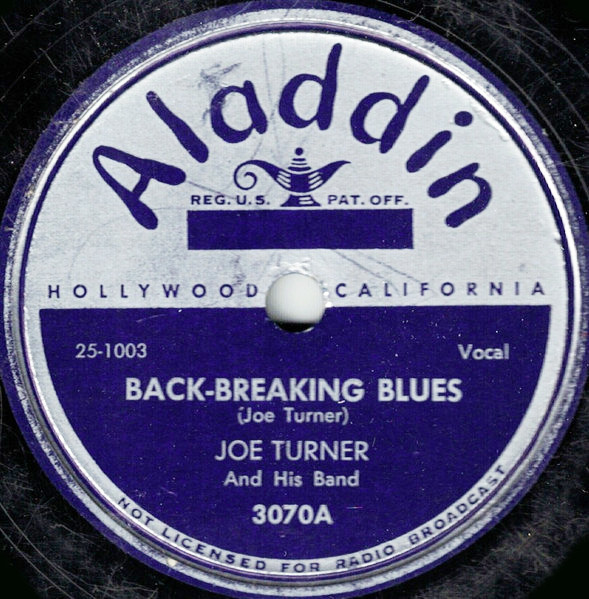
"Back-Breaking Blues" is a classic jump blues/shouting blues track by Big Joe Turner (Joseph Vernon Turner Jr., 1911–1985), the Kansas City-born "Boss of the Blues" and a foundational figure in the transition from big-band jazz and boogie-woogie to R&B and rock 'n' roll.
Recording Session and Release
The song was recorded on November 6, 1947, in San Francisco, California, during a session for Aladdin Records. It was released as a single (Aladdin 3070) paired with "Empty Pocket Blues," likely around late 1950 (some sources note regional chart activity in New Orleans in early 1951).
It later appeared on various compilations, such as Jumpin' With Joe: The Complete Aladdin & Imperial Recordings (and reissues under Capitol/EMI), The Boss of the Blues: 1939-1947, and chronological series like Classics Records. The master was later assigned an Imperial matrix number (IM-4782), reflecting label transitions common in the era.
Producer details are not prominently documented in standard sources for this indie-label session, but Aladdin (and its successor Imperial) sessions from this period often involved A&R oversight typical of West Coast R&B labels. The track fits Turner's post-National Records period of hopping between labels while maintaining a high-energy jump blues sound.
Songwriters and Credits
Big Joe Turner is credited as the composer/writer. Some editions also associate it with his long-time collaborator Pete Johnson in broader credits, though Turner is the primary credited artist and writer. Like many of his songs, it draws on traditional blues structures and phrasing, showcasing his mastery of "traditional blues verses" delivered with powerhouse shouting vocals.
The song embodies Turner's style: robust, expressive vocals over a driving rhythm, often with call-and-response elements and energetic band interplay. Lyrically, it fits the "hard times" or lamenting blues tradition implied by the title—evoking physical/emotional strain ("back-breaking" labor or heartbreak), set to an uptempo, danceable jump blues groove rather than a slow drag.
Musicians (Personnel)
The band for this session (credited as Joe Turner and His Band or Joe Turner Band) included top West Coast session talent:
- Big Joe Turner – vocals
- Pete Johnson – piano (Turner's iconic long-time partner, central to his boogie-woogie sound)
- Maxwell Davis – tenor saxophone (prominent West Coast arranger and saxophonist)
- Kirkland Bradford – alto saxophone
- Jewell L. Grant – saxophone
- Ralph Hamilton – string bass
- Jesse Sailes – drums
- Unnamed trumpeter (noted in discographies)
This lineup delivered a tight, swinging small-combo sound typical of late-1940s jump blues—honking saxes, rolling piano, and a solid rhythm section propelling Turner's massive voice. Pete Johnson's piano anchors the boogie feel, while the horns add punch and excitement.
Musical Style and Analysis
"Back-Breaking Blues" is a prime example of post-war jump blues: energetic, riff-driven, and dance-oriented, bridging Kansas City swing, boogie-woogie, and emerging R&B. Turner's voice—deep, resonant, and powerful enough to cut through a band without amplification—dominates, with his signature shouts and phrasing. The arrangement emphasizes groove over complexity, making it jukebox- and dance-floor friendly.
It lacks the massive crossover success of later Turner hits like "Shake, Rattle and Roll" (1954) or "Chains of Love" (1951), but it showcases his consistency in the late 1940s. The track received regional attention (e.g., Cash Box "Hot in New Orleans") but didn't break nationally, typical for many strong Aladdin sides before his Atlantic breakthrough.
Other Versions
There are no widely documented major cover versions or alternate takes that achieved notable success. The song appears primarily on Turner compilations, sometimes with slight variations in mastering or as part of live performances in his extensive catalog. Turner rerecorded or revisited similar material across decades, but this specific title is tied to the 1947 Aladdin session. Its inclusion in reissues (e.g., with alternate takes of related tracks like "Battle of the Blues") highlights its place in his discography.
Suggested Listening
 Buy from Amazon Jumpin' With Joe: The Complete Aladdin & Imperial Recordings
Legacy
As part of Turner's Aladdin/Imperial era output, "Back-Breaking Blues" contributes to his reputation as a bridge between pre-war blues/jazz and rock 'n' roll. Turner influenced artists from Wynonie Harris and Fats Domino to later rock figures; his shouting style and energetic delivery prefigured rock vocalists. Songs like this helped solidify jump blues as a precursor to R&B chart dominance in the early 1950s.
It appears on comprehensive retrospectives celebrating his "complete" recordings from the 1940s, underscoring its value in documenting his prolific, label-hopping phase after National Records. In the broader context of Turner's career—spanning from 1920s Kansas City bars to 1980s jazz festivals—this track exemplifies his resilience and adaptability. He remained a vital performer into later life, inducted into the Blues Hall of Fame (1983) and Rock & Roll Hall of Fame (1987 posthumously).
Overall, "Back-Breaking Blues" is a solid, grooving deep cut that rewards listeners with Turner's commanding presence and the tight West Coast ensemble sound of the era—essential for understanding the roots of rock 'n' roll and the golden age of jump blues.









