"Back Door Man" is a seminal Chicago blues track written by Willie Dixon and first recorded by Howlin' Wolf (Chester Arthur Burnett, 1910–1976) in 1960. It stands as one of the most influential blues songs of the era, blending raw sexuality, swagger, and hypnotic groove.
Recording Session
In June 1960, Howlin' Wolf—then 50 years old and already a veteran with nearly a decade of Chess recordings—entered Chess Studios in Chicago for a highly productive session alongside trusted sidemen. The date is widely cited as June 1960, though exact day details vary slightly in discographies. This session yielded several landmark tracks, including "Back Door Man," "Spoonful," and "Wang Dang Doodle," showcasing the peak chemistry of Wolf's band and Willie Dixon's songwriting.
Producers: Leonard and Phil Chess oversaw the session, with Willie Dixon serving as de facto arranger, bassist, and key creative force. Dixon's dual role helped shape the raw yet polished Chicago sound that defined Wolf's output.
Songwriters
Willie Dixon (1915–1992) wrote "Back Door Man." As Chess Records' primary house songwriter, arranger, and bassist, Dixon was the architect behind many of Howlin' Wolf's (and Muddy Waters') signature hits in the late 1950s and early 1960s. He crafted the song specifically with Wolf's commanding, larger-than-life persona in mind—his gravelly voice and theatrical delivery perfectly suited the boastful, mischievous character.
Dixon drew directly from Southern African American vernacular and folklore. The phrase "back door man" was longstanding slang for a man engaged in an extramarital affair, sneaking out the back door to avoid the husband. This theme appeared in earlier blues (e.g., Sara Martin's 1925 "Strange Loving Blues," Charley Patton, Lightnin' Hopkins, and Blind Willie McTell), but Dixon modernized and popularized it with vivid, rhythmic storytelling.
How Dixon put the song together:
- Lyrics: He used simple, repetitive, chant-like structures typical of his style—call-and-response phrasing that encouraged audience participation and fit Wolf's shouting delivery. Key lines like "When everybody trying to sleep / I'm somewhere making my midnight creep" and "Every morning the rooster crow / He's telling me you got to go" paint a cinematic picture of nocturnal adventure, humor, and risk. The boastful chorus ("I am a back door man") and cheeky lines about eating "more chicken than any man ever seen" add swagger and double entendre. Dixon often wrote quickly, tailoring words to an artist's strengths; for Wolf, he emphasized raw power and sexuality.
- Music: Dixon composed a modal, riff-driven framework that hangs on one primary chord, creating hypnotic tension. This allowed flexibility for improvisation while providing a strong, memorable hook. The insistent guitar riff (primarily Sumlin's contribution in execution) complements the lyrics' sneaky, propulsive energy.
- Process: Like many Dixon songs, it stemmed from his deep well of blues tradition, poetry (he wrote poetry as a child), and observations of everyday life. He frequently demoed ideas on bass or piano at Chess, refining them in rehearsals with the artist. The song was part of a burst of creativity in the 1960 session, where Dixon supplied multiple winners for Wolf.
Dixon's genius lay in blending tradition with commercial appeal—universal themes wrapped in catchy, durable packages that crossed over to rock audiences. "Back Door Man" is one of his enduring masterpieces, alongside "Spoonful," "Wang Dang Doodle," and "Hoochie Coochie Man."
Musicians (Personnel)
The core lineup for the session created a tense, modal, one-chord groove with a driving rhythm:
- Howlin' Wolf – vocals, harmonica
- Hubert Sumlin – guitar (his stinging, inventive leads are a highlight)
- Willie Dixon – double bass
- Otis Spann – piano
- Fred Below – drums
- Possible second guitarist: Freddie King or Freddy Robinson (Abu Talib)
This ensemble delivered a loose, swaggering electric blues sound—insistent riff, hypnotic feel, and powerful interplay—that defined Wolf's Chess output.
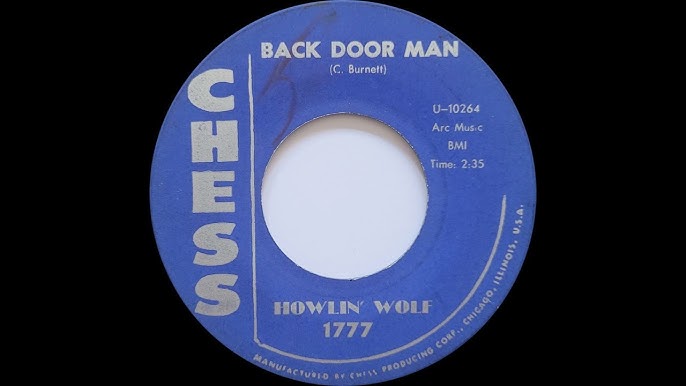
The session captured the band in a loose, intuitive mode typical of Chess recordings—live-feeling takes with minimal overdubs, emphasizing interplay and groove. "Back Door Man" was paired as the B-side to "Wang Dang Doodle" on Chess 1777 (released 1961). It did not chart nationally but gained traction through jukebox play and later reissues. The master takes reflect the era's efficient studio practices, where multiple strong sides were cut quickly
Musical Style and Analysis
"Back Door Man" exemplifies modal Chicago electric blues at its most potent. It is built around a single-chord (modal) vamp, primarily hanging on a droning tonic chord (often analyzed in the key of E or A depending on transposition), creating hypnotic tension rather than traditional I-IV-V progression resolution. This structure is akin to Wolf/Dixon tracks like "Spoonful" or "I Asked for Water (She Gave Me Gasoline)," allowing space for vocal improvisation and instrumental dialogue.
The song hinges on an infectious, insistent guitar riff—a tense, swaggering, stop-start figure (often doubled or supported by harmonica or piano) that drives the entire track. Hubert Sumlin's playing is central: his jagged, staccato fills, angular single-note lines, and percussive attack cut through the mix with a bright, biting tone. The riff combines rhythmic propulsion with melodic wit, using slides, bends, and rapid vibrato to mimic vocal inflections.
Wolf's delivery is primal and boastful—his gravelly roar and harmonica interjections trade with the band in call-and-response fashion. The arrangement features:
- Rhythm section: Dixon's solid, walking bass and Below's crisp drumming provide a loose, swinging foundation with shuffle undertones.
- Piano (Spann): Adds rolling, supportive fills and chordal punctuation.
- Overall groove: A mid-tempo swagger with dynamic builds—tight verses exploding into Wolf's shouts and Sumlin's explosive leads. The modal approach creates a hypnotic, almost trance-like quality, perfect for the song's themes of nocturnal secrecy and defiance.
Lyrically and musically, it balances humor, sexuality, and menace, with the "back door" metaphor reinforced by the music's slippery, evasive feel. The track clocks in around 2:50–3:00 in its original form, concise yet packed with energy—ideal for singles and live performance. Its raw production (typical of Chess) captures natural room ambience and instrumental bleed, enhancing its visceral impact.
Other Versions
- Howlin' Wolf himself revisited it in 1968–69 for The Howlin' Wolf Album (sometimes called the "electric" or psychedelic version), adapting it to contemporary rock influences.
- The Doors (1967 debut album): Their high-energy, psychedelic rock interpretation, with Jim Morrison's vocals, became a staple of their live shows and introduced the song to rock audiences. Robby Krieger brought it to the band after hearing John Hammond Jr.'s version.
- Numerous covers exist (over 60 documented), including acoustic/folk-blues takes (e.g., John Hammond Jr.), rock/punk versions (e.g., Iggy Pop with Soul Asylum), and tributes by artists like Ronnie Hawkins, Guy Davis, and others in jazz, reggae, and instrumental formats.
Legacy
"Back Door Man" solidified Howlin' Wolf's status as a blues giant and amplified Willie Dixon's songwriting influence. It became a bridge to rock 'n' roll: The Doors' cover helped popularize it during the 1960s blues revival, influencing British Invasion bands and beyond. Elements even echoed in tracks like Led Zeppelin's "Whole Lotta Love."
The song appears on key compilations and Wolf retrospectives, contributing to his inductions into the Blues Hall of Fame (1980) and Rock & Roll Hall of Fame (1991). It exemplifies the raw power of Chicago electric blues and its profound impact on popular music, from rock to modern blues revivals. Wolf's ferocious performance remains the definitive version, embodying the untamed spirit of the genre.
This track, alongside Dixon-penned gems like "Spoonful" and "Little Red Rooster," cements Howlin' Wolf's legacy as one of the most imitated and respected voices in blues history.
Suggested Listening
 Buy from Amazon Howlin' Wolf - Back Door Man