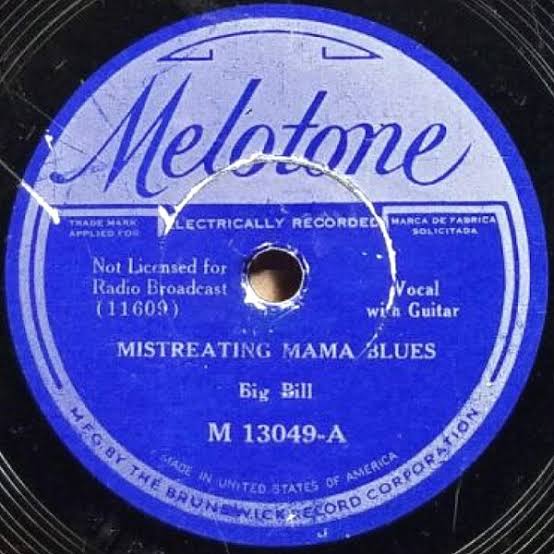
"Mistreatin' Mama" is one of Big Bill Broonzy's earliest and most influential recordings, a raw country blues from the Depression era that captures the sound of a young artist finding his voice. Recorded in 1932 under the pseudonym "Big Bill Johnson," it represents a crucial moment in Broonzy's development from a derivative country fiddler to a distinctive blues voice.
Recording Session
Date: 1932
Location: Richmond, Indiana — likely at Gennett Studios or a similar ARC-affiliated facility
Label: Champion Records (catalog number 16396) — a budget subsidiary of the American Record Corporation (ARC)
Pseudonym: "Big Bill Johnson" — Broonzy used numerous aliases during his early career, including Big Bill Johnson, Sammy Sampson, and Slim Hunter, as record companies often required artists to record under different names for competing labels or to avoid contract disputes.
Producer: The session was arranged through Lester Melrose, the powerful Chicago-based talent scout and producer who controlled much of the blues recording output for ARC, Paramount, and later Bluebird Records. Melrose was the central figure in what became known as the "Melrose scene" — a stable of Chicago blues musicians who recorded regularly for various labels under his supervision.
Recording Context: 1932 was the worst year for the American record business during the entire 20th century. The Great Depression had devastated sales, and most labels had drastically cut their recording schedules. Despite these conditions, Broonzy managed to record 20 issued sides that year — a testament to his persistence and Melrose's confidence in his potential.
Songwriter & Composition
Songwriter: Big Bill Broonzy (William Lee Conley Broonzy)
"Mistreatin' Mama" is an original composition by Broonzy, though it draws on traditional blues themes and structures common to the era. The song follows the classic AAB blues verse form and addresses the timeless blues subject of romantic betrayal and mistreatment by a woman.
The title itself — "Mistreatin' Mama" — uses the common blues convention of addressing a woman as "Mama," a term that could signify a lover, wife, or simply a woman of romantic interest. The "mistreatin'" element establishes the song's central conflict: the narrator is suffering at the hands of a woman who has done him wrong.
Musicians
This is a solo performance by:
-
Big Bill Broonzy (as "Big Bill Johnson") — vocals, acoustic guitar
In 1932, Broonzy was still primarily an acoustic country blues artist. He had not yet made the transition to the small-group electric Chicago blues sound that would define his later career. His guitar playing on this recording would reflect the fingerpicking style he had learned from Papa Charlie Jackson, combining bass-string thumping with melodic runs on the higher strings.
Lyrical Content: A Deep Analysis
The lyrics of "Mistreatin' Mama" follow the classic blues narrative of romantic complaint, but Broonzy's treatment of the material reveals the qualities that would make him one of the most prolific and influential blues songwriters of his generation.
The Blues as Personal Narrative
Broonzy's early recordings, including "Mistreatin' Mama," established a pattern he would follow throughout his career: using his own experiences and observations as the basis for his songs. As blues scholar Kevin Reisman noted, Broonzy "made a decision to use himself, his family and others in the world that he grew up in and came from in Jefferson County, Ark., as ways of conveying to primarily white audiences the story of the African American experience in this country."
While "Mistreatin' Mama" predates this conscious artistic strategy by decades, it contains the seeds of Broonzy's autobiographical approach. The song is not a generic blues lament but a specific complaint about a specific woman — the "mistreatin' mama" of the title.
The "Mama" Figure in Blues Tradition
The "mama" or "mama" figure in blues lyrics is complex and multilayered. It can refer to:
-
A mother figure (sometimes literally)
-
A wife or long-term partner
-
A lover or romantic interest
-
A woman who provides emotional or material support
In "Mistreatin' Mama," the term is clearly romantic, but it carries undertones of dependency and vulnerability. The narrator is not just complaining about a lover; he is complaining about a woman who has power over him — the power to "mistreat" him, to make him suffer.
The Economics of Mistreatment
Many blues songs from this era encode economic anxieties within romantic narratives. The "mistreatin' mama" may be a woman who has taken the narrator's money, left him for a man with better financial prospects, or simply refused to provide the emotional support that would help him endure the hardships of Depression-era life. Broonzy's own experience — working as a Pullman porter, cook, foundry worker, and custodian while trying to establish himself as a musician — would have given him ample material for songs about struggle and betrayal.
The Guitar as Emotional Voice
On a solo recording like "Mistreatin' Mama," the guitar functions as a second voice — responding to the vocal lines, echoing the emotional content of the lyrics, and providing rhythmic momentum. Broonzy's fingerpicking style, learned from Papa Charlie Jackson, allowed him to create the illusion of multiple instruments: a bass line thumped out by the thumb, melodic figures picked by the fingers, and occasional chordal strums for emphasis.
This "orchestral" approach to solo guitar — creating a full band sound with just one instrument — was one of Broonzy's great contributions to blues guitar technique. It would influence generations of players, from Muddy Waters to Eric Clapton.
Other Versions & Covers
While "Mistreatin' Mama" has not been as widely covered as some of Broonzy's later hits (such as "Key to the Highway," "I Feel So Good," or "Hey Hey"), it is part of the broader tradition of "mistreatin' woman" blues that has been recorded by countless artists.
Broonzy himself revisited the theme throughout his career. His 1930 recording "I Can't Be Satisfied" (as "Sammy Sampson") deals with similar themes of romantic dissatisfaction. Later songs like "Mean Old World" (1937) and "Just a Dream" (1939) continued to explore the dynamics of troubled relationships.
The song's influence can be traced through:
-
Muddy Waters, who cited Broonzy as "the nicest guy he'd ever met in his life" and absorbed his narrative approach to blues songwriting
-
Willie Dixon, who worked with Broonzy and carried forward his tradition of storytelling blues
-
The folk-blues revivalists of the 1950s and 1960s, including Pete Seeger and Ramblin' Jack Elliott, who learned from Broonzy's acoustic repertoire
-
Eric Clapton, who covered Broonzy's "Key to the Highway" and absorbed his fingerpicking techniques
Legacy & Historical Significance
"Mistreatin' Mama" is significant not for its individual fame but as a representative of Broonzy's crucial early period — the years when he was learning his craft, developing his voice, and building the foundation for a career that would span more than 300 recorded songs and influence virtually every subsequent generation of blues musicians.
The 1932 recording date places it in the darkest days of the Depression, when the record industry was on the verge of collapse. That Broonzy managed to record at all — and that Lester Melrose saw fit to produce him — speaks to the resilience of the blues tradition and the determination of its practitioners.
Broonzy's early work, including "Mistreatin' Mama," was collected in the comprehensive 12-volume Document Records anthology released in 1994, which remains the most complete collection of his early recordings.
 Buy from Amazon Complete Recorded Works 1927-1947 Vol. 1 1927-1932 (which contains Mistreatin' Mama)
In 1938, Broonzy would get his big break when John Hammond asked him to appear at the legendary "From Spirituals to Swing" concert at Carnegie Hall, replacing the recently deceased Robert Johnson. This appearance — and the follow-up concert in 1939 — established Broonzy as a major figure on the blues scene and launched him into the most successful phase of his career.
By the early 1950s, Broonzy had become an "ardent supporter of folk-blues" as electric blues rose in popularity. He felt it was his duty to serve as an ambassador, bringing the blues to audiences around the world. His 1951 tour of Europe introduced the blues to audiences just as skiffle and rock blues were gaining popularity in London — making him a crucial link between the Delta blues tradition and the British Invasion.
Big Bill Broonzy passed away in 1958, but his influence continues through the countless musicians he inspired. "Mistreatin' Mama" — recorded in the depths of the Depression, under a pseudonym, for a budget label — is a small but essential piece of that legacy: a document of a young artist finding his voice, laying the groundwork for one of the most important careers in blues history.