"32-20 Blues" is one of the most intense and unsettling recordings in the Robert Johnson catalog — a murder ballad disguised as a blues song, built around a borrowed guitar arrangement and a title that refers to a specific caliber of Winchester ammunition. Recorded during Johnson's first Texas sessions in 1936, it stands as a testament to his ability to absorb influences, transform them, and create something uniquely his own.
Recording Session
Date: November 26, 1936 (Thanksgiving Day)
Location: Gunter Hotel, Room 414, San Antonio, Texas
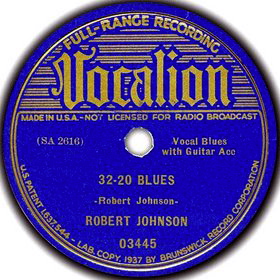
Label: Vocalion Records (American Record Corporation)
Matrix Number: Not specified in available sources
Catalog Number: Vocalion 03445 (released as the A-side, with "Last Fair Deal Gone Down" as the B-side)
Release Date: April 1937
Producer: Don Law — the British-born record producer who oversaw both of Johnson's Texas recording sessions. Law was a "roving A&R man" for ARC who had previously worked with Brunswick and Vocalion. He was present at the Gunter Hotel sessions and would later become famous for producing country music legends including Johnny Cash and Willie Nelson.
Talent Scout: Ernie Oertle — an ARC salesman and part-time talent scout who had discovered Johnson in Mississippi and arranged for him to travel to Texas. Oertle was the crucial link between Johnson and the recording industry, a white businessman traveling through the South in search of "race record" talent.
Recording Engineer: Vinnie Liebler — Chief Engineer for Brunswick/ARC, who was present at the San Antonio sessions. Photographs show Liebler and head recorder Ralph Perez inspecting new "thin type masters" being used in the United States for the first time.
The Gunter Hotel sessions were makeshift affairs. ARC had booked two adjoining rooms — recording equipment in one, the musician in the other. The label had been recording hillbilly and Mexican artists at the hotel since November 10, and Johnson was slotted into their schedule. The conditions were primitive by modern standards, but the acoustics of the hotel room captured Johnson's voice and guitar with remarkable intimacy.
The Session Context
November 26, 1936 was a strange day in the Johnson saga. Johnson had already recorded eight songs on November 23 (his first session, including "Terraplane Blues," "Kind Hearted Woman Blues," and "Sweet Home Chicago"). According to producer Don Law, Johnson had managed to get himself arrested and landed in Bexar County jail. After being released, he returned to the Gunter Hotel on November 26 to record just one song — "32-20 Blues." He would return the next day (November 27) to record seven more sides, including the legendary "Cross Road Blues."
This pattern — recording in bursts, with days off between sessions — was typical of the era, but the jail incident adds a layer of mystery to the "32-20 Blues" recording. Whether the arrest was related to the song's violent themes, or whether the song's intensity was fueled by Johnson's recent troubles, we can only speculate.
Songwriter & Composition
Songwriter: Robert Johnson (adaptation)
Original Source: Skip James — "22-20 Blues" (1931)
"32-20 Blues" is not an original composition in the strict sense. Johnson adapted it from Skip James's "22-20 Blues," recorded in 1931 for Paramount Records. James's version was itself a reworking of earlier blues material, but Johnson's adaptation is so thorough that it constitutes a new song. As musicologist Robert Palmer noted in his book Deep Blues, Johnson took James's framework and rebuilt it with his own lyrics, guitar arrangement, and emotional intensity.
The title change from "22-20" to "32-20" reflects Johnson's desire to upgrade the firepower. The .32-20 Winchester cartridge (also known as .32 WCF) was a more powerful round than the .22-20, capable of being used in both handguns and rifles. This was not merely a poetic choice — the .32-20 was a real cartridge that was widely available in the 1930s South, and Johnson's audience would have understood the reference immediately.
Musicians
This is a solo performance by:
-
Robert Johnson — vocals, acoustic guitar (including bottleneck/slide guitar)
Johnson's guitar work on "32-20 Blues" is characteristic of his mature style: a driving, rhythmic bass line played with the thumb, while the fingers execute melodic lines and slide passages on the higher strings. The technique creates the illusion of two guitars playing simultaneously — a polyrhythmic approach that would influence generations of blues and rock musicians. His vocal delivery is equally complex, shifting between a conversational murmur and a high, keening falsetto that conveys both menace and despair.
Lyrical Content: A Deep Analysis
The lyrics of "32-20 Blues" are among the most disturbing in Johnson's catalog — a first-person narrative of domestic violence that escalates to murder. The song is structured as a series of threats, justifications, and finally, a confession of sorts.
The Opening Threat: Medical Imagery and Murder
The song opens with a chilling declaration of intent:
"If I send for my baby, and she don't come / If I send for my baby, man, and she don't come / All the doctors in Hot Springs sure can't help her none"
Johnson establishes the scenario with economy: he has summoned his woman, she has refused, and he has decided on lethal retaliation. The reference to "Hot Springs" — the Arkansas spa town famous for its healing waters — is bitterly ironic. No amount of medical intervention can save her from what he plans to do. The phrase "sure can't help her none" is delivered with a cold finality that is more frightening than any shouted threat.
The Weapon: The .32-20 as Character
The title weapon becomes a character in the song:
"And if she gets unruly, and thinks she don't want to do / If she gets unruly and thinks she don't want to do / Take my 32-20, now, and cut her half in two"
The casual violence of these lines is shocking even by blues standards. Johnson doesn't say he'll shoot her — he'll "cut her half in two," as if the bullet is a blade. The .32-20 is not just a gun; it's a tool of dismemberment, a way to reduce a human being to pieces. The word "unruly" is particularly disturbing — it suggests that her crime is merely disobedience, a refusal to submit to his will.
The Gunfight: Mutual Violence and Masculine Anxiety
The song introduces a counter-narrative in the third verse:
"She got a .38 Special, but I say it won't do / She got a .38 Special, but I say it won't do / She may get unruly, I don't mind killin' her too"
Here Johnson acknowledges that his woman is armed — she has a .38 Special, a common revolver caliber. But he dismisses it as inadequate ("it won't do") against his .32-20. This is a fantasy of masculine dominance through superior firepower. The fact that she is armed at all suggests a relationship of mutual violence, a domestic war zone where both parties are armed and dangerous. Johnson's response is not to de-escalate but to double down — he'll kill her before she can kill him.
The Final Image: Death and the Weapon
The song ends with a stark, almost cinematic image:
"I'm gonna shoot my pistol, gonna shoot my gatling gun / I'm gonna shoot my pistol, gotta shoot my gatling gun / I'm gonna shoot my baby, she's been doin' me wrong"
The escalation from pistol to "gatling gun" is absurd and terrifying — a gatling gun is a rapid-fire weapon of mass destruction, completely impractical for domestic violence but symbolic of Johnson's overwhelming rage. The final line — "she's been doin' me wrong" — is the justification, the blues trope of female betrayal that supposedly excuses male violence. But by this point in the song, the justification rings hollow. The violence has become its own reason for being.
The Blues Tradition of Violence
"32-20 Blues" exists within a tradition of blues songs that depict violence against women, including "Frankie and Johnny," "Stagger Lee," and countless others. But Johnson's version is distinguished by its first-person perspective and its refusal to romanticize or mythologize the violence. There is no Stagger Lee swagger here, no folk-hero grandeur. Just a man with a gun, a woman who won't obey, and a bullet that will settle the argument.
As the music blog Gloomy Tunes noted in their analysis, "one of the scariest gun songs out there is '32-20 Blues,' specifically Robert Johnson's version." The song is not a condemnation of guns or violence — it is a celebration of them, a fantasy of absolute power through firepower.
The Guitar as Weapon
Johnson's guitar playing reinforces the lyrical violence. The driving, relentless rhythm creates a sense of unstoppable momentum — like a train, or a bullet in flight. The slide guitar passages wail and cry, suggesting the woman's voice or the sound of the gun itself. The music and the lyrics are inseparable; the guitar is the .32-20, and Johnson's fingers are the trigger.
Other Versions & Covers
Despite its disturbing subject matter, "32-20 Blues" has been covered by numerous artists across multiple genres:
-
Muddy Waters — recorded a version that brought the song to the Chicago electric blues audience
-
Bob Dylan — covered it early in his career, absorbing its narrative intensity into his own songwriting
-
Eric Clapton — included it on his 2004 album Me and Mr. Johnson, a tribute to Robert Johnson
-
Johnny Winter — the Texas blues-rock guitarist brought his fiery slide technique to the material
-
Keith Richards — recorded a version that emphasized the song's raw, primal energy
-
The New York Dolls — the punk band's cover brought the song to a new generation
-
Gov't Mule — the Southern rock jam band extended the song into epic live performances
-
Rory Block — the acoustic blues revivalist returned the song to its solo roots
-
Cassandra Wilson — the jazz vocalist brought a haunting, atmospheric quality to her interpretation
-
Cowboy Junkies — the alt-country band's version emphasized the song's dark, cinematic quality
-
Peter Green Splinter Group — the Fleetwood Mac founder's blues project recorded a faithful adaptation
-
Phil Manning — the Australian blues guitarist covered it on his solo albums
-
Alexis Korner — the British blues pioneer helped introduce Johnson's music to UK audiences
-
Colin Hodgkinson — recorded a bass-driven version of the song
-
Flamin' Groovies — the power-pop band brought a garage-rock energy to the blues classic
-
Rusty Cage — the modern blues-rock artist recorded a contemporary version
-
Chain — the Australian blues band included it in their repertoire
-
Peter Laughner — the Cleveland punk/proto-punk musician recorded a raw, intense version
Legacy & Historical Significance
"32-20 Blues" is a crucial document in understanding Robert Johnson's artistic development and his place in the blues tradition. It demonstrates several key aspects of his genius:
-
Adaptation and Transformation: Johnson's ability to take Skip James's "22-20 Blues" and completely remake it — changing the title, rewriting the lyrics, reworking the guitar arrangement — shows his creative process at work. He was not merely copying; he was building on foundations laid by others.
-
Narrative Compression: In under three minutes (the standard length for a 78 rpm record), Johnson creates a complete narrative arc — threat, escalation, confrontation, resolution. This economy of storytelling would influence songwriters from Bob Dylan to Bruce Springsteen.
-
Emotional Complexity: The song is not simply a celebration of violence. There is fear in Johnson's voice — fear of the woman's independence, fear of his own rage, fear of the consequences. The .32-20 is both a weapon and a talisman, a way to assert control in a world that feels uncontrollable.
-
The Blues as Social Document: The song reflects the realities of African American life in the Jim Crow South, where violence was endemic and the legal system offered no protection. The gun is not just a murder weapon; it's a form of self-assertion in a society that systematically denied black men power and dignity.
The song was included in the landmark King of the Delta Blues Singers album (1961), the compilation that introduced Johnson to the rock generation. It appeared on King of the Delta Blues Singers, Vol. 2 (1970) and the Grammy-winning The Complete Recordings box set (1990).
Robert Johnson was inducted into the Blues Foundation Hall of Fame in 1980 and the Rock and Roll Hall of Fame in 1986 as an Early Influence. He received a Grammy Lifetime Achievement Award in 2006. "32-20 Blues" remains one of his most frequently covered and most controversial songs — a blues that confronts its listeners with the darkest corners of human nature, delivered with a musical mastery that makes the horror almost beautiful.