Introduction: The Unlikeliest Chart-Topper of 1966
The American pop charts in early 1966 were dominated by sounds that had arrived from across the Atlantic or from the well-funded hitmaking factories of Detroit. The Beatles, the Rolling Stones, the Four Tops, the Supremes — these were the artists who owned the upper reaches of the Billboard Hot 100 and the R&B charts that ran alongside them. The American music industry had industrialised its own product in response to the British Invasion, tightening its productions, layering strings, adding horns, smoothing the edges off anything that sounded too rough or too regional or too strange. In this climate, the idea that a slow, loping, mostly spoken blues record made by a part-time musician from Baton Rouge in a small studio in a small Louisiana town would hit number one on the R&B chart and crack the pop top twenty was, on the face of it, absurd.
And yet, on February 26, 1966, "Baby Scratch My Back" by Slim Harpo reached the top of Billboard's Hot Rhythm & Blues Singles chart, where it remained for two weeks. It simultaneously climbed to number 16 on the broader Hot 100, spending eight weeks in that position. At the end of the year, it was voted the number three R&B recording of 1966 — a remarkable achievement against the combined forces of Motown, Atlantic, and Stax. Not bad for a record that Slim Harpo said he wrote at the back of a record shop, a record whose most prominent feature was a tremolo-drenched "chicken scratch" guitar riff and a set of percussion sounds that its producer described with the exclamation "gee wee, we had some percussion."
The story of "Baby Scratch My Back" is the story of how the right sound at the right moment can cut through everything — every commercial calculation, every industry trend, every assumption about what kind of music the market wants. It is also the story of how a long and sometimes painful creative partnership between an unassuming blues musician and an idiosyncratic small-town producer could, after nearly a decade of work, produce something that briefly made the whole country stop and listen.
The Long Road Back: From "Rainin' in My Heart" to "Baby Scratch My Back"
Between the success of "Rainin' in My Heart" in 1961 and the recording of "Baby Scratch My Back" in October 1965, Slim Harpo had lived through a period of professional turbulence that would have ended the careers of artists with fewer resources of patience and perseverance. The royalties dispute that had followed "Rainin' in My Heart" — Harpo's conviction that he was not receiving the money he was owed under his arrangement with producer J.D. Miller and Excello Records — had resulted in a two-year recording moratorium during which Harpo toured the Southern club circuit with his band the King Bees, leveraging whatever fame the hit had given him but unable to capitalise on it with new material.
The situation had become so bad that Harpo had even attempted to circumvent his contract with Miller by recording four sides for Imperial Records, the Los Angeles-based label owned by Lew Chudd. Those sessions, held in New Orleans in June 1961 and produced by Dave Bartholomew, went unreleased when Miller's lawyers intervened. Harpo found himself in the same trap that had caught so many small-label blues artists of his era: contractually bound to a producer who controlled his master recordings, unable to release music elsewhere, watching the momentum of his breakthrough slowly dissipate.
When Harpo and Miller eventually renegotiated their arrangement in 1963, the settlement gave Harpo full songwriting royalties under his own name, James Moore — though Lovelle Moore, his wife and creative collaborator, still received no formal credit on Excello releases. The new contract brought him back to the studio, and the resulting singles — "I Love the Life I'm Living" (1963), "I Need Money (Keep Your Alibis)" (1964), "My Little Queen Bee" (1964), "Still Rainin' in My Heart" (1964), "Sittin' Here Wondering" (1964), "Harpo's Blues" (1965) — showed an artist in solid creative form but without the commercial traction of his earlier breakthroughs. None of these records made the national charts.
Simultaneously, however, something significant was happening in Britain that would eventually reshape Harpo's commercial fortunes. By 1963 and 1964, the British rock groups who had been discovered by Harpo's Excello recordings were beginning to introduce his music to international audiences. The Rolling Stones' recording of "I'm a King Bee" on their 1964 debut album; the Kinks' version of "Got Love If You Want It"; the Yardbirds' live interpretations of his blues — these acts of homage were circulating through radio stations and rock clubs across the English-speaking world, creating a market for Slim Harpo's music that he himself was not yet positioned to exploit. And while the British Invasion had temporarily squeezed American blues artists out of the pop mainstream, the same wave had also created an enormous appetite among young white American audiences for the authentic blues sources that had inspired those British bands.
By 1965, Slim Harpo was in an interesting position: modestly famous, active and performing, recording steadily but without a major chart hit since 1961, his music beloved by some of the most influential rock bands in the world. What was needed was a record that could convert that diffuse influence into direct commercial impact. When he walked into J.D. Miller's studio in Crowley in October 1965 with a new song he'd come up with at the back of a Baton Rouge record shop, that record was about to be made.
The Song: From Tommy's Record Shop to Excello
According to Baton Rouge singer John Fred Gourrier — one of the local musicians who moved in the same circuits as Harpo during this period — the song that would become "Baby Scratch My Back" was conceived in an appropriately informal setting. As the Blues Foundation records it: "According to Baton Rouge singer John Fred, Slim Harpo wrote 'Scratch My Back' at the back of Tommy's Record Shop." The image is entirely consistent with what we know of Harpo's working method: he was a songwriter who worked from the material of everyday life, who let ideas develop naturally rather than sitting down to formally compose, and who brought songs to the studio in finished or near-finished form.
The song's formal structure is deceptively simple. Classified on its label as a country blues, it operates on a leisurely, loping groove that resists classification into any standard 12-bar or 8-bar blues format. The lyrics are built around an extended double entendre — the narrator asking his lover to scratch his back, a request that functions simultaneously as a straightforward physical description and as a coded sexual proposition. This was not new territory for Harpo: the tradition of blues double entendre ran through his entire catalogue, from the king bee who wanted to make honey to the bread maker who wanted to be somebody's lovin' man. But the approach in "Baby Scratch My Back" is notably more casual and spoken than in those earlier songs — less sung and more monologued, almost conversational in its delivery.
Harpo's vocal approach on the record reflects the evolution his singing had undergone since the first Miller sessions of 1957. The nasal drawl that Miller had coached him into at the outset was still present, but it had relaxed further, taking on an almost sleepy quality that somehow made the song more rather than less engaging. The delivery is casual to the point of sounding almost improvised, though the construction of the lyric was clearly deliberate. Lines like "Scratch my back, baby, with a soothe, easy stroke, baby, don't scratch too hard, baby, and when you get a little tired, baby, you can stop and give me a little rest" have the rhythmic quality of spoken-word blues performance — closer to the tradition of talking blues than to conventional singing. The effect is of a man talking almost to himself, intimate and unhurried, which gave the record an unusual quality in the context of the more polished, produced sounds that surrounded it on radio playlists in early 1966.
Music writer Todd Everett, who wrote the liner notes for the 1989 Rhino compilation The Best of Slim Harpo, captured the significance of this approach: "Harpo evidently figured that he had a future in rock and roll" — an observation that points to Harpo's conscious awareness of his crossover potential and his deliberate effort to pitch this record toward the broadest possible audience while remaining rooted in his own authentic idiom.
The writing credit on Excello 2273 — the single's catalogue number — lists the songwriter simply as Slim Harpo (James Moore). Unlike "Rainin' in My Heart," where the "Jerry West" alias of J.D. Miller appeared as co-writer, "Baby Scratch My Back" carries a sole credit. This reflects the more equitable contractual terms that had been agreed following the post-1961 renegotiation, though the commercial publishing arrangements remained complicated in ways that blues artists of this era rarely had the legal resources to fully audit.
The Producer: J.D. Miller's Final Masterpiece
By October 1965, J.D. Miller had been producing records for Slim Harpo for eight years. The two men had quarrelled bitterly over money after the success of "Rainin' in My Heart," had spent two years in effective estrangement, and had returned to the studio in 1963 with a renegotiated arrangement that, while more equitable than what had preceded it, still left Miller in control of the recording process and the master tapes. What had never changed, through all the business disputes and creative tensions, was Miller's fundamental understanding of what made Slim Harpo's music work.
Miller's studio at his home in Crowley had evolved since the first sessions of 1957. The room was the same, but Miller's awareness of its particular acoustic properties — the natural reverb, the way sounds behaved in the small space — had deepened through years of use. He had also refined his approach to percussion, developing an idiosyncratic vocabulary of supplementary sounds that would become a hallmark of the Excello recordings. For "Baby Scratch My Back," Miller pushed this percussive approach further than he had on any previous Harpo recording.
In a revealing interview, Miller described the production philosophy that underpinned the session: "Even when we had drums we used a lot of sound effects… like for instance 'Baby Scratch My Back,' gee wee, we had some percussion." This is an understatement characteristic of Miller's plain-spoken Louisiana manner. The percussion on "Baby Scratch My Back" is not merely an addition to a standard drumkit-led arrangement — it is the rhythmic foundation of the entire record, the element that gives the track its distinctive character and its irresistible physical momentum.
The "snapping snare drum sound" described in contemporary assessments of the record, the woodblocks, the maracas — these were elements that Miller had been developing across years of Excello sessions. For the "Baby Scratch My Back" session, the percussive arrangement was enriched by the involvement of Leslie Johnson, better known as Lazy Lester, who had been an invaluable creative presence in Miller's studio since the late 1950s. Lazy Lester claimed active involvement in the session, though, as was consistent with Miller's working practice, the studio credits were never formally documented in full. Lester recalled: "'Scratch My Back' was a thing that came up in Slim Harpo's mind. He's a very talented guy, and he had a guy called Bo Melvin and James Johnson was on the guitars on that."
The woodblocks and bongos that feature in the percussion track are consistent with Lazy Lester's documented contributions to other Excello sessions — he was, as one music historian has noted, "instrumental in improvising an extra-terrestrial form of percussion that became one of Excello's trademarks." The fact that this percussive approach "especially inspired the young musicians of the British Invasion" is historically ironic and telling: the sounds that were influencing the Rolling Stones and the Kinks were being produced, in part, with improvised instruments in a small Louisiana studio.
Miller's production decisions on "Baby Scratch My Back" reveal a clear artistic intelligence at work. He understood that Harpo's vocal on this song was spoken more than sung — that the record would live or die by its groove, not by any conventional melodic hook. So he built that groove with obsessive care, layering percussion elements over the rhythm section, positioning the tremolo guitar riff as the song's melodic signature, and leaving enough space in the arrangement for Harpo's harmonica to breathe and move. The result is a record that is simultaneously raw and precise — it sounds spontaneous but is actually the product of very deliberate production choices.
The echo and reverb that characterised all Miller's Excello productions are present but deployed with particular skill on "Baby Scratch My Back." The harmonica has a slight bloom around it that gives it presence without muddying the rhythm track. Harpo's voice sits dry and close in the mix, conversational and immediate, while the guitar and percussion float in a slightly more ambient space. The contrast creates a sense of depth and texture that belies the simplicity of the arrangement.
The Musicians: James Johnson, Rudolph Richard, and the October 1965 Session
The session that produced "Baby Scratch My Back" took place in October 1965 at J.D. Miller's Studio in Crowley, Louisiana. The core personnel — confirmed by session documentation and by a contemporaneous YouTube upload that records the precise lineup — consisted of: Slim Harpo (vocals and harmonica), James Johnson and Rudolph Richard (guitars), Geese August (bass), and Sammy K. Brown (drums). Lazy Lester contributed to the percussion arrangement, though the exact nature and extent of his contribution remains somewhat contested, as was typical of the informally documented Miller sessions.
James Johnson was, by this point, one of the most experienced members of Harpo's recording ensemble. He had been working with Harpo since Lightnin' Slim had effectively passed him along following a period of religious observance, and he would continue as one of Harpo's primary guitarists until Harpo's death in 1970. Johnson's contribution to "Baby Scratch My Back" is precisely identified in Wikipedia's entry on the song: "The 'chicken scratch' guitar was played by James Johnson." This attribution, drawn from a 2022 obituary tribute in The Advocate newspaper, is significant both musically and historically.
The "chicken scratch" or "chicken pickin'" technique refers to a style of guitar playing that uses palm muting and staccato picking to create a percussive, choppy sound — the guitar functioning almost as another rhythm instrument, its notes brief and clipped rather than sustained. On "Baby Scratch My Back," Johnson's guitar work is the most immediately memorable element of the track: that repeated, tremolo-drenched figure that opens the record and continues underneath Harpo's vocal. It is deceptively simple — a few notes, a distinctive tremolo effect, a rhythmic pattern that locks tightly with the percussion — but it is the sound that defines the record, the element that made it immediately recognisable on first hearing and impossible to get out of your head once heard.
Johnson spoke of his recording sessions with Harpo with characteristic modesty: "Yeah, we didn't know exactly which one was going to make it. But Slim hit the right spot at the right time. We were just an old blues band, and I didn't never think something like that would go that far." This is the authentic voice of a working musician who was doing what he always did — showing up, playing well, trusting the groove — and who was as surprised as anyone when the result turned out to be a number one record.
Rudolph "Rudy" Richard, the other half of Harpo's dual-guitar lineup, had been with Harpo "on and off since 1958," according to various accounts of his career. Richard's role on "Baby Scratch My Back" was complementary to Johnson's — less the featured melodic presence and more the supporting rhythmic and harmonic foundation. Richard's "vibrato-laden chicken pickin' guitar" style, as Bear Family Records has described it, was as much a part of the King Bees' sound as Johnson's work, and the two guitarists' interplay had developed over years of live performance and studio recording into an instinctive musical partnership.
Geese August on bass and Sammy K. Brown on drums completed the rhythm section. Brown had appeared on Harpo's sessions since at least the December 1959 recordings that had produced much of the Rainin' in My Heart album material, and his drum work on "Baby Scratch My Back" is a model of restraint and effectiveness. The snare snap that Miller identified as central to the track's sound is Brown's contribution — a sharp, dry crack that cuts through the mix and gives the groove its physical immediacy. The drum pattern is minimal but perfectly calibrated to the song's requirements: there is no unnecessary elaboration, no attempt to fill space that the guitar and percussion are already occupying. Everything serves the groove.
The bass work on the track — August's contribution — is similarly restrained and purposeful. Walking figures that anchor the harmony without crowding the midrange, creating the space in which Johnson's guitar riff can float and Harpo's harmonica can move freely. The bass and drums together create the loping, almost lazy-feeling momentum that Harpo described as his "attempt at rock and roll" — a rhythm that is somehow both laid-back and irresistibly propulsive.
Lazy Lester's presence in the session, while not formally credited, adds an important dimension to the recording. His reputation in Miller's studio was built partly on his ability to devise and execute percussive effects using unconventional instruments — newspapers, cardboard boxes, woodblocks, bongos, and whatever else came to hand. The specific sounds he contributed to "Baby Scratch My Back" are consistent with his documented work on other Excello sessions, and the overall percussive density of the track — the layered rhythm sounds that give it such physical momentum — reflects his creative involvement.
The Record Itself: A Study in Productive Simplicity
"Baby Scratch My Back" runs two minutes and forty-seven seconds, which for a record with this much happening in it feels simultaneously brief and spacious. The song begins with Johnson's guitar riff — that tremolo-drenched, muted, choppy figure — appearing alone or nearly alone for a brief moment before the rest of the ensemble joins. This opening is not a dramatic fanfare; it is more like a beckoning, an invitation to lean in and listen. And once the groove locks in, with the percussion and drums and bass all falling into their interlocking patterns, the record achieves something remarkable: it sounds both perfectly simple and somehow impossibly complete.
Harpo's vocal enters in the spoken mode that was the song's defining innovation. He is not singing, exactly — he is talking, the words shaped by his nasal drawl and his Louisiana cadences, the phrases following the rhythm of the track rather than imposing a melodic line on top of it. The double entendre of the lyric is entirely consistent with the tradition he had been working in since "I'm a King Bee" — the king bee who wants to make honey, the narrator who wants his back scratched — but the delivery is more relaxed and knowing than the atmospheric suggestiveness of the debut. He sounds older, more comfortable in his own skin, more certain of his effect. There is something almost amused in his vocal — a sense of a man who knows exactly what he's doing and is taking quiet pleasure in doing it this well.
The harmonica appears between vocal phrases, brief and purposeful, not improvising freely so much as punctuating. This was always Harpo's preferred harp style — use it to serve the song, not to display technique — but on "Baby Scratch My Back" the restraint is particularly effective because the harmonica's moments of appearance are so precisely timed and so perfectly weighted. Each entry says just enough and then departs, leaving the rhythm section to hold the groove until the next vocal phrase arrives.
The record is, in the technical language of music criticism, predominantly an instrumental — most of its runtime is occupied by the groove rather than by lyrics, since Harpo's spoken sections are relatively brief and the instrumental texture carries most of the song's duration. This partly explains its crossover appeal: an audience that might not engage with the double-entendre lyrics could still respond to the groove, to the guitar riff, to the physical immediacy of the percussion. It was a record you could dance to without necessarily understanding what it was about, and in the context of the dance-floor oriented pop radio landscape of 1966, that was a significant commercial advantage.
Dave Marsh, in his book The Heart of Rock and Soul: The 1001 Greatest Singles Ever Made, included "Baby Scratch My Back" among his selections — a recognition from one of rock criticism's most rigorous voices that this modest, loping Louisiana blues record belonged in the company of the century's most significant recordings.
The Release, the Charts, and the Comeback That Surprised Everyone
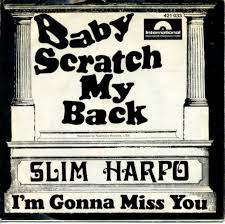
"Baby Scratch My Back" was released as Excello 2273 in January 1966, backed with "I'm Gonna Miss You (Like the Devil)." The record's ascent up the charts was rapid by the standards of small-label blues releases, driven significantly by radio exposure on WLAC in Nashville, Tennessee — the powerful station that had long been the primary vehicle for reaching African American music audiences across a wide geographic area. WLAC's reach was extraordinary: the station broadcast at 50,000 watts on a clear channel, and its signal could reach thirty-eight states after dark. The advertising that accompanied the station's music programming — including Ernie's Record Mart, the mail-order retail arm that was connected to Excello Records — created a direct pathway from radio exposure to commercial sales that was unusually efficient for the era.
"Baby Scratch My Back" hit number one on the R&B chart on February 26, 1966, and remained there for two weeks. On the pop chart, it reached number 16 and spent eight weeks in that position — the longest chart run of any Slim Harpo single, and a performance that dwarfed even the crossover success of "Rainin' in My Heart" in 1961. The Blues Foundation records its remarkable year-end status: "It maintained its strength to be voted the No. 3 R&B recording for the year. This is even more significant if one takes into account the dominance of Motown on the R&B charts." To place third in R&B behind the polished, well-funded Detroit hitmaking machine and the equally well-resourced Atlantic and Stax operations was a triumph of authenticity over commercial calculation.
The commercial success immediately transformed the live opportunities available to Slim Harpo. The record's crossover reach into pop markets — particularly among younger, white audiences who had been primed by the British Invasion to appreciate the blues roots of rock and roll — opened venues that had previously been inaccessible. "The success of the song led to a concert appearance with James Brown at Madison Square Garden in 1966," the Blues Foundation notes. Later, Harpo appeared at the Whisky a Go Go in Los Angeles, at the Apollo Theater in Harlem, at the Electric Circus and eventually the Fillmore East in New York — venues that marked his belated arrival in the rock and blues-rock circuit that his music had long been influencing from a distance.
It was also around this period that Harpo was able, finally, to reduce his dependence on the trucking business and other non-musical employment that had sustained him through the lean years. Writer Ryan Whirty noted that "Harpo and his band needed to tour constantly and play as much as possible; times were frequently lean financially, and the men had to scrape up whatever they could get." The success of "Baby Scratch My Back" and the opportunities it created began to change that equation, though the broader music business infrastructure for blues artists was never as commercially supportive as it was for pop and soul acts.
The impact of the record on Excello itself was also significant. The label, which had been owned since its founding by Ernie Young in Nashville, was sold in 1966 to new Nashville-based owners — a change of ownership that would eventually affect Harpo's recording relationship with the label's established production processes. In the immediate term, however, Excello responded to the "Baby Scratch My Back" success by pressing ahead with further Harpo releases in quick succession.
The Follow-Up Releases and the Shift Away from Miller
The success of "Baby Scratch My Back" created an immediate demand for follow-up material, and Excello and Miller moved quickly to capitalise on the momentum. "Shake Your Hips" was released as Excello 2278 in 1966, followed by "I'm Your Bread Maker, Baby" (Excello 2282) later the same year. Both were recorded in the Miller studio in Crowley with the same core ensemble — Rudolph Richard and James Johnson on guitars, with the King Bees rhythm section — and both are among the most effective records of the late Harpo-Miller collaboration. "Shake Your Hips" in particular, with its driving rhythm and its dance-floor orientation, would achieve its own lasting fame when the Rolling Stones recorded it for Exile on Main Street in 1972, with Mick Jagger even identifying himself as "Slim Harpo" in the lyric — the ultimate tribute from one generation to the artist who had inspired them.
For the Excello 2273 session's companion piece, "I'm Gonna Miss You (Like the Devil)," the production followed the same Crowley blueprint as "Baby Scratch My Back" itself, maintaining the loping groove and the tremolo guitar as central elements. The pairing on the single gave buyers two sides of consistent quality, even if "Baby Scratch My Back" was always the dominant track.
However, the disagreements between Harpo and Miller that had periodically disrupted their collaboration did not disappear with commercial success — if anything, they intensified as the financial stakes rose. When subsequent singles "Tip On In" and "Te-Ni-Nee-Ni-Nu" were recorded, Harpo had moved production away from Miller and Crowley entirely, recording them in Nashville with a new producer, Robert Holmes. The Nashville sessions, which used an entirely different set of musicians — a soul-oriented rhythm section that included, on the 1968 album Tip On In, the Hi Rhythm Section (Charles Hodges on organ, Mabon "Teenie" Hodges on guitar, Leroy Hodges on bass, Howard Grimes on drums) — reflected Harpo's attempt to update his sound for the late-1960s soul market. Both "Tip On In, Part 1" (1967) and "Te-Ni-Nee-Ni-Nu" (1968) made the R&B top 40, demonstrating that Harpo's commercial instincts remained sound even without Miller's guiding hand.
But it is worth noting what was lost in that transition. The Nashville recordings, while professionally executed, lack the particular atmospheric quality that Miller's Crowley studio had given the Harpo catalogue. The Hi Rhythm Section was one of the finest rhythm sections in American soul music, but their professional polish was a different thing entirely from the organic, atmospheric groove of the King Bees in Miller's room. "Baby Scratch My Back" could only have been made in Crowley in 1965, with those particular musicians, that particular producer, and that particular set of sound effects. The Nashville records are good; the Crowley records are irreplaceable.
Covers, Influence, and the Song's Lasting Reach
The commercial success of "Baby Scratch My Back" inspired rapid cover versions from other artists, the most significant of which was Otis Redding's take on the song, which appeared on his album The Soul Album (Volt Records, 1966) — the same year as the original. That Otis Redding, then one of the most commercially successful soul singers in America, chose to cover a Slim Harpo record is a measure of the esteem in which the original was held among professional musicians. Redding's version is a characteristically committed soul performance, but it does not — as Mick Jagger had noted of the Stones' relationship to Harpo — improve on the original. The original's power resides precisely in its Louisiana plainness, its refusal of professional slickness, its confident simplicity.
Frank Frost's adaptation, titled "My Back Scratcher" and recorded for the Jewel label in 1966 under the production of Scotty Moore — Elvis Presley's former guitarist — reached number 43 on the R&B chart, the only chart appearance of Frost's career. The fact that two significant R&B artists recorded versions of the song in the same year as the original speaks to its immediate impact on the musical community.
The song's subsequent life has been extensive. It has been recorded by blues, soul, R&B, and rock artists across multiple decades and genres, and it remains a staple of the blues repertoire. Music critic Dave Marsh included it in The Heart of Rock and Soul: The 1001 Greatest Singles Ever Made, situating it in the broadest possible canon of recorded popular music. The observation from The Hound Blog that "Baby Scratch My Back"'s "tremolo guitar riff" is the one that "John Fogerty would build a career on" — referring to the connection between Johnson's guitar work and the approach that defined Creedence Clearwater Revival — is an arresting claim that points to the depth of the record's influence, even if the direct line of influence is difficult to establish with precision.
The Blues Foundation's induction of the song into its Hall of Fame — the institution that also recognised Harpo's debut single "I'm a King Bee" — confirmed the record's status as one of the canonical recordings of American blues history.
The Legacy: What "Baby Scratch My Back" Meant for Slim Harpo
For James Moore — the man who was Slim Harpo — "Baby Scratch My Back" meant, above all, that his music had finally been heard. Not by the small community of blues cognoscenti who had always known his worth, not by the British rock musicians who had covered his songs for a decade, but by the general American public, the radio-listening, record-buying, jukebox-playing public that constituted the mainstream audience for popular music in 1966.
The irony that this long-delayed breakthrough came with a record that Harpo himself described as "an attempt at rock and roll for me" is significant. "Baby Scratch My Back" was, in a sense, a meeting point between two currents: the deep Louisiana blues tradition in which Harpo had been working since 1957, and the more rhythmically assertive, dance-floor-oriented approach of mid-1960s R&B. The record was neither a stylistic departure nor a commercial calculation in the conventional sense — it was a natural evolution of what Harpo and Miller had been developing together, pushed slightly further toward the dance floor by a production sensibility that had absorbed something of the era's rhythmic energy without abandoning any of the essential swamp blues character.
The subsequent years — from 1966 until Harpo's sudden death on January 31, 1970 — saw the Baton Rouge bluesman finally performing in the concert venues and rock clubs that his influence had long merited. The Fillmore East, the Whisky a Go Go, the Electric Circus, the Apollo Theater — these were the stages that the success of "Baby Scratch My Back" opened for him, and by all accounts he acquitted himself brilliantly on all of them, his King Bees playing with the same tight, groove-oriented precision that had characterised the best of his studio work.
He was, in these final years, planning his first European tour — and recording sessions in London had already been arranged — when the heart attack took him on January 31, 1970. He was 46. The cruel timing of his death, arriving precisely at the moment when his international recognition had finally caught up with his reputation, is one of the sadder accidents of blues history. But the records he left behind — and "Baby Scratch My Back" above all the rest — ensure that his music has continued to speak long after his voice was stilled.
Conclusion: The Groove That Couldn't Be Denied
"Baby Scratch My Back" is, at its most fundamental, a groove record — a record whose power resides not in any single element but in the interaction of all its elements: the tremolo guitar riff, the layered percussion, the dry snap of the snare drum, the conversational vocal, the perfectly timed harmonica fills. Remove any one of these components and the record loses something irreplaceable. Together, they constitute a whole that is not explicable by its parts, a sonic experience that is greater than the sum of what went into creating it.
This is the quality that the best popular recordings possess and that no commercial calculation can reliably produce. It comes from the right artist — a man with a genuine voice and a genuine feel for the groove — in the right studio, with the right musicians, and with a producer who understood exactly what kind of space to create and what to leave unfilled. J.D. Miller had been building toward this record for eight years, developing his percussion philosophy, honing his approach to Harpo's voice and harmonica, learning the acoustic properties of his small Crowley room the way a painter learns the properties of a particular canvas. James Johnson and Rudolph Richard had been playing together long enough to function as a single musical organism. Sammy K. Brown and Geese August had developed a rhythm section understanding that made the groove feel inevitable rather than constructed. And Slim Harpo himself — the truck driver and part-time musician from Baton Rouge, the quiet, amiable man who would sit in his driveway playing harmonica on a Sunday afternoon — brought to the microphone everything he had learned about how to make a song feel true.
The result was number one. Of course it was.
"Baby Scratch My Back" was released as Excello 2273 in January 1966. Written by James Moore (Slim Harpo). Produced by J.D. Miller. Recorded at J.D. Miller's Studio, Crowley, Louisiana, October 1965. Personnel: Slim Harpo (vocals, harmonica); James Johnson (guitar — "chicken scratch"); Rudolph Richard (guitar); Geese August (bass); Sammy K. Brown (drums); Lazy Lester/Leslie Johnson (additional percussion — woodblocks, bongos). It reached number 1 on the U.S. Hot R&B Singles chart on February 26, 1966 (remaining for two weeks), and number 16 on the Billboard Hot 100. It was voted the number 3 R&B recording of 1966. The song was later inducted into the Blues Foundation Hall of Fame.