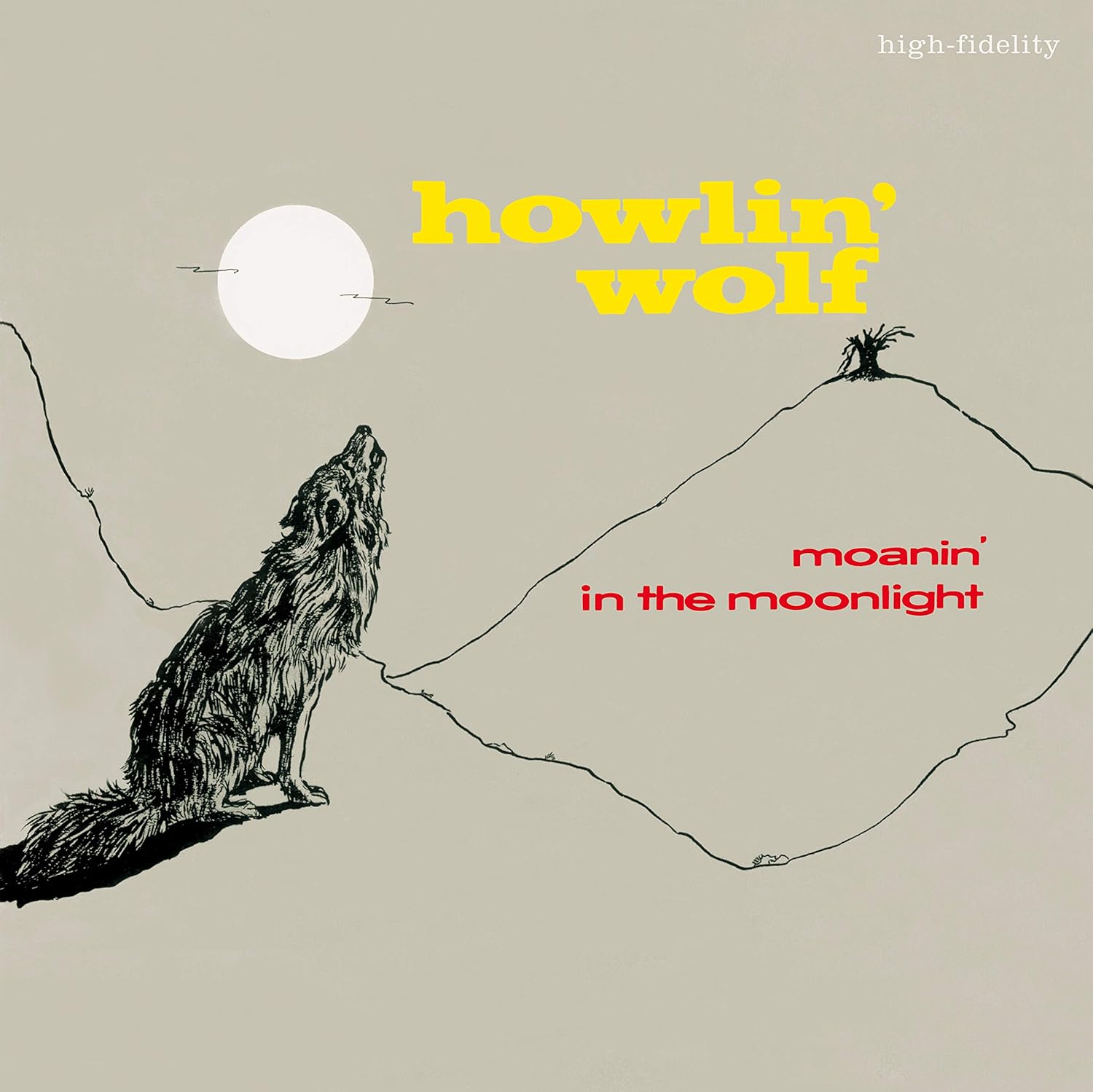
Moanin' in the Moonlight is the debut album by American blues singer and guitarist Howlin' Wolf, released in 1959 by Chess Records. It is not a studio album in the conventional sense but a compilation of twelve singles recorded between 1951 and 1959, capturing the seismic transition of Chester Arthur Burnett from Mississippi Delta bluesman to the electrified Chicago blues titan who would become one of the most influential voices in American music history. The album's raw, primal power and its extraordinary roster of session musicians — including Sam Phillips, Willie Dixon, Hubert Sumlin, Ike Turner, and Otis Spann — make it one of the most consequential blues records ever assembled.
Background and Context
Howlin' Wolf was born Chester Arthur Burnett on June 10, 1910, near West Point, Mississippi. He learned guitar from Charley Patton, harmonica from Sonny Boy Williamson II, and absorbed the Delta blues tradition before serving in the Army from 1941 to 1943. After his discharge, he returned to West Memphis, formed his first band in 1948 with Willie Johnson on guitar, and became a regular on radio station KWEM. In May 1951, producer Sam Phillips recorded him at his Memphis Recording Service, and the resulting singles — "Moanin' at Midnight" and "How Many More Years" — were leased to Chess Records, launching Wolf's career.
Wolf moved to Chicago around 1952–53 and signed an exclusive deal with Chess. It was there that he connected with guitarist Hubert Sumlin, who replaced Willie Johnson in May 1954 and would become Wolf's musical foil for the rest of his career. The album Moanin' in the Moonlight gathers singles from both the Memphis and Chicago periods, presenting a portrait of an artist in evolution — from the raw, barely controlled chaos of the early Sun recordings to the more disciplined but equally intense Chicago sides.
The album was released in the summer of 1959, at a time when Chess was beginning to package its extensive singles catalog into LPs for the growing album market. It was not conceived as a unified artistic statement but rather as a commercial compilation. Yet the sheer consistency of Wolf's vision — his gravelly, howling vocals, his menacing harmonica, and the extraordinary caliber of his backing musicians — transformed it into a cohesive masterpiece that ranks among the greatest albums in American music. Rolling Stone placed it at number 477 on its 2020 list of the 500 Greatest Albums of All Time (it was number 154 in the 2003 edition).
The Producers
Sam Phillips
Sam Phillips (1923–2003) produced the earliest and most historically significant recordings on the album. Phillips, the founder of Sun Records and the man who would discover Elvis Presley, Johnny Cash, and Jerry Lee Lewis, first heard Howlin' Wolf through an introduction from Ike Turner. His reaction was instantaneous and legendary: "This is where the soul of man never dies."
Phillips recorded Wolf at his Memphis Recording Service in July 1951. His production approach was minimal and raw — he set up microphones, pressed record, and let Wolf's overwhelming presence fill the room. The Memphis recordings have a distinctive sonic character: distorted, overloaded, and atmospheric. Robert Palmer cited "How Many More Years" (recorded May 1951) as the first record to feature a distorted power chord, played by Willie Johnson on electric guitar — a sound that would prove foundational to rock and roll.
Leonard and Phil Chess
Leonard Chess (1917–1969) and Phil Chess (1921–2016), the Polish-Jewish immigrant brothers who founded Chess Records in Chicago, oversaw the majority of the album's recordings. Their production style was similarly hands-off in the creative sense — they trusted their artists and session musicians to deliver the goods — but they were shrewd businessmen who understood how to market raw blues to a growing audience. They acquired Wolf's Memphis recordings from Phillips and subsequently recorded him extensively in Chicago.
Willie Dixon
Willie Dixon (1915–1992) served as the principal composer, bassist, and de facto producer on many of the Chicago sessions. Dixon's role was transformative — he understood Wolf's persona better than anyone and wrote songs that perfectly channeled the Wolf's menacing, supernatural presence. His bass playing provided the rhythmic and harmonic foundation for the Chicago recordings, and his songs "Evil," "No Place to Go," and "Forty Four" became staples of Wolf's repertoire.
The Musicians
The personnel on Moanin' in the Moonlight reads like a who's who of blues history:
-
Howlin' Wolf – vocals, harmonica
-
Willie Johnson – guitar (Memphis sessions, 1951–1953; Chicago sessions on "Smokestack Lightnin'" and "Somebody in My Home")
-
Hubert Sumlin – guitar (Chicago sessions from 1954 onward; "Smokestack Lightnin'," "Baby How Long," "No Place to Go," "Evil," "I'm Leavin' You," "Moanin' for My Baby," "Forty Four")
-
Jody Williams – guitar (Chicago sessions; "Baby How Long," "Evil," "Forty Four")
-
Lee Cooper – guitar ("No Place to Go")
-
L.D. McGhee – guitar ("I'm Leavin' You")
-
Otis "Smokey" Smothers – guitar ("I Asked for Water," "Somebody in My Home")
-
Ike Turner – piano (Memphis sessions, "Moanin' at Midnight," "How Many More Years")
-
Otis Spann – piano (Chicago sessions, "No Place to Go," "Baby How Long," "Evil," "Forty Four")
-
Hosea Lee Kennard – piano ("Smokestack Lightnin'," "I Asked for Water," "Somebody in My Home," "I'm Leavin' You")
-
Willie Dixon – double bass, producer
-
Alfred Elkins – bass ("Somebody in My Home," "Moanin' for My Baby," "I'm Leavin' You")
-
Willie Steele – drums (Memphis sessions, "Moanin' at Midnight," "How Many More Years")
-
Earl Phillips – drums (Chicago sessions, "Baby How Long," "Evil," "Forty Four," "Smokestack Lightnin'," "I Asked for Water," "Somebody in My Home," "Moanin' for My Baby")
-
Fred Below – drums ("All Night Boogie")
-
S.P. Leary – drums ("I'm Leavin' You")
-
Adolph "Billy" Duncan – tenor saxophone ("Moanin' for My Baby," "Somebody in My Home")
-
Abb Locke – tenor saxophone ("Moanin' for My Baby" — some sources)
The Songwriters
The album's songwriting credits reflect the transition from Wolf's own compositions to the Willie Dixon era:
-
Chester Burnett (Howlin' Wolf) wrote the majority of the tracks: "Moanin' at Midnight," "How Many More Years," "Smokestack Lightnin'," "Baby How Long," "No Place to Go," "All Night Boogie," "I'm Leavin' You," "Moanin' for My Baby," "I Asked for Water (She Gave Me Gasoline)," and "Somebody in My Home"
-
Willie Dixon wrote "Evil (Is Goin' On)"
-
Roosevelt Sykes wrote "Forty Four" (credited to Burnett on the original LP)
The original 1959 LP credited all compositions to "C. Burnett," a common practice at Chess that obscured the true authorship of several songs. Later reissues have corrected these credits.
Track-by-Track Breakdown
Side One
1. "Moanin' at Midnight" – 2:58
Recorded: July 1951, Memphis Recording Service, Memphis, Tennessee
Produced by: Sam Phillips
Written by: Chester Burnett
Musicians: Howlin' Wolf (vocals, harmonica), Willie Johnson (guitar), Ike Turner (piano), Willie Steele (drums)
Produced by: Sam Phillips
Written by: Chester Burnett
Musicians: Howlin' Wolf (vocals, harmonica), Willie Johnson (guitar), Ike Turner (piano), Willie Steele (drums)
The album opens with Wolf's first single and his biggest commercial hit — a record that reached No. 10 on the Billboard R&B chart. The track begins with Wolf humming in a deep, throbbing style before launching into blazing harmonica and the unforgettable opening line: "Yeah, somebody knockin' on my door." His voice has a hypnotic, almost supernatural power. As Wolf himself joked, "I couldn't do no yodellin', so I turned to howlin'. And it's done me just fine."
The production by Sam Phillips is raw and atmospheric. Willie Johnson's guitar is distorted and aggressive, Ike Turner's piano pounds with blues-drenched authority, and Willie Steele's drums bash with unremitting power. The track establishes the Wolf persona immediately — not a victim of darkness but its perpetrator, its embodiment. This is blues as exorcism, as invocation of something primal and ancient.
2. "How Many More Years" – 2:42
Recorded: May 1951, Memphis Recording Service, Memphis, Tennessee
Produced by: Sam Phillips
Written by: Chester Burnett
Musicians: Howlin' Wolf (vocals, harmonica), Willie Johnson (guitar), Ike Turner (piano), Willie Steele (drums)
Produced by: Sam Phillips
Written by: Chester Burnett
Musicians: Howlin' Wolf (vocals, harmonica), Willie Johnson (guitar), Ike Turner (piano), Willie Steele (drums)
The B-side of Wolf's debut single and another Top 10 R&B hit (reaching No. 8). This is the track that Robert Palmer identified as containing the first recorded distorted power chord — Willie Johnson's guitar creating a sound that would echo through rock and roll history. The song is a jaunty juke-joint jive with Turner's jazzy piano, Wolf's Sonny Boy Williamson-styled harmonica, and Johnson's squalls of guitar notes.
Thematically, the song recycles decades-old blues patterns — the pleading lover asking how long he must suffer — but the presentation is entirely new. No electric blues player had sounded this crude, this aggressive, this alive. The Memphis Recording Service studio, where Ike Turner and Jackie Brenston had cut "Rocket '88'" just months earlier, provided the perfect environment for this proto-rock explosion.
3. "Smokestack Lightnin'" – 3:07
Recorded: 1956, Chess Studios, Chicago, Illinois
Produced by: Leonard Chess / Phil Chess / Willie Dixon
Written by: Chester Burnett
Musicians: Howlin' Wolf (vocals, harmonica), Willie Johnson and Hubert Sumlin (guitars), Willie Dixon (bass), Earl Phillips (drums), Hosea Lee Kennard (piano)
Produced by: Leonard Chess / Phil Chess / Willie Dixon
Written by: Chester Burnett
Musicians: Howlin' Wolf (vocals, harmonica), Willie Johnson and Hubert Sumlin (guitars), Willie Dixon (bass), Earl Phillips (drums), Hosea Lee Kennard (piano)
Wolf's most famous composition and one of the most enduring blues standards of all time. The song rose to No. 8 on the R&B chart and has been covered by the Yardbirds, the Who, the Grateful Dead, and countless others. The song is built around a hypnotic guitar figure that Wolf had been performing since the early 1930s, drawn from his childhood memories of watching trains go by in Mississippi.
The Chess Studios production is cleaner than the Memphis sides, but the intensity is undiminished. The twin guitars of Willie Johnson and Hubert Sumlin create a web of sound, Willie Dixon's fatback bass provides the foundation, and Earl Phillips' steady-handed drumming keeps the train rolling. Wolf's vocals soar above the performance with what one critic described as "the intensity of a runaway chainsaw." The song is an amalgam of previous blues recordings — Tommy Johnson's "Big Road Blues" and Charley Patton's "Moon Going Down" — but Wolf's synthesis is entirely his own.
4. "Baby How Long" – 2:56
Recorded: 1954, Chess Studios, Chicago, Illinois
Produced by: Leonard Chess / Phil Chess / Willie Dixon
Written by: Chester Burnett
Musicians: Howlin' Wolf (vocals, harmonica), Hubert Sumlin and Jody Williams (guitars), Otis Spann (piano), Willie Dixon (bass), Earl Phillips (drums)
Produced by: Leonard Chess / Phil Chess / Willie Dixon
Written by: Chester Burnett
Musicians: Howlin' Wolf (vocals, harmonica), Hubert Sumlin and Jody Williams (guitars), Otis Spann (piano), Willie Dixon (bass), Earl Phillips (drums)
A 1954 single that inexplicably failed to chart despite its quality. The performance offers an unusually nuanced vocal turn by Wolf, with elegant six-string interplay between Sumlin and Williams and an early appearance by future blues legend Otis Spann, whose tinkling piano moves the song closer to the "rhythm" side of rhythm and blues.
This is the first recording on the album to feature the classic Chicago lineup that would define Wolf's sound — Sumlin's sharp, inventive lead guitar, Spann's sophisticated piano, Dixon's authoritative bass, and Phillips' rock-solid drums. The song is a standard blues complaint about a departing lover, but Wolf's delivery elevates it to something approaching art song.
5. "No Place to Go" – 2:59
Recorded: March 1954, Chess Studios, Chicago, Illinois
Produced by: Leonard Chess / Phil Chess
Written by: Chester Burnett
Musicians: Howlin' Wolf (vocals, harmonica), Lee Cooper (guitar), Otis Spann (piano), Willie Dixon (bass), Earl Phillips (drums)
Produced by: Leonard Chess / Phil Chess
Written by: Chester Burnett
Musicians: Howlin' Wolf (vocals, harmonica), Lee Cooper (guitar), Otis Spann (piano), Willie Dixon (bass), Earl Phillips (drums)
Wolf's first single recorded in Chicago after his permanent move from Memphis, and ironically titled given his circumstances. The track has been criticized as "pathetically boring" compared to the Memphis sides — Spann's subtle piano fills and Lee Cooper's dark-hued guitar notes accompany a monster vocal performance on a song of love and betrayal, but the band seems to be working out a basic skeleton rather than delivering a fully realized performance.
Yet even in this transitional recording, Wolf's presence is undeniable. The song is essentially a recreation of "How Many More Years" with new lyrics, and the Chicago musicians had not yet found the formula that would make their collaborations with Wolf legendary. Within two months, however, the pieces would fall into place.
6. "All Night Boogie" – 2:12
Recorded: 1953, Memphis, Tennessee
Produced by: Sam Phillips or Chess brothers
Written by: Chester Burnett
Musicians: Howlin' Wolf (vocals, harmonica), Willie Johnson (guitar), Fred Below (drums), unidentified rhythm section
Produced by: Sam Phillips or Chess brothers
Written by: Chester Burnett
Musicians: Howlin' Wolf (vocals, harmonica), Willie Johnson (guitar), Fred Below (drums), unidentified rhythm section
The last track on Side One and the final Memphis recording on the album. "All Night Boogie" is a rowdy, breakneck jump blues with rockabilly-tinged fretwork and enough musical energy to liven any party. Fred Below, the drummer who would create the iconic beat on Chuck Berry's "Johnny B. Goode," provides propulsive drumming.
The track demonstrates that Wolf could work the dance floor with the best of the jump blues shouters — Wynonie Harris, Big Joe Turner — but somehow the demonic aura that defines his best work is slightly diminished at this tempo. He is not quite as good at preserving his menacing presence in up-tempo material as Muddy Waters would prove to be with "Got My Mojo Working." Still, the instrumental workout on guitar and harmonica is thrilling, with Wolf and Johnson sprinting toward the finale until both run out of steam and collapse around the two-minute mark.
Side Two
7. "Evil (Is Goin' On)" – 2:55
Recorded: May 1954, Chess Studios, Chicago, Illinois
Produced by: Leonard Chess / Phil Chess / Willie Dixon
Written by: Willie Dixon
Musicians: Howlin' Wolf (vocals, harmonica), Hubert Sumlin and Jody Williams (guitars), Otis Spann (piano), Willie Dixon (bass), Earl Phillips (drums)
Produced by: Leonard Chess / Phil Chess / Willie Dixon
Written by: Willie Dixon
Musicians: Howlin' Wolf (vocals, harmonica), Hubert Sumlin and Jody Williams (guitars), Otis Spann (piano), Willie Dixon (bass), Earl Phillips (drums)
Side Two opens with a masterpiece — the first Willie Dixon composition in Wolf's Chicago catalog and the beginning of one of the most fruitful songwriter-singer partnerships in blues history. "Evil" is where the Chicago band truly finds its footing. The song is dominated by Otis Spann soloing with abandon, but the stuttering rhythm tailored by Dixon to fit his bass-playing preference makes up for any deficiencies in the arrangement.
The lyric is a warning about female infidelity, but the delivery transcends the mundane. Wolf's incantation — "That's EEEEEVIL, evil is goin' on!" — brings back the Beelzebub persona of "Moanin' at Midnight," now comfortably readjusted to the cold climate of Chicago. The song would inspire later covers by Luther Allison, Canned Heat, Cactus, Gary Moore, Monster Magnet, and Greta Van Fleet. Koko Taylor's version was featured in the 1987 film Adventures in Babysitting.
8. "I'm Leavin' You" – 3:01
Recorded: 1958, Chess Studios, Chicago, Illinois
Produced by: Leonard Chess / Phil Chess
Written by: Chester Burnett
Musicians: Howlin' Wolf (vocals, harmonica), Hubert Sumlin and L.D. McGhee (guitars), Hosea Lee Kennard (piano), Alfred Elkins (bass), S.P. Leary (drums), Adolph "Billy" Duncan (tenor saxophone)
Produced by: Leonard Chess / Phil Chess
Written by: Chester Burnett
Musicians: Howlin' Wolf (vocals, harmonica), Hubert Sumlin and L.D. McGhee (guitars), Hosea Lee Kennard (piano), Alfred Elkins (bass), S.P. Leary (drums), Adolph "Billy" Duncan (tenor saxophone)
The most recent recording on the album, from 1958, and a revelation of late-decade rock and roll influences hiding beneath traditional R&B. Wolf is accompanied by a band that creates a solid soundtrack, with Kennard's piano leading the charge alongside twangy guitar licks and Wolf's surprisingly smooth vocals. The saxophone of Adolph "Billy" Duncan adds a layer of R&B sophistication.
This track shows Wolf's adaptability — he could incorporate contemporary influences without losing his essential identity. The song is a standard blues farewell, but the execution is polished and assured, demonstrating how far Wolf had come as a recording artist in the seven years since his Memphis debut.
9. "Moanin' for My Baby" – 2:47
Recorded: 1957, Chess Studios, Chicago, Illinois
Produced by: Leonard Chess / Phil Chess / Willie Dixon
Written by: Chester Burnett
Musicians: Howlin' Wolf (vocals, harmonica), Hubert Sumlin (guitar), Hosea Lee Kennard (piano), Alfred Elkins (bass), Earl Phillips (drums), Adolph "Billy" Duncan (tenor saxophone)
Produced by: Leonard Chess / Phil Chess / Willie Dixon
Written by: Chester Burnett
Musicians: Howlin' Wolf (vocals, harmonica), Hubert Sumlin (guitar), Hosea Lee Kennard (piano), Alfred Elkins (bass), Earl Phillips (drums), Adolph "Billy" Duncan (tenor saxophone)
A slow blues that showcases the perfection of Wolf's Jimmie Rodgers-inspired, semi-falsetto "howl." The song is standard Chicago blues fare with a shuffling rhythm and tasty guitar playing from Sumlin, but the vocal performance takes it to another level entirely. The saxophone of Duncan adds a jazz-flecked texture that enriches the arrangement.
The lyric is a straightforward lament for an absent lover, but Wolf's delivery — alternating between guttural growls and piercing falsetto cries — transforms it into something almost operatic in its emotional scope. This is the track that most clearly demonstrates why Wolf was not merely a blues singer but a vocal phenomenon without precedent or parallel.
10. "I Asked for Water (She Gave Me Gasoline)" – 2:53
Recorded: 1958, Chess Studios, Chicago, Illinois
Produced by: Leonard Chess / Phil Chess
Written by: Chester Burnett
Musicians: Howlin' Wolf (vocals, harmonica), Otis "Smokey" Smothers (guitar), Hosea Lee Kennard (piano), Willie Dixon (bass), Earl Phillips (drums)
Produced by: Leonard Chess / Phil Chess
Written by: Chester Burnett
Musicians: Howlin' Wolf (vocals, harmonica), Otis "Smokey" Smothers (guitar), Hosea Lee Kennard (piano), Willie Dixon (bass), Earl Phillips (drums)
An underrated deep cut, the 1958 recording is balanced by a recurring rhythmic pattern and the circular fretwork of guitarists Sumlin and McGhee. Any subtlety here is blown out of the window by Wolf's growling, sandpaper vocals, which hit the ears like a sonic boom and leave a lasting impression. The title is one of the great blues metaphors — a plea for simple sustenance met with poison — and Wolf's delivery makes every word count.
Otis "Smokey" Smothers, a regular songwriter for Muddy Waters, contributes guitar work that is both supportive and inventive. The track is a masterclass in how the Chicago blues ensemble could create a sound that was simultaneously disciplined and wild, controlled and explosive.
11. "Forty Four" – 2:51
Recorded: 1954, Chess Studios, Chicago, Illinois
Produced by: Leonard Chess / Phil Chess / Willie Dixon
Written by: Roosevelt Sykes (credited to Burnett on original LP)
Musicians: Howlin' Wolf (vocals, harmonica), Hubert Sumlin and Jody Williams (guitars), Otis Spann (piano), Willie Dixon (bass), Earl Phillips (drums)
Produced by: Leonard Chess / Phil Chess / Willie Dixon
Written by: Roosevelt Sykes (credited to Burnett on original LP)
Musicians: Howlin' Wolf (vocals, harmonica), Hubert Sumlin and Jody Williams (guitars), Otis Spann (piano), Willie Dixon (bass), Earl Phillips (drums)
A cover of the legendary New Orleans pianist Roosevelt Sykes' composition, and arguably the weakest track on the album. The performance offers what some critics have described as "half-hearted vocals," Spann's muted piano-play, and muddy production that provides little to write home about. The song failed to make any chart impact, which is somewhat surprising given the caliber of the musicians involved.
Yet even a relatively subdued Wolf performance contains moments of power. The interplay between Williams playing a merry-go-round riff and Dixon ramming his bass into it, or taking a running jump over the merry-go-rounders every now and then, is mesmerizing in its geometric inventiveness. The song's odd vibe — as if it is aching to break into a waltz tempo but never quite does — creates a tension that is uniquely compelling.
12. "Somebody in My Home" – 2:27
Recorded: 1957, Chess Studios, Chicago, Illinois
Produced by: Leonard Chess / Phil Chess / Willie Dixon
Written by: Chester Burnett
Musicians: Howlin' Wolf (vocals, harmonica), Willie Johnson and Otis "Smokey" Smothers (guitars), Hosea Lee Kennard (piano), Alfred Elkins (bass), Earl Phillips (drums), Adolph "Billy" Duncan (tenor saxophone)
Produced by: Leonard Chess / Phil Chess / Willie Dixon
Written by: Chester Burnett
Musicians: Howlin' Wolf (vocals, harmonica), Willie Johnson and Otis "Smokey" Smothers (guitars), Hosea Lee Kennard (piano), Alfred Elkins (bass), Earl Phillips (drums), Adolph "Billy" Duncan (tenor saxophone)
The album closer brings together elements from both the Memphis and Chicago periods. Willie Johnson, Wolf's original guitarist from the Memphis days, returns alongside Otis "Smokey" Smothers, creating a guitar interplay that bridges Wolf's early and mature styles. The song is a shuffling blues with tasty guitar playing and a vocal performance that demonstrates the full range of Wolf's powers.
The saxophone of Duncan adds R&B punch, and the rhythm section of Elkins and Phillips provides a solid foundation. The track ends the album on a note of affirmation — after the darkness and menace of "Evil," the heartbreak of "Moanin' for My Baby," and the bitterness of "I Asked for Water," Wolf closes with a statement of resilience. There may be somebody in his home, but the Wolf remains standing.
Artwork and Packaging
The original version of Moanin' in the Moonlight featured cover artwork by Don S. Bronstein and sleeve notes by Billboard editor Paul Ackerman. The album was featured in a Billboard advertisement on August 10, 1959, which amusingly misprinted the title as Howlin' at Midnite. Original label pressings from different plants used different colors, a common practice for Chess Records at the time.
Accolades and Legacy
Moanin' in the Moonlight received a W.C. Handy Award in 1987 in the "Vintage/Reissue Album (US)" category. Its ranking on Rolling Stone's 500 Greatest Albums list — number 154 in 2003, adjusted to 477 in 2020 — reflects both its enduring importance and the shifting critical consensus as more albums entered the canon.
The album's influence extends across multiple genres and generations. The Rolling Stones, the Doors, and Cream were directly inspired by its unfiltered power and rhythmic drive. Captain Beefheart and Tom Waits attempted to replicate Wolf's howl in their own distinctive ways. Jimi Hendrix, Taj Mahal, Nick Cave, and even free jazz musicians like Albert Ayler and Archie Shepp drew connections to Wolf's primal energy. As one critic noted, "Anyone who fails to join the dots between Wolf and Albert Ayler and Archie Shepp is clearly looking in the wrong direction."
Howlin' Wolf was inducted into the inaugural class of the Blues Hall of Fame in 1980 and the Rock and Roll Hall of Fame in 1991. His career lasted a quarter-century until his death in 1976 at age 65. Moanin' in the Moonlight was where it all began — a compilation of singles that, through the sheer force of Wolf's personality and the extraordinary caliber of his musicians, became one of the handful of truly seminal albums in the history of the blues.
Reissues and Bonus Tracks
The album has been reissued numerous times with additional material. A 2016 vinyl reissue by the Spanish archival label Vinyl Lovers added four bonus tracks, expanding the album to sixteen tracks. The 2012 box set The Complete Chess Masters 1951–1960 (released coincidentally within days of Hubert Sumlin's death) gathered 97 tracks across four CDs, including alternate takes and unreleased material from the period covered by Moanin' in the Moonlight.
Notable bonus tracks on various reissues include:
-
"Rockin' Daddy" (1957) — a jazz-flecked romp with Lee Cooper's stunning guitar and Earl Phillips' light-hearted fills
-
"Going Back Home" (1956) — featuring an exotic, syncopated rhythm beneath Wolf's raging vocals and Sumlin's trembling guitar
-
"I'll Be Around" (1954) — another strong vocal performance with wailing harmonica and livewire fretwork
-
"So Glad" (1956) — fusing jazzy instrumentation with Chicago blues tradition
Buy this Album on Amazon
Conclusion
Moanin' in the Moonlight is not merely a compilation of singles — it is a document of transformation. It captures Howlin' Wolf's evolution from the raw, unbridled force of the Memphis recordings to the more structured but equally intense Chicago sound. It showcases the work of three distinct guitarists — Willie Johnson's distorted, aggressive Memphis playing, Hubert Sumlin's sharp, inventive Chicago lead work, and Jody Williams' elegant counterpoint — each contributing to a sound that would influence generations of rock and blues musicians.
The album's primal power remains undiminished more than six decades after its release. Sam Phillips' Memphis recordings and the Chess brothers' Chicago sessions created a body of work that is simultaneously rooted in the Delta blues tradition and pointing toward the future of electrified blues, rock and roll, and beyond. From the opening hum of "Moanin' at Midnight" to the closing shuffle of "Somebody in My Home," Moanin' in the Moonlight is a journey into the dark heart of American music — a place where, as Phillips recognized, "the soul of man never dies."