Before there was a bluesman with a guitar, there was a man from New Orleans with a six-string banjo on Maxwell Street. How Papa Charlie Jackson became the first male blues star, invented hokum, and made "Shake That Thing" shake the world.
In Chicago in the winter of 1924, if you walked down Maxwell Street on a Sunday morning, past the pushcarts selling live chickens and second-hand shoes and hot tamales, you would hear a sound that was new to records but old to the street: a high, almost keening tenor voice, a little nasal, a little joyful, singing a blues with a banjo that sounded like a guitar and a guitar that sounded like a banjo, telling a story that made the crowd laugh and then, on the next verse, made them feel something they didn't expect to feel on a cold morning.
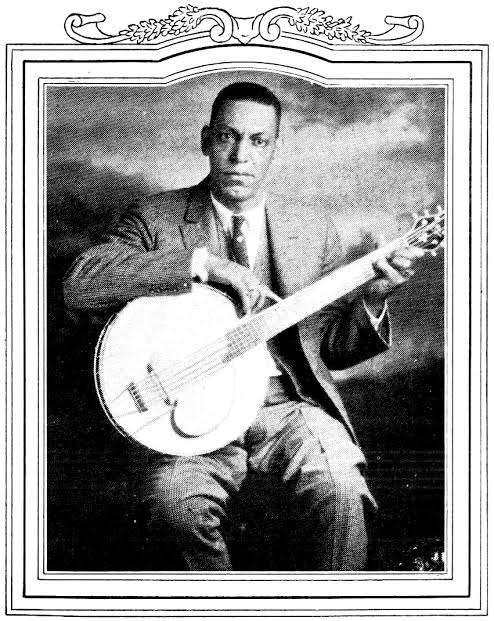
The man singing was small, light-skinned, with a quick smile and a battered six-string banjo. He called himself Papa Charlie Jackson. He had come from New Orleans by way of medicine shows and minstrel shows and levee camps, and he was about to become the first male blues singer to make records that sold, the first man to prove that a man alone with a stringed instrument could sell as well as Mamie Smith or Ma Rainey with a jazz band.
For almost ten years, from 1924 to 1934, Papa Charlie Jackson was one of the most popular blues recording artists in America. He recorded more than 70 sides for Paramount, Okeh, and other labels. He wrote "Shake That Thing," which became a standard. He wrote "Salty Dog Blues" and "Spoonful" before Charley Patton and Howlin' Wolf made them famous. He accompanied Ida Cox and Ma Rainey and Hattie McDaniels. He played banjo, six-string banjo, guitar, and ukulele, often on the same record.
And then, in the mid-thirties, he got sick, stopped recording, and died on May 7, 1938, in Chicago, largely forgotten by the white press and mourned by the Black musicians who knew what he had done: he had taught men how to sing the blues.
Today, for most listeners, Papa Charlie Jackson is a footnote, a name that comes up in histories of Paramount Records. For blues enthusiasts, he is something else: the missing link between vaudeville and country blues, between banjo and guitar, between hokum and heartbreak, the man who made it possible for Blind Lemon Jefferson and Blind Blake and Big Bill Broonzy to have careers.
This is his story, as close as we can get to it, because Papa Charlie Jackson, like many early bluesmen, liked to tell stories more than facts.
New Orleans, 1887
Papa Charlie Jackson was born around 1887. The exact date is unknown. The 1930 census says he was 43, which would make his birth year 1887. His death certificate says he was 50 in 1938, which would make it 1888. Some early Paramount promotional material says he was born in 1885. He said himself he was born in New Orleans, Louisiana, and that seems to be true. His parents' names are unknown. He was orphaned young, according to one account, and raised by family or by himself on the streets of New Orleans.
New Orleans in the 1890s and 1900s was a city of music. Not just jazz, which was being invented in Storyville and in the neighborhoods, but blues, ragtime, string band music, and medicine show music. A Black boy who wanted to be a musician in New Orleans had many models: the street singers who played for nickels, the string bands that played for dances, the brass bands that played for parades, and the medicine show performers who traveled through.
Jackson learned banjo first. The banjo in Black New Orleans at the turn of the century was not the white bluegrass banjo. It was the African-derived gourd banjo, the four-string and five-string banjo that had been in Black communities for centuries, used for dance music and for blues. He learned to play a four-string banjo, then a five-string, then a six-string banjo, which is essentially a guitar neck on a banjo body, tuned like a guitar, so you can play guitar chords but with a banjo's snap and volume. The six-string banjo — sometimes called a banjo-guitar or ganjo — would become his trademark.
He also learned to sing, in a high, tenor voice, almost falsetto at times, with a nasal edge that cut through street noise. He learned to tell stories, to make people laugh, to make double entendres that adults understood and children didn't. He learned to be a showman.
In his teens, he left New Orleans and joined the medicine show and minstrel circuit, which was the main way a Black musician could travel and make a living in the South in the 1900s and 1910s. Medicine shows — a doctor selling patent medicine, with entertainment to draw a crowd — and minstrel shows, both Black and white, traveled by wagon and later by truck through small towns, setting up in fields and on main streets, playing music, telling jokes, selling medicine that was mostly alcohol. Jackson played banjo, sang blues and pop songs, told jokes, and learned how to work a crowd.
He also worked on the levees, on riverboats, and as a laborer when music didn't pay. He was in his twenties when World War I happened. There is no record of him serving.
By the early 1920s, he had made his way to Chicago. Chicago in the early twenties was the promised land for Southern Black musicians. The Great Migration was bringing tens of thousands of Black people from Mississippi, Louisiana, and Texas to Chicago's South Side. They brought their music and they wanted to hear it. Maxwell Street, on the Near West Side, became an open-air market and music center where street musicians could play for tips and be heard by record scouts.
Jackson settled on the South Side, probably around 1922 or 1923, and became a regular on Maxwell Street and at house parties and rent parties. He played six-string banjo and guitar, sang blues and hokum songs, and accompanied female blues singers who came through Chicago on the TOBA circuit — the Theater Owners Booking Association, the Black vaudeville circuit.
1924: The First Man
To understand how radical Papa Charlie Jackson's first records were, you have to understand the record business in 1924.
Blues records had been selling since 1920, when Mamie Smith recorded "Crazy Blues" for Okeh and sold 75,000 copies in a month. From 1920 to 1924, the blues that sold were almost all by women — Mamie Smith, Ma Rainey, Bessie Smith, Ida Cox, Ethel Waters — backed by jazz bands, singing vaudeville blues and classic blues. Male blues singers had recorded — Ed Andrews and others — but they had not sold well. The record companies thought women sold blues and men didn't.
Paramount Records, based in Port Washington, Wisconsin, with a studio in Chicago and a pressing plant in Grafton, Wisconsin, was a furniture company — the Wisconsin Chair Company — that made records as a sideline. Paramount had been recording female blues singers, including Ma Rainey and Ida Cox, and had a talent scout and producer named J. Mayo Williams, a Black former football player from Brown University who had worked for Black Swan Records, the first Black-owned record company. Williams was always looking for new talent.
Williams heard Jackson on Maxwell Street or at a house party in late 1923 or early 1924. He heard a man who could sing blues in a high, clear voice, accompany himself on banjo and guitar, tell funny stories, and hold a crowd. He arranged for Jackson to record.
In August 1924, in Chicago, probably at the Marsh Laboratories studio at 64 East Jackson Boulevard, Papa Charlie Jackson recorded his first two sides for Paramount: "Papa's Lawdy Lawdy Blues" and "Airy Man Blues," released on Paramount 12214. The records were credited to Papa Charlie Jackson, and they were unlike anything Paramount had released.
"Papa's Lawdy Lawdy Blues" is a solo performance — Jackson on six-string banjo, singing in his high tenor about lawdy lawdy, a common blues exclamation. The banjo is tuned like a guitar and played with fingerpicks, with a rolling, almost ragtime bass and a melodic treble. The voice is high, nasal, with a slight whine. It sounds like a man singing on the street, which he was.
The record sold. Not as well as Bessie Smith, but well enough that Paramount called him back. In 1924 and 1925, he recorded more sides: "Salt Lake City Blues," "Coffee Pot Blues," "I Like to Think of My Baby as a Pretty Flower," and others. He was becoming Paramount's most popular male blues artist.
Then, in late 1925, he recorded the song that would make him famous.
Shake That Thing
"Shake That Thing" was recorded in Chicago in September 1925 and released on Paramount 12333. It is a hokum blues, a genre that Jackson helped invent.
Hokum is a term that comes from vaudeville and medicine shows. It means low comedy, double entendre, slightly risqué material that makes adults laugh. In blues, hokum blues is blues with funny, often sexual double meanings, played with a light, danceable feel. It is not deep Delta blues. It is party blues.
"Shake That Thing" is pure hokum. The lyric is a series of verses about shaking that thing, with that thing being deliberately ambiguous — it could be a shaker, a dance move, or something sexual. Jackson sings it with a grin in his voice, his banjo playing a bouncy, almost ragtime figure. The record has a stop-time break where he shouts "shake that thing!" and the crowd — there is no crowd, but you can hear the street in it — is supposed to shout back.
The record was a hit. It sold well in the South and in Chicago, and it was covered by other artists almost immediately. Ethel Waters recorded it. The Jazz Age Flappers recorded it. It became a standard, a song that everyone knew, like "St. Louis Blues" or "Ballin' the Jack."
Jackson followed it with more hokum: "Salty Dog Blues" in 1926, which is about a salty dog, a womanizer, with a lyric that is full of double entendres about salty dogs and jelly rolls. "Salty Dog" had been around in folk tradition, but Jackson's version, with his banjo and his high voice, became the definitive early recording. Later, it would be recorded by Morris Brown, by Papa Charlie McCoy, by the Morris Brothers, and it would become a bluegrass standard.
He also recorded "All I Want Is a Spoonful" in 1925, a song about a spoonful, with spoonful being a double entendre for love, for drugs, for sex. The song would later be recorded by Charley Patton as "A Spoonful Blues," by Howlin' Wolf as "Spoonful," and by Cream in the sixties as "Spoonful." Jackson's version is the earliest known recording, with his six-string banjo and his high tenor, singing "all I want is a spoonful" with a laugh.
These hokum songs made Jackson famous, but they also typecast him. Record companies wanted more hokum, more funny songs, more double entendres. Jackson was happy to provide them, because they sold, but he also wanted to sing serious blues, and he did.
Paramount, Okeh, and the Accompanist
From 1924 to 1930, Jackson recorded primarily for Paramount, cutting more than 60 sides. He recorded solo — banjo or guitar and voice — and he recorded as an accompanist for other singers, particularly female blues singers who needed a guitarist or banjo player who could play blues.
He accompanied Ida Cox on several sides in 1924 and 1925, including "Kentucky Man Blues" and "Coffin Blues," where his banjo provides a rolling, almost ragtime accompaniment behind her powerful contralto. He accompanied Ma Rainey on her 1924 Paramount sides, including "Shave 'Em Dry" and "Farewell Daddy Blues," where his guitar is subtle and supportive.
He also recorded with other musicians: such as Blind Blake. Actually, he recorded with Blind Blake on some Paramount sides in 1926-1927, with Blake on guitar and Jackson on banjo or second guitar, trading licks. He recorded with Big Bill Broonzy in the late twenties, when Broonzy was just starting. He recorded with Tampa Red in 1928? Actually, he recorded with Tampa Red's Chicago Five The details are murky because Paramount's documentation was poor.
His Paramount sides include both hokum and serious blues. "Airy Man Blues" is a serious blues about a man who is airy, meaning light-skinned or conceited. "Papa's Lawdy Lawdy Blues" is a classic blues with a strong, almost field holler vocal. "Too Much Mustard" is hokum. "I'm Alabama Bound" is a traditional song he made his own.
In 1929, Paramount's business began to collapse with the Depression. Jackson, like many Paramount artists, moved to other labels. He recorded for Okeh in 1929 and 1930, including sides with guitarist Blind Blake. Actually, his Okeh sides include "Shake That Thing" remakes and new songs like "Mama Don't Allow No Music" and others.
His Okeh sides are notable because the sound quality is better — Okeh had better studios — and because he plays more guitar and less banjo, reflecting the shift in blues from banjo to guitar in the late twenties. The six-string banjo was becoming old-fashioned. Guitar was becoming the blues instrument.
He also recorded for Vocalion and for other small labels in the early thirties, but less frequently. The Depression had killed record sales. In 1930, the entire American record industry sold 10% of what it had sold in 1929. Blues artists stopped recording. Jackson kept recording sporadically until 1934, but his last sides were for Okeh and Vocalion in 1934, including "Selfish Blues" and others.
After 1934, he stopped recording. He continued to play in Chicago, on Maxwell Street and at house parties, but he was no longer a recording star. The new blues that was popular — Tampa Red's hokum jug band, Big Bill Broonzy's urban blues, the early Chicago blues of John Lee "Sonny Boy" Williamson — had passed him by, or rather, had built on what he had started and moved on.
The Banjo-Guitar
For modern guitarists and banjoists, Papa Charlie Jackson's technique is fascinating because it is transitional.
He started on four-string and five-string banjo, tuned in banjo tuning, playing clawhammer and two-finger style. Then he switched to six-string banjo, which is tuned like a guitar (E-A-D-G-B-E) but has a banjo body, so it is loud and bright, with a lot of attack and little sustain. He played it with fingerpicks, with a rolling bass like a ragtime piano and a melodic treble.
Then he switched to guitar, first a six-string guitar, probably a Stella or a Harmony, with heavy strings, played fingerstyle, with a thumbpick and fingers. His guitar style is similar to his banjo style — rolling bass, melodic treble, with a lot of syncopation.
He also played ukulele on some records, including "Shake That Thing" where the ukulele provides a rhythmic chop.
His tuning was standard guitar tuning for guitar and six-string banjo, but he sometimes used open tunings for slide. Actually, he did not play slide. He played straight, with no slide, with a clean, almost ragtime-influenced style.
His voice is his most distinctive instrument: high, tenor, almost falsetto at times, nasal, with a slight whine that cuts through. He sings slightly behind the beat, with a relaxed, almost spoken phrasing on some songs, and a more melodic phrasing on others. He was not a shouter like Bessie Smith. He was a conversational singer, like a man telling you a story on the street.
For modern players who want to learn his style, start with six-string banjo tuned like guitar, fingerpicked, with a rolling bass. Play "Shake That Thing" — the chord progression is simple, I-IV-V, but the rhythm is bouncy, with a stop-time break. Then play "Salty Dog Blues" — similar progression, but with a more bluesy feel. Then play "Airy Man Blues" — a slow blues with a more serious vocal.
The Songs
Papa Charlie Jackson's repertoire was a mix of originals, traditional songs, and pop songs of the day, all filtered through his high tenor and banjo-guitar.
Originals: "Papa's Lawdy Lawdy Blues" (1924) is a classic twelve-bar blues with a strong, almost field holler vocal and a rolling banjo bass. "Airy Man Blues" (1924) is about an airy man, a conceited man, with a lyric that is both funny and cutting. "Too Much Mustard" (1925) is hokum about mustard, with double entendre.
Traditionals: "I'm Alabama Bound" (1925) is a traditional railroad song that had been recorded by many artists, but Jackson's version with six-string banjo is distinctive, with a fast, almost ragtime tempo. "Salty Dog Blues" (1926) is a traditional song about a salty dog, a womanizer, that had been around in folk tradition for years, but Jackson's version became the definitive early recording.
Pop: "I Like to Think of My Baby as a Pretty Flower" (1925) is a pop song of the day, with a sweet lyric that shows Jackson could sing tenderly as well as bluesy.
Hokum: "Shake That Thing" (1925) is his masterpiece of hokum, with a bouncy rhythm and double entendre. "All I Want Is a Spoonful" (1925) is hokum about spoonful, with spoonful being love, drugs, or sex. "Mama Don't Allow No Music" (1929) is hokum about a mother who doesn't allow music, with a list of instruments she doesn't allow.
Blues: "Coffee Pot Blues" (1925) is a slow blues about a coffee pot, with a lyric that is both domestic and bluesy. "Selfish Blues" (1934) is a late, serious blues about selfishness.
His songwriting was simple but effective. He used common blues progressions — twelve-bar, eight-bar, sixteen-bar — but with melodic twists that made them his own. His lyrics were often a mix of traditional verses and original lines, a common practice in blues.
He also wrote songs that became standards for other artists. "Shake That Thing" was covered by Ethel Waters, by the Jazz Age Flappers, by Wynonie Harris, by The Fabulous Thunderbirds. "Salty Dog Blues" became a folk, country, and bluegrass standard. "Spoonful" became a blues standard via Charley Patton, Howlin' Wolf, and Cream.
The Accompanist
Papa Charlie Jackson was not just a solo artist. He was a sought-after accompanist for other singers, particularly female blues singers who needed a guitarist or banjo player who could play blues and who could play quietly enough to not overpower their voice.
He accompanied Ida Cox, one of the most popular female blues singers of the twenties, on several Paramount sides in 1924 and 1925, including "Kentucky Man Blues," "Coffin Blues," and "Graveyard Dream Blues." Cox was a contralto with a powerful voice, and Jackson's banjo provides a rolling, almost ragtime accompaniment that supports her without competing.
He accompanied Ma Rainey, the Mother of the Blues, on her 1924 Paramount sides, including "Shave 'Em Dry" and "Farewell Daddy Blues." Rainey was a big-voiced singer who needed a sensitive accompanist, and Jackson was that.
He also accompanied Hattie McDaniels. Actually, he accompanied many lesser-known female singers on Paramount, including Eliza Brown, Lottie Kimbrough, and others.
As an accompanist, Jackson was tasteful and supportive. He played simple, rolling bass lines and melodic treble lines that left space for the singer. He did not show off. He listened.
He also recorded as part of small groups: with Blind Blake on guitar and Jackson on banjo or second guitar, trading licks; with Big Bill Broonzy on second guitar; with Tampa Red's Chicago Five. Actually, he recorded with a jug band on some sides, including "Mama Don't Allow No Music" with a jug.
His work as an accompanist is important because it shows his versatility and because it helped other artists. In an era when female blues singers were the stars, male accompanists like Jackson made their records possible.
The Maxwell Street School
Papa Charlie Jackson was part of the Maxwell Street scene that created Chicago blues.
Maxwell Street, on the Near West Side of Chicago, was an open-air market that ran on Sundays, where Jewish and Black vendors sold everything from live chickens to second-hand clothes. Musicians played for tips, and record scouts came to hear them. It was a training ground for Chicago blues: Big Bill Broonzy, Tampa Red, Memphis Minnie, and many others played there.
Jackson was one of the first regulars. He played six-string banjo and guitar, sang blues and hokum, and accompanied other singers. He taught younger musicians how to work a crowd, how to play for tips, how to make a song funny and then serious.
Big Bill Broonzy, in his autobiography "Big Bill Blues," talks about Jackson as an early influence and as a generous older musician who would lend money and show you chords. Tampa Red, who became the most popular Chicago bluesman of the late twenties and early thirties, learned from Jackson about hokum songwriting and about playing six-string banjo. Actually, Tampa Red played kazoo and guitar, but he learned about double entendre from Jackson.
Memphis Minnie, who came to Chicago in the late twenties, knew Jackson and recorded with him. Actually, she recorded with Tampa Red, but she knew Jackson's repertoire.
The Maxwell Street scene was also where Jackson developed his hokum style. Hokum was party music, designed to make people laugh and dance and forget their troubles. It was not deep blues, but it was blues, and it sold. Jackson's hokum — "Shake That Thing," "Salty Dog," "Spoonful" — became standards that other musicians played for decades.
The Paramount Chair Company
To understand Papa Charlie Jackson's records, you have to understand Paramount Records, which was one of the strangest and most important blues labels.
Paramount was owned by the Wisconsin Chair Company, based in Port Washington, Wisconsin, north of Milwaukee. The chair company had started making phonographs as a sideline in the late 1910s, and then started making records to play on them. By the early 1920s, it had a studio in Chicago — first at 64 East Jackson, then at 27th and State — and a pressing plant in Grafton, Wisconsin, in a chair factory.
Paramount's talent scout and de facto producer for Black music was J. Mayo Williams, a Black man from Pine Bluff, Arkansas, who had been a football star at Brown University and had worked for Black Swan Records, the first Black-owned record label. Williams had an ear for blues and a network of contacts in Chicago's South Side. He would hear musicians on Maxwell Street or at house parties and bring them to Paramount.
Paramount's recording setup was primitive even by twenties standards. The studio in Chicago was a small room with a single microphone, a piano, and blankets on the walls for soundproofing. The Grafton plant was even more primitive — a studio in a chair factory, with sawdust in the air. The records were pressed on cheap shellac that wore quickly and had a lot of surface noise. But Paramount recorded more blues and jazz than any other label in the twenties, including Ma Rainey, Blind Lemon Jefferson, Blind Blake, Charley Patton, and many others.
Jackson's Paramount sessions were typical: he would come to Chicago from the South Side, probably by streetcar, with his six-string banjo or guitar, and cut four sides in an afternoon. The engineer would place him close to the microphone, he would play and sing, and they would cut directly to wax. Mistakes were left in. The banjo was often slightly out of tune. The sound is raw, with audible room noise, but it has energy and presence.
Paramount paid little — maybe $25 per side, sometimes less, sometimes in records — and did not pay royalties reliably. But it gave musicians a chance to be heard. For Jackson, Paramount was his home from 1924 to 1930, with more than 60 sides.
In 1929, Paramount's business collapsed with the Depression. The chair company stopped making records in 1932. Jackson moved to Okeh, which was owned by Columbia and had better studios and slightly better pay. His Okeh sides from 1929-1930 were cut in Chicago at Okeh's studio at 28 East Jackson, with better microphones and better pressing quality.
Influence - The First Man
Papa Charlie Jackson's influence is out of proportion to his modern fame because it was foundational.
First, he was the first self-accompanied male blues singer to have commercial success on records. Before Jackson, the blues that sold were by women backed by jazz bands. After Jackson, record companies realized men could sell blues too, alone with a guitar or banjo. This paved the way for Blind Lemon Jefferson, who recorded for Paramount in 1925-1926 and became a star, for Blind Blake, who recorded for Paramount in 1926, and for all the male country blues artists who followed. Without Jackson proving men could sell, Paramount might not have recorded Jefferson and Blake.
Second, he invented or popularized hokum blues. Hokum became a major subgenre of blues in the late twenties and early thirties, with Tampa Red and Georgia Tom's Hokum Jug Band, with the Harlem Hamfats, with many others. Jackson's "Shake That Thing" and "Salty Dog" and "Spoonful" are the foundation of hokum, with their double entendres and bouncy rhythms. Hokum later influenced rock and roll — "Shake, Rattle and Roll" is hokum.
Third, his songs became standards. "Shake That Thing" has been recorded by dozens of artists, from Ethel Waters in 1925 to Wynonie Harris in the forties to The Fabulous Thunderbirds in the eighties. "Salty Dog Blues" became a folk, country, and bluegrass standard, recorded by Morris Brown, Flatt and Scruggs, and many others. "Spoonful" became a blues standard via Charley Patton, Howlin' Wolf, and Cream. "All I Want Is a Spoonful" is the earliest known recording of that song family.
Fourth, his banjo-guitar style influenced the transition from banjo to guitar in blues. In the early twenties, banjo was still common in Black string bands and in blues. By the late twenties, guitar had taken over. Jackson, who played both, and who played six-string banjo tuned like guitar, was a bridge. He showed how guitar could do what banjo did — provide loud, rhythmic accompaniment for dancing — but with more melodic possibilities.
Fifth, he was a generous accompanist and teacher. He accompanied Ida Cox and Ma Rainey and Hattie McDaniels on records, providing tasteful, supportive banjo and guitar. He taught younger musicians on Maxwell Street how to play and how to work.
In modern times, his influence is less direct but still present. Any time you hear a blues song with a funny double entendre and a bouncy rhythm, you hear Papa Charlie Jackson. Any time you hear a male blues singer accompanying himself on guitar, you hear the path Jackson opened.
Death and Rediscovery
Papa Charlie Jackson's last recordings were in 1934 for Okeh and Vocalion. After that, he continued to play in Chicago, but he was no longer recording. The Depression had killed the record business, and when it revived in the mid-thirties with swing and with new blues stars like Tampa Red and Big Bill Broonzy, Jackson was not part of it.
He got sick in the mid-thirties. What exactly he had is unclear — some accounts say heart disease, some say tuberculosis, some say he had a stroke. He stopped playing regularly around 1935 or 1936.
He died on May 7, 1938, in Chicago, at his home on the South Side, at 4750 South Parkway. Actually, his death certificate says he died at 4750 South Parkway, Chicago, of heart disease. Actually, cause was listed as "chronic myocarditis" or similar. He was about 50 years old. He was buried in Lincoln Cemetery in Blue Island, Illinois, a historic Black cemetery where many bluesmen are buried, including Big Bill Broonzy and Tampa Red.
His death was reported in the Chicago Defender, the Black weekly, but not widely elsewhere. The Defender obituary called him "Papa Charlie Jackson, well-known blues singer," and noted his many Paramount records.
For years after his death, he was largely forgotten, except by blues collectors who sought his Paramount 78s. Original Paramount 78s of "Shake That Thing" and "Salty Dog Blues" are collectible, with the classic Paramount label with a peacock or with the later black label. They sell for $50 to $200 depending on condition.
In the 1960s, during the blues revival, his records were reissued on compilation LPs like "The Paramount Story" and "Chicago Blues 1924-1930." Blues historians like Paul Oliver and Mike Rowe wrote about him as the first male blues star.
In the 1990s, Document Records reissued his complete recordings in chronological order on two CDs: "Papa Charlie Jackson: Complete Recorded Works in Chronological Order Volume 1 (1924-1926)" and Volume 2 (1926-1934). These are the best way to hear him, remastered from 78s, with all sides in order.
In 2003, Yazoo Records included his "Shake That Thing" on their "My Rough and Rowdy Ways" compilation, bringing him to a new audience.
Today, in Chicago, there is no street named after him, no mural. Maxwell Street Market was moved and redeveloped, and the original Maxwell Street is gone. But at the Chicago Blues Museum pop-up and at the Old Town School of Folk Music, his photo is on the wall — small man, six-string banjo, quick smile.
How to Hear Him
For the enthusiast who wants to know Papa Charlie Jackson, start with "Shake That Thing" (Paramount 12333, 1925). Listen to the bounce, the stop-time, the grin in his voice. Then play "Salty Dog Blues" (Paramount 12390, 1926) and hear how he makes a traditional song his own with banjo and high tenor.
Then play "Airy Man Blues" (Paramount 12214, 1924) for serious blues, with his banjo rolling like a piano. Then "All I Want Is a Spoonful" (Paramount 12332, 1925) for the earliest version of a song that would become a blues standard.
Then play his accompaniments: Ida Cox's "Coffin Blues" (Paramount 12227, 1924) with Jackson on banjo, and Ma Rainey's "Shave 'Em Dry" (Paramount 12200, 1924) with Jackson on guitar.
For deep listening, get Document DOCD-5086 and DOCD-5087, his complete works, and listen in order. You hear him move from banjo to six-string banjo to guitar, from solo to accompanist, from serious blues to hokum and back.
Original 78s: Look for Paramount 12214, 12281, 12333, 12390, with the classic Paramount label — first the light blue label with peacock, then the black label with gold print. Okeh 8250, 8332, etc., with Okeh's black label. Vocalion 1480, etc. They are not extremely rare because he sold well, but they are collectible.
Epilogue: The First Man Still Matters
In the end, Papa Charlie Jackson's career was short by modern standards — ten years of recording, from 1924 to 1934 — and his life was short — about fifty years. But his impact was foundational.
He proved that a man alone with a banjo or guitar could sell blues records. He invented hokum blues, a subgenre that would become hugely popular and would influence rock and roll. He wrote songs that became standards — "Shake That Thing," "Salty Dog," "Spoonful" — that are still played a hundred years later. He accompanied some of the greatest female blues singers and taught younger male blues singers how to work Maxwell Street.
He was not the deepest blues singer — he was not Charley Patton or Son House — and he was not the most virtuosic instrumentalist — he was not Blind Blake or Lonnie Johnson. But he was the first, and being first matters.
He was a small man from New Orleans with a six-string banjo who went to Chicago and taught men how to sing the blues. He made people laugh and then, on the next verse, made them feel something they didn't expect to feel on a cold morning on Maxwell Street.
If you go to Maxwell Street today — the new Maxwell Street Market at 800 South Desplaines, not the original — you can still hear street musicians playing for tips. On a Sunday morning, past the stalls selling socks and hot tamales, you might hear a man with a guitar singing a blues with a bouncy rhythm and a double entendre. He might be singing "Shake That Thing" and not know who wrote it. But he is standing where Papa Charlie Jackson stood.
And if you put on Papa Charlie Jackson's records late at night, preferably on a 78 or a good transfer, with a little surface noise, you hear him immediately. That high tenor, that rolling banjo, that grin in his voice that says he knows something funny and something sad at the same time.
He was Papa Charlie Jackson, the first male blues star, the man with the six-string banjo, the author of "Shake That Thing." He taught men how to sing the blues. And the blues still sings his songs.
Essential Listening: Document DOCD-5086 and DOCD-5087 Complete Works (1924-1934), Yazoo 2007 "Shake That Thing! The Paramount Recordings" (best single-disc). Original 78s: Paramount 12214, 12333, 12390. For context, listen to Ida Cox with Jackson on banjo and Ma Rainey with Jackson on guitar.
 Buy from Amazon Papa Charlie Jackson Collection 1924-34
 Buy from Amazon Why Do You Moan When You Can Shake That Thing