Original Folk Blues (also released as Lightning Hopkins Sings the Blues) is a compilation album by Sam "Lightnin'" Hopkins (1912–1982), released by Crown Records in 1961. The album collects 10 tracks originally recorded between 1947 and 1951 at Gold Star Studios in Houston, Texas, and originally issued as 10-inch 78 rpm singles on the RPM label. It was one of the first 12-inch LP collections of Lightnin' Hopkins material to be released, and it played a significant role in introducing his music to the emerging folk-blues revival audience of the early 1960s.
The Artist: Lightnin' Hopkins
Sam "Lightnin'" Hopkins was born on March 15, 1912, in Centerville, Texas. He learned guitar from his brothers and claimed to have met Blind Lemon Jefferson at age eight. By the mid-1920s, he was traveling around Texas with his cousin Texas Alexander, playing in the black ghetto of Dowling Street in Houston. In 1946, talent scout Lola Anne Cullum discovered Hopkins and paired him with pianist Wilson "Thunder" Smith for the Aladdin label in Los Angeles, where they recorded as "Thunder and Lightnin'."
After his Aladdin contract was sold, Hopkins recorded for Bill Quinn's Gold Star label in Houston beginning in 1947. His Gold Star recordings included "T-Model Blues" (1948, R&B No. 8) and "Tim Moore's Farm" (1949, R&B No. 4). In 1950, he moved to RPM Records (owned by the Bihari brothers), where he recorded the tracks that would eventually appear on Original Folk Blues.
Hopkins's career was reignited in the late 1950s when folklorist Mack McCormick presented him to integrated audiences as a folk-blues artist. He made his Carnegie Hall debut on October 14, 1960, alongside Joan Baez and Pete Seeger. The Original Folk Blues compilation, released the following year, capitalized on this newfound visibility.
The Original Recording Sessions (1947–1951)
The tracks on Original Folk Blues were recorded at Gold Star Studios in Houston, Texas, between 1947 and 1951. Gold Star was founded by Bill Quinn in 1941 and became one of the most important independent studios in the South. Quinn, despite the racial attitudes of the post-WWII era, opened his studio to all comers and recorded a remarkably diverse range of artists — from Cajun musicians like Harry Choates to country artists like George Jones to bluesmen like Lightnin' Hopkins.
The RPM Records Era
RPM Records was a subsidiary of Modern Records, founded by the Bihari brothers (Saul, Joe, and Jules) in Los Angeles. The Biharis were among the most successful independent label operators of the era, and their RPM subsidiary focused on R&B and blues. Hopkins's RPM recordings were made at Gold Star Studios in Houston, with the masters shipped to Los Angeles for pressing.
The exact session dates for the individual tracks on Original Folk Blues are not definitively documented in available sources, but they fall within Hopkins's 1947–1951 Gold Star/RPM period. During this time, Hopkins recorded approximately 50 sides for Gold Star and numerous additional tracks for RPM.
The Producer
Bill Quinn
Bill Quinn was the owner of Gold Star Studios and the producer of the original recording sessions. Quinn was not a hands-on producer in the modern sense — he set up the equipment, pressed record, and let Hopkins do what he did best. His approach was typical of independent studio operators of the era: capture the performance with minimal interference.
Quinn's Gold Star studio was a modest facility, but it produced some of the most important blues, country, and Cajun recordings of the era. As one historian noted, "Quinn undoubtedly sowed the seed that spawned the recording explosion of the 1950s, the golden years of Houston blues."
The Bihari Brothers (RPM/Modern)
The Bihari brothers — Saul, Joe, and Jules — were the owners of Modern/RPM Records and the executive producers of Hopkins's recordings. They were shrewd businessmen who understood the R&B market and distributed Hopkins's records nationally. Their role was primarily commercial — selecting which tracks to release, manufacturing, and distribution — rather than creative.
Crown Records Compilation
The Original Folk Blues compilation itself was produced by Crown Records in 1961. Crown was a budget subsidiary of Modern Records, known for releasing low-priced compilations of material from the parent company's catalog. The compilation was likely assembled without direct involvement from Hopkins, as was standard practice for budget reissues of the era.
The Musicians
The personnel on Original Folk Blues is minimal and consistent with Hopkins's typical recording approach during this period:
-
Lightnin' Hopkins — vocals, guitar (all tracks)
Hopkins's style was uniquely self-sufficient. As one account described it: "His unique style developed after spending many hours playing informally without a backing band. In fact his distinctive style often included playing, in effect, bass, rhythm, lead, percussion, and vocals, all at the same time. His musical phrasing would often include a long low note at the beginning, the rhythm played in the middle range, then the lead in the high range."
There are no other musicians credited on the tracks on Original Folk Blues. Hopkins performed solo, accompanying himself on acoustic guitar, which was his standard approach for the down-home Texas blues style he pioneered.
The Songwriters
All compositions on Original Folk Blues are credited to Sam "Lightnin'" Hopkins, though like most blues artists of his era, he drew from traditional material and adapted existing songs to his own style. The folk process of oral transmission means that many of these songs existed in multiple versions before Hopkins recorded them.
Track-by-Track Breakdown
Side One
1. "Just Sittin' Down Thinkin'" – 2:33
Originally recorded: 1947–1951, Gold Star Studios, Houston, Texas
Originally released: RPM 78 rpm single
Written by: Sam "Lightnin'" Hopkins
Personnel: Lightnin' Hopkins — vocals, guitar
Originally released: RPM 78 rpm single
Written by: Sam "Lightnin'" Hopkins
Personnel: Lightnin' Hopkins — vocals, guitar
The album opens with a quintessential Lightnin' Hopkins blues. The song's title perfectly captures Hopkins's aesthetic — he is not performing for an audience so much as thinking aloud, with the guitar as his companion. The track features his trademark long low bass notes, rhythmic mid-range figures, and high-register lead lines, all played simultaneously. His vocal is conversational and intimate, as if he's sitting on a porch talking to himself.
2. "Jake Head Boogie" – 2:53
Originally recorded: 1947–1951, Gold Star Studios, Houston, Texas
Originally released: RPM 78 rpm single
Written by: Sam "Lightnin'" Hopkins
Personnel: Lightnin' Hopkins — vocals, guitar
Originally released: RPM 78 rpm single
Written by: Sam "Lightnin'" Hopkins
Personnel: Lightnin' Hopkins — vocals, guitar
One of Hopkins's most celebrated compositions, "Jake Head Boogie" is an uptempo, danceable blues that demonstrates his ability to work the boogie-woogie end of the spectrum. The "jake head" refers to a person addicted to Jamaica ginger extract (a patent medicine with high alcohol content that was popular during Prohibition). The song's driving rhythm and playful lyric made it a favorite of jukebox audiences. The track was later included in the 1999 double-CD collection Jake Head Boogie, which gathered all of Hopkins's RPM recordings.
3. "Lonesome Dog Blues" – 2:38
Originally recorded: 1947–1951, Gold Star Studios, Houston, Texas
Originally released: RPM 78 rpm single
Written by: Sam "Lightnin'" Hopkins
Personnel: Lightnin' Hopkins — vocals, guitar
Originally released: RPM 78 rpm single
Written by: Sam "Lightnin'" Hopkins
Personnel: Lightnin' Hopkins — vocals, guitar
A blues of isolation and melancholy, "Lonesome Dog Blues" uses the metaphor of a stray dog to express the narrator's emotional state. Hopkins's guitar creates a sparse, desolate atmosphere, with single-note lines that seem to wander like the dog of the title. His vocal is particularly affecting on this track — a low, mournful delivery that conveys genuine loneliness without theatricality.
4. "Tell Me Pretty Mama" – 3:03
Originally recorded: 1947–1951, Gold Star Studios, Houston, Texas
Originally released: RPM 78 rpm single
Written by: Sam "Lightnin'" Hopkins
Personnel: Lightnin' Hopkins — vocals, guitar
Originally released: RPM 78 rpm single
Written by: Sam "Lightnin'" Hopkins
Personnel: Lightnin' Hopkins — vocals, guitar
A blues of romantic pleading, with Hopkins asking his "pretty mama" for reassurance and affection. The song's structure is more conventional than some of Hopkins's work, with a clear verse-chorus pattern and a memorable hook. The guitar accompaniment is more melodic than on the preceding tracks, with arpeggiated figures that suggest a gentler emotional state.
5. "Last Affair" – 2:55
Originally recorded: 1947–1951, Gold Star Studios, Houston, Texas
Originally released: RPM 78 rpm single
Written by: Sam "Lightnin'" Hopkins
Personnel: Lightnin' Hopkins — vocals, guitar
Originally released: RPM 78 rpm single
Written by: Sam "Lightnin'" Hopkins
Personnel: Lightnin' Hopkins — vocals, guitar
A blues about a final romantic encounter — the "last affair" before a relationship ends. Hopkins's delivery is world-weary but not bitter, accepting the transience of love with a stoicism that is characteristic of his best work. The guitar creates a sense of finality through descending bass lines and unresolved harmonic tension.
Side Two
6. "Don't Keep My Baby Long" – 2:15
Originally recorded: 1947–1951, Gold Star Studios, Houston, Texas
Originally released: RPM 78 rpm single
Written by: Sam "Lightnin'" Hopkins
Personnel: Lightnin' Hopkins — vocals, guitar
Originally released: RPM 78 rpm single
Written by: Sam "Lightnin'" Hopkins
Personnel: Lightnin' Hopkins — vocals, guitar
The shortest track on the album, a concise blues of jealousy and impatience. The narrator warns his rival not to keep his baby away too long. Hopkins's delivery is urgent and direct, with a guitar figure that drives the song forward with relentless momentum. The brevity of the track works in its favor — there is no time for elaboration, just the essential blues statement.
7. "Santa Fe Blues" – 2:23
Originally recorded: 1947–1951, Gold Star Studios, Houston, Texas
Originally released: RPM 78 rpm single
Written by: Sam "Lightnin'" Hopkins
Personnel: Lightnin' Hopkins — vocals, guitar
Originally released: RPM 78 rpm single
Written by: Sam "Lightnin'" Hopkins
Personnel: Lightnin' Hopkins — vocals, guitar
A blues about the Santa Fe Railroad and the travel it represents. The railroad was a common theme in blues and folk music, symbolizing both escape and the hardships of migrant labor. Hopkins's guitar mimics the rhythm of a train — steady, insistent, and forward-moving. The song is one of the more uptempo tracks on the album, with a driving energy that contrasts with the slower, more reflective blues.
8. "Give Me Back That Wig" – 1:56
Originally recorded: 1947–1951, Gold Star Studios, Houston, Texas
Originally released: RPM 78 rpm single
Written by: Sam "Lightnin'" Hopkins
Personnel: Lightnin' Hopkins — vocals, guitar
Originally released: RPM 78 rpm single
Written by: Sam "Lightnin'" Hopkins
Personnel: Lightnin' Hopkins — vocals, guitar
The shortest track on the album and one of the most humorous. The "wig" is a metaphor for something borrowed or taken — possibly a lover, possibly a more literal object. Hopkins's delivery is playful and sly, with a guitar accompaniment that bounces along with good-natured energy. The song demonstrates that Hopkins was not solely a purveyor of dark, brooding blues but could work the comic, danceable end of the genre with equal facility.
9. "Someday" – 2:38
Originally recorded: 1947–1951, Gold Star Studios, Houston, Texas
Originally released: RPM 78 rpm single
Written by: Sam "Lightnin'" Hopkins
Personnel: Lightnin' Hopkins — vocals, guitar
Originally released: RPM 78 rpm single
Written by: Sam "Lightnin'" Hopkins
Personnel: Lightnin' Hopkins — vocals, guitar
A blues of deferred hope — "someday" things will get better, the narrator will find love, escape hardship, or achieve peace. The song's structure is simple and repetitive, with Hopkins returning to the "someday" refrain like a mantra. The guitar creates a sense of suspended time, with sustained notes and pauses that suggest waiting and patience.
10. "Ain't It Lonesome" – 2:36
Originally recorded: 1947–1951, Gold Star Studios, Houston, Texas
Originally released: RPM 78 rpm single
Written by: Sam "Lightnin'" Hopkins
Personnel: Lightnin' Hopkins — vocals, guitar
Originally released: RPM 78 rpm single
Written by: Sam "Lightnin'" Hopkins
Personnel: Lightnin' Hopkins — vocals, guitar
The album closes with one of Hopkins's most affecting blues. The title question — "ain't it lonesome?" — is both a statement and a plea, with Hopkins's voice conveying the depths of isolation that the blues tradition was created to express. His guitar is particularly stark on this track, with single-note lines that seem to echo in empty space. The song is a fitting conclusion to the album, bringing the listener full circle from the contemplative opening of "Just Sittin' Down Thinkin'" to this final meditation on solitude.
Critical Reception and Legacy
Original Folk Blues / Lightning Hopkins Sings the Blues was one of the first 12-inch LP collections of Lightnin' Hopkins material to be released, making it historically significant as a document of how Hopkins's music was presented to the emerging folk-blues revival audience. The album's release on Crown — a budget subsidiary — meant it was priced affordably and accessible to young listeners who were discovering blues through the folk revival.
The album's influence extends through its role in preserving and presenting Hopkins's early work. In 1999, a double-CD collection titled Jake Head Boogie was released, containing all of the Hopkins recordings released by the RPM label along with several previously unreleased recordings. This comprehensive collection superseded Original Folk Blues as the definitive document of the RPM era, but the original 1961 LP remains a landmark in Hopkins's discography.
The tracks on Original Folk Blues have been reissued numerous times on various compilations, including the JSP box sets Lightning Hopkins: All The Classics 1946-1951 and Lightning Special: Volume 2 of the Collected Works. These reissues have ensured that Hopkins's Gold Star/RPM recordings remain accessible to new generations of listeners.
The Gold Star Legacy
The original recordings for Original Folk Blues were made at Gold Star Studios, which later became SugarHill Studios and remains the oldest continually operating recording studio in Texas. The studio's legacy extends far beyond Hopkins — it recorded George Jones, Willie Nelson, Clifton Chenier, the Sir Douglas Quintet, the 13th Floor Elevators, and Destiny's Child. But Hopkins's sessions there in the late 1940s and early 1950s were among the most important, establishing the template for Texas blues and influencing generations of musicians.
Buy From Amazon
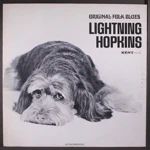 Original Folk Blues (Kent ReIssue) Buy from Amazon
Conclusion
Original Folk Blues is more than a compilation — it is a document of a pivotal moment in American music history. The 10 tracks, recorded at Bill Quinn's Gold Star Studios in Houston between 1947 and 1951, capture Lightnin' Hopkins at the height of his early powers, before the folk-blues revival brought him to international attention. His solo guitar and voice, with no other accompaniment, create a sound that is simultaneously primitive and sophisticated — the sound of a man who had spent decades playing on street corners and in juke joints, who had absorbed the entire blues tradition and made it his own.
The 1961 Crown compilation, whatever its commercial motivations, served an important historical function: it preserved these recordings for an audience that was just beginning to discover the blues, and it helped establish Hopkins as one of the foundational figures of the genre. From "Just Sittin' Down Thinkin'" to "Ain't It Lonesome," Original Folk Blues is a journey into the heart of Texas blues — raw, intimate, and timeless.
For more information on Lightnin' Hopkins please see this article Lightnin' Hopkins: The Texas Troubadour and Prolific Blues Poet