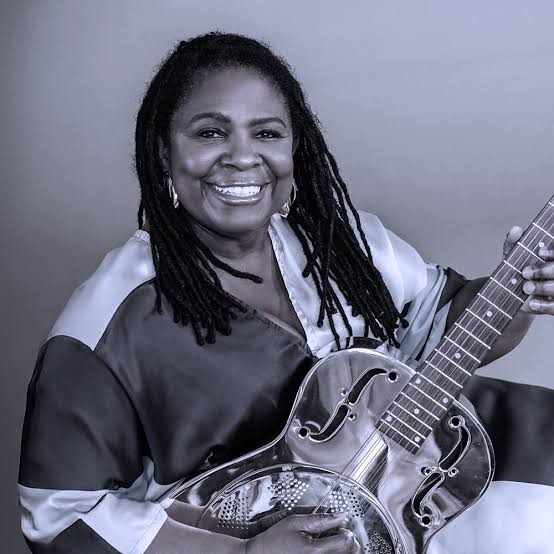
The story of Ruthie Foster begins in Gause, Texas, a small rural town situated about an hour northeast of Austin, in the blackland prairie region where the soil is dark and the communities are tight-knit. She was born on February 10, 1964, into a family where music was not merely entertainment but the very air they breathed. Her mother, grandmother, and extended family were gospel singers, and the walls of their home resonated with the sounds of worship, testimony, and praise. Ruthie's earliest musical education took place not in a conservatory or a studio but in the pews and choir lofts of the New Hope Missionary Baptist Church in Caldwell, Texas, where her uncles preached, her grandmother served as a matriarch, and the congregation raised its collective voice in songs of faith and endurance.
It was in this sacred environment that Ruthie first discovered the power of her own voice. She was a shy child, initially preferring to play guitar and piano and write songs for others rather than stand in the spotlight herself. But her mother saw something in her, something that needed encouragement, and she pushed Ruthie to step up and sing out. In a choir scene dominated by pianos, Ruthie stood out as a young black girl with a guitar, an instrument that would become her constant companion and her primary mode of expression. Her grandmother provided vocal coaching, teaching her the fundamentals of breath control, projection, and the emotional delivery that would later define her career. And from the church community, Ruthie learned that music was a form of service, a way of lifting others up and carrying them through difficult times.
The influences that shaped Ruthie's early musical imagination were formidable. She listened to Mahalia Jackson, the Queen of Gospel, whose monumental voice and unwavering faith set a standard for sacred music that has never been surpassed. She absorbed the work of Sister Rosetta Tharpe, the godmother of rock and roll, who brought electric guitar into the church and blurred the lines between the sacred and the secular long before anyone else dared to do so. She studied Aretha Franklin, the undisputed Queen of Soul, whose ability to move between gospel fervor and secular sensuality demonstrated the full range of what a black woman singer could achieve. And she listened to Mavis Staples, whose work with the Staple Singers and her subsequent solo career showed that the message of gospel could be delivered with a groove, a smile, and a political consciousness that spoke to the struggles of the times.
Ruthie's father, too, played a role in her musical education, though his tastes ran in a different direction. He was a blues fan, and the house was filled with cassette tapes of Lightnin' Hopkins, Ike and Tina Turner, and other artists who represented the earthier side of the African American musical tradition. This dual exposure—the sacred and the secular, the church and the juke joint, the spiritual and the blues—would become the foundation of Ruthie's distinctive sound, a sound that refuses to be contained within any single genre because it draws from too many sources to be limited by conventional categories.
The Waco Years and the Navy Interlude
After high school, Ruthie enrolled at McLennan Community College in Waco, Texas, where she studied commercial music and audio engineering. It was a practical choice, reflecting her interest in the technical side of music as well as the performative side, but it also placed her in an environment where she could begin to explore the wider world of American popular music. She fronted a blues band during her college years, gaining experience on stage and beginning to develop the confidence that would eventually make her one of the most commanding performers in contemporary roots music.
But by the time she graduated, Ruthie had reached a point of burnout. The grind of playing in clubs, the pressure of trying to make a living as a young musician, and the uncertainty of her path had taken their toll. She decided to take a break from music, to do something completely different, and in a move that would seem surprising to anyone who knows her today, she enlisted in the United States Navy. The decision was almost whimsical. She had walked past the recruiting offices of the Army, Air Force, Marines, and Navy, and when she looked through the window of the Navy office and saw the recruiter with his feet up on his desk, reading a newspaper, she thought to herself: "Okay. That's pretty relaxed. Let's try this! I can do that!" The recruiter, Gail Chandler, introduced her to the concept of getting paid to chill, and Ruthie signed on the dotted line.
The Navy, however, had other plans for her musical talents. After boot camp, she attended the Navy School of Music in Norfolk, Virginia, and was eventually stationed in Charleston, South Carolina, where she became part of Navy Band Southeast, an operation that oversaw fifteen individual musical groups. Ruthie was assigned to Pride, a show band whose duties included playing pop and funk tunes at Navy recruitment drives across the country. It was during this time that she discovered her genuine love for performing, not just as a musician but as an entertainer who could connect with audiences of all backgrounds. She sang pop and funk, genres that were far removed from the gospel and blues of her Texas upbringing, and she learned how to work a crowd, how to hold a stage, and how to make people feel good through music.
There was a moment when Ruthie could have taken a different path. She tried out for The Commodores, the elite Navy band based in Washington, D.C., and was accepted. But she turned it down. She had recently gotten married, and the commitment would have meant signing on for another four years plus, extending her service far beyond what she had originally intended. More importantly, she realized in that moment, standing in front of the admiral who had offered her the position, that she wanted to do things on her own terms, to sing what she wanted to sing and play what she wanted to play. It was a defining decision, a rejection of security in favor of artistic freedom, and it set the pattern for the rest of her career.
While still in uniform, Ruthie returned to college in Charleston, studying broadcasting and working as a production assistant during TV news broadcasts. After her discharge, she moved to New York City, where she immersed herself in the vibrant music scene and quickly became a staple of the folk community. It was there, in the clubs and coffeehouses of Greenwich Village and beyond, that she was discovered by executives from Atlantic Records, who offered her a development deal. For a young artist from rural Texas, the opportunity seemed like a dream come true. Atlantic was one of the most prestigious labels in the world, home to Aretha Franklin, Ray Charles, and countless other legends. But the dream came with a price. Atlantic envisioned Ruthie as a pop artist, the next Tracy Chapman, and they wanted to mold her into a commercial product that fit their vision rather than hers. In a bold and courageous move, Ruthie walked away from the deal. She chose authenticity over ambition, roots over radio play, and she returned to Texas to spend time with her family and reconnect with the music that had shaped her.
The Caregiver and the Return
The return to Texas was not merely a career decision; it was a response to a family crisis. Ruthie's mother had fallen ill, and Ruthie stepped back from music entirely to care for her. It was a period of profound introspection, of deep bonding with the woman who had first encouraged her to sing, and of reckoning with the impermanence of life. For a couple of years, Ruthie was not a professional musician; she was a daughter, a caregiver, a woman sitting at a bedside and holding a hand. The experience changed her. When she eventually returned to writing and performing, it was with a new depth, a new understanding of love and loss, and a determination to use her music as a vehicle for storytelling that spoke to universal themes of resilience, hope, and the human capacity for healing.
She settled in Austin, Texas, a city whose musical community is famously intolerant of posturing. In Austin, you either bring it or you don't, and if you do, word gets around. Ruthie brought it. She became a regular on the local scene, playing clubs and festivals, building a reputation as a singer-songwriter of uncommon power and authenticity. In 1997, she self-released her debut album, Full Circle, a collection of songs that announced her arrival as a solo artist with a fully formed vision. The album was a success on the local level, paving the way for a follow-up, Crossover, in 1999, and catching the attention of Blue Corn Music, a Texas independent label that would become her home for the next two decades.
The Blue Corn Years: Building a Catalog
Ruthie Foster's relationship with Blue Corn Music began in 2002 with the release of Runaway Soul, an album that established her as one of the most exciting voices in the Texas roots music scene. Produced by Lloyd Maines, the record showcased Ruthie's ability to blend blues, folk, gospel, and soul into a seamless whole, her powerful vocals supported by her own acoustic guitar and a sympathetic band. The title track, which had begun as a gospel song before evolving into a blues number, became a staple of her live shows and a signature statement of her artistic identity: "I do believe my soul's found a happy home."
The album Stages, released in 2004, was her first live recording, capturing the energy and intimacy of her performances in front of an audience. It was followed in 2007 by The Phenomenal Ruthie Foster, produced by Malcolm "Papa Mali" Welbourne, who heard more Muscle Shoals than Kerrville in Ruthie's voice, more funk than folk. The album was an homage to the classic soul records of the 1960s, filtered through Ruthie's organic sentiments and her refusal to simply imitate the past. It felt, as she described it, like being reintroduced to her own voice, and it expanded her audience beyond the folk and Americana circuits into the broader world of blues and soul music.
But it was The Truth According to Ruthie Foster, released in 2009 and produced by Grammy-winning producer Chris Goldsmith, that elevated her to national prominence. Recorded at Ardent Studios in Memphis, the album was a masterpiece of contemporary roots music, blending original compositions with covers that Ruthie made entirely her own. It earned her a Grammy nomination for Best Contemporary Blues Album, the first of what would become a remarkable string of nominations and awards. The album's success was not merely commercial; it was a validation of Ruthie's decision to follow her own path, to refuse the major-label mold, and to build a career on her own terms.
Let It Burn: The New Orleans Sessions
If The Truth According to Ruthie Foster announced her arrival as a major artist, Let It Burn, released in 2012, confirmed her status as one of the most versatile and compelling voices in American music. Produced by Grammy winner John Chelew and recorded at Piety Street Studios in New Orleans, the album represented a bold expansion of Ruthie's musical palette. For the first time in her career, she did not play an instrument on the record, a decision that gave her unprecedented freedom to concentrate entirely on her vocals. "This is the only album I've done where I don't play an instrument, which is really different," she explained. "It gave me a lot more freedom vocally. Without a guitar, all I did was concentrate on singing."
The sessions brought together some of the most respected musicians in New Orleans: the Funky Meters rhythm section of bassist George Porter Jr. and drummer Russell Batiste, guitarist Dave Easley, saxophonist James Rivers, and Hammond B3 wizard Ike Stubblefield, whose credits stretched from Curtis Mayfield to Eric Clapton. The album also featured special guests of the highest caliber: the legendary gospel group the Blind Boys of Alabama, who appeared on four tracks, and soul icon William Bell, who dueted with Ruthie on his classic "You Don't Miss Your Water."
The material on Let It Burn was as eclectic as the personnel. Ruthie covered Adele's anthemic "Set Fire to the Rain," Johnny Cash's "Ring of Fire," the Black Keys' "Everlasting Light," Pete Seeger's "If I Had a Hammer," and Los Lobos' "This Time," alongside originals like "Aim for the Heart" and the devotional "Lord Remember Me." Her version of "Ring of Fire" was particularly striking, a slow, atmospheric ballad that stripped away the mariachi bravado of the original to reveal the song's emotional core. "When it comes to songs, often older ones, I love it when they find me," she said, "and that's what happened with 'Ring of Fire.' I put myself inside of that song, which speaks to the passion of a new relationship."
The album was a critical and commercial triumph, earning Ruthie her second Grammy nomination, this time for Best Blues Album, and winning her the Blues Music Award for Traditional Blues Female Artist of the Year. It also won the DVD of the Year award for Live at Antone's, a CD and DVD release that documented her electrifying stage presence. The success of Let It Burn proved that Ruthie could transcend the boundaries of genre without losing her identity, that she could sing pop, soul, blues, gospel, and folk with equal authority and still sound unmistakably like herself.
Promise of a Brand New Day and the Grammy Streak
Ruthie Foster's momentum continued with Promise of a Brand New Day, released in 2014. For this album, she enlisted Meshell Ndegeocello, the acclaimed singer, songwriter, and bassist, as producer. It was a daring choice, bringing in an artist known for her experimental approach and her refusal to be categorized, and the result was an album that pushed Ruthie's boundaries while remaining true to her essence. "I wanted this album to highlight Ruthie's voice and also communicate her vibe, give a fuller picture of her artistry and ability," Ndegeocello explained. "She really trusted me with the music and I think we've made something that complements and holds its own alongside the power of her voice."
The album featured songs that went deeper than anything Ruthie had recorded before. "Complicated Love," a relationship ballad, explored emotional territory that was raw and personal. "Learning to Fly," inspired by a friend's difficult relationship, contained the elegant lyric, "Everybody knows the seed must die so the flower can grow." The record earned Ruthie her third consecutive Grammy nomination for Best Blues Album, cementing her reputation as an artist who could consistently deliver work of the highest caliber.
The streak of Grammy nominations was unprecedented for an independent artist working in the roots music field. Three albums in a row—The Truth According to Ruthie Foster, Let It Burn, and Promise of a Brand New Day—had been recognized by the Recording Academy, a feat that placed Ruthie in the company of the most celebrated artists in blues and soul. But the nominations were only part of the story. The awards kept coming: Blues Music Awards, Austin Music Awards, the Grand Prix du Disque from France's Académie Charles-Cros, and a Living Blues Critics' Award for Female Blues Artist of the Year. By 2016, she had earned six consecutive Blues Music Awards, a run of dominance that reflected both her artistic excellence and the deep affection she commanded from fans and critics alike.
Joy Comes Back: Music as Therapy
The album Joy Comes Back, released in 2017, was born from one of the most difficult periods of Ruthie Foster's life. She was separated from her partner, splitting custody of her five-year-old daughter, and living out of a suitcase on the road more than she cared to. The title track, which featured Derek Trucks of the Tedeschi Trucks Band on slide guitar, was recorded with producer Daniel Barrett, her former neighbor in Austin, in a studio where she could go home after recording and be with her child, have a meal with friends, and find some semblance of normalcy amid the chaos. "When she recorded this album, Foster wasn't merely singing about love and loss; she was splitting a household and custody of her 5-year-old daughter. Music was her therapy."
The album was a testament to the healing power of music, not just for the listener but for the artist herself. It mixed covers and originals with the same eclecticism that had become Ruthie's trademark: Chris Stapleton's "What Are You Listening To?," Mississippi John Hurt's "Richland Woman Blues," Grace Pettis's "Working Woman," and, most audaciously, Black Sabbath's "War Pigs," which Ruthie reimagined as a jam session with Son House. The Four Tops' "Loving You Is Sweeter Than Ever" was given a soulful reading, while Warren Hood's fiddle and mandolin on "Richland Woman Blues" added a bluegrass tint to the proceedings.
The emotional core of the album was its title track, a bluesy gospel number that channeled the spirit of the New Hope Missionary Baptist Church and the fellowship of family that had nurtured Ruthie from the beginning. "We were the choir, my uncles were preachers, my grandma was one of the matriarchs," she said. "I had an uncle who played piano. It brings back a feeling of family, a sense of fellowship." Derek Trucks's slide guitar wept and soared around Ruthie's vocal, creating a sound that was simultaneously mournful and triumphant, a recognition that joy can indeed come back, even after the deepest losses.
Healing Time and the Big Band
Healing Time, released in 2022, represented yet another evolution in Ruthie's career. The album found her pushing her boundaries as a singer and songwriter more than ever before, contributing more to the writing process than on any of her previous records. The title reflected a philosophy that had sustained her through decades of challenges: "There's always time for healing, if you give it time." The songs were creative, warm, and flowed smoothly from track to track, creating a truly live-sounding atmosphere with the help of her band, who sounded refreshingly loose and lived-in throughout the twelve songs.
But the most ambitious project of her later career was Live at the Paramount, released in 2020. Recorded on January 26, 2019, on the 105-year-old stage of Austin's grand Paramount Theater, the album featured the Ruthie Foster Big Band: a guitarist, keyboardist, bassist, and drummer, plus ten horn players, three backing vocalists, and one conductor. It was a throwback to the era when Ella Fitzgerald sang with Duke Ellington and Frank Sinatra blasted off with Count Basie and Quincy Jones, a celebration of the big band tradition that had always been part of American popular music. The album reached number one on the Billboard Blues charts and earned Ruthie her fourth Grammy nomination, this time for Best Contemporary Blues Album, proving that even after more than two decades in the business, she was still capable of surprising her audience and herself.
Mileage: The Grammy Triumph and Sun Records
In 2024, Ruthie Foster released Mileage on Sun Records, the legendary label founded by Sam Phillips in Memphis that had launched the careers of Elvis Presley, Johnny Cash, Jerry Lee Lewis, and Howlin' Wolf. The album was a historic release for both the artist and the label, and at the 2025 Grammy Awards, it won Best Contemporary Blues Album, giving Ruthie her first Grammy win after five previous nominations. It was also the first-ever Grammy win for Sun Records, a triumph that underscored the power of Foster's artistry and the enduring legacy of a label that continues to champion timeless voices.
The album featured songs written in collaboration with Rebecca Lovell of Larkin Poe and Tyler Bryant of the Shakedown, among others, and it continued Ruthie's tradition of blending original material with carefully chosen covers. The single "Rainbow" was a meditation on love that asked, "What is love?" and sought to answer the question without apology or explanation. "It's not just another song about love but seeing love through," Ruthie explained. "It's also about what love looks like to me without having to apologize or explain. Hopefully this song rings sweet and true for all of you."
The Grammy win was a long-awaited milestone, a recognition that had been building for years through nominations, awards, and the steady accumulation of respect from peers and predecessors alike. Mavis Staples, one of Ruthie's earliest and most important influences, had long been a champion, declaring, "I love Ruthie Foster. That's my little sister. A phenomenal woman, yes indeed. She's great." The endorsement from a legend who had marched with Dr. King and sung at the Obama White House carried a weight that no Grammy statue could match, but the Grammy was nevertheless a validation of Ruthie's place in the pantheon of American music.
The Voice and the Style
To describe Ruthie Foster's voice is to attempt to describe a force of nature. It is a powerful, flexible instrument that can move from a whisper to a roar in the space of a single phrase, from the grittiest blues shout to the most ethereal gospel cry. Critics have compared her to Aretha Franklin, Etta James, and Mavis Staples, and while these comparisons are flattering, they do not quite capture what makes Ruthie's voice unique. She is not an imitator; she is an original, a singer who has absorbed the lessons of her predecessors and synthesized them into something that is unmistakably her own.
Her vocal style is rooted in the gospel tradition, with its emphasis on emotional truth, spiritual authority, and the ability to move an audience to tears or ecstasy—sometimes in a single song. But it is also deeply informed by the blues, with its acknowledgment of pain, struggle, and the hard-won wisdom that comes from surviving both. She can sing folk with the intimacy of a confessional poet, soul with the swagger of a Memphis horn section, and rock with the intensity of a woman who has paid her dues on stages around the world. As producer Daniel Barrett once described her music to Warren Hood: "some blues, some folk, some soul, some rock, some gospel." Hood's reply was perfect: "Sounds like Ruthie Foster music."
As a guitarist, Ruthie is equally distinctive. She plays acoustic guitar with a rhythmic drive that propels her songs forward, her fingers dancing across the strings with a precision that belies the power of her attack. She is not a flashy soloist in the manner of some electric blues players; her guitar work is supportive, textural, and deeply connected to the vocal. When she does put the guitar aside, as she did on Let It Burn, it is a deliberate choice that allows her to explore new dimensions of her voice, but the guitar remains her primary instrument, the tool she uses to write, to accompany herself, and to connect with audiences in the most direct and personal way.
As a songwriter, Ruthie has developed a craft that is both deeply personal and universally resonant. Her songs deal with love and loss, faith and doubt, struggle and triumph, the daily realities of working-class life and the transcendent possibilities of the human spirit. She writes from her own experience but also borrows from the lives of those around her, turning her observations into stories that speak to anyone who has ever loved, lost, or hoped for better days. Her lyrics are elegant without being pretentious, grounded without being pedestrian, and they are delivered with a vocal authority that makes every word feel true.
The Stage and the Collaborations
Ruthie Foster's live performances are legendary. She has referred to her shows as a "hallelujah time," and the description is apt. Whether she is playing a small club or a festival main stage, she commands the attention of every person in the room, her voice filling the space with a warmth and power that seems to come from somewhere beyond herself. She has shared stages with Bonnie Raitt, the Allman Brothers, Susan Tedeschi, Warren Haynes, Big Head Todd, Eric Bibb, and Paul Thorn, and she has held her own with every one of them, her voice rising above the din of even the most star-studded ensemble.
Her collaborations are as diverse as her musical influences. She has recorded with the Blind Boys of Alabama, whose harmonies add a spiritual dimension to her already devout sound. She has worked with William Bell, the Stax legend whose duet with her on "You Don't Miss Your Water" is a master class in soulful restraint. She has traded verses with Derek Trucks, whose slide guitar on "Joy Comes Back" provided the perfect counterpoint to her vocal. And she has performed with Conspirare, Austin's prestigious vocal ensemble, demonstrating a classical discipline that complements her roots-music rawness.
In 2018, Ruthie performed at Carnegie Hall's Zankel Hall with the North Mississippi Allstars, a performance that critics hailed as a triumph. "She commands a stage as completely as Judy Garland or Janis Joplin did," wrote one reviewer, "but with unfailing grace and good cheer." The comparison to Garland and Joplin is significant: both were artists of immense talent and tragic vulnerability, and Ruthie's ability to command a stage with the same authority while maintaining her grounded, good-humored presence is a testament to her strength and her sanity.
Awards, Honors, and the Hall of Fame
The list of Ruthie Foster's accolades is long and distinguished. She has won multiple Blues Music Awards, including three for Best Female Vocalist, one for DVD of the Year for Live at Antone's, and the Koko Taylor Award for Traditional Blues Female Artist of the Year multiple times. She has been named Best Female Vocalist at the Austin Music Awards. She has won the Grand Prix du Disque from the Académie Charles-Cros in France, one of the most prestigious awards in international music. She has received a Living Blues Critics' Award for Female Blues Artist of the Year and has been nominated for Best Live Performer.
In 2018, she was awarded a fellowship by US Artists, a prestigious organization that recognizes contributions to the field of music with an unrestricted $50,000 award. In 2024, she was inducted into the Texas Songwriters Hall of Fame, a recognition of her contributions to the musical heritage of her home state. And in 2025, the Grammy win for Mileage capped a career of sustained excellence, bringing her the institutional recognition that her fans and peers had long believed she deserved.
Influence and Legacy
Ruthie Foster's influence on contemporary American music extends in several directions. For women in blues and roots music, she is a role model and a trailblazer, proof that an artist can build a successful career without compromising her authenticity or her vision. For independent musicians, she is a testament to the power of staying true to one's artistic identity, of building a catalog on a small label rather than chasing major-label dreams. For the blues community, she is a bridge between the traditional and the contemporary, an artist who honors the legacy of Mavis Staples and Aretha Franklin while pushing the music into new territory.
Her influence can be heard in the work of younger artists who have followed her path, blending gospel, blues, folk, and soul into their own distinctive sounds. Her commitment to social justice, to using her music as a force for healing and unity, has inspired a generation of musicians who see their art not merely as entertainment but as a form of service. And her refusal to be categorized, to accept the limitations that the music industry tries to place on black women artists, has opened doors for others who refuse to fit into predetermined boxes.
The Philosophy of "Just Say Yes"
In 2025, Ruthie Foster released Just Say Yes on Sun Records, an album whose title reflected a philosophy that had guided her entire career. The phrase originated on a sticky note that Ruthie had written to herself years earlier, a reminder to stay open to possibility, to say yes to opportunities even when they seemed daunting or unlikely. "I wrote this thing on a sticky note and it just said 'Just say yes,'" she recalled. "That little note-to-self stuck with Foster as she re-pursued her dream. She has that sticky note to thank for all that's come after."
The album's lead single, "Tangled," and its follow-up, "Thank You," addressed the imposter syndrome that even a Grammy-winning artist can feel, the sense of being questioned about one's authenticity as a blues performer despite decades of awards and acclaim. Ruthie's response was characteristic: she refused to apologize for her eclecticism, her refusal to be confined to a single genre. "There's a front door but there's also a window and back door," she said. "There are ways to get in. I never put any kind of constraints on myself. I'm showing up with all of this."
This philosophy—showing up with all of it, bringing every influence, every experience, every emotion to the table—is the essence of Ruthie Foster's artistry. She is not a blues singer or a gospel singer or a folk singer or a soul singer. She is all of these things and none of them, an artist who has created a category of her own. As she has said, "I like for my music to be that reminder for people to just be kinder to each other, really. Especially with this album that I just put out, 'Healing Time'—it's really what it is, it's just a reminder to be kind, be good to yourself, be gentle with yourself first and I think people learn by watching how other people live."
Reassessing Ruthie Foster in the Twenty-First Century
As we move further into the twenty-first century, Ruthie Foster's music sounds less like a product of any single genre and more like a distillation of American music itself. She carries the gospel tradition of the black church, the blues tradition of the rural South, the folk tradition of the singer-songwriter, the soul tradition of Memphis and Muscle Shoals, and the rock tradition of the festival stage, all of it filtered through a voice that is as powerful as it is personal, as commanding as it is compassionate.
To listen to Ruthie Foster is to hear the sound of Texas, of the small church in Caldwell where she first sang, of the Navy bases where she learned to perform, of the Austin clubs where she built her reputation, of the New Orleans studios where she expanded her sound, of the Memphis label where she finally won her Grammy. It is to hear a woman who turned down a major record deal to preserve her authenticity, who stepped away from music to care for her mother, who returned with a deeper understanding of what music could do, and who has spent the subsequent decades proving that the right choice is always the true choice.
Ruthie Foster is not merely a blues singer, though she has won more blues awards than most. She is not merely a gospel singer, though the church is never far from anything she touches. She is not merely a soul singer or a folk singer or a rock singer. She is Ruthie Foster, and that is enough. Her voice, her guitar, her songs, and her spirit have made her one of the most important artists in American music, and her journey is far from over. As she continues to tour, to record, to collaborate, and to inspire, she remains a testament to the power of authenticity, the healing power of music, and the truth that joy, indeed, comes back.
For those seeking to explore Ruthie Foster's music in depth, the 2009 album The Truth According to Ruthie Foster remains an ideal entry point, featuring the Grammy-nominated sound that first brought her national attention. Let It Burn (2012) showcases her interpretive genius with the Blind Boys of Alabama and the Funky Meters. Joy Comes Back (2017) captures her at a moment of personal transformation, with Derek Trucks contributing slide guitar. Live at the Paramount (2020) documents her big band triumph, and Mileage (2024), her Grammy-winning release on Sun Records, represents the culmination of a career built on truth, resilience, and an unwavering commitment to the music. All are available through her website and through the usual digital and physical retailers.

 Buy from Amazon The Truth According to Ruthie Foster
 Buy from Amazon Let It Burn - Ruthie Foster
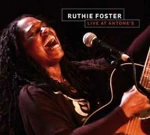 Buy from Amazon Ruthie Foster Live at Antones