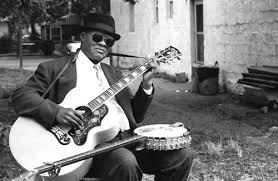
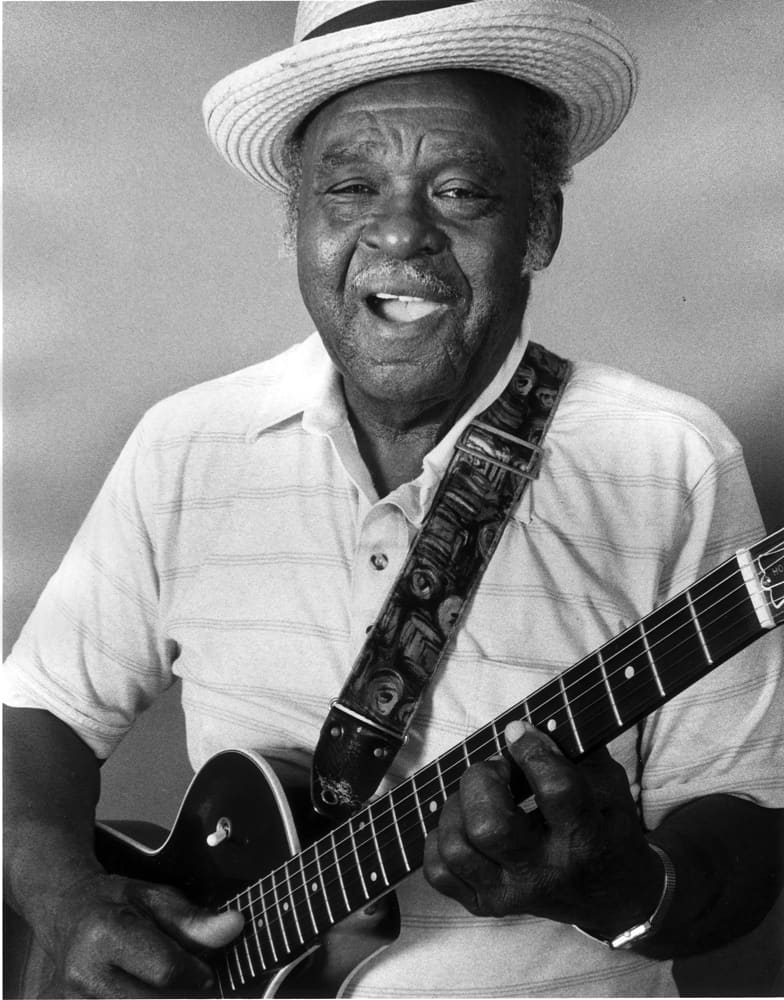
Gary D. Davis—known to the world as Reverend Gary Davis, or Blind Gary Davis—was one of the most extraordinary musicians in American history. A blind, Black gospel preacher from the rural South, he developed a guitar technique of such complexity and brilliance that it defied categorization, blending Piedmont blues, ragtime, gospel, spirituals, medicine show tunes, and military marches into a singular, polyphonic style that sounded like an entire orchestra emerging from a single acoustic guitar. His influence on the folk and rock revival of the 1960s was profound and direct: he taught, mentored, and inspired a generation of musicians including Bob Dylan, the Grateful Dead, Ry Cooder, Jorma Kaukonen, and David Bromberg, spreading his musical DNA through the counterculture and into the mainstream of American popular music.
Gary Davis was born on April 30, 1896, in Laurens County, South Carolina, in the Piedmont region—"way down in the sticks; so far you couldn't hear a train whistle blow unless it was on a cloudy day," as he later recalled. Of the eight children his mother bore, only two survived to adulthood. Davis became blind as an infant; his grandmother told him he contracted "sore eyes" at three weeks old, and doctors put something in his eyes that caused ulcers to grow over them, leaving him permanently blind. His official diagnosis was buphthalmos (congenital glaucoma) with secondary corneal ulceration.
His childhood was marked by rejection and trauma. His mother, Evelina, was unable to care for him, and his father, John Davis, was constantly in trouble with the law. Davis was placed in the care of his paternal grandmother, who raised him despite her own poverty. When he was ten years old, his father was killed in Birmingham, Alabama—Davis later said he was told the Birmingham sheriff shot him. His mother remarried and gave birth to a half-brother, with whom Davis felt his mother favored over him. "I felt horrible about it because I felt like I was throwed away," he told Alan Lomax's wife, Elizabeth Lyttleton Harold, in extensive 1951 interviews. "In fact my mother never had cared as much about me as she did my younger brother... She'd wish I was dead. She tell me that a heap of times."
Despite—or perhaps because of—these hardships, Davis found solace in music. He built his first instrument around age seven from a pie pan and a broomstick. His mother eventually bought him a cheap mail-order guitar from Sears, Roebuck, and he learned his first chords from a local musician named Craig Fowler. He sang in the choir at Gray Court's Center Raven Baptist Church in South Carolina, where he was first exposed to the spirituals that would form the foundation of his musical identity. By the time he was ten, he was singing and playing guitar, banjo, and harmonica at segregated country dances, house parties, and picnics.
The Greenville String Band and Willie Walker
Around 1910 or 1911, when Davis was approximately fifteen, he began playing in a black string band in Greenville, South Carolina—a town some thirty-five miles from Laurens that was then a center of the Piedmont blues style. The band included fellow blind guitarist Willie Walker, two violins, a bass violin, and a mandolin. The repertoire was wide-ranging: blues, ragtime, dance tunes, vaudeville and minstrel show songs, and any popular songs of the day. Davis's time with Walker was formative; Walker was a legendary figure in blues history, described by contemporaries as a guitarist of extraordinary ability, though he recorded only a handful of sides. Davis absorbed Walker's technique and expanded upon it, developing the multi-voice fingerpicking style that would become his trademark.
Davis's approach to the guitar was already unique. He played with only his thumb and index finger, producing a polyphonic sound that mimicked the complexity of piano ragtime. He told his student Stefan Grossman: "You've got three hands to play a guitar and only two for a piano. Well, your forefinger and your thumb—that's the striking hand, and your left hand is the leading hand. Your left hand tells the right hand what strings to touch, what changes to make... One hand can't do without the other." This two-finger technique, combined with his broken left wrist (sustained in a slip on ice in the mid-1920s, which healed in an awkward position), allowed him to access unusual chord fingerings that other guitarists could not easily replicate.
The Wandering Years: Marriage, Migration, and Ministry
In 1914, at age eighteen, Davis enrolled in the South Carolina School for the Deaf and Blind in Cedar Springs, Spartanburg County, where he learned to read Braille and received some industrial training. He stayed only six months—he later claimed he left because he didn't like the food—before returning to the farm. He married Mary Hendrix, a woman five years his senior, on June 17, 1919. The couple moved to Asheville, North Carolina, and later Winston-Salem, but the marriage ended around 1924 when Davis discovered, as he put it, that "she wasn't my wife but everybody else's."
The 1920s were years of wandering. Davis traveled through South Carolina, North Carolina, and Tennessee as an unaccompanied street musician, performing in barrelhouses, on street corners, and at country dances. He absorbed a vast repertoire: medicine show tunes, white ballads, military marches, country instrumentals, early jazz and ragtime, church hymns, gospel songs, and blues. He was, as one commentator noted, "a walking encyclopedia of the Piedmont guitar style," capable of playing any type of music he encountered in any key—including challenging keys like F, B-flat, and E-flat that most blues guitarists avoided.
In the late 1920s, Davis settled in Durham, North Carolina, a major center of Black culture and the heart of the Piedmont blues scene. There he collaborated with other musicians, including Bull City Red (George Washington), and became a mentor to Blind Boy Fuller, the most commercially successful Piedmont blues artist of the 1930s. Davis's influence on Fuller's playing was significant, though Fuller never achieved the technical complexity of his teacher.
Davis's spiritual journey intensified during his Durham years. By 1933–34, his interest in performing Christian gospel material began to overtake his secular blues work, a shift accelerated by the illness and death of his mother in June 1934. In 1937, he was ordained as a Baptist minister in Washington, North Carolina, and married Annie Bell Wright, a deeply religious woman who would remain his devoted partner until his death. Following his ordination, Davis largely abandoned secular blues in favor of gospel music, though he continued to perform "gospel blues" like "Death Don't Have No Mercy" and "Samson and Delilah" that blurred the line between sacred and secular.
The 1935 Recording Sessions: A False Start
Davis's first recording opportunity came in July 1935, when J.B. Long, a Durham store manager and talent scout who managed Blind Boy Fuller, escorted Davis, Fuller, and Bull City Red to New York City to record for the American Record Company (ARC), the "race" music subsidiary of Columbia Records. Between July 23 and July 26, Davis recorded fifteen sides—ten Christian songs and two blues, "I'm Throwin' Up My Hands" and "Cross and Evil Woman Blues" (which Davis himself called "Mountain Jack Blues" and "Ice Pick Blues"). Fourteen were released, but they were not large sellers. The market for gospel tunes was small, and Davis's vocals, though accompanied by spectacular guitar work, sounded strained, possibly due to poor health.
The sessions were also fraught with tension. Davis, unfamiliar with the recording process, couldn't see the red light that signaled when a disc was finished and wanted to keep playing. He was also upset at being paid less than the other performers, who had recorded before and thus received higher rates. He felt cheated, and when Long tried to get him to record again in 1939, Davis refused. "There was a difference between me and the 'man' [Long]," he later explained. It would be ten years before he made another record. The 1935 ARC sides, now collected on
The Complete Early Recordings of Rev. Gary Davis, are invaluable documents of his early style, but at the time they did nothing to lift him out of poverty.
The New York Years: Harlem Street Singer (1940–1960)
By 1940, the blues scene in Durham was declining, and Davis and Annie moved to New York. They settled first in Mamaroneck, where Annie found work as a housekeeper, then moved to 169th Street in Harlem, where they would live for the next eighteen years. Davis became a minister of the Missionary Baptist Connection Church and acquired the appellation "Harlem Street Singer," preaching and singing gospel on street corners and in storefront churches throughout the city. For a time, he stopped playing blues altogether, focusing exclusively on gospel and old-time songs.
Life in New York was hard. The Davises were poor and dependent on welfare to supplement their meager earnings from street performing and preaching. In 1945, Davis's playing on the street came to the attention of folk record producer Moses Asch, who recorded approximately thirty-one minutes of music. Only one piece—the non-religious instrumental "Soldier's Drill" (retitled "Civil War Parade")—appeared on a U.S. release, on a 1967 Folkways collection. Four other tunes were licensed to a British release in 1965. Davis was probably not paid for the session.
In 1951, Davis recorded an extensive oral history for folklorist Elizabeth Lyttleton Harold, Alan Lomax's wife. The transcript runs more than 300 pages and provides an invaluable firsthand account of Davis's life, musical development, and spiritual philosophy. It was during this period that Davis also began teaching guitar, giving lessons that could last all day and into the night. His students were initially local musicians, but as the 1950s progressed and the folk revival gathered momentum, a new generation of young, predominantly white folk and blues enthusiasts began making pilgrimages to Harlem to study with the master.
The Folk Revival: Rediscovery and Recognition (1960–1972)
The turning point in Davis's career came around 1960. A cover feature in the February 1960 issue of
Sing Out! magazine, written by Barry Kornfeld, called him "one of our greatest folk artists." Davis began obtaining bookings at folk festivals and, at age sixty-four, started his first residency at a folk club—Gerde's Folk City in New York—performing two shows a night during the week and three on weekends. For this, he had to obtain a cabaret identification card and join the musicians' union, marking his transition to officially recognized professional musician status.
In 1960, producer Kenneth Goldstein approached Davis about making higher-profile recordings. The sessions, held at Rudy Van Gelder's legendary studio in Englewood Cliffs, New Jersey, produced
Harlem Street Singer, an all-gospel album that biographer Ian Zack calls "Davis' masterpiece and one of the most breathtaking recordings of the folk era." Davis recorded twenty songs in three hours using his weather-beaten Gibson J-200 guitar, featuring "soaring vocals and a remarkable interplay between voice and virtuoso guitar." For this recording, Davis received a $309 advance and royalties on every LP sold in the U.S.—a considerable improvement over his previous recording experiences, though still modest.
Goldstein continued to record Davis, producing three more albums of material:
Say No to the Devil (1961), featuring Davis on twelve-string guitar;
A Little More Faith (1961); and
The Guitar and Banjo of the Reverend Gary Davis (1964), which also showcased his blues harmonica playing. These four Prestige/Bluesville albums are widely recognized as containing some of Davis's finest work.
Davis's reputation grew rapidly in the early 1960s. He performed at the Newport Folk Festival in 1963 and 1965, and his appearances were captured on the influential
Blues at Newport (1964) and
Rev. Gary Davis at Newport (1968) albums. In 1964, he was part of "The American Blues and Gospel Caravan," a UK tour that included Muddy Waters, Sonny Terry, Brownie McGhee, Sister Rosetta Tharpe, and Cousin Joe, managed by a young Joe Boyd. The tour played concerts across Britain and a final session in Paris, with English reviewers speaking highly of Davis's performances. A 40-minute set at Manchester's Free Trade Hall was recorded and released on CD in 2008. The experience was repeated in 1965 with the English Folk Dance and Song Society, featuring Davis alongside Josh White, Ramblin' Jack Elliott, Derroll Adams, and Buffy Sainte-Marie. By this time, Davis's profile may have been higher in Europe than at home.
The Teacher and Mentor: A Generation of Students
Perhaps Davis's most significant contribution to American music was not his own recordings but his role as a teacher and mentor to the generation of musicians who would shape the folk and rock revival. His students formed a who's who of 1960s and 1970s American music:
-
Stefan Grossman — The most dedicated chronicler of Davis's technique, Grossman recorded Davis extensively, published instructional books and videos, and founded the Kicking Mule label to release Davis's music.
-
David Bromberg — A multi-instrumentalist who became one of Davis's most devoted students and later a successful solo artist.
-
Bob Weir — Guitarist for the Grateful Dead, who studied with Davis and incorporated his vocal inflections and guitar patterns into the Dead's repertoire, particularly on "Samson and Delilah."
-
Ry Cooder — The master guitarist and producer who absorbed Davis's fingerpicking style and applied it to his own eclectic work.
-
Jorma Kaukonen — Guitarist for Jefferson Airplane and Hot Tuna, who called Davis "one of the greatest figures of 20th-century music."
-
Dave Van Ronk — The "Mayor of MacDougal Street" and central figure of the Greenwich Village folk scene, who studied with Davis and covered many of his songs.
-
Taj Mahal — The blues polymath who drew deeply from Davis's repertoire and technique.
-
Jerry Garcia — The Grateful Dead's lead guitarist, who was influenced by Davis's style though he did not study with him directly.
-
Rory Block, Ernie Hawkins, Woody Mann, Larry Campbell, Steve Katz, Roy Book Binder, Nick Katzman, Larry Johnson, Tom Winslow — All studied with Davis and became professional musicians, many dedicating their careers to preserving and teaching his style.
-
Bob Dylan — While not a formal student, Dylan covered Davis's "Candyman" and several other songs, was close to both Elliott and Van Ronk, and met Davis at the Indian Neck Folk Festival on May 6, 1961. In 1961, Dylan told Robert Shelton and Suze Rotolo that he wanted Reverend Davis to officiate his and Suze's wedding. Dylan called Davis "one of the wizards of modern music."
Davis's teaching method was as unique as his playing. Lessons could last all day and often extended into the night, accompanied by preaching, food, and companionship. He did not simply teach songs; he taught a philosophy of music as spiritual expression. His students were expected to approach the guitar with the same reverence he brought to his ministry. As one student recalled, Davis would often say, "I just play the way I talk"—suggesting that his music was an extension of his being, not a performance technique to be copied.
The Musical Style: Unparalleled Complexity
Reverend Gary Davis's musical style is difficult to describe because it transcends conventional categories. He was rooted in the Piedmont blues tradition—the syncopated, ragtime-influenced guitar style of the Carolinas and Virginia—but he incorporated elements from so many sources that his music became a genre unto itself.
His guitar technique was built on several foundations:
The Two-Finger Picking Style: Using only his thumb and index finger, Davis produced a polyphonic sound that suggested multiple instruments playing simultaneously. His thumb handled bass lines and rhythmic patterns while his index finger picked out melodies, counter-melodies, and improvised fills on the treble strings. This approach allowed him to create the illusion of a piano's left-hand and right-hand coordination on a single guitar.
Ragtime and Stride Piano Influences: Davis absorbed the rhythmic complexity of ragtime piano and stride piano, translating their syncopated patterns and moving bass lines to the guitar. His "stride-influenced fingerpicking," as Ernie Hawkins described it, enabled him to work through chord changes while maintaining a steady bass line and improvising on the treble strings.
Multi-Key Fluency: Unlike most blues guitarists, who favored the keys of E, A, and G, Davis played comfortably in any key, including challenging flat keys like F, B-flat, and E-flat. This versatility came from his early practice of learning every song he heard on the street, regardless of key, and from his formal study at the South Carolina School for the Deaf and Blind.
Vocal-Guitar Integration: Davis's voice and guitar were so intertwined that they functioned as a single instrument. He could shift from a preaching, shouting delivery on gospel numbers to a near-spoken, blues-inflected verse, to a softer, more melodic approach on carnival songs and ballads. His vocal range was wide, and his emotional intensity—whether expressing joy, sorrow, or spiritual ecstasy—was matched by his guitar's dynamic response.
Repertoire Breadth: Davis's repertoire was encyclopedic. He played old church hymns, revival meeting songs, gospel blues, Piedmont blues, ragtime instrumentals, medicine show tunes, white ballads, military marches (including John Philip Sousa compositions arranged for guitar), country instrumentals, and popular songs of the day. He was equally comfortable playing Blind Blake's "West Coast Blues," a Sousa march, a spiritual like "Twelve Gates to the City," or a novelty tune like "The Boy Was Kissing the Girl (And Playing the Guitar at the Same Time)."
As Woody Mann wrote in his 1973 book
Six Black Blues Guitarists: "The music of Gary Davis is so free from any discernible technical limitation that it cannot be placed in any single category. Rather, it synthesizes the very contrasting elements that circumscribe other musicians. His flawless control enabled him to play with seemingly endless improvisation and to perform the same song in four different ways—each suited to different moods." Mann noted that Davis's "only musical finishing school was the streets of Greenville, South Carolina," yet his craft was perfection.
Key Recordings and Songs
Davis's discography spans nearly four decades and includes some of the most important recordings in American roots music:
Early Recordings (1935):
-
"Cross and Evil Woman Blues" / "I'm Throwin' Up My Hands" — His first blues recordings, displaying a fully formed style at age thirty-nine.
-
"I Am the Light of This World," "Twelve Gates to the City," "I Saw the Light" — Gospel recordings from the ARC sessions that established his spiritual repertoire.
The Prestige/Bluesville Masterpieces (1960–1964):
-
Harlem Street Singer (1960) — The all-gospel masterpiece featuring "Death Don't Have No Mercy," "Samson and Delilah," "Oh Lord, Search My Heart," and "You Got to Move."
-
A Little More Faith (1961) — Including "You Got to Move," "Crucifixion," "I'll Fly Away," and "When I Die I'll Live Again."
-
Say No to the Devil (1962) — Featuring Davis on twelve-string guitar, with the title track, "Bad Company Brought Me Here," and "Lost Boy in the Wilderness."
-
The Guitar & Banjo of Reverend Gary Davis (1964) — Instrumental showcases including "Maple Leaf Rag," "Devil's Dream," "Candy Man," and "United States March," plus blues harmonica performances.
Live and Later Recordings:
-
Blues at Newport (1964) — Capturing his festival performances of "Samson and Delilah" and "You Got to Move."
-
Rev. Gary Davis at Newport (1968) — A full live album from the 1965 festival.
-
Ragtime Guitar (1971) — Compiled by Stefan Grossman from private recordings made between 1962 and 1970, featuring Davis's ragtime and instrumental compositions.
-
The Legendary Reverend Gary Davis: New Blues and Gospel (1971) — Studio recordings from March 1971, among his final sessions.
-
O, Glory – The Apostolic Studio Sessions (1973, recorded 1969) — His final studio album.
Influence and Legacy
Reverend Gary Davis's influence on American music is incalculable and continues to expand decades after his death. His direct students—Grossman, Bromberg, Weir, Cooder, Kaukonen, Van Ronk, and dozens of others—spread his technique and repertoire throughout the folk and rock worlds. His songs were covered by a remarkable range of artists:
-
Peter, Paul and Mary recorded "Samson and Delilah" (as "If I Had My Way"), bringing Davis's gospel to the pop charts.
-
The Grateful Dead covered "Samson and Delilah" on Terrapin Station (1977), with Bob Weir's vocal inflections directly reflecting Davis's influence.
-
Bob Dylan covered "Candyman" and "Baby, Let Me Follow You Down" (the latter via Eric Von Schmidt's adaptation, which Von Schmidt credited three-quarters to Davis).
-
The Rolling Stones recorded "You Gotta Move" on Sticky Fingers (1971).
-
Taj Mahal incorporated Davis's songs and style into his eclectic blues work.
-
Patty Griffin recorded a raucous version of "If I Had My Way" on her 2010 gospel album Downtown Church.
-
Jackson Browne, Nick Drake, Janis Joplin, and Keb' Mo' are among the many artists who loved Davis's music and wove his sound into their own.
Bob Weir of the Grateful Dead said Davis had "a Bacchian sense of music which transcended any common notion of a bluesman." Jorma Kaukonen of Jefferson Airplane called him "one of the greatest figures of 20th-century music." Bob Dylan's assessment was equally effusive: "one of the wizards of modern music."
Davis's posthumous recognition has grown steadily. In 2003, he received a posthumous Lifetime Achievement Award from Folk Alliance International. In 2019, he and Blind Boy Fuller were recognized as Main Honorees by the Sesquicentennial Honors Commission at the Durham 150 Closing Ceremony for their contributions to Piedmont blues. The 2013 documentary film
Harlem Street Singer brought his story to a new generation. His former students continue to teach his technique through books, videos, and workshops, ensuring that the "Guitar Evangelist's" legacy lives on in the fingers of new generations of players.
Death and Final Assessment
Reverend Gary Davis died on May 5, 1972, in Hammonton, New Jersey, at the age of seventy-six. The cause was a heart attack. He left behind a widow, Annie, who survived him for many years, living in the brick house in Queens, New York, that had been their home.
Davis's recorded legacy, while extensive, does not fully capture the magnitude of his artistry. His live performances—whether on a Harlem street corner, at a folk festival, or in a concert hall—were legendary for their intensity and spiritual power. His gruff vocals, which some listeners found off-putting on record, were transformed in person by the force of his presence and the complexity of his guitar work. As Chris Smith wrote in
The Penguin Guide to Blues Recordings (2006): "Even if he had stuck exclusively to gospel, this guide would be incomplete without Gary Davis, who developed African-American guitar music into a personal style of unparalleled complexity and brilliance which had a profound influence on more than one generation of musicians."
Reverend Gary Davis was, in the end, a musician who transcended the categories that tried to contain him. He was a bluesman who became a gospel preacher, a street singer who became a concert artist, a blind Black man from the Jim Crow South who taught white folk-rock stars how to play the guitar. His music was a synthesis of everything he had heard and lived—the spirituals of his grandmother's church, the ragtime of Greenville's streets, the blues of Durham's tobacco warehouses, the marches of John Philip Sousa, the medicine show tunes of traveling entertainers. He played it all with two fingers and a broken wrist, producing sounds that other guitarists could not replicate, and he taught it to anyone who would listen, extending his lessons with preaching, food, and companionship. The "Guitar Evangelist" did not merely play music; he lived it, and in doing so, he changed the course of American popular music forever.
Suggested Reading
 Buy from Amazon Say No to the Devil: The Life and Musical Genius of Rev. Gary Davis
Suggested Listening
 Buy from Amazon Harlem Street Singer
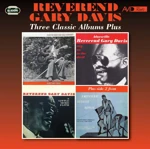 Buy from Amazon Three Classic Albums - Pure Religion/Say No To The Devil/A Little More Faith