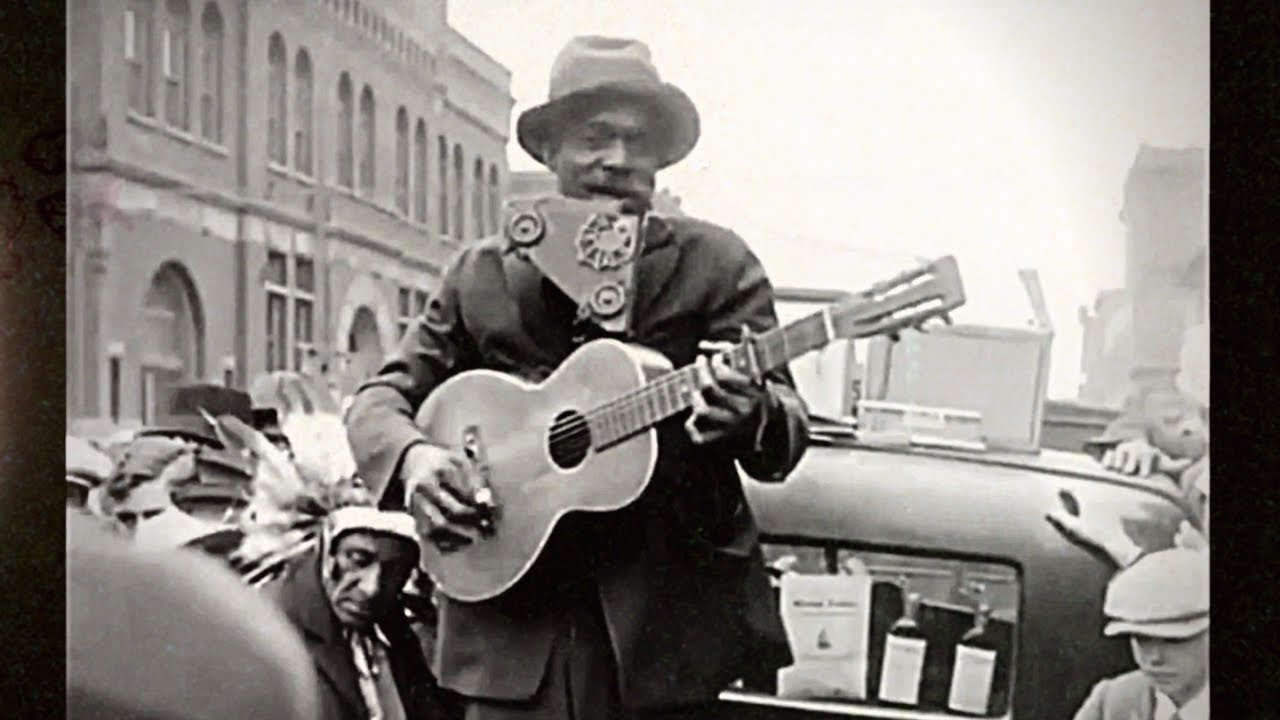
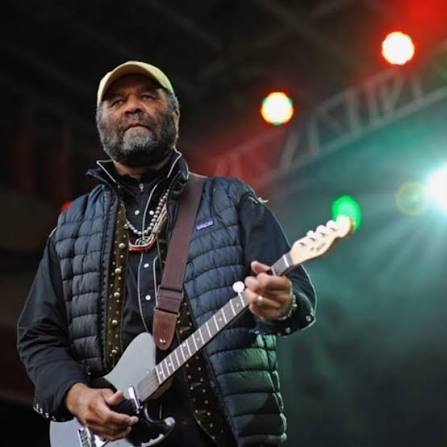
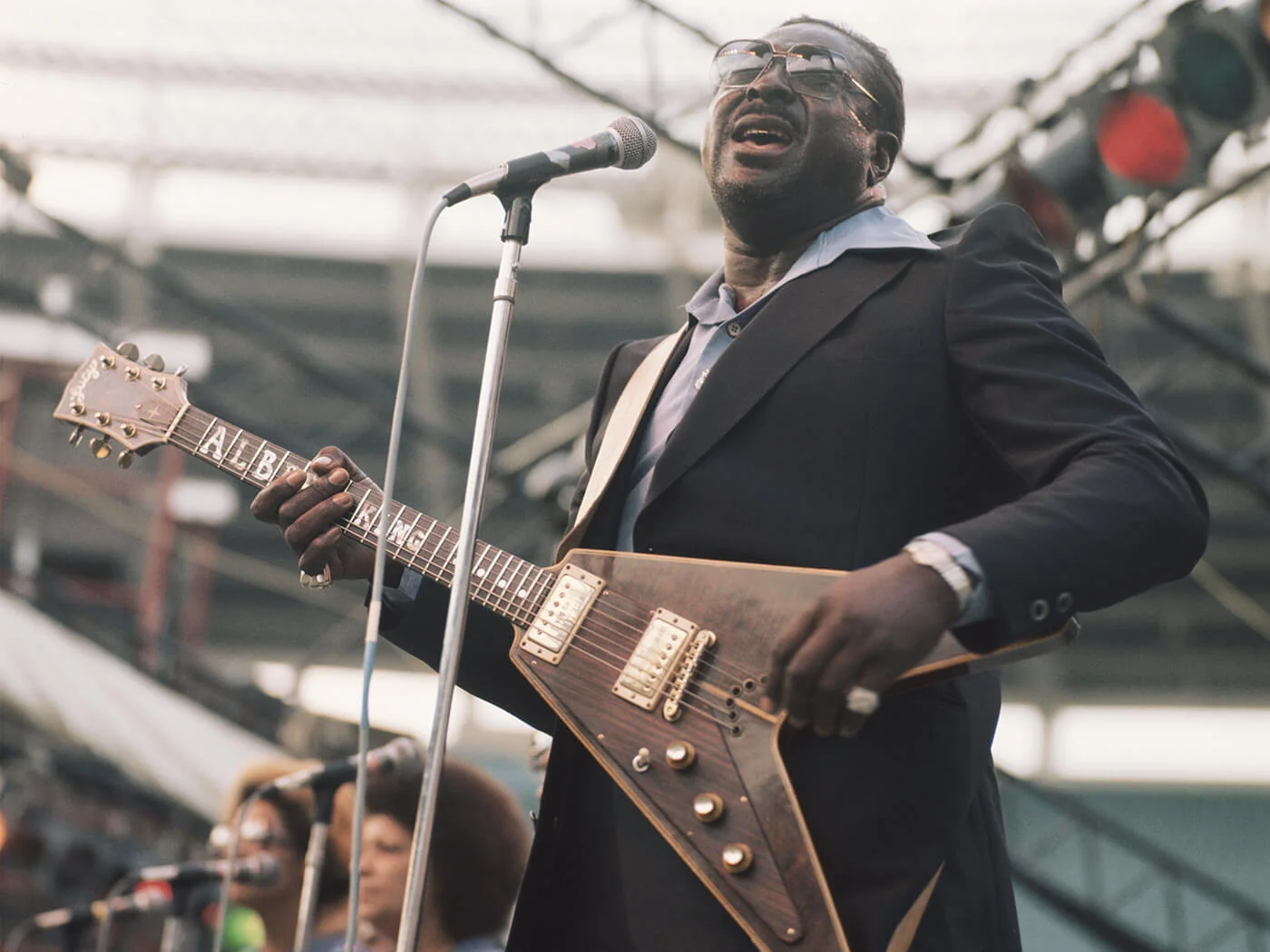
Albert King was one of the most commanding figures in the history of the electric blues guitar. A physically imposing man whose nickname "The Velvet Bulldozer" perfectly captured the paradox of his gentle baritone voice and his ferocious guitar attack, King forged a style so distinctive and influential that it became the bedrock upon which generations of rock and blues guitarists built their own sounds. From Jimi Hendrix to Eric Clapton, from Stevie Ray Vaughan to Gary Clark Jr., King's upside-down, left-handed playing on his signature Gibson Flying V created a template for blues-rock that remains the standard by which all electric blues guitarists are measured.
Early Life: From the Delta to the Stage
Albert King was born Albert Nelson on April 25, 1923, on a cotton plantation in Indianola, Mississippi—the same hometown as B.B. King, though the two were not related. (Albert would later claim to be B.B.'s half-brother, a claim B.B. gently dismissed, though he acknowledged Albert as "my brother in the blues.") King was one of thirteen children born to Mary Blevins, a church singer, and Will Nelson, an amateur guitarist and itinerant preacher who would prove to be a major influence on his son's music.
When King was eight years old, the family moved to the Forrest City, Arkansas, area, where he spent his childhood picking cotton and working on farms. He had little formal schooling. His first instrument was a one-string "diddley bow" constructed from a cigar box, a piece of bush, and a strand of broom wire—a common homemade instrument in the rural South. At age twelve, he purchased his first real six-string guitar for $1.25 from a friend. Because he was left-handed, he simply turned the guitar upside down and played it with the strings in their right-handed configuration, a technique he would maintain throughout his entire career.
King's early musical influences were diverse and formative. He sang in a family gospel group at a nearby church, where his father played guitar. As a teenager in Osceola, Arkansas, he was profoundly influenced by the sounds of Elmore James and Robert Nighthawk, whom he saw performing in West Memphis. He also drew inspiration from pre-war bluesmen Lonnie Johnson and Blind Lemon Jefferson, and from the sophisticated electric blues of T-Bone Walker. "I listened to the slide guitar of Elmore James and a couple of more people I knew way back there," he later recalled. "Then along came T-Bone Walker, and that did it. So I just mixed it all together, and I couldn't get it exactly like they had it, but I just put my own thing to it."
The Early Career: Gospel, Drums, and the Road
Before establishing himself as a guitarist, King sang lead tenor with the Harmony Kings gospel quartet in South Bend, Indiana, and fronted his own group, the Groove Boys, in Osceola, Arkansas. In an unusual detour, he also worked briefly as a drummer, backing seminal blues guitarist Jimmy Reed in Gary, Indiana, in the early 1950s. But his destiny lay with the guitar, and by the late 1940s he had begun performing professionally in nightclubs and on the radio while supporting himself with day jobs as a bulldozer operator and construction worker.
King's physical presence was as distinctive as his playing. Standing between six-foot-four and six-foot-seven and weighing approximately 250 pounds, he was an intimidating figure who made any guitar look like a toy in his massive hands. This imposing stature, combined with his surprisingly smooth vocal delivery, earned him the nickname "The Velvet Bulldozer"—a name that resonated with anyone who had seen him perform. He was also known for a notoriously bad temper; he would lay into band members onstage if things weren't going his way, and he was reputed to carry a .45-caliber pistol and keep a submachine gun on his tour bus.
The Pre-Stax Years: Parrot, Bobbin, and King Records (1953–1965)
King's recording career began in 1953 when he traveled to Chicago and cut his first single, "Bad Luck Blues" backed with "Be On Your Merry Way," for Parrot Records, owned by Al Benson. The record lived up to its title, failing to provide King with the commercial breakthrough he needed. He also auditioned repeatedly for Chess Records, the dominant Chicago blues label, but was rejected each time. Undeterred, King moved to the St. Louis area, settling in Lovejoy, Illinois, across the river from the city, where he became a fixture of the thriving Midwest blues scene.
In 1959, King signed with Bobbin Records, the St. Louis label founded by Little Milton Campbell and disc jockey Bob Lyons. His Bobbin recordings, including "Why Are You So Mean to Me" and "Ooh-Ee Baby," showcased his powerful singing and stinging guitar leads but achieved only modest success. His breakthrough finally came in 1961 with "Don't Throw Your Love on Me So Strong," released on the King label. The record climbed to No. 14 on the Billboard R&B chart and became the title track of his debut album,
The Big Blues (1962). The song's lead guitar intro made it clear that Albert King was not about to do things in a small way—his biting leads alternated with a vocal performance that scaled the full emotional range, from mournful croon to high-pitched gospel wail.
Throughout the early 1960s, King continued recording for Bobbin and King, releasing over a dozen singles. He also cut sides for Coun-Tree Records in 1964, including "Worrisome Baby" and "Lonesome." But despite his growing regional reputation, national stardom remained elusive. That would change dramatically in 1966.
The Stax Years: Born Under a Bad Sign (1966–1975)
The most important event in Albert King's career was his signing with Stax Records in Memphis, Tennessee, in 1966. The deal came about through Al Bell, a Little Rock native who had met King when he played shows in the area and who was then a rising executive at Stax. The label was riding high with hits by Otis Redding, Sam & Dave, Rufus Thomas, and Wilson Pickett, and Bell recognized that King's raw blues power could be the perfect complement to Stax's soulful sound.
King's first Stax recording was "Laundromat Blues," which reached No. 29 on the Billboard R&B chart in 1966. Backed by Booker T. Jones on piano, Donald "Duck" Dunn on bass, Al Jackson Jr. on drums, and the Memphis Horns, the song demonstrated the magic that occurred when King's blues met Stax's funky soul. The song had come to Stax via an unsolicited demo that co-founder Estelle Axton correctly believed could be a hit for King.
But it was the 1967 album
Born Under a Bad Sign that transformed King from a regional bluesman into an international star. The title track, written by Booker T. Jones and Stax singer William Bell, featured one of the most recognizable bass riffs in blues history and King's pin-prick note bending, which harked back to his early influences, particularly the slide playing of Blind Lemon Jefferson. The album was a masterful blend of blues and soul, with the M.G.'s and Memphis Horns providing a tight, funky foundation for King's vocals and guitar.
The album's standout tracks became blues standards:
-
"Born Under a Bad Sign" — The title track reached No. 49 on the R&B chart and was immediately covered by Cream on their 1968 album Wheels of Fire, introducing the song to rock audiences worldwide.
-
"Crosscut Saw" — A swaggering blues that A.C. "Moohah" Williams, a veteran DJ at Memphis R&B station WDIA, brought to King's attention. The song dated back to a 1941 recording by Delta bluesman Tommy McClennan.
-
"Oh, Pretty Woman" — Written by WDIA DJ Williams, this track required the steady presence of Steve Cropper's rhythm guitar to augment King's lead licks.
-
"The Hunter" — A pulsating stew of a track, as trademark Booker T. & the M.G.'s as "Green Onions."
-
"Kansas City" — King's urban blues treatment of the Jerry Leiber/Mike Stoller standard.
-
"As the Years Go Passing By" — A beautiful reading of Fenton Robinson's composition.
-
"I Almost Lost My Mind" — A rare King ballad with countrypolitan overtones and jazz flute, showcasing his rich baritone.
-
"Personal Manager" — The B-side of the title track single, with songwriting help from David Porter.
Born Under a Bad Sign charted on the Billboard Top 50 and established King as a full-fledged blues luminary, masterfully bridging the gap between the Chitlin' Circuit and the rock arena.
King's Stax tenure produced a remarkable string of albums and singles.
Years Gone By (1969) was his first true studio album (as opposed to a compilation of singles), reaching No. 133 on the Billboard 200. That same year, he recorded
Blues for Elvis – King Does the King's Things, a tribute to Elvis Presley that demonstrated his versatility.
I'll Play the Blues for You (1972) was another landmark, a soulful minor-key outing in the vein of B.B. King's "The Thrill Is Gone," backed by members of the Bar-Kays and Isaac Hayes' Movement.
Lovejoy (1971) reached No. 29 on the R&B chart, and
I Wanna Get Funky (1974) hit No. 37.
King's live recordings from this period are equally essential.
Live Wire/Blues Power (1968), recorded at the Fillmore Auditorium in San Francisco, captured his commanding stage presence before enthusiastic rock audiences. The 1968 Fillmore booking came about when rock impresario Bill Graham walked into the Manhattan Club in East St. Louis and offered King $1,600 for three nights at the Fillmore. "I hadn't made $1,600 for three days in my life," King recalled. When he arrived, he discovered he was on a bill with Jimi Hendrix and Janis Joplin. The show started at the smaller Fillmore but had to move to Winterland due to demand, and Graham kept them for three more weeks. King became one of the few blues singers to attract large numbers of both Black and white fans.
The Fillmore Era and Rock Crossover
King's 1968 performances at the Fillmore Auditorium and Fillmore East marked a turning point in his career and in the history of blues music. He shared bills with Jimi Hendrix, Janis Joplin, John Mayall's Bluesbreakers, and other rock acts, introducing his blues to young white audiences who had never experienced the music live. The experience was transformative for both King and his new fans.
At the Fillmore East opening night on March 8, 1968, a memorable incident occurred: King's drummer was hauled away by military police for being AWOL from the Army. Buddy Miles played the first set, and then Big Brother & the Holding Company's drummer Dave Getz had to fill in. "It was scary because he was a big, scary guy, Albert King," Getz recalled. "He turned around at one point... and he said something like, 'Don't slow up, boy.'" King was known for punching out band members who didn't meet his standards.
King also recorded at the Fillmore West, and on the live album
Blues at Sunrise, he can be heard saying, "This is that thing I recorded with Jimi Hendrix and Janis Joplin at the Fillmore West." While the exact nature of this collaboration remains debated among scholars, it is clear that King and Hendrix shared a bill and mutual respect. Hendrix, a fellow left-handed guitarist, had already brought elements of King's searing sound to legions of young white rock fans.
In 1969, King became one of the first blues performers to unite blues and classical music, performing with the St. Louis Symphony Orchestra. He also took night classes in music theory, demonstrating a commitment to musical growth that belied his "uneducated" background.
The Post-Stax Years: Utopia, Tomato, and Fantasy (1975–1992)
When Stax Records went bankrupt in 1975, King moved to Utopia, a small label under RCA Records. He released
Albert (1976) and
Truckload of Lovin' (1976), which some fans criticized for venturing too far into mainstream pop territory, though tracks like "Love Shock" from
Albert demonstrated King's ability to groove in a funk context. He also released the double live set
Albert Live (1977).
In 1978, King signed with Tomato Records and recorded
New Orleans Heat, produced by Allen Toussaint at Sea-Saint Studios, incorporating Crescent City R&B elements alongside his signature guitar work. He remained with Tomato for several years, releasing additional material that reflected his adaptability to contemporary sounds while maintaining his blues roots.
After a four-year break from recording in the late 1970s, during which he re-embraced his roots as a straight-ahead blues artist, King returned in 1983 with
San Francisco '83 on Fantasy Records. The live album earned a Grammy nomination for Best Traditional Blues Recording and marked the beginning of a productive final decade. That same year, he recorded the legendary television session with Stevie Ray Vaughan for CHCH-TV in Hamilton, Ontario, Canada.
The session with Vaughan, released posthumously in 1999 as
In Session (and reissued in a deluxe edition in 2024), is one of the most celebrated blues guitar duets in history. Vaughan, who cited King as his primary influence and favorite guitarist, appears almost overwhelmed by King's presence, pouring forth a deft but rollicking guitar accompaniment while King delivers searing vocals and guitar work. The two trade solos on "Born Under a Bad Sign," "Stormy Monday," and other classics, with King drenched in sweat, shaking his head, hollering and whooping—a picture of blues intensity. The album represents the passing of the torch from one master to the next.
In 1984, King released
I'm in a Phone Booth, Baby, which earned another Grammy nomination. The album included a redo of "Truckload of Lovin'" and covers of Elmore James's "Dust My Broom" and "The Sky Is Crying." His final album,
Red House (1991), was named after the Jimi Hendrix song. Throughout the 1980s and early 1990s, King toured extensively, using a customized Greyhound tour bus with "I'll Play the Blues for You" painted on the side.
The Guitar Style: Upside Down and Inside Out
Albert King's guitar style was as unique as his physical presence. Playing left-handed on right-handed guitars that he simply flipped over without restringing, he created a sound that was immediately recognizable and virtually inimitable. This "upside-down" technique gave him what guitarists call the "lefty advantage" when it came to bending notes: with the strings' vertical arrangement flipped, he bent the higher-pitched strings by pulling downward, which is much easier than pushing upward. He exploited this to dramatic effect, sometimes bending notes as much as four tones up.
King's huge hands and the slackness of the strings in his low-slung tunings were additional factors in his distinctive sound. He mainly used his thumb to pluck the notes, having abandoned picks early in his career. "I never could hold a pick in my hand," he explained. "I had started out playing with one, but I'd be really gettin' into it, and after a while the pick would sail across the room. I said, 'To hell with this.' So I just play with the meat of the thumb." His first finger would sometimes help shape the steely pinched tones that were another hallmark of his style.
King was also known for his use of unusual open tunings. He is mainly associated with an E minor tuning (low to high: C-B-E-G-B-E), but he also tuned to the same intervals in C# and D, and used open F (C-F-C-D-A-D). These unconventional tunings, combined with his upside-down playing, yielded a perspective on the instrument that was "more in tune with nature," as one commentator put it, with the low strings closer to the ground and the high strings nearer to the sky. "I knew I was going to have to create my own style," King told guitar journalist Dan Forte, "because I couldn't make the changes and chords the same as a right-handed man could. I play a few chords, but not many. I always concentrated on my singing guitar sound—more of a sustained note."
His instrument of choice was the Gibson Flying V, which he favored for its symmetrical shape that looked natural when flipped upside down. Along with Lonnie Mack, he was one of the earliest guitarists to popularize the angular, V-shaped guitar. In 1972, luthier Dan Erlewine built King a custom left-handed Flying V from a 125-year-old piece of black walnut, with the tone controls and output jack positioned for a true left-handed player. This guitar, with King's name inlaid in pearl and abalone on the fretboard, became his main instrument for the final twenty years of his life.
Influence and Legacy
Albert King's influence on subsequent generations of guitarists is almost unrivaled. As a member of the "Three Kings of the Blues Guitar" (alongside B.B. King and Freddie King, none of whom were related), he helped define the electric blues canon. His spare, single-string playing with aggressive string-bending became the bedrock of a gritty electric blues style that influenced virtually every blues-rock guitarist who followed.
Stevie Ray Vaughan cited King as his primary influence and favorite guitarist, emulating his bending approach in performances. The two jammed together at the 1983 Montreux Jazz Festival, and Vaughan's playing on
In Session echoes King's dynamic attack. "Every time you hear a rock 'n' roll guitar player, he's playing Albert King licks," said Wayne Jackson of the Memphis Horns.
Eric Clapton directly adapted King's solo from the 1967 instrumental "Personal Manager" for Cream's 1967 track "Strange Brew," incorporating King's stinging bends and vibrato into his blues-rock vocabulary. Cream's rendition of "Born Under a Bad Sign" on
Wheels of Fire (1968) popularized the track among rock audiences and helped produce the first-ever platinum-selling double album.
Jimi Hendrix, a fellow left-handed guitarist, drew from King's left-handed style and bending innovations, acknowledging him as an idol during their shared billing at the 1968 Fillmore West shows. Hendrix featured King as an opening act, and King's raw intensity left a mark on Hendrix's experimental blues explorations.
Other guitarists profoundly shaped by King include
Mike Bloomfield,
Mark Knopfler,
Gary Clark Jr. (who has hailed King as the "bedrock of the guitar tradition"), and
Joe Bonamassa (who performed a 2016 live cover of "Angel of Mercy" and a 2015 tour celebrating the Three Kings). King's work at Stax contributed to the label's signature soul-blues sound, fusing horn-driven arrangements with gritty guitar leads to pioneer soul-rock hybrids that echoed in later acts like the Allman Brothers Band.
Death and Posthumous Recognition
Albert King died on December 21, 1992, in Memphis, Tennessee, at the age of 69, following a heart attack. He had performed his final concert two days earlier, on December 19, in Los Angeles. He became ill shortly after and was flown back to Memphis, where he suffered a heart attack on December 20, leading to his admission to Eastwood Medical Center. There, he lapsed into a coma and passed away the next day. At the time of his death, he was planning a European tour with B.B. King and Bobby "Blue" Bland. "He was one of a kind," Bland said. "There was never any type of jealousy when we three worked together on a package. One just pushed the others."
King was honored with a jazz-style "blues funeral" procession down Memphis's iconic Beale Street, with the Memphis Horns (Wayne Jackson and Andrew Love) performing "When the Saints Go Marching In." He was buried at Paradise Gardens Cemetery in Edmondson, Arkansas, near his childhood home.
His posthumous recognition has been extensive:
-
Blues Hall of Fame: Inducted in 1983, during his lifetime.
-
Rock and Roll Hall of Fame: Posthumously inducted in 2013 as an Early Influence.
-
Grammy Hall of Fame: Born Under a Bad Sign inducted in 1999.
-
Rolling Stone's 100 Greatest Guitarists: Ranked No. 13 in 2011, and No. 22 on the expanded 2023 list of 250 Greatest Guitarists.
-
Memphis Music Hall of Fame: Inducted in 2015.
-
Mississippi Blues Trail: Honored with a marker in his hometown of Indianola in 2011.
-
Arkansas Entertainers Hall of Fame: Inducted in 2010.
-
St. Louis Walk of Fame: Received a star in 1993.
-
Albert King Legacy LLC and Foundation: Launched by his family in 2025 to preserve his influence through annual tribute events, exhibits, and community programs.
Conclusion: The King Reigns
Albert King's career embodied the journey of the blues from the rural South to the international stage. Born in a Mississippi cotton field, he built his first guitar from a cigar box and broom wire, taught himself to play upside-down, and forged a style so powerful and distinctive that it became the template for electric blues guitar. His Stax recordings, particularly Born Under a Bad Sign, bridged the gap between the Chitlin' Circuit and the rock arena, bringing blues to young white audiences who had never heard the music before.
His influence is woven into the fabric of modern guitar playing. Every time a rock guitarist bends a string with soulful intensity, every time a blues player delivers a sustained, crying note, the ghost of Albert King is present. He was, as Wayne Jackson said, the source from which rock guitar flows. The Velvet Bulldozer may be gone, but his sound—raw, powerful, and unmistakably his own—continues to roll through the music world, flattening everything in its path and leaving a trail of inspired guitarists in its wake.
Suggested Reading
 Buy from Amazon Albert King: The Velvet Bulldozer
 Albert King: The Velvet Bulldozer
Suggested Listening
 The Definitive Albert King

 Buy from Amazon Born Under A Bad Sign