Taj Mahal is the debut studio album by American blues musician Taj Mahal, released in February 1968 by Columbia Records. Recorded in August 1967, it stands as one of the most quietly iconoclastic records of its era—a raw, energetic fusion of 1930s and 1940s blues traditions with the electric energy and recording technology of the late 1960s. The album consists entirely of covers and traditional arrangements, with Taj Mahal serving as the charismatic frontman, backed by a remarkable ensemble of musicians who would go on to shape American roots music for decades.
Background and Context
Following the dissolution of the Rising Sons in 1966—a band that included Taj Mahal, Ry Cooder, bassist Gary Marker, and drummer Kevin Kelley—Taj Mahal opted to pursue a solo career. The Rising Sons had recorded a full album for Columbia that went unreleased until 1992, but the experience established Taj Mahal's relationship with the label and with producer David Rubinson, who would oversee his first five albums.
Taj Mahal conceived the album as an authentic revival of early blues traditions, particularly Delta and country blues styles, while infusing them with contemporary rock, funk, and soul elements. As the original liner notes by journalist Tom Nolan emphasized, Taj Mahal sought to honor 1930s roots without mere imitation. His approach was summed up in a quote from the sleeve notes: "Now I could play this tune just exactly like Robert Johnson, but what would be the point of that? This is 1968, not 1926."
Recording Sessions and Production
The album was recorded in August 1967, most likely at Columbia Studios. Producer David Rubinson played a pivotal role in directing the process, prioritizing live, energetic takes to preserve the authenticity of the blues tradition. The production utilized vintage analog equipment, contributing to the album's warm, organic sound. Emphasis was placed on improvisation during the sessions, allowing for spontaneous extensions in tracks like "The Celebrated Walkin' Blues," which clocks in at over eight minutes. Engineers Rafael O. Valentin and Roy Halee handled the recording, ensuring a clean yet gritty analog sound that preserved the performances' live feel.
The album was part of Columbia's January-February 1968 "Rock Machine" campaign, a marketing initiative aimed at introducing emerging rock and blues acts to American audiences amid the waning dominance of the British Invasion. It was issued in both stereo (CS 9579) and mono (CL 2779) formats.
Personnel
The album features a rotating cast of musicians, with Taj Mahal at the center. The original liner notes provided limited per-track credits, focusing instead on the collective ensemble effort. The musicians included:
-
Taj Mahal – vocals, blues harmonica, slide guitar, acoustic guitar
-
Jesse Ed Davis – lead guitar, slide guitar, piano, brass arrangements
-
Ry Cooder – rhythm guitar, mandolin
-
Bill Boatman – rhythm guitar
-
James Thomas – bass (on some tracks)
-
Gary Gilmore – bass (on some tracks)
-
Sanford Konikoff – drums (on some tracks)
-
Chuck "Brother" Blackwell – drums (on some tracks)
The rhythm section was flexible, adapting to the album's varied tempos. Jesse Ed Davis, a Kiowa guitarist renowned for his rock-blues fusion style, handled lead and slide guitar duties across most tracks and also contributed piano and brass arrangements. Ry Cooder, Taj Mahal's former Rising Sons bandmate, contributed rhythm guitar and mandolin, infusing folk and early world music textures.
Track-by-Track Breakdown
Side One
1. "Leaving Trunk" (Sleepy John Estes) – 4:51
The album opens with a funky, high-energy adaptation of Sleepy John Estes's "Milk Cow Blues." Taj Mahal's version bursts out of the gate with what critics have described as "deluxe funkiness" that points to the tough strut found shortly thereafter on recordings by The Rolling Stones. The track features Taj Mahal on vocals, harmonica, and guitar, with Jesse Ed Davis's lead guitar and Ry Cooder's rhythm guitar driving the arrangement. The song's raw energy and rhythmic drive immediately establish the album's character—authentic blues delivered with youthful enthusiasm and electric power.
The personnel for this track likely includes Taj Mahal, Jesse Ed Davis, Ry Cooder, James Thomas on bass, and Sanford Konikoff on drums, based on the pattern of musicians credited for the "bookend" tracks (the opening and closing songs of each side).
2. "Statesboro Blues" (Blind Willie McTell, arr. Taj Mahal) – 2:59
This track is perhaps the album's most historically significant. Taj Mahal's arrangement of Blind Willie McTell's 1928 classic would later inspire Duane Allman to master slide guitar. The story goes that while Duane had a cold, his brother Gregg stopped by his place and dropped off two items: a bottle of Coricidin and a copy of Taj Mahal. When Gregg later returned, Duane was using the empty medicine bottle as a slide and playing along to the tracks. Three years later, "Statesboro Blues" became the opener to the Allman Brothers Band's legendary live album At Fillmore East (1971).
The track features Taj Mahal's vocals and harmonica, with Jesse Ed Davis's slide guitar playing being the standout instrumental element. The arrangement is relatively stripped-down compared to the Allman Brothers' later version, but Davis's slide work provides the template that Duane Allman would expand upon. The track is credited as arranged by Taj Mahal, indicating his interpretive approach to the McTell original.
3. "Checkin' Up on My Baby" (Sonny Boy Williamson II) – 4:55
The longest track on Side One, this is a cover of Sonny Boy Williamson II's classic. The arrangement stretches out to nearly five minutes, allowing for extended instrumental interplay. Jesse Ed Davis contributed piano on this track in addition to his guitar work, adding a different textural layer to the blues standard. The track showcases the band's ability to stretch out and improvise while maintaining the song's structural integrity. The rhythm section likely features Gary Gilmore on bass and Chuck Blackwell on drums, who handled the "inner tracks" of the album.
4. "Everybody's Got to Change Sometime" (Sleepy John Estes) – 2:57
Another Sleepy John Estes cover, this track maintains the album's focus on the Tennessee bluesman's repertoire. The song is delivered with Taj Mahal's characteristic mix of authenticity and youthful energy. The relatively short running time keeps the track focused and punchy. Based on the pattern of personnel rotation, this likely features the "inner tracks" rhythm section of Gary Gilmore and Chuck Blackwell, with the core guitar trio of Taj Mahal, Jesse Ed Davis, and Ry Cooder.
Side Two
5. "E Z Rider" (Traditional, arr. Taj Mahal) – 3:04
The only original composition on the album (credited as arranged by Taj Mahal), "E Z Rider" is based on a traditional folk-blues theme. The track demonstrates Taj Mahal's ability to work within traditional forms while bringing his own personality to the material. Critic Robert Christgau noted that the original "E Z Rider" could have been found on an old 78, highlighting Taj Mahal's deep connection to the source material. The track features the same core ensemble, with Taj Mahal's vocals and harmonica at the forefront.
6. "Dust My Broom" (Robert Johnson/Elmore James) – 2:39
This is Taj Mahal's take on the blues standard most associated with Robert Johnson and Elmore James. The track is a concise, driving version that captures the essence of the classic while updating it with electric instrumentation. Jesse Ed Davis's lead guitar work and the tight rhythm section propel the song forward. The attribution to both Robert Johnson and Elmore James reflects the song's evolution from Johnson's 1936 original to James's electrified 1951 version that made it a blues standard.
7. "Diving Duck Blues" (Sleepy John Estes, arr. Taj Mahal) – 2:42
Another Sleepy John Estes composition, this track features textures that, according to AllMusic critic Bruce Eder, resemble the mix on the early Cream albums. The arrangement is credited to Taj Mahal, indicating his interpretive approach. The song's title and theme reflect the classic blues tradition of animal metaphors and rural imagery. This track, along with "Leaving Trunk" and "Everybody's Got to Change Sometime," forms a trilogy of Sleepy John Estes covers that anchor the album in the Tennessee blues tradition.
8. "The Celebrated Walkin' Blues" (Traditional, arr. Taj Mahal) – 8:52
The album's epic closer, running nearly nine minutes, showcases the band's improvisational capabilities. Ry Cooder's animated mandolin weaves through the stereo mix, adding an exotic, folk-tinged texture to the extended blues jam. The track has been described as having "the sound of a late '40s Chess release by Muddy Waters" despite the mandolin and extended running time. The length allowed the musicians to stretch out and explore the material, with spontaneous extensions captured in the live-feeling recording. This track, along with "Leaving Trunk," likely features James Thomas on bass and Sanford Konikoff on drums, completing the "bookend" pattern of the album's personnel.
Buy this album on Amazon
Musical Style and Critical Reception
The album is primarily a blues-rock effort infused with folk-rock elements, blending acoustic and electric instrumentation for a hybrid sound that revitalizes traditional blues forms. Taj Mahal's West Indian heritage subtly informs the album's rhythmic undercurrents with Caribbean and African influences. The production eschews the heavy distortion and psychedelic experimentation dominant in 1967-68 in favor of raw, rootsy textures.
Music critic Bruce Eder gave the album five out of five stars, calling it "as hard and exciting a mix of old and new blues sounds as surfaced on record… in what had to be one of the most quietly, defiantly iconoclastic records of 1968." Entertainment Weekly's Tony Scherman gave it an "A," writing that the album "explodes with high spirits; of Taj's 30-plus albums, it might be the best." Robert Christgau described Taj Mahal as "the most credible voice" of the blues revival, noting that he was "clearly an original stylist already in bloom."
Album Artwork
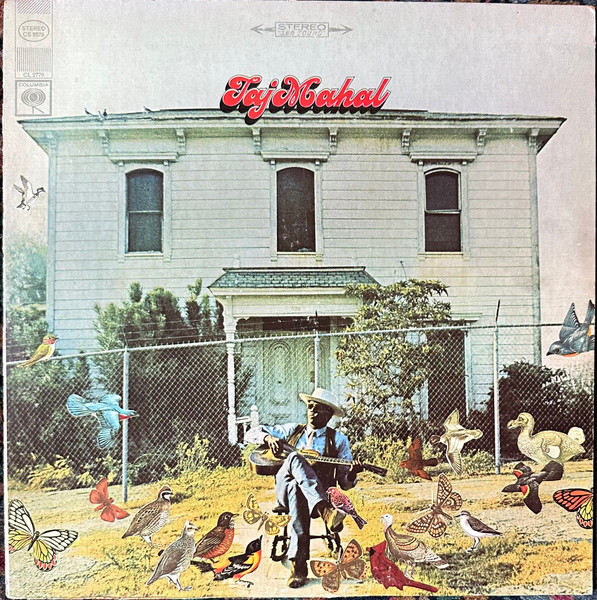
The album cover features a black-and-white photograph by Guy Webster of Taj Mahal sitting on the steps outside the Salt Box, a Victorian house at 339 South Bunker Hill Avenue in Los Angeles. The house was designated Los Angeles Historic-Cultural Monument No. 5 in 1962, but due to urban redevelopment, it was relocated in 1968 and subsequently destroyed by arson on October 4, 1969. The minimalist design, featuring the artist's name in bold sans-serif font, evokes the urban blues grit associated with Taj Mahal's Los Angeles roots.
Legacy
Though the album did not achieve commercial chart success upon release, it has proven enormously influential. Taj Mahal introduced the core band that Taj Mahal had been working with for approximately two years, and it established the template for his approach to American roots music. The album's influence on the Allman Brothers Band, through "Statesboro Blues," is perhaps its most famous legacy, but the record as a whole demonstrated that traditional blues could be revitalized for a rock audience without losing its authenticity.
The album remains a cornerstone of modern electric blues, bridging 1930s blues origins with late-1960s sensibilities through vivid, electrified interpretations. It stands as a testament to the power of youthful enthusiasm combined with deep respect for tradition—a combination that would define Taj Mahal's nearly 50-year career and establish him as a pioneer of world music and roots radicalism.